


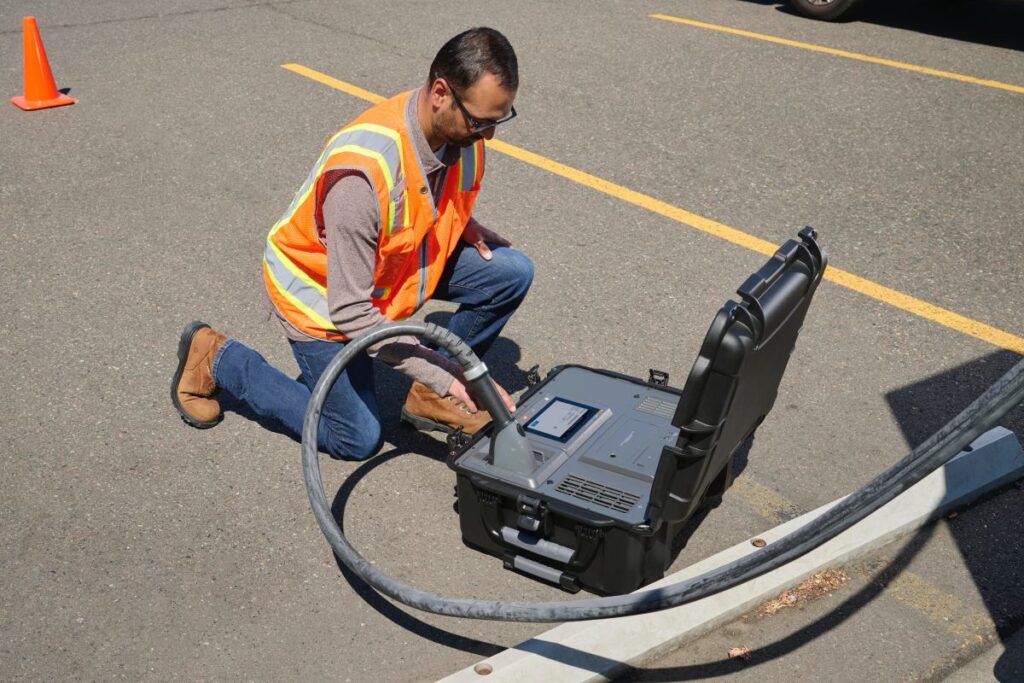
Fluke, a manufacturer of industrial test, measurement, and diagnostic equipment, has launched the FEV500, a testing device designed for fast DC electric vehicle charging stations.
The tool is intended for testing and maintaining high-power Level 3 chargers, which operate at significantly higher energy levels than AC charging systems and rely on complex digital communication protocols.
The device simulates an electric vehicle, allowing technicians to carry out safety and operational checks without connecting a physical EV.
Fluke explains that the FEV500 enables engineers to test charging stations on site to verify performance, communication, and electrical safety.
Martijn Gerlag, EMEA Application Engineer at Fluke Corporation, says, “With the FEV500, Fluke is redefining how fast DC EV charging stations are tested and maintained.
“These high-powered, complex stations are critical infrastructure, and ensuring their safety, reliability, and uptime is essential.
“Our all-in-one solution acts like a virtual electric vehicle, allowing technicians to diagnose, test, and validate stations on-site – reducing risk, accelerating service, and enabling the EV charging industry to scale with confidence.”
Testing EV chargers with a single device
The FEV500 combines several testing functions typically carried out with separate tools, including a digital multimeter, insulation tester, and oscilloscope.
It supports communication standards used between electric vehicles and charging equipment, including ISO 15118 and DIN SPEC 70121. The system can simulate charging behaviour and communication processes to verify interoperability and station performance.
The device provides guided workflows and pass or fail results to assist technicians during commissioning, maintenance, and fault finding.
Fluke says the tool also enables testing without opening the charging station, allowing technicians to complete checks through a single connection point and helping reduce service downtime.
Designed for field work, the device is housed in a wheeled chassis for transport between sites and includes a removable battery for easier travel.
For more from Fluke, click here.


