


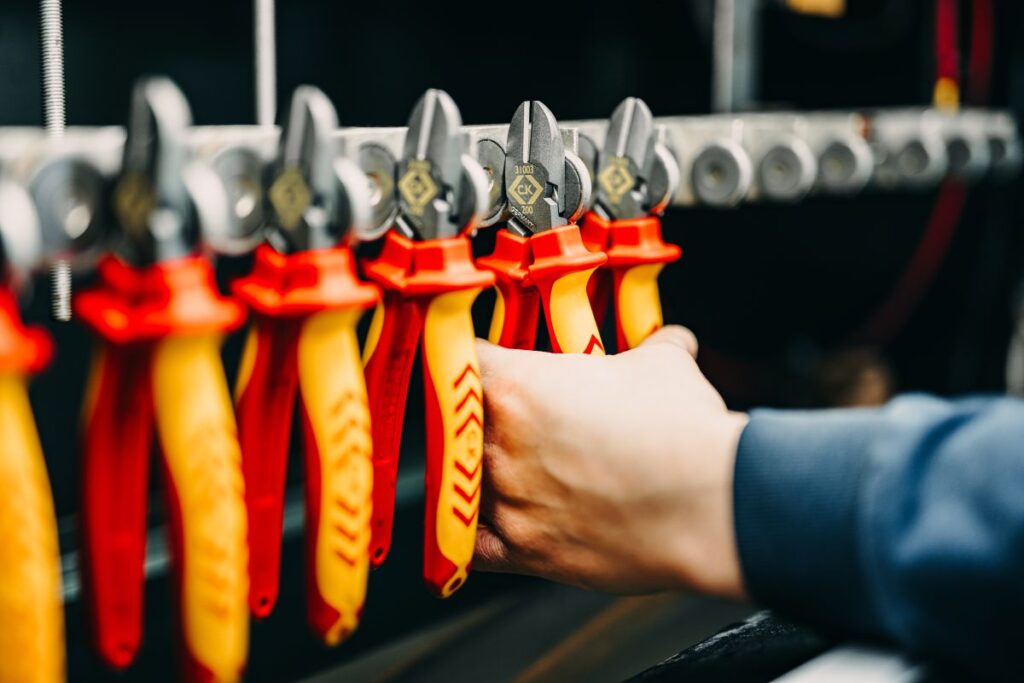
The difference between a compliant tool and a non-compliant one isn’t a matter of preference – it’s a matter of life and death. Here, C.K Tools makes the case for why VDE certification should be the non-negotiable starting point, and why its RedLine VDE range sets a new benchmark for the trade.
Every electrician knows the feeling: a system that should be isolated, a colleague who assured you it was, and the moment of doubt that hits just before the tool makes contact. On a live system, there is no second chance. It is a standard the trade knows by name, expects on site, and increasingly demands by contract, and the tools that meet it need to be beyond question.
VDE, awarded by Germany’s Association for Electrical, Electronic and Information Technologies, is one of the most rigorous independent testing regimes in the world for insulated hand tools. Every tool is individually tested to withstand 10,000 volts and rated for safe working at 1,000 volts AC or 1,500 volts DC.
Certification is not granted on the basis of design alone; it requires third-party laboratory verification and is subject to ongoing surveillance audit. For professionals working on or near live systems, it is not a premium extra, it is the professional baseline, and the due diligence that protects both the electrician and their liability.
The steel behind the standard
C.K Tools has built its reputation over more than a century on uncompromising specification. Its RedLine VDE range is a comprehensive suite of cutters, pliers, and strippers manufactured using German steel throughout and has long been the choice of electricians who understand that the material a cutting jaw or gripping face is made from is not incidental.
German steel, alloyed and hardened to exacting tolerances, delivers the edge retention, jaw integrity and long-term performance that professional, repetitive use demands. For cutters and strippers in particular, blade hardness determines not just longevity but precision: a jaw that has lost its edge or begun to deform under load does not cut cleanly, and in cable preparation work, an unclean cut creates problems later in the job.
The latest generation of the RedLine VDE range also introduces a handle design that represents a step forward in ergonomics and practical performance. The new handles incorporate 30% more material than their predecessors, a change which is noticeable in the hand. The increased volume, distributed through a refined, rounded profile, reduces the pressure points that accumulate during sustained gripping and cutting work.
For electricians spending hours working through cable schedules, terminating panels, or stripping back wiring in awkward voids, this is not a marginal gain. Fatigue in the hand translates directly into reduced control and slower progress; tools that actively counter it are tools that justify their place in a professional kit bag.
The handles are also longer than in the previous generation, providing greater leverage – a particularly significant improvement for cutting tools, where mechanical advantage determines how cleanly and efficiently heavier cable gauges can be worked. Better leverage means less effort per cut, which over the course of a full day’s cable work makes a significant difference to how a professional arrives at the end of it.
Made for where the work actually happens
A significant development in the new RedLine VDE range is the integration of tether points directly into the tool design. As working at height regulations tighten, and as awareness of dropped-tool incidents grows, the ability to secure tools when working off the ground is moving from niche requirement to standard expectation.
With C.K’s approach, the tether point is not an afterthought: it is engineered into the handle structure itself, conforming to both VDE certification and the ANSI standard for working at height. There is no compromise to insulation integrity, no awkward retrofit solution, and no reason to reach for a less specified alternative simply because it happens to have a lanyard attachment.
This matters particularly working in commercial and industrial environments where working-at-height risk assessments are mandatory and where project managers increasingly expect documented evidence of tool compliance. A tool that satisfies both VDE and ANSI requirements within a single, integrated design removes stress from that compliance process entirely.
A new generation
The arrival of a significantly upgraded product range presents a familiar question: how quickly to transition. The engineering improvements in the new RedLine VDE handles are not cosmetic revisions. The changes to handle geometry, material volume, leverage length, and tether integration reflect a step change in what the range offers. The new handles deliver meaningfully better performance across cutting, gripping, and stripping work, and the integrated tether system adds a compliance capability that the previous range did not offer.
The RedLine VDE range represents C.K Tools at its most focused: German steel, independently certified insulation, ergonomic design that reflects real-world working conditions, and safety features built to the highest international standards.
For more from C.K Tools, click here.
– This article first appeared in the May 2026 edition of ECN, which is available by clicking here.


