


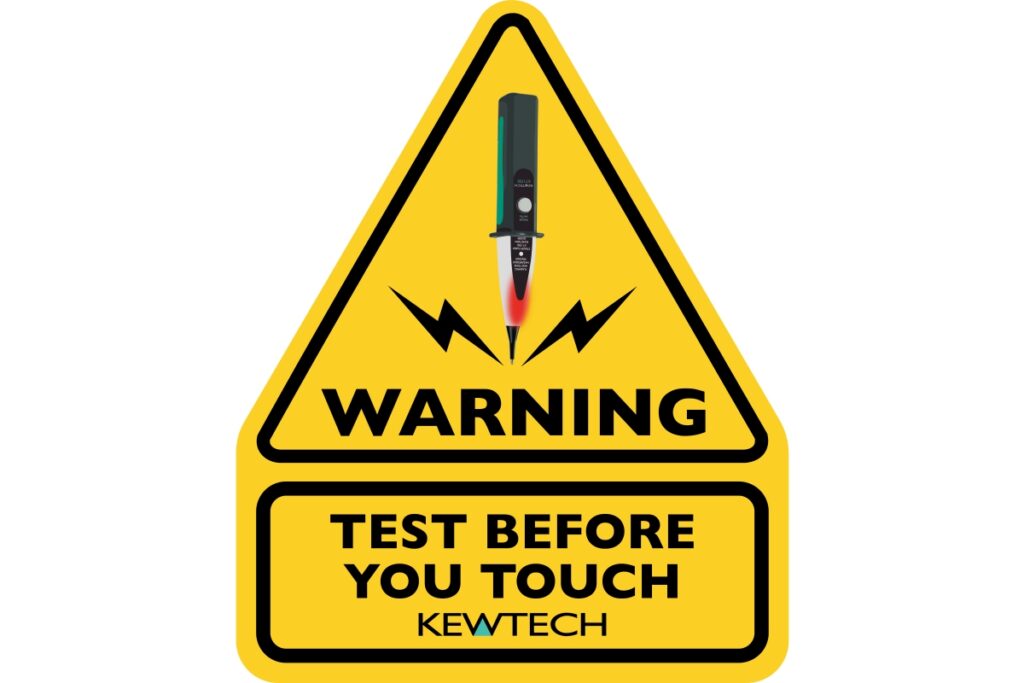
In recent years, there has been increasing concern in the industry regarding PEN faults, a specific type of network fault with potentially lethal consequences.
Whilst the rise in PEN faults is being acknowledged and investigated, it’s important to note that these are not the only way that hazardous situations – including touch voltage and diverted current flow – are created.
In particular, there has been an increasing number of incidents where engineers have come into contact with live metallic parts (e.g. metal casings or equipment) during installation or maintenance activities. These contacts can and have led to fatalities.
Touch voltages and diverted currents
Touch voltages: This occurs when there is a fault in the system that results in no return path for current (i.e. due to a broken or disconnected earth or neutral, combined with other faulty wiring). As a result, metallic parts (such as a distribution board, boilers, or control panel) that are connected to the electrical earth could be raised to a dangerous potential.
Diverted current: This is a more complex fault, where the current may flow through unintended paths (e.g. through earth or neutral conductors). Even though the circuit might appear to be functioning normally, diverted current can present serious dangers.
Issues with current safe isolation procedures
The current safe isolation procedures in place often do not specifically account for or test for touch voltages and diverted current. Even though the best industry practices for safe isolation and proving dead are followed, these two specific hazards are often overlooked.
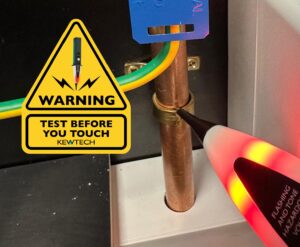

The proving dead process usually involves opening enclosures or testing electrical terminals to confirm that the equipment is not live. However, this step can be potentially lethal if there is already a touch voltage present.
Test before touch: The missing step
The concept of ‘Test Before Touch’ is well established and often taught to engineers. However, it’s usually focused on high-voltage equipment and not before entering or touching low-voltage equipment like distribution boards, control panels, pipework, and appliance casings (e.g. boilers or motor casings).
In practice, engineers may not always adhere to this guideline, especially when handling parts of the installation that seem to be disconnected or ‘dead’; they may neglect to check if there is a touch voltage or diverted current present.


The KT1700 for hazard detection
When it comes to electrical safety, you should not be guessing. The KT1700 single pole contact voltage tester from Kewtech is your first line of defence against hidden electrical hazards on metalwork and equipment.
Make direct contact with metal enclosures, distribution boards, earth bonding, and pipework before you go near them and get a clear, instant warning if hazardous voltages are present. That’s real peace of mind before you touch.
Unlike non-contact voltage testers, the KT1700 contact voltage tester delivers reliable voltage and live phase detection, helping you identify increasing network hazards such as PEN faults, diverted neutrals, phenolic breakdown, and touch voltages early.

For more from Kewtech, click here.


