


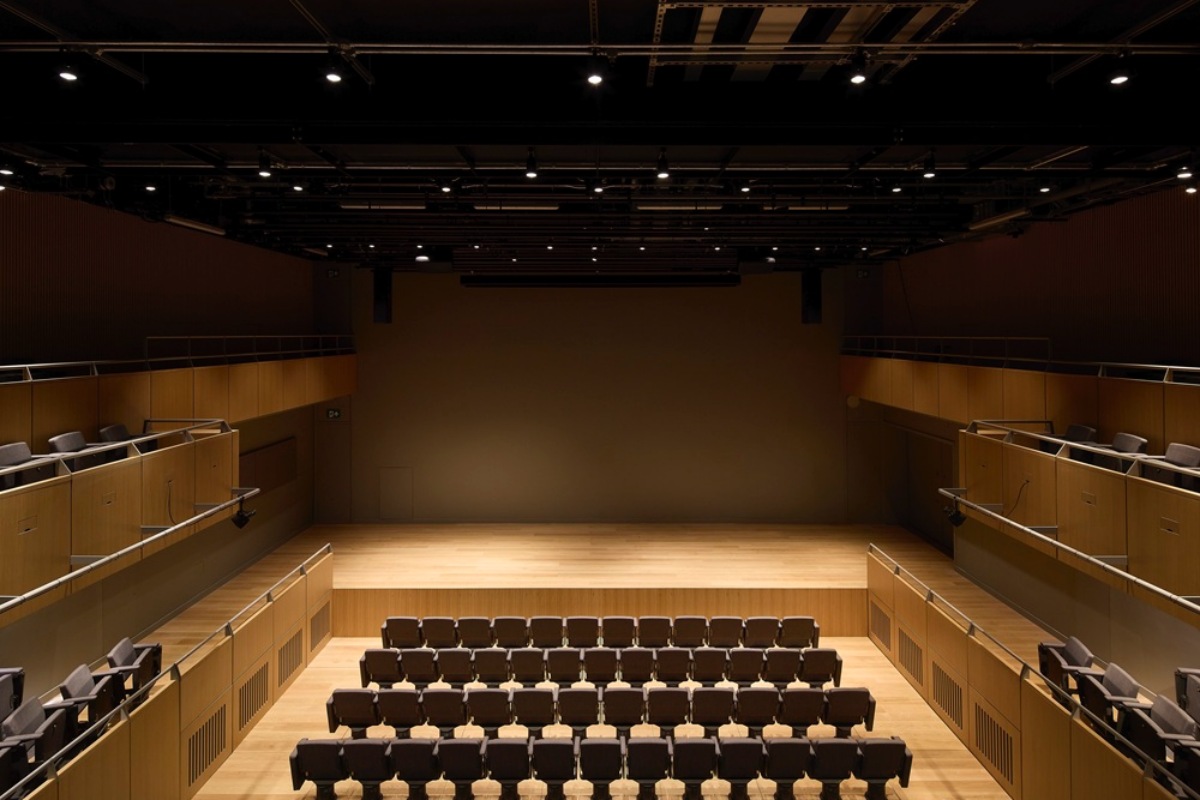
TRILUX, a manufacturer of professional lighting systems, has supplied 6,691 luminaires for the Stephen A. Schwarzman Centre for the Humanities at the University of Oxford, providing lighting across teaching, performance, library, and public spaces.
Located within Oxford’s Radcliffe Observatory Quarter, the centre brings together teaching, research, performance, and public engagement facilities within a single building.
Designed by Hopkins Architects, with Max Fordham acting as M&E engineers and lighting designers, the project is the largest single building development undertaken by the University of Oxford.
TRILUX supplied general, architectural, and emergency lighting throughout the 25,000m² Passivhaus-certified building.
Tailored lighting for a diverse environment
The centre incorporates a range of spaces, including academic facilities, performance venues, libraries, and public areas, requiring different lighting approaches throughout the building.
Key areas such as the main entrance, Great Hall, and concert venue required integrated architectural lighting, while teaching rooms, circulation spaces, and study areas called for functional and efficient illumination.
Wireless lighting controls have been implemented across the site, with Bluetooth-enabled luminaires supporting zoning, scene setting, and lighting adjustments throughout the building.
A significant part of TRILUX’s involvement was the development of a bespoke luminaire for the library areas. The fitting was designed to provide uniform vertical illumination across shelving while maintaining visual comfort for users.
According to the company, the optical design enables multiple light distributions from a compact luminaire profile, helping achieve consistent lighting levels across library collections.
Alongside the bespoke library solution, TRILUX supplied a range of products from its standard portfolio across the wider building.
Finea linear luminaires were installed throughout teaching spaces, offices, and circulation areas, while Sonnos downlights were used in social and shared spaces.
Oleveon and Aragon luminaires were specified for performance and service areas, with Siella G5 suspended luminaires installed in offices and Onplana downlights used across a variety of working environments.
Meeting Passivhaus requirements
The Schwarzman Centre was designed to meet Passivhaus standards, requiring careful consideration of energy performance across all building systems.
TRILUX says its lighting systems support these objectives through energy-efficient luminaires and intelligent controls designed to reduce energy consumption while maintaining appropriate lighting conditions throughout the building.
The project involved collaboration between TRILUX, Max Fordham, Laing O’Rourke, and other members of the project team to ensure the lighting design aligned with architectural, construction, and operational requirements.
For more from TRILUX, click here.