


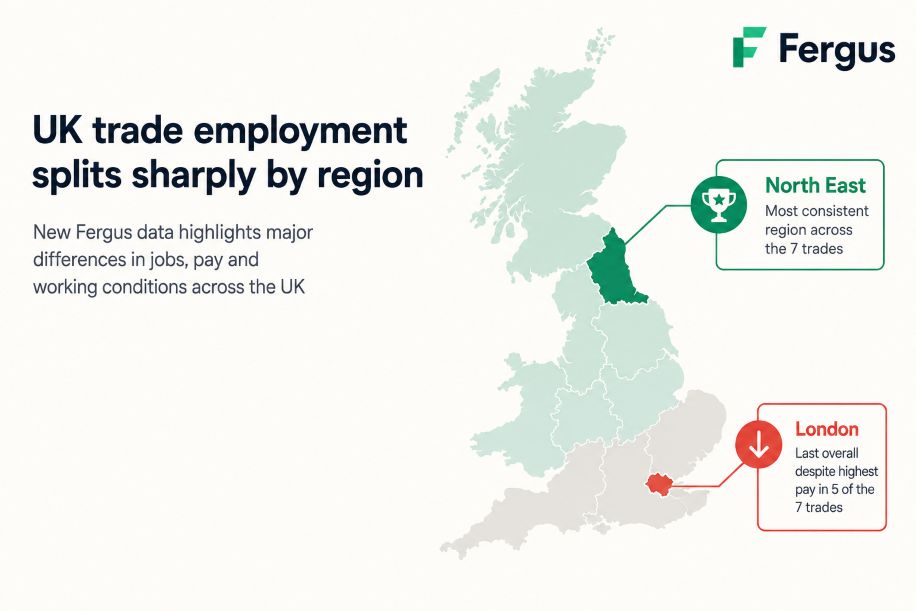
New research from Fergus has revealed significant regional differences in employment, earnings and working conditions across the UK’s skilled trades, with electricians among the professions experiencing particularly sharp variations.
The job management platform’s UK Tradespeople Hotspots Index compares 11 regions across seven trades: electricians, plumbers, carpenters, bricklayers, roofers, painters and decorators and construction and building trades supervisors.
Using eight measures including pay, employment growth, working hours, housing affordability, living costs, self-employment and insurance costs, the research suggests that higher headline wages do not necessarily translate into better prospects for tradespeople.
The North East emerges as the most consistently strong region across the seven trades, helped by comparatively affordable housing and good local earning power. At the other end of the table, London finishes last overall despite offering the highest wages for five of the seven trades studied.
East Midlands Leads For Electricians
For electricians, the East Midlands achieves the highest overall score of any trade-region combination in the research. Weekly pay stands at £836.20, while electrician employment has increased by 34.8% over three years.
The North West follows closely, while Yorkshire and the Humber and London present a very different picture. Despite offering above-average pay, electrician employment has fallen by 31.4% in Yorkshire and the Humber and 49% in London.
The figures underline the extent to which employment prospects for electrical professionals can vary depending on location, even where headline earnings remain attractive.
Plumbing Opportunities Strong In Yorkshire
Yorkshire and the Humber tops the rankings for plumbers, heating and ventilating installers, supported by 42% employment growth and relatively strong housing affordability. Scotland and the North West follow.
London offers the highest weekly wage for the trade at £857.90 but drops to seventh place overall once housing and other living costs are considered.
Construction supervisors experience an even more dramatic divide. The West Midlands leads the rankings, while London records the highest weekly wage at £975.30 but finishes last overall. Employment among construction and building trades supervisors in the capital has fallen 64.5% in three years – the steepest decline recorded for any trade-region combination in the study.
Elsewhere, Yorkshire and the Humber leads for roofers, with employment increasing 68.8%, while Wales ranks first for painters and decorators. The North East tops the rankings for carpenters and joiners and the South East leads for bricklayers.
The research also highlights considerable differences in working patterns. Self-employment ranges from 32.7% among carpenters in the East Midlands to 95.7% for painters and decorators in the East of England.
Mark Bartels, CEO at Fergus, says: “There’s a common assumption that the best opportunities for tradespeople are wherever the wages are highest, but our research shows that’s not always the case. In many parts of the UK, tradespeople can earn slightly less on paper but end up with a better quality of life and stronger long-term prospects because housing is more affordable, costs are lower and demand remains strong.
“For trade business owners, that’s an important lesson. Success isn’t just about chasing the biggest contracts or the largest cities – it’s about understanding where demand is growing, where skilled workers can afford to live and where businesses can operate sustainably.
“As the construction sector continues to evolve, we expect regional differences to play an even bigger role in shaping opportunities. The businesses that pay attention to those shifts will be best placed to attract talent, win work and grow in the years ahead.”
The UK Tradespeople Hotspots Index uses data from sources including ONS ASHE, the Annual Population Survey, UK House Price Index and Registers of Scotland and ONS Family Spending, alongside insurance quote data. Northern Ireland was excluded due to insufficient data coverage.