


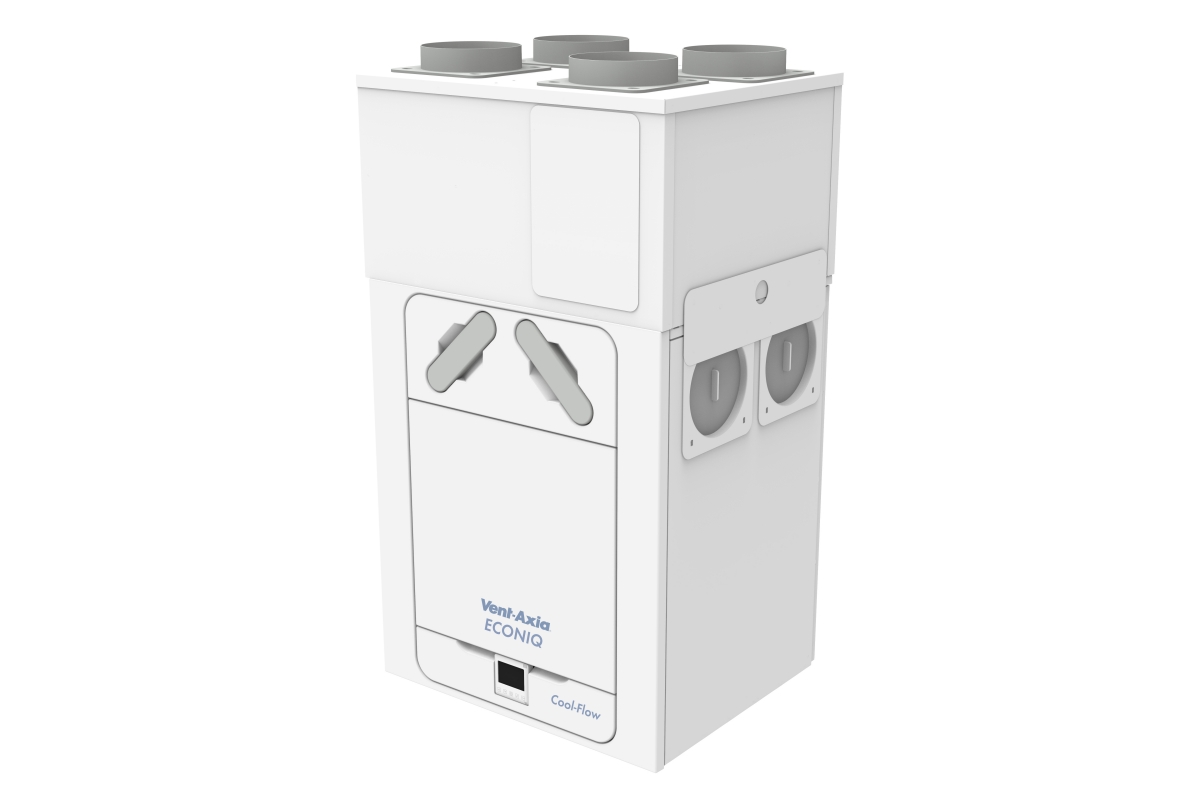
Ventilation manufacturer Vent-Axia has welcomed the Future Homes Standard – alongside the publication of updated Approved Document Part F (Means of Ventilation) and Part L (Conservation of Fuel and Power) of the Building Regulations – as a step forward in reducing residential carbon emissions.
The Future Homes Standard is expected to deliver homes that produce 75–80% less carbon emissions compared to 2013 standards. However, as buildings become increasingly airtight, Vent-Axia believes indoor air quality (IAQ) must also be considered to protect occupants’ well-being.
The company has highlighted the updated guidance’s strengthened focus on competency, noting that well-designed, correctly installed, and effectively commissioned ventilation systems will be more important than ever as compliance becomes more complex for housebuilders.
What the updated Building Regulations mean for installers
Part F now states that greater care should be taken when installing mechanical ventilation systems, particularly centralised ones, and that the installer must be suitably competent – for example, a registered competent person – and that the work must meet Building Regulations requirements.
Compliance can be demonstrated via self-certification by a registered competent person, or certification by a building control body. Part F also introduces guidance that those commissioning and testing mechanical ventilation systems should be trained and hold membership of an organisation that independently verifies their competence.
There is also increased emphasis on system design, including airflow performance and ductwork resistance. The addition of maximum design system pressure for Mechanical Ventilation (MEV) and Mechanical Ventilation with Heat Recovery (MVHR) systems means designers must ensure pressure calculations are completed for each project.
Part L introduces tighter specific fan power (SFP) targets across ventilation. Intermittent fans remain at 0.5W/l/s, while decentralised MEV (dMEV) is set at 0.3W/l/s and centralised MEV at 0.5W/l/s for new build. MVHR systems are reduced to 1.4W/l/s for new build.
Part F also brings further changes to ducting, with a shift away from flexible ductwork. Rigid or smooth semi-rigid ducting is now required for continuous MEV or MVHR, while rigid ducting with duct lengths kept to a maximum of 2m is required for intermittent extract fans or dMEV where possible. Where duct runs exceed 2m, detailed design calculations and drawings must be provided to building control by a competent person.
Joe Brawn, Product and Marketing Director at Vent-Axia, says, “We welcome the Future Homes Standard and the clarity it provides housebuilders.
“As carbon targets rise and homes become more airtight, it will become even more important to ensure ventilation systems are correctly designed, installed, and commissioned to ensure good indoor air quality.”
In response to the changes, Vent-Axia is opening a new training facility at its Dudley manufacturing site in the coming months, adding to its existing NICEIC Domestic Ventilation Training Course at its Crawley training suite.
The two-day course covers legal requirements, system design, installation, testing, commissioning, and fault-finding in line with the latest National Occupational Standards and Minimum Technical Competency documents.
For more from Vent-Axia, click here.