2 November 2026
Product of the Month: Amari Floodlight range by Aurora Lighting
 
26 November 2026
Thorn scores second Highland football lighting installation
 
26 November 2026
Segen pens exclusive distribution contract with M-Rack
 
25 November 2026
Scolmore helps rejuvenate Tamworth Cancer Support Centre
 
25 November 2026
Leicester apprentice crowned 2026 SkillELECTRIC champion
 

Latest News


Heat Pump Industry Welcomes Support For Low Carbon Heat
The Heat Pump Industry has welcomed the Government consultation on Future Support for Low Carbon Heat - in particular the proposal to make grants of £4,000 available for consumers wishing to replace fossil fuel boilers with Heat Pumps. Chairman of the Heat Pump Association (HPA), Graham Wright, says, “We are pleased the Government is proposing this important step to decarbonise the way we heat our homes, and thank the Minister, the Rt Hon Kwasi Kwarteng MP, and his civil servants, for their constructive engagement with the HPA, and for developing these policy proposals on the basis of sound evidence and economic analysis. We are particularly pleased that the Government has quoted our recent Industry Roadmap, published last November, within the consultation, and has adopted our proposal for a £4,000 grant per customer, to support heat pump uptake. “The Committee on Climate Change has made it clear that the most cost-effective way for the heat sector to deliver the country’s legally binding carbon targets, is to ensure all new heating systems from 2035 are low carbon. Yesterday’s publication is an important first step in delivering that critical market transformation. “Although there is further dialogue to be had during and after the consultation period, particularly on whether the overall levels of funding are sufficient to deliver the required growth, and ensuring that alternative policy support is developed for larger heat pump installations, today’s announcement is a most welcome step in the right direction.”

Report Reveals Tradespeople Being Harassed During Essential Construction Work
The Construction Industry Coronavirus (CICV) Forum is providing greater visibility on what constitutes ‘essential work’ to prevent key workers being harassed and verbally abused during vital construction projects. The Forum’s members have reported an increasing number of tradespeople being intimidated and verbally abused by the public while carrying out legitimate projects in line with CICV Forum guidelines. One contractor says, “On one commercial job, our engineers were subjected to a barrage of abuse by residents and staff. Our guys were upset and didn’t want to be there, so in the end, the local authority had to put up posters explaining that we were carrying out essential work. It was the only way our engineers could be left alone to do the work. “Not all essential obvious work is obvious to the public, but that is no excuse for the behaviour that some of us in the construction industry are having to put up with.” To try and diffuse the situation, the Forum has produced a checklist of projects to help the public understand the range of work classified as ‘essential’. It also plans to offer on-site signage to help workers make it clear to the public they are carrying out essential work only. Kevin Stewart, Minister for Local Government, Housing and Planning, said such measures were essential to provide clarity and reduce tension between the wider public and workers. He comments, “The general public may not be aware of the full range of projects that constitute ‘essential work’, but these are workers who are performing a vital role safely and responsibly. “At a time when the Scottish Government is asking people to remain in their homes it is even more important that these homes are watertight, safe and have essential working facilities, such as water, gas and electricity. “Builders and plumbers’ merchants are also needed to provide supplies for essential repair and maintenance, such as heating and hot water breakdowns, roofing repairs, and electrical and fire safety. “It is important that the public understand that there is still a need for essential works to be carried out in these challenging times and industry professionals should be able to complete repairs in safety, without fear of criticism and rebuke.” His words were echoed by John McKinney, secretary of Forum members the National Federation of Roofing Contractors, the Stone Federation and the Scottish Contractors Group, who adds, “Essential construction work is not confined to building a major hospital for COVID-19, but we know that people might not be aware of this. “There are dozens of other construction works that are classed as essential to keep the fabric of Scotland intact. At the very least, homes need to be watertight and safe both inside and out for people to be able to live in them. That’s why the construction industry is working hard across Scotland to ensure people can stay at home during these times to protect the NHS. “Greater understanding is needed among the public to understand that the key workers carrying out such work aren’t flouting the rules – they are performing essential tasks and should be allowed to do so without fear of abuse.” To help the public, the Forum has now compiled a list of essential work that is permitted to be carried out, including:                 Removal of elements in danger of collapse, e.g. cladding                 Repair and construction of critical road and utility infrastructure                 Emergency call-out services, e.g. electrical, plumbing, glazing and roofing                 Making inhabited buildings safe and watertight, e.g. after storm damage                 Domestic repairs to ensure occupants’ safety and wellbeing, e.g. the elderly                 Repair and maintenance of essential buildings, e.g. fire and police stations                 Safe operation of faulty heating and water systems                 Essential inspections to prevent health outbreaks, e.g. legionnaires                 Supply of materials for these and other essential COVID-19 projects. In addition, the Forum is developing a series of free signage for contractors to use to make it clear that any work being carried out is essential. Designed to be printed out and inserted in van windows and properties, the read: ‘Key Worker: Carrying Out Essential Construction Work.’ Andrew Renwick, Managing Director of Caltech Lifts, who represents Forum member the Lift and Escalator Industry Association, said it was vital that this new collateral was used responsibly. “It is imperative that this material is only displayed and worn by individuals undertaking qualifying work, so employers should also issue employees with appropriate paperwork so that they can provide evidence if questioned by the police,” he says. “Anyone caught abusing this material should be dealt with and the employer spoken to by the authorities.” Set up in March, the CICV Forum has already played a major role in clarifying conflicting information for the sector and issuing practical guidance for companies, clients and employees. It has also established a series of influential sub-groups dealing with mission-critical aspects such as health and safety, skills and future planning.

NICEIC and Elecsa Partner With ECA For Free Industry Webinar
NICEIC and Elecsa will once again partner with ECA, the industry's leading trade association, to deliver the second in a series of business support webinars aimed at supporting electrical contractors. The next webinar, which takes place on Friday, May 1 at 11am, will examine all the latest advice surrounding the government’s furlough scheme. Open to all, this session will answer contractor's questions and provide specific guidance on how the support programme applies to the electrical contracting industry. To register, visit www.niceic.com/COVID-19-Support-Webinar. "As the economic realities of COVID-19 continue to take hold, it is vital that all electrical contractors have access to sound and tailored advice," says Darren Staniforth, Senior Technical Presenter NICEIC & ELECSA. "The landscape is moving at pace, and while the government's furlough scheme has been well documented in the media, we are acutely aware that there are still a lot of unanswered questions surrounding the eligibility criteria and the process associated with claiming grants. "By way of supporting our registrants and the broader electrical contracting industry, we have partnered with the ECA to deliver expert tailored advice to our sector. "Please join myself and ECA's Director of Employment & Skills, Andrew Eldred, to get the answers you need to make the right decisions for your business.” The previous webinar, which explored the financial support available to small businesses and sole traders, is available to watch on-demand via the NICEIC and Elecsa websites.

Exclusive KNX Taster Course
Hosted by Bemco, ECN presents an exclusive chance to learn more about building automation platform, KNX. Presenting the course will be Jeremy Aston, Managing Director of Channel Smart Buildings (CSB). Channel Smart Buildings is an expert in all aspects of integrated technology in the home and commercial built environment. Jeremy will present this special free introductory course over zoom on Wednesday, May 13, 2020, 2pm – 3pm (GMT). To sign up, click here. The online KNX ‘taster’ course is a one-hour introduction session that will enable installers to gain a better understanding of: KNX infrastructure and the benefits it offers The fundamentals of KNX programming Which applications work best with KNX The wide range of KNX products and the design aesthetics Integrating AV and other control systems (eg. Control 4 / Crestron / RTI / Savant / Elan / AMX) into a KNX building control system The intro seminar is an ideal opportunity for technical and non-technical minds to learn more about KNX and work out if it’s right for your business. Bemco has provided the following entry criteria that needs to be in place before registering. Entry criteria Must follow Bemco on Instagram: @bemcoelectrical Tag a friend who might be interested using the hashtag #KNX. Save the date and join the webinar on time. Open to UK residents aged 18 or over. Only one entry per person. Each registration automatically enters the person registering for a special price draw. Enter to win three special giveaways for three lucky followers! 1 x five days KNX Basic Course (worth £750) 1 x ETS5 Lite Dongle (worth £100) 1 x ETS5 Lite Dongle (worth £100) Once again, the registration link can be found by clicking here.

Will Coronavirus Job Retention Scheme Claims Be Paid On Time?
The newly-established Construction Industry Coronavirus (CICV) Forum has hailed the “speed and efficiency” of the Coronavirus Job Retention Scheme rollout – but says the real test will be if all claims are paid on time. The specialist body – set up to support Scotland’s construction industry during the current pandemic – said the successful launch by HMRC last week could provide a “vital lifeline” to companies across the country. Since the HMRC portal opened on Monday 20 April, more than 140,000 companies employing around a million workers have applied to the furlough scheme. The cost of about £1 billion is expected to rise significantly as more companies take up the offer. Vaughan Hart, Managing Director of Forum member Scottish Building Federation and chair of the Forum Employment sub-group, says, “The Forum wishes to record its appreciation of the intense amount of work that has been undertaken behind the scenes by HMRC to so effectively address a situation that, just a few short weeks ago, nobody could have envisaged. “Fears that the system might be overwhelmed seem unfounded as the rollout and handling seems to have gone smoothly so far.“Feedback also seems to suggest that payments are now being made as scheduled, so fingers crossed this continues and a vital lifeline is successfully delivered.” Andrew Renwick, Managing Director of Caltech Lifts, and also a member of the Forum Employment sub-group, says, “The Revenue has taken on a mammoth task and seems to have made a really good start, demonstrating admirable speed and efficiency. The circumstances have been unprecedented and it is very gratifying to see the importance that the government attaches to the small businesses which are the lifeblood of the economy. However, the job is still only half done, and the real test will come over the next week or so when it will become clear if funds are paid out on time to those who need them most.” The scheme means that employers who cannot maintain their current workforce because their operations have been severely affected can furlough employees and apply for a grant that covers 80% of their usual monthly wage costs, up to £2,500 a month, plus the associated Employer National Insurance and pension contributions. The scheme is temporary, in place for four months starting from March 1, 2020, but it may be extended if necessary and employers can use this scheme at any time during this period. The CICV Forum has already played a major role in clarifying conflicting information for the sector and issuing practical guidance for companies, clients and employees. It has now established a series of influential sub-groups dealing with mission-critical aspects such as Health and Safety, Skills, Communication and Future Planning.

CENTIEL Achieves ISO 14001:2015 Environmental Management System Accreditation
CENTIEL UK has announced it has been awarded ISO 14001:2015 Environmental Management System accreditation by the BSI.  ISO 14001 Environmental Management is the world's most recognised environmental management system, and CENTIEL UK now adds this to its BSI accredited ISO 9001:2015 Quality Management System and its BSI accredited OHSAS 18001:2007 Occupational Health & Safety Management System certifications. David Bond, chairman, CENTIEL UK explains, “We are now one of the very few companies in the UPS industry in the UK to hold all three of these key BSI accreditations, enabling us to deliver more than regulatory compliance and the ability to meet supplier requirements.  “BSI has received the official UK accreditation status from UKAS, which means it has  been assessed against internationally recognised standards. This status also means that the certificates issued by the BSI, are both credible and impartial. “The BSI route was challenging but we wanted to provide the highest level of certification to complement our commitment to product and service quality. The accreditation process required a great deal of investment in terms of both time and resource. However, as Theodore Roosevelt once said, ‘nothing worth having comes easy,’  therefore, we are delighted to gain the ISO 14001 Environmental Management accreditation which completes our BSI “tick & crown collection’.” Karen Rough, service and compliance manager, CENTIEL UK confirms, “Our ISO 14001 Environmental Management System certification needed us to consider and document multiple aspects of our business in relation to the environment.  This included recording processes about how we purchase, manage, store and dispose of certain products such as batteries for example, and how we work to reduce our impact on the environment on a company-wide basis.  BSI attended our offices to survey our systems and will continue to do so every year.  We needed to show working examples of our processes and records and how all staff adhere to the detailed management system we have in place. “For tenders and proposals, the BSI accreditations we now hold tick many boxes, but they also serve as reassurance to our valued customer base that our “Swiss quality” approach to best practice runs right throughout our organisation.  As well as underlining our continued commitment to providing the best possible service and inspiring trust, it offers our customers complete peace of mind and we anticipate the certification will help us attract new clients and expand further within the UPS marketplace.”  CENTIEL’s additional certifications include: Safe Contractor status; CIPS Sustainability Index and Constructionline gold level.

BS 5839-6:2019 – Are You Up To Date?
With revisions to the standard for domestic fire detection introduced last year, Neil Baldwin, Managing Director at ESP, takes a look at the key updates that contractors need to be aware of to ensure that they are fully compliant when installing fire alarm systems. The BSI’s recent update of the domestic fire detection and alarm system standard, specifically Part 6 of BS 5839, outlines the code of practice for the design, installation, commissioning and maintenance of fire detection and fire alarm systems in domestic properties. The standard is aimed at architects, engineers and other building professionals, enforcing authorities, installers and others responsible for implementing fire precautions in domestic premises. It provides the latest recommendations for fire detection and fire alarm systems in both new and existing domestic premises in order to make them safer to live in. The main revisions include: Re-grading and revision of statistics and recommendations Updating guidance to take all other standards in the BS 5839 series into account New table on testing and servicing by grade of alarm system New recommendations for ensuring alarm signal transmission required within social care and sheltered housing settings function accordingly Increased protection in sheltered housing and supported housing New recommendation that communal fire alarm systems should not normally be installed in purpose built blocks of flats The key standard for domestic premises The BS 5839 series of standards began life with the publication of BS 5839-1 in 1980. It has since grown into nine parts, splitting domestic and non-domestic premises and also dealing with a range of specific systems in detail. Part 6 has become the key standard for domestic premises. The document supplies guidance and recommendations on planning, designing, installing, commissioning and maintaining detection and fire alarm systems. The recommendations refer principally to fire detection and fire alarm systems installed for the purpose of life safety but also include recommendations for systems that are intended to protect property. The standard covers homes designed to accommodate a single family; HMOs comprising a number of self-contained units, each designed to accommodate a single family; and sheltered housing, including both the dwelling units and the common areas. It applies to both new and existing premises. Its recommendations can be applied to the fire detection components of combined domestic fire and intruder alarm systems, or fire and social alarm systems. The standard also includes recommendations for routine attention. The systems it covers range from those comprising a single self-contained smoke alarm to systems of the type described in BS 5839-1. New recommendations have been added for fire detection in supported housing in particular, whilst revised guidance on the installation of communal fire alarm systems in purpose-built blocks of flats has also been introduced. The Standard has also been updated to reflect the updates made to Part 1 in 2017, which addresses non-domestic premises, combined with any other updates made to other Standards since the last full revision. Below is an outline of the key changes to BS 5839-6 and the areas to be aware of to ensure residents are offered the highest standard of fire protection throughout all types of domestic properties. This applies to property managers, architects, building professionals, installers and enforcing authorities. Revised system grading for fire detection and fire alarm systems Whilst BS 5839-6 has previously been split into six varying Grades, each outlining the level of protection appropriate for certain properties and their corresponding levels of risk, the new update has altered the six sections, removing Grade B and Grade E, whilst Grade D and Grade F have been split into Grade D1 / Grade D2 and Grade F1 / Grade F2 respectively. Grade C has been revised and its recommendations expanded. The new grading system is as follows: Grade A Separate detectors, sounders and central control and indicating equipment with back-up power supply that conforms to British Standards BS EN 54. Grade C Separate detectors and sounders that are mains powered with back-up power supply and central control equipment. Grade D1 A system of one or more mains powered detectors, each with a tamper proof standby supply consisting of a battery or batteries. Grade D2 A system of one or more mains-powered detectors, each with an integral standby supply consisting of a user replaceable battery or batteries. Grade F1 A system of one or more battery-powered detectors powered by a tamper proof primary battery or batteries. Grade F2 A system of one or more battery-powered detectors powered by a user replaceable primary battery or batteries. These grades need to be adhered to when designing, constructing and managing fire detection and fire alarm systems in domestic properties. Attention also needs to be given to the revisions made to Table 1 of the Standard, which outlines the minimum grade and category of system that should be installed to provide protection of life in typical premises. The updates have been made to reflect current living conditions. In conjunction with Table 1, a new table has also been created, which outlines the recommended testing and servicing by grade to prevent the blocking or delaying of fire alarm signals transmitted via social alarm systems in sheltered housing to an alarm receiving centre. Three categories for fire detection and fire alarm systems With regard to categories, the standard of protection in sheltered housing flats has been increased from Category LD2 to Category LD1, positioning it as a higher potential risk. To meet LD1 requirements, the installation of a fire detection system is required throughout the premises – this includes all rooms (and circulation areas that form part of the escape routes) except toilets, bathrooms and shower rooms. The three categories for fire detection and fire alarm systems are listed below and outline where fire detection systems should be installed: LD1 Maximum Protection – all areas where a fire could start Alarms in all circulation spaces that form part of escape routes and all areas where a fire might start, but not bathrooms, shower rooms or toilets, such as: hallway, landing, living room, kitchen, bedroom, airing / meter cupboards, loft and garage. LD2 Additional Protection – circulation spaces and high-risk rooms Alarms in all circulation spaces that form part of escape routes and rooms or areas that present a high fire risk, such as: hallway, landing, living room and kitchen. LD3 Minimum Protection – escape routes only Alarms in all circulation spaces that form part of escape routes, such as the hallway and landing. Around 80% of UK fire deaths and injuries happen in domestic premises. Tragically, that adds up to over 300 deaths and around 9,000 injuries each year caused by fires in people’s homes, where they should feel safe. The latest changes to BS 5839-6 are designed to ensure that the systems being installed are fit for purpose for current living environments within domestic premises, and means that individuals are provided with the highest forms of protection available, contributing to the reduction in the number of fire deaths and injuries that occur each year.

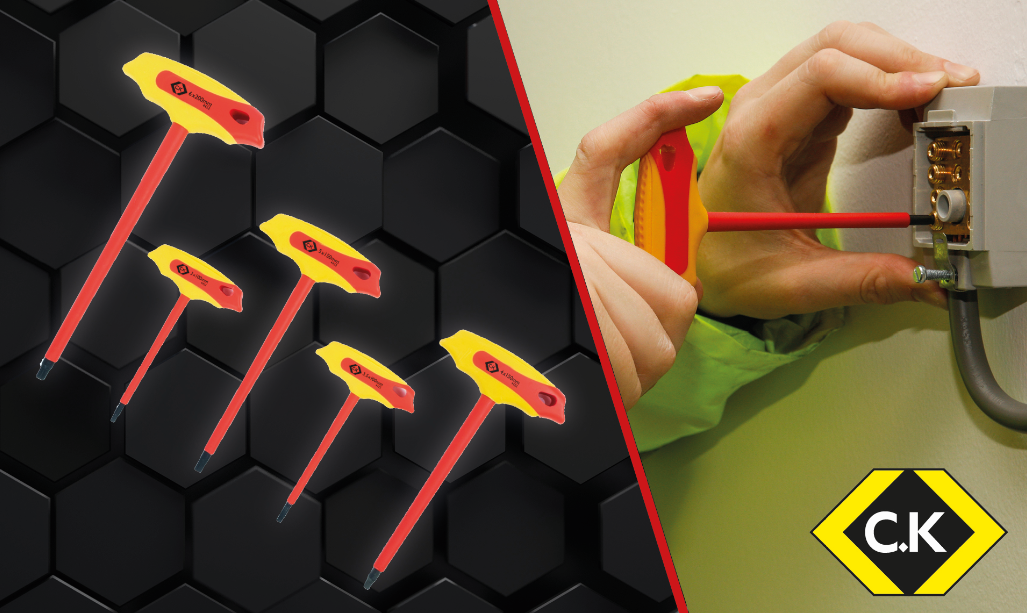
C.K Strengthens its Range of Insulated T-Handle Hex Keys
A good quality set of T-Handle Hex Keys can make all the difference when it comes to completing a whole range of tasks quickly and easily. Following recent market research and valuable feedback from professionals, C.K has introduced more product sizes to its already popular Insulated T-Handle Hex Key (4mm). These include the innovative C.K five-piece Insulated T-handle Hex Keys Set (T4422 SET – 3, 3.5. 4, 5 and 6mm), plus two of the most frequently used Insulated T-Handle Hex Key sizes 3mm (T4422 03); and 3.5mm (T4422 035), which can be purchased separately. Fantastic features and benefits Regularly working with professionals also gives C.K great insight into what works best to get the job done quickly and efficiently. The new C.K Insulated T-Handle Hex Keys are designed to do just that, combining high quality with a great range of features and benefits. Take a look at what’s new: C.K five-piece Insulated T-Handle Hex Keys Set (T4422 SET) - Comprises the most requested insulated T-Handle hex key sizes in one handy set (3, 3.5, 4, 5 and 6mm). Ideal for those needing a range of sizes to complete their work, the set is: VDE approved – individually tested to 10,000V for safe working up to 1,000V; features premium quality S2 steel blades, tempered and hardened for exceptional strength and durability; and a dual component, ergonomic handle for ease of use. C.K Insulated T-Handle Hex Key 3mm (T4422 03) and 3.5mm (T4422 035) - These are two of the most commonly used insulated T-Handle hex keys and feature the same C.K quality specifications.  Perfect for a range of applications such as Henley blocks and meter box cut outs, these versatile insulated t-handle hex keys provide the best hassle-free solution around. Find out more about the C.K T-handle Hex Keys at https://www.carlkammerling.com/products/ck_tools/electricians_tools/insulated_thandle_hex_keys/

SELECT Puts Its Hands Together For NHS In New Video
Staff and office bearers at the electrical trade association SELECT have saluted the work of the NHS and key workers by putting their hands together in a new film for the weekly ‘Clap for our Carers’ event. The isolated workers filmed themselves clapping in a special compilation video that was screened on social media as part of the now-regular #clapforourcarers initiative. Among those taking part were SELECT President Kevin Griffin, vice-president Donald W Orr and office bearers Alex Guyan, Alistair Grant, David Smith, Jim Cooper, Graeme Anderson and Paul Erasmuson. Also shown clapping while they work at home were SELECT Managing Director Alan Wilson, Director of Technical Services Dave Forrester, Director of Employment and Skills Fiona Harper, Director of Resources John McGhee and Director of Membership and Communications Iain Mason. Mason says, “We wanted to show our appreciation for everything the NHS and other key workers are doing throughout the COVID-19 outbreak, so we thought we would make a film that would help us join in the weekly national clapping event that’s been organised in their honour. Many of us know key workers working in the front line, so it seemed fitting for us to show our appreciation like this.” https://www.youtube.com/watch?v=dGYuAb3HXTk Staff and office bearers provided clips on their phones, which were then collated and edited together by Simon Organ of video production company, Skills Player. Mason adds, “With staff continuing to work in isolation, it was also a good way to do something together and see our friends and colleagues again. It was an enjoyable experience and we hope to do more in the future.” Others seen clapping in the video are Training Manager Jenny Cryans, Technical Standards Adviser Bob Cairney, Training and Development Officer Malcolm Duncan, Technical Adviser Stuart McKelvie, Certification Scheme Administrator Mary McSporran and Technical Administrator Susie Liddle. Also taking part were Membership Manager Sandra Bennett, Events, Marketing and Communications Coordinator Linda Rolfe, Membership and Communications Administrator Anita Horeckyj and Membership Representatives Diane Hales and Emma Paterson. ICT Project Manager Carolynn Shaw also contributed a clip to the video, along with Employment Affairs Adviser Nicola Jengaenga, Employment Affairs Administrators Gilian Hogarth, Riki Gillespie and Nicky Deighan, Temporary Support to Employment and Skills and the SJIB Alex Kerr, and Receptionist Adrienne Thompson. Thursday’s event was the fifth week in a row that the initiative has taken place, with the first ‘clap for our carers’ held on March 26. While the first event was held in honour of the NHS, the 8pm event now pays tribute to all key workers including NHS staff, supermarket workers and teachers. During the current pandemic, SELECT has created a dedicated COVID-19 hub, offering open source advice and guidance to contractors. It is also a key member of the Construction Industry Coronavirus (CICV) Forum, a collective of 16 industry bodies offering vital information and lobbying for protection of cashflow and jobs.  

Survey Results - Electrical Wholesale Sector Is Open For Business
Despite the COVID-19 challenges to business, well over 90% of UK electrical wholesalers are continuing to trade, with only a handful taking the decision to temporarily close completely, according to the Electrical Distributors’ Association (EDA) following a recent survey. The EDA recently polled all 245 wholesaler members on their opening status, the results of which are published in the Associations’ newly created online COVID-19 Hub, which also provides a range of information, resources, and downloads for members and affiliated members. Even with the obvious alterations needed to accommodate social distancing, most member businesses are fully operational from all branches. Swift to react to necessary constraints of COVID-19 changes, many businesses have established 'keep your distance' collection services to ensure their contractor customers are supplied with essential products – many of whom are responding to critical infrastructure and emergency projects. Margaret Fitzsimons, CEO at the EDA comments, “Electrical wholesalers are an essential link in the supply chain, keeping contractors supplied with the products they need to keep the UK’s critical infrastructure safe and operational. There have been many inspirational stories of huge efforts by our members to get resources to where they are needed most, and we’ve shared as many of these as we can on our social media channels. “Swift to respond, our members have adapted their business operations to ensure safe working practices for their employees, customers and suppliers. In the medium to longer term, there is no doubt that both manufacturers and wholesalers will want to explore their e-commerce and data harnessing capabilities. As social distancing looks set to be with us for some time, wholesalers will be looking for how best to integrate online efficiencies with the trade counter expertise that we know is so important to contractors.” Also planned for the EDA’s COVID-19 Hub is information on the operating status of the 80-plus manufacturer affiliated members. Margaret promoted the EDA’s COVID-19 Hub in a webinar run by the ECA earlier this week. The 53-minute webinar can be viewed below: https://www.youtube.com/watch?v=baKP9Ts9VWY&feature=youtu.be