2 November 2026
Product of the Month: Amari Floodlight range by Aurora Lighting
 
26 November 2026
Thorn scores second Highland football lighting installation
 
26 November 2026
Segen pens exclusive distribution contract with M-Rack
 
25 November 2026
Scolmore helps rejuvenate Tamworth Cancer Support Centre
 
25 November 2026
Leicester apprentice crowned 2026 SkillELECTRIC champion
 

Latest News


Homing in on surge protection
On the back of a 20-year partnership, Hager and Taylor Wimpey, one of the UK’s largest housebuilding companies, are working together to ensure safety remains the number one priority for the owners of the developers’ newly built homes following recent electrical industry regulation changes. As a result of the introduction of the 18th Edition of the Wiring Regulations, all new Taylor Wimpey homes, where construction was started after January 2019, will benefit from an ‘as standard’ installation of a surge protection device within the property’s consumer unit as an extra safety precaution. The new 18th Edition regulations state that all new build properties should have surge protection unless a risk assessment is carried out by electrical contractors to look at the likelihood of lightning strikes and other geographical factors that could result in short, disruptive and excessive voltage levels. The risk of such occurances can adversely affect properties and their contents such as electrical devices like laptops, and TVs. From this assessment, electrical contractors can decide if the consumer unit installation warrants the cost of including a surge protection device to help protect potentially expensive household technology items from damage due to an unpredictable spike in voltage. However, committed to the highest levels of customer service, Taylor Wimpey has taken the strategic decision to phase in the roll out of consumer units prefitted with a surge protection device across its new build developments going forward. As well as offering complete peace-of-mind for the new property homeowner, by specifying Hager’s Design 30 consumer units, electrical contractors can benefit from a straightforward and fast on-site installation process as the surge protection devices come pre-wired. This helps to keep the construction programme on schedule and allows purchasers to take ownership of their new homes without any undue delay. Ian Smith, Marketing Manager at Hager, says, “The introduction of the 18th Edition regulations mean many in the electrical industry supply chain have had to reassess their specification and installation processes to comply. Surge protection was an area of major change, especially with the onus on contractors to carry out a risk assessment before the installation of a consumer unit. “While this could lead to potential confusion among the market, Taylor Wimpey, as a responsible developer, has taken the decision to ensure all its new homes offer increased electrical protection. The company’s judgement to install the Hager Design 30 consumer units with factory pre-wired surge protection on a blanket basis, means it has removed any doubt about the best course of action. “The impact of the 18th Edition changes can be seen by the fact that production of Hager’s surge protection-ready Design 30 consumer units has increased ten-fold, as the electrical industry gets to grips with the new regulatory landscape.” A spokesperson for Taylor Wimpey comments, “By taking the strategic decision to install 18th Edition-ready consumer units into all of our new build homes where initial construction has started after January 2019, we are able to assure our new homeowners that their property and valuable items are better protected from unpredictable surges in voltage. We also take the pressure off electrical contractors. They no longer have to make the decision around the suitability of surge protection for a home following the risk assessment. They can simply get on with the installation. “Our long-standing relationship with Hager means we are totally confident we are specifying a quality, high performing solution thanks to the Design 30 consumer unit.”

Electrical contractors show further fall in reportable accidents
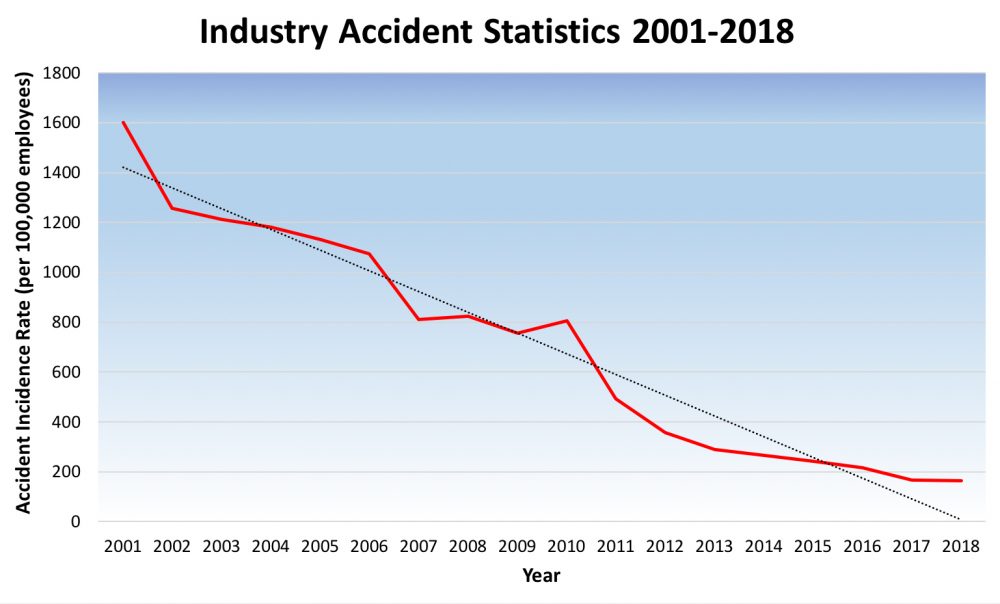
The latest accident statistics for electrical contracting businesses, employing over 13,000 operatives in total, show a further reduction in the accident rate in 2018. The figures, collected by the Joint Industry Board (JIB) on behalf of leading electrotechnical trade body ECA and Unite the Union, show that the rate of RIDDOR-reportable accidents fell once again, to 164/100,000. Significantly, no fatalities were reported during 2018 and the rate of specified (major) accidents was also lower than in 2017 at just over 52/100,000. The main causes of injury were falls, slips and trips, and there was one reportable injury due to electric shock. Steve Brawley, Chief Executive of the JIB, comments, “It’s very encouraging to report that the rate of reportable accidents in our industry continues to fall, and it means that the rate of these accidents is now, remarkably, only slightly more than 10% of what it was in 2001, the year we started to collect data for the industry’s highly successful ‘ZAP safety initiative.” Paul Reeve, ECA Director of CSR, adds, “Since the turn of the millennium, there has been near continuous improvement in the accident rate reported by participating companies. The 2018 figures mean that the accident rate has fallen nearly 90% since 2001, which is a great achievement. In fact, the number of RIDDOR-reportables – in a sample of over 13,500 operatives – is now so low, that in 2019 we will be asking companies for additional details of any ‘over one day accidents’. While these accidents are not RIDDOR-reportable, this will give us more data to work with in future.” Rob Miguel, Unite National Health and Safety Advisor, notes, “While these new figures are very welcome and show huge improvements in safety in the electrical contracting industry over the last two decades, JIB is also working to improve occupational health. “The JIB occupational health scheme provides operatives employed by a JIB member company with the opportunity to receive a fully funded occupational health assessment every three years. This facility, funded through the JIB Benefits Scheme, will deliver various benefits including improved compliance with health and safety law, meeting client and main contractor requirements, and helping people to identify and remedy health issues at an earlier stage. This assessment looks for the effects on health that might be caused by situations people are exposed to at work, and highlights action which employers will need to take to protect the health and wellbeing of their employees and our members.” To download the accident report visit: www.jib.org.uk/jib-accident-survey

Apprentices deliver clear ROI, new research shows
Companies that recruit apprentices can see a return on investment (ROI) as soon as year two of the apprenticeship programme, according to new figures from The Electrotechnical Skills Partnership. Using scenarios based on low, medium and high charge-out rates for unskilled and skilled work, the overall net costs and benefits of apprentice recruitment have been projected. At the lowest rates, an apprentice delivers a net benefit of around £11,400 over the four years, and starts to make a return in year three of the apprenticeship. At higher charge-out rates, the apprentice begins to pay for themselves in year two, and by the end of year four, has created a net total benefit of just over £34,000 at medium charge out rates and £56,700 at high rates. Research specialist, Pye Tait Consulting, carried out the analysis on behalf of TESP after speaking to 20 companies of different sizes and specialisms. Each company was asked about the weekly wages of apprentices over the course of the apprenticeship, as well as additional costs for course fees, travel, equipment, in-house training and the time spent by supervisors and other skilled staff for mentoring and support. The calculations take into account the weekly costs of an apprentice and supervision, the percentage of time spent on supervision, and the increasing amount of time the apprentice spends completing the work of a qualified electrician. With 95% of training costs in England now funded by the Government for apprentices of all ages, these new figures provide a strong case for employers to consider apprentices as a means of bringing new skills into the business. For smaller companies that often struggle with the resource for managing the apprenticeship and initial impact of productivity, TESP believes these projected returns demonstrate that, with the support of a quality training provider, an apprenticeship will eventually pay off. “Although it is a commitment, which can be daunting to small businesses in particular, investing the time and resource into apprenticeships will ultimately drive business growth,” says Ruth Devine, Managing Director of SJD Electrical and Chair of TESP. “As a small business owner, I have experienced first-hand that, over time, apprenticeships increase capacity and strengthen the business culture. “A strong relationship with a quality local FE college or training provider is vital, however. Industry organisations such as the TESP partners are also happy to help and give advice. When I first started at SJD, I found the supportive network of fellow ECA members invaluable to navigate some of the challenges of managing apprentices and providers; it’s always good to benefit from others’ experience.” Leading apprentice training providers, JTL and Focus Training, also welcomed the release of the ROI figures to support their employer recruitment efforts: “The report is really helpful to us as a training provider. We’ve never been under any illusion about the value of apprentices, but the analysis will help us to convince employers of the tangible benefit to taking on an apprentice,” comments Liam Sammon, JTL’s Director of Learning and Innovation. Bernard Collins, Curriculum and Quality Director at Focus Training Group, adds, “It is great to see evidence that having an apprentice not only delivers an individual who fits in with the companies’ ethos and work ethic, but also provides an appreciable financial return, even after making allowances for support and expenses.” To read the report in full, visit www.the-esp.org.uk/ourwork/lmi

Schneider Electric collaborates with Edmundson Electrical to open EV centres
Schneider Electric has collaborated with Edmundson Electrical to open four electric vehicle (EV) centres of excellence. Partnered with Schneider, the new centres in Manchester, West Bromwich, Glasgow and Twickenham, will develop expertise around smart, interoperable EV charging systems. The companies say that these efforts will support contractors in meeting growing EV infrastructure and energy demands. Since 2015, the number of ultra-low emission vehicles has quadrupled. Along with this continued market growth, the demand for EV energy management system knowledge will too increase. As EV charging systems scale in size and complexity, the opening of the centres will enable Edmundson Electrical and Schneider to deliver expertise, training and support to the UK EV charging installation market. “With the growth of low emission vehicles across the UK, we need to have the best possible knowledge base. Investing in the creation of excellence centres with Schneider Electric means we can utilise their knowledge to ensure we can help our contractors develop new skills, broaden our customer base and improve standards,” comments Andrew Fawcett, Business Development Manager at Edmundson Electrical. Danny Winn, Business Unit Director, eMobility at Schneider Electric, adds, “Edmundson have recognised the emergence of EVs in the UK and have reacted in the most positive way possible. With this partnership we can share our expertise and they can have a competitive advantage for the future. At Schneider Electric we are committed to making the UK as energy efficient as possible. This partnership is another step in the right direction.”

ECIC urges electrical contractors to declare diversification
As new laws have been announced to guarantee payment for solar homes providing excess electricity, demand for solar panel technology from homeowners is expected to increase. This will in turn present a number of new opportunities for electrical contractors looking to broaden their contract opportunities. ECIC, the specialist insurer for the building services sector, is encouraging electrical contractors who are diversifying into renewable technology to make sure that their insurance reflects the new work they are undertaking, to help ensure they are adequately protected if they need to make a claim. New government legislation states that all new solar homes and businesses exporting electricity to the grid will be guaranteed a payment from suppliers. What is being described as the Smart Export Guarantee (SEG) will ensure that the owners of small-scale electricity generators with a capacity up to 5MW will be paid for each unit of electricity they sell to the grid - tracked by a smart meter. Consequently, demand for renewable technology that generates this electricity is anticipated to grow, creating an opportunity for electrical contractors to fulfil this demand. However, change in work changes the insurance risk and under the Insurance Act 2015, contractors are under a duty to ensure that they present a ‘fair presentation of risk’ to their insurer. This means declaring changes in the type of work contractors are taking on. Richard Forrest Smith, CEO of the ECIC, comments, “This new legislation has the potential to create a number of new business opportunities for electrical contractors. However, these opportunities can only be capitalised on if the contractors themselves are properly accredited and insured. Fitting solar panels and other renewable technologies have different risk factors, so insurance covers need to be adapted accordingly. Declaring these changes to their broker or insurer is essential to ensure the contractor is properly protected in the event of a claim.”

Schneider Electric launches 'Rethink Energy' initiative
Schneider Electric UK has launched its ‘Rethink Energy’ initiative, a programme which aims to change business, consumer and government attitudes to energy waste and help combat climate change. Whilst other forms of waste such as plastics, fast fashion and food are highly visible, energy is frequently overlooked. A Schneider Electric commissioned study of 2,000 UK adults and over 600 UK businesses revealed that just 10% of consumers want to do more to curb their current energy use, while 74% believe they already do enough. In the same report, 68% of business leaders reported their organisations wasted energy, particularly in the form of inefficient building and office space. Under half (43%) of company chiefs also shared their organisation had not implemented any measures aimed at tackling these inefficiencies in 2018. To launch its initiative, Schneider Electric held a panel debate at Tottenham Hotspur’s new stadium, one of the world’s most energy efficient stadiums.  Schneider Electric is THFC’s official energy management partner. The debate focused on three key areas: The role for energy in achieving a zero-carbon economy by 2050 £1 trillion price tag – cost or opportunity What will drive change in the UK’s demand for energy The panellists included: David Joffe, Team Leader at theUK Committee on Climate Change Ben Golding, Director, Energy Efficiency and Local,Department for Business, Energy & Industrial Strategy James Diggle, Head of Energy & Climate Change,the Confederation of British Industry (CBI) Mike Hughes, Zone President,Schneider Electric UK & Ireland Mike Hughes, Zone President, Schneider Electric UK & Ireland comments, “We need to bring energy front of mind.  The market needs to take an activist approach to advocate for and instil efficiency and build an investment mindset if we are to achieve the 2050 net zero goal. As energy waste becomes more visible, businesses will increasingly be held accountable.” He continues, “HM Treasury recently suggested it could cost the UK around £1 trillion to achieve carbon neutrality by 2050, but it’s not about cost, it’s about huge savings. Sustainability is a cost that pays for itself and technology and innovation will be key to meeting the energy efficiency challenge.” Also speaking at the event, David Joffe, Team Leader at the UK Committee on Climate Change says,“How do you encourage people to change their behaviour? 1) give people enough information to make decisions, 2) make it a desirable (almost competitive) thing to do, 3) enable people to take action”  “Much of the problem with energy efficiency is measurement, you need to know how the measures you have put in place are performing,” he adds.

Flicking the switch to LED lighting
As awareness of the climate crisis intensifies, switching to LED-based lighting systems makes sense from both environmental and economic perspectives, writes Tamlite Lighting's Managing Director, John Allden. With the amount of evidence pointing to an escalating climate crisis growing by the week, there is a feeling that businesses everywhere need to be doing more to reduce their carbon footprints. One of the most effective ways in which they can do this is to make the switch from traditional light sources to next-generation LED-based systems – a move that can often reduce lighting-related energy consumption by up to 90%. Sadly, not all businesses are yet aware of the benefits of LED lighting, so there is an important (and potentially rewarding) opportunity for contractors and suppliers to steer companies towards upgrading their systems to the latest LED-based solutions. In the UK, the imperative to act now seems especially strong given that it recently became the first major economy to pass laws to end its contribution to global warming by 2050. Agreed in June 2019, the legislation stipulates that all greenhouse gas emissions must be brought to net zero by the middle of the century – compared with the previous target of at least 80% reduction from 1990 levels. Meanwhile, multiple major organisations and trade associations have been making moves towards a more energy efficient future. The Royal Institute of British Architects (RIBA) is a case in point: having voiced support for the UK Government’s 2050 plan, it recently confirmed that it would develop a five-year action plan to embed sustainable industry standards and practices, and seek to reduce RIBA’s own carbon footprint. Consequently, the feeling that businesses of all sizes and shapes should ‘do their bit’ to help meet these ambitious – but very necessary – targets has never been stronger. Fortunately, there are some relatively straightforward steps that can be taken to reduce a company’s overall carbon footprint – not least making the move from traditional lighting types to highly efficient LED-based systems. Making the case for LED lighting From a steady stream to a flood – there is no doubt that the transition towards LED-based lighting has accelerated dramatically during the past five years. But for contractors and suppliers working with the as-yet-unconverted, it doesn’t take long to construct a compelling case for them to review their use of lighting. What follows is a roll-call of some of the main points that need to be made. First and foremost, it is not uncommon for LED lights to use 90% less energy than a typical incandescent bulb. As a result, in even the case of a relatively modest lighting infrastructure, there can be a significant reduction in a company’s primary carbon footprint, as less fossil fuels will have to be burned to produce it. Then there are the benefits to what is frequently termed secondary carbon footprint. With the latest-generation systems, LED lights can offer a life expectancy that is 20 times longer than a traditional bulb. The result is that many LEDs only need to be replaced once every 50,000 hours – that can represent more than 17 years of typical annual use in many applications. Attendant to this vastly improved efficiency and life expectancy are multiple other potential cost reductions. Fewer replacements equals less need to call on maintenance staff – spelling significant savings on third-party contractors and/or increased capacity for internal support personnel. Switching to long-life LED systems also translates to reduced stoppages for replacement work that could put whole areas of an office complex or factory out of action. Mind you, that’s not the only potential benefit for productivity of adopting LED lighting. There is now a substantial body of study that indicates its ability to generate improved and more consistent lighting levels is conducive to better health among employees. As the UK Health & Safety Executive has observed, “Poor lighting can not only affect the health of people at work causing symptoms like eyestrain, migraine and headaches, but it is also linked to Sick Building Syndrome in new and refurbished buildings.” In the context of the above, it is hard to see the encouragement of companies by contractors and suppliers to move across to LED as anything but a win-win. On one hand, it can deliver dramatic carbon and energy-expenditure savings to businesses; on the other, it can contribute to a healthier environment for personnel and thereby reinforce companies’ credentials as eco-conscious organisations, with all the positive PR implications which that brings. With the cost of even the higher-end systems steadily falling, there has never been a better time to embrace the benefits of LED lighting. For further information, click here.

Riello UPS shines light on potential electricity grid failure
Riello UPS, a manufacturer of uninterruptible power supplies (UPS), has published a report entitled ‘The Blackout report’, which explores the likelihood of the UK experiencing a nationwide electricity grid failure. Only last month, a massive power failure across Argentina, Paraguay, and Uruguay left nearly 50 million people without electricity. According to the report, official government risk assessments state there is a 1-in-200 chance of the UK power grid experiencing a similar complete shutdown in the next five years. The company’s in-depth report explores the most likely causes of such an incident, from the increased threat of extreme weather including flooding or gales knocking out the network infrastructure, to terrorism, industrial accidents, and geomagnetic space weather storms that play havoc with satellite systems. It also poses the question as to whether the shift towards ‘smart’ energy grids heightens the UK’s vulnerability to cyber-attacks – similar to when Russian hackers shut down 30 substations in Ukraine in December 2015, leaving 250,000 people without electricity. State-sponsored hackers, believed to be the Russian-based Dragonfly group, are said to have already infiltrated the UK grid on June 8, 2017 – the day of the General Election. The report addresses this and the rise in fears of an escalating ‘cyber cold war’ – where countries including the US can insert high-grade malware inside energy networks which could potentially be used to turn off entire electricity supplies at a moment’s notice. The report goes on to examine the process for rebooting the electricity network if a complete system failure ever occurs. Known as a ‘black start’, worst-case contingency planning is that it could take up to five to seven days for power to be fully restored. Such an incident is likely to be accompanied by rota disconnections, which essentially ration power by cutting off electricity for blocks of three hours at a time. This was last seen on a wide-scale basis in the UK back in the 1970s, notably during the infamous ‘three-day week’. The Blackout report also investigates the catastrophic consequences of a world without power: mobile phone coverage lost within a couple of hours; transport systems grinding to a halt; hospitals and care homes overwhelmed as electrical devices stop working; businesses crippled as electronic payment systems go offline. Leo Craig, General Manager, Riello UPS, comments, “We’ve never been as reliant on the internet and interconnectivity, but without the electricity to power this digital world, our whole way of life falls apart at the seams.” “Many will look at the recent blackout across South America and think ‘that could never happen here’. It’s not necessarily complacency, more perhaps the belief that our infrastructure is more robust and that we’ve committed enough resource towards planning for the worst,” he adds. “The Blackout report investigates whether these assumptions are true. By thinking the unthinkable, it also poses some critical questions for the Government, the power industry, and wider society, such as whether we’re truly prepared for the ever-changing threats to our electricity supply.”

C-Tec launches new BS 5839-6 CPD seminar
C-Tec, an independent manufacturer of quality life safety electronic systems, has launched a new CPD-certified seminar. Entitled ‘A guide to BS 5839-6 2019 domestic fire alarms’, the company says its topical and informative seminar highlights what’s new in the recently updated code of practice for the design, installation, commissioning and maintenance of fire detection and fire alarm systems in domestic premises – with particular emphasis on the revised system of grading for such systems. Andy Green, Marketing Manager, C-Tec says, “Our new CPD-certified seminar is free-of-charge and an absolute must-attend for anyone involved in the design, specification and installation of domestic fire alarm systems.” At the end of the seminar, delegates will also have the opportunity to see demonstrations of C-Tec’s range of life-safety systems including Hush Pro, its new BS 5839-6 grade C domestic fire alarm system. The UK-based manufacturer says its new system has been designed to seamlessly integrate domestic fire systems with communal/landlord fire system.

Recolight recommends changes to the WEEE system
At an event marking the 12th anniversary of the commencement of the WEEE regulations in the UK, Recolight’s CEO Nigel Harvey took the opportunity to recommend changes to the system. [caption id="attachment_16897" align="alignleft" width="269"] Nigel Harvey, CEO, Recolight[/caption] “Over the last three years, there has been a material decline in the tonnage of waste lamps collected in the UK, along with other WEEE.  Fresh thinking is needed reverse this decline,” says Harvey He proposed three areas in which change is needed... More ways for consumers to return their waste Consumers currently have limited options for correct disposal of WEEE – largely limited to their local household waste recycling centres.  “That is clearly no longer sufficient.  We need to give consumers more options.  Those options should include providing kerbside collections of WEEE and requiring high street retailers to takeback WEEE instore.” Many of these changes, Harvey suggests, can be achieved by a review of the distributor takeback scheme, which currently allows retailers to opt out of providing a WEEE takeback service. Tackle online freeriders However, implementing these changes could increase costs for some producers, and retailers.  As a result, Harvey recommends tackling non-compliant producers selling through online marketplaces. “The level of non-compliant product sold through online marketplaces and fulfilment houses is truly shocking.  We found that 76% of LED light bulbs offered for sale on one marketplace were not WEEE compliant.  Those producers avoid the costs incurred by companies that follow the law.” He continues, “We are delighted that the government has now consulted on making online marketplaces responsible for the packaging compliance of product for which they facilitate the import into the UK.  What is now needed for government to adopt that same approach for WEEE.” “Ensuring that online retailers, and all producers bear their fair share of WEEE costs should minimise or even eliminate any additional burden on compliant producers and high street retailers.” More enforcement powers for agencies Harvey also suggests that the UK’s four environment agencies need more enforcement powers to drive compliance. “If we change the law to tackle freeriders, it is also vital that the agencies have better enforcement powers.  That should include statutory fines for free-riding producers.  The existence of an annual compliance fee every year since 2013 means it is possible to calculate, to the nearest penny, the costs avoided when producers do not comply.  That creates the ideal base cost for a statutory fine.  Implementing this mechanism would, at last, create the fair system that compliant companies crave.”