2 November 2026
Product of the Month: Amari Floodlight range by Aurora Lighting
 
24 November 2026
JTL celebrates opening of new Tyneside training centre
 
24 November 2026
LiGHT 26 welcomes record number of visitors to fifth event
 
23 November 2026
Advanced acquires communications specialist Baldwin Boxall
 
23 November 2026
Trades face 'skills squeeze' as apprenticeship demand soars
 

Latest News


New metal cable cleats available from Unicrimp
Unicrimp’s growing Q-Fire portfolio of fire-rated cable accessory products now includes a range of metal cable cleats. Meeting the BS 7671 (18th Edition) requirements, they are designed to prevent cables from premature collapse during a fire which, in turn, helps keep the public safe. The 18th Edition of the Wiring Regulations stipulate that cable support systems must be constructed with materials that will withstand premature collapse caused by direct exposure to heat. There are no applications excluded – trunking, conduit and cabling fixed to surfaces of the building or attached to cable support systems must all have fire-resistant supports in place. Unicrimp’s fire-rated black Metal Cable Cleats are available in 14 different size options suitable for cable sizes from 5mm up to 50mm. The key feature of the product is an oval fixing hole which allows for cable diameter tolerances. To install the metal cable cleat, the electrician just needs to bend the cleat around the cable and fix in place to the designated wall. For more from Unicrimp, click here.

CU Phosco introduces PhosLink Adjustable Power Connector
CU Phosco, the largest family-owned UK designer and manufacturer of outdoor lighting solutions, has announced the launch of a new product, the PhosLink Adjustable Power Connector. Designed for the versatile CU Phosco E95X luminaire range, PhosLink offers an unprecedented level of power adjustability and efficiency for outdoor lighting applications. The PhosLink series includes two variants – PhosLink1 and PhosLink2 – each engineered to provide nine distinct power settings. This flexibility empowers customers to tailor the power output of their luminaires to suit specific project requirements, directly on-site or within their depots. As a result, customers can benefit from more streamlined stock management with the flexibility to adjust the lumen output as necessary either in the workshop or on site, and greater adaptability in their inventory holdings. Key features of PhosLink: • Customisable power settings: Both PhosLink1 and PhosLink2 allow users to adjust power outputs in increments of 100mA. PhosLink1 supports settings ranging from 200mA to 1000mA, while PhosLink2 ranges from 250mA to 1050mA • On-site flexibility: Each luminaire is initially set to the lowest output, allowing for easy adjustments to higher settings as required. This enables customers to achieve the desired wattage without the need for additional installation procedures • Energy efficiency: PhosLink ensures direct, economical, and targeted lumen output, making it ideal for energy-conscious lighting schemes • Ease of installation: Designed to be user-friendly, the PhosLink connector simplifies the process of adjusting wattage. By simply repositioning a link wire and pressing the connector button, users can select the appropriate setting with ease • Optics compatibility: Standard optics options include P4 for residential roads and R2 for footpaths, with additional optics available upon request • International Dark-Sky Association approved: Initially designed with DarkSky accredited E95x range, compliant when using a colour temperature of 3000K or below, at zero-degree tilt. CU Phosco's commitment to innovation is exemplified in the development of PhosLink, which aligns with the company’s dedication to providing cutting-edge, energy-efficient lighting solutions. The PhosLink Adjustable Power Connector is set to transform how outdoor lighting systems are managed and optimised, offering unparalleled adaptability and convenience. “The introduction of PhosLink represents a significant advancement in our E95X product offerings, providing customers with a versatile and efficient solution to manage their outdoor lighting needs on-site,” says Matt Murray, Sales and Marketing Director at CU Phosco. “We are excited to bring this innovative product to market, continuing our tradition of excellence in design and sustainability.” For more from CU Phosco, click here.

School heating system harnesses heat from thermal spring
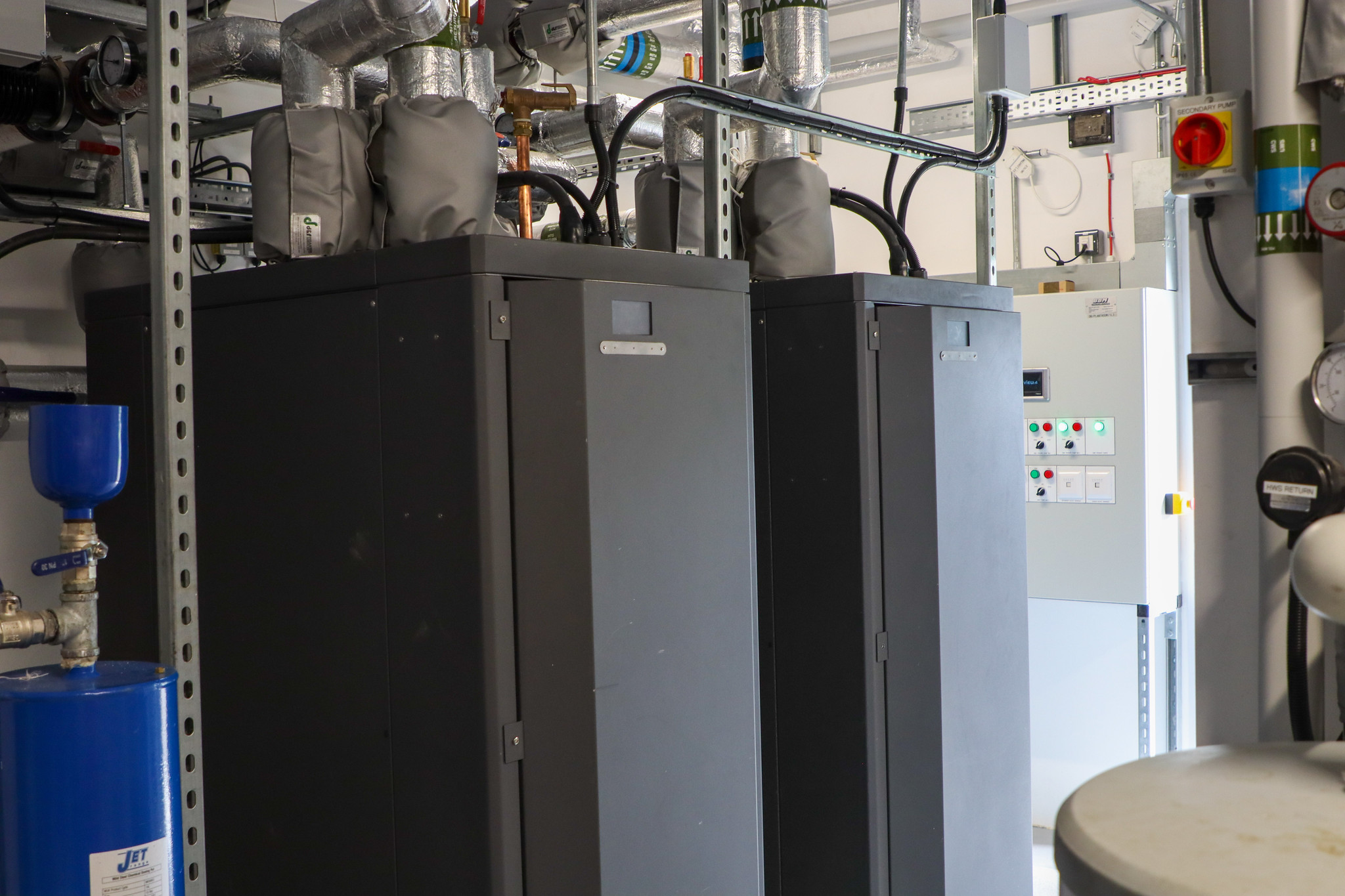
A primary school and bowls pavilion in a South Wales village have switched to clean, renewable heating in an innovative way that cannot be replicated anywhere else in Wales. Ffynnon Taf Primary School and the Pavilion at Taff’s Well Bowling Club in Taff’s Well, Wales, have had a bold new heating system installed by Kensa, a UK-based ground source heat pump specialist, that uses naturally occurring heat from the only thermal spring in Wales – the historic Taff’s Well Spring. This unique water source heat pump system harnesses natural heat from the warm spring water, which emerges from deep beneath the earth at around 21°C, to provide the two council-owned properties with low-carbon heating and hot water. Using the innovative clean heating method instead of gas is expected to cut the school and pavilion’s carbon emissions linked to heating by close to 80%. It also demonstrated a way of using Kensa’s ground source heat pumps without drilling vertical boreholes to access heat energy stored in the ground. The bold idea of using the Taff's Well thermal spring to heat buildings was initially proposed by the Friends of Taff’s Well community group, who were looking at other ways the historic spring could benefit the local community. This project follows other retrofit renewable heating installations completed in non-domestic buildings by Kensa. Using ground source heat pump technology, the UK’s leading manufacturer and solutions provider has futureproofed heating and lowered carbon emissions caused by heat in multiple UK schools and council properties. The unique installation also highlights the versatility of Kensa’s ground source heat pump systems and forms part of Rhondda Cynon Taf Borough Council’s ambitious plans to decarbonise by 2030. How the system works Kensa’s ground source heat pumps, found in thousands of UK properties, are usually set up to source energy from the ground to provide heating and hot water. The one-of-a-kind installation at Taff’s Well pumps warm water from the spring and passes it through a nearby heat exchanger, which is connected to Kensa’s ground source heat pumps housed inside the school and pavilion. In this highly energy-efficient system, heat energy stored in the warm spring water is absorbed and converted by the heat pumps into usable energy for the school and pavilion’s heating and hot water systems. While in the system, the water is confined to its own pipework, mostly hidden under the ground and out of sight, and doesn’t encounter any other substances to ensure there’s no issue of contamination or pollution. To keep the connecting pipework hidden and to avoid above-ground damage, Kensa horizontally drilled hundreds of metres between the well, the school, and the pavilion. After passing through the system, the clean water is emptied back into the well’s overflow, feeding into the River Taff. This is the only system installed by Cornwall-based Kensa that uses a natural thermal spring as a heat source. On Tuesday 16 July, Kensa’s Dr Stuart Gadsden visited the site, along with representatives from Rhondda Cynon Taf County Borough Council, to demonstrate to pupils from the Ffynon Taf Primary School’s Eco Committee how their new low-carbon heating and hot water system works. Dr Stuart Gadsden, Kensa Contracting Commercial Director, says, “This is an incredibly unique system and really demonstrates how versatile Kensa’s ground source heat pumps are. It was great to show the pupils how their exciting new heating system works and how it will reduce their carbon footprint. “Kensa has a proven track record of delivering the high efficiencies of ground source heat pump technology for numerous UK schools and local authorities, providing them with a futureproofed low-carbon heating system. “Using the historic Taff’s Well thermal spring as a renewable heat source is a brilliant example of how bold ideas can lead to something that benefits future generations. It’s something the whole community can be proud of, and we were pleased to play our part in making it happen.” Ffynnon Taf Primary School Headteacher, Kathryn Price, notes, “We are very excited about how Taff’s Well Thermal Spring has been utilised for the whole school community. Our Eco Committee thoroughly enjoyed learning more about the heat pump system and how this helps to reduce the school’s carbon footprint. We will continue to celebrate the success of the thermal spring installation in our community for many years to come.” Jon Arroyo, Energy and Carbon Reduction Manager at Rhondda Cynon Taf County Borough Council, adds, “We have an ambition to decarbonise the Council by 2030 and we understand there is no one solution to decarbonise our heating systems, so it is important that we look at what heat resources are around or under us. As a Council, we see our role in exploring alternative solutions to help steer our businesses and residents in their journey towards a net zero future.” For more from Kensa, click here.

Two thirds of Brits unconfident about house building targets
Close to two thirds of British residents are not confident that the new Government can meet its targets for homebuilding during the next five years. According to new data from MyBuilder.com, 57% of people are not confident that government targets for house building will be met. In the age range of over 55s, this jumps to 72% stating that they are not confident that these aims will be achieved. Geographically there are some variations in the levels of confidence of British people in the house building targets. Bristol has the least confidence, with 70% of those surveyed believing the goals would not be met, while Londoners had more confidence, with less than half (48%) stating that they did not think the Government would achieve its goals. The list below shows the percentage of respondents in each geographical who are not confident that the government will meet its house building targets: • Southampton 68% • Nottingham 67% • Brighton 65% • Birmingham 63% • Norwich 61% • Manchester 59% • Wales 57% • Scotland 57% • Liverpool 56% • Leeds 55% • Newcastle 55% Professionals from MyBuilder.com have pointed out that the current skills shortage in construction and the skilled trades could make this new target problematic. Government policy around house building targets in the UK has been inconsistent over the past 15 years, with 16 housing ministers since 2010. Despite repeated pledges to build more homes by successive governments, no targets have been met in the last 20 years. Meanwhile, the housing shortage continues to grow, with an estimated shortfall of over four million homes across Britain. The newly-elected government has stated that it has a target of building 1.5 million houses by 2029. While experts at MyBuilder.com welcome this ambitious target, it raised concerns around how realistic this is, taking into account the skills shortage within the building industry. According to recent research from the UK Trade Skills Index (2023), the UK is facing its largest ever deficit of skills tradespeople in history. The industry will need to recruit close to a million new apprentices in the next 10 years just to stay afloat - and that’s without an increase in house building targets. The Skills Index also found that the UK has seen a worrying rise of skills shortages across construction – from 29% in Q1 2021, to 55% in Q4 2021. Widespread shortages exist particularly among plumbers, bricklayers, carpenters, and electricians. Andy Simms from MyBuilder.com (pictured above), says that the government must do all it can to encourage young people into trades to address the skills shortages. He comments, “It’s great to see that the new government is keen to prioritise house building when there is such a problem in this area. “Government incentives helped the UK see a spike in trades apprenticeships, but in 2021 nearly half of this apprenticeship levy was unspent. The government must work with the education system to promote the trades as a career path, or we will be facing bigger shortages than ever at a time when house building needs to be a priority for the British people.”

JTL calls on employers to ‘Energise their business’
JTL, a leading apprenticeship provider in the building services engineering sector, has launched a new campaign appealing directly to employers and calling on them to energise their business by taking on an apprentice. JTL works with over 3,800 businesses and trains more apprentices than anyone else in the building services engineering sector, currently training around 8,000 learners in electrotechnical engineering and plumbing - key skills that are contributing to the UK’s transition to net zero and future workforce. With a growing number of training centres across the country, JTL can provide tailored training in renewable technologies and ensures access to the latest academic criteria. Each training centre boasts state-of-the-art learning environments and resources required for each apprenticeship standard. This enables the delivery of high-quality training in response to industry demand. Employers working with JTL apprentices have told of the benefits they bring to their business as talented and highly motivated team members; as well as the value of a smooth and efficient process in hiring an apprentice. Government funding may be available to assist employers when recruiting an apprentice and cover the expenses related to qualification training with JTL. Hayley Tabberer, Employer Campaign Manager at JTL, says, “This is an exciting time for the industry, as innovative technologies are transforming our daily lives and increasing the demand for both commercial and domestic installations. The apprenticeship standards focus on a greener future, making it invaluable to bring an apprentice into your business who is trained to these practices from the start, ensuring sustainable growth.” Supporting employers directly, JTL provides a dedicated training officer to manage the apprenticeship process from the initial appointment through to completion, and all JTL apprentices are supported with learning resources and provided with a free toolkit for their workplace. The campaign, running across all digital channels, also raises awareness about updated academic standards to better reflect business and industry’s needs, and changes to government funding rules which mean apprenticeships within small businesses are fully funded for anyone up to the age of 21. Employers are encouraged to find out further information to maximise the potential of apprentices for their business by visiting JTL’s dedicated employer webpage. For more from JTL, click here.

Unicrimp offers All-Round Banding range
Unicrimp, part of the Scolmore Group of companies, offers a comprehensive range of products in its growing Q-Fire fire-rated collection, including All Round Banding products. The All Round Banding range provides users with an expanded choice of fixing solutions, suitable across a range of applications and environments – helping installers to satisfy the latest IET Wiring Regulations. The pre-punched steel banding is highly versatile and has multipurpose uses – to secure cables, pipes, ducts and conduits. It is easy to cut and bend and the pre-punched holes allow for easy fixing using nail, screws, or bolts. The All Round Banding range comprises a choice of a non-coated galvanised steel finish in 12mm and 17mm widths, LSF coated options in black (12mm and 17mm widths), plus red and white colour choices (available in 12mm widths). They are all supplied boxed in a 10 metre coil size. For more from Unicrimp, click here.

New lighting brings Newport Railway bridge to life
A new pedestrian and cycle bridge has been built at Newport station in Wales, forming a vital crossing over the Great Western Mainline Railway. The bridge has been introduced to encourage active travel and improve connectivity for local residents and commuters. Designed by renowned architectural practice, Grimshaw, with additional engineering support from Arup, the 230m bridge is divided into several distinct parts, including two dark grey steel sections that span the railway lines plus stairs and a lightweight step-free ramp on each side. The whole structure has been unified with continuous orange flooring to create a bold statement and a unique identity. Lighting was a key aspect of the bridge's construction, with a particular focus on safety, security, and accessibility. The design called for a discreet handrail solution to illuminate the floor deck while also supporting users with limited mobility. Additional lighting was also specified to enhance the surrounding public spaces. Leading M&E consultant, Vitec, was appointed to oversee the lighting and approached DW Windsor to fulfil key elements of the scheme's design. To satisfy the brief, DW Windsor supplied products from its award-winning Garda illuminated handrail range, adapted to suit the project's unique requirements. For the ramps and stairs, nearly 500m of seamless stainless-steel handrail was installed, fitted with 300mm Garda Classic asymmetric modules. Special attention was paid to how the handrail attached to the balustrade fins, which had pre-drilled holes, meaning a lot of coordination between all parties was needed to ensure everything fitted together on site without modification. For the main bridge deck, where handrails could not be used for safety reasons, an alternative approach was required. To overcome this challenge, DW Windsor developed a bespoke solution, integrating Garda LED modules directly into the two parapet structures slotted between the vertical ribs. Additional lighting was also supplied for the central section between these structures where, again, handrails could not be used. Here, the designers came up with an innovative solution to vertically mount recessed Ligman Lightalk luminaires between the balustrade fins. To achieve the required light levels, 3000K LED modules were spaced at approximately 2m across the whole structure. This provided a consistent appearance and ensured the scheme delivered an average maintained illuminance of 30 lux and a minimum uniformity of 0.5 to comply with British Standards. Discussing the installation, David Anstee, Technical Manager at DW Windsor, says, "This was a very large project, requiring a lot of coordination, particularly for the handrail, which had hundreds of touch points. Additionally, the power supplies needed to be in one location, meaning a lot of planning was needed to calculate circuit loads and voltage drop to ensure the lighting would operate as intended. This included planning all of the cable routing and ducting which had to be built into the bridge structure." In addition to the bridge lighting, the brief specified that lighting should be integrated into the hard landscaping beneath each ramp, which has been styled into amphitheatre-like areas. To support this, DW Windsor supplied sections of its Vaio linear system, which were recessed horizontally into the granite seating around the perimeter. This offered a point of focus for users while also providing low-level lighting to guide people into the space. Additional Ligman uplighters were also installed into the planters to illuminate the ramp soffits and vertical supports, enhancing the general ambience of the space while having minimal impact on the surrounding areas. Shaun Davies, Project Engineer at Vitec, comments, “The Newport Station bridge provides residents and visitors to the area with a safer, more accessible link over the mainline railway. With its distinctive design and discreet lighting scheme, the new bridge has helped to transform a neglected area into a vibrant public space.” For more from DW Windsor, click here.

2024 set for record heat pump installations
2024 is on track to see more heat pumps installed in the UK than ever before, according to data from MCS (Microgeneration Certification Scheme), the UK’s quality mark for small-scale renewable energy. In the first six months of the year there have been 27,000 certified heat pump installations in the UK, which is 45% higher than the same period in 2023 – which was itself a record-breaking year for the technology. It means that the total figure for 2024 is almost certain to be higher than any previous years, as the transition to net zero gathers pace. Speaking about the increasing number of heat pumps being installed in the UK, Charlotte Lee, Chief Executive of Heat Pump Association, says, “It is fantastic to see the continuing growth in heat pump installations within the UK, underscoring the progress and commitment from the sector in supporting the decarbonisation of heat. Clarity and confidence from the new Labour Government on the direction of travel for the electrification of heat will be crucial to continue the momentum and ensure we stay on track for a record year.” The data also reveals more than 80,000 homes have had certified solar panels installed so far in 2024, having surpassed the 1.5 million installations mark earlier this year. Battery storage installations, meanwhile, have reached almost 8,000 certified installations in 2024, which is already more than any previous year with six months still to go. It shows a remarkable rise for the technology since the Battery Storage Installation Standard was introduced in 2021, and as homeowners increasingly look to build their own energy resilience. Chris Hewett, CEO at Solar Energy UK, adds, “I am glad that consumer demand for solar energy has remained both substantial and stable over the first half of the year, buoyed both by high energy bills and undoubtedly by environmental concerns too. This should provide installers with the confidence to invest in their staff, particularly in recruiting the new people we need to grow the sector.” “We should also celebrate reaching the milestone of 1.5 million MCS-scale solar installations this spring, not to mention battery storage systems - the natural partner to solar PV - hitting a new record last month. It's safe to say that now is something of a golden era for smaller-scale sustainable energy.” Ian Rippin, CEO at MCS, comments, “As the decarbonisation of UK homes gathers pace, it’s vital that homeowner confidence in renewables continues to grow alongside that to sustain demand. High-quality installations are key to this because we want everyone to enjoy the benefits of home-grown energy, so it’s fantastic to see these record numbers for certified installations. “We also know that alongside consumer trust in the effectiveness of renewable technology, ongoing government support can make a significant difference in helping to make the transition. The recently published Heat Strategy for Wales highlights a clear commitment to heat pumps, and initiatives such as the Boiler Upgrade Scheme (BUS) – which provides up to £7,500 towards the installation of a heat pump – are crucial in providing support to consumers. It is no coincidence that the record number of certified heat pump installations has coincided with a record number of BUS applications in 2024, which is ensuring more homeowners have access to low-carbon technology. It’s something that we hope the government will continue to support as home-grown energy becomes more mainstream in UK homes.” MCS holds the most comprehensive repository of data on the uptake of small-scale renewable technologies across the UK on The MCS Data Dashboard. For near-real-time updates on renewable installations, sign up to The MCS Data Dashboard by clicking here. For more from MCS, click here.

Metcor appoints new Group Managing Director
Aylesford Electrical Contractors' parent company, The Metcor Group, has announced the appointment of Philip Fellowes-Prynne as Group Managing Director. Philip brings a wealth of experience in leading sustainable building solutions to the role, and will play a key role in driving the Metcor Group's continued growth and commitment to environmentally responsible solutions. “We are thrilled to welcome Philip to the Metcor Group,” says Nicholas Gaisman, CEO of the company. “His proven track record in the sustainable building solutions sector perfectly aligns with our vision for the future. Philip's leadership will be instrumental in expanding our service offerings and solidifying our position as a leader in sustainable drainage, water management, pumping, and electrical solutions.” Prior to joining the Metcor Group, Philip was Chief Executive at Efficient Building Solutions, where he championed sustainable practices within the construction industry. His extensive experience positions him perfectly to leverage the combined expertise of the Metcor Group's companies - Metcor Environmental, Anglo Pumps, and Aylesford Electrical Contractors. Philip comments, “I am honoured to join the Metcor Group at such a pivotal time. The Group's dedication to providing innovative and sustainable solutions aligns perfectly with my own values. I look forward to working with the talented team to build upon the company's impressive legacy and further our commitment to environmental responsibility.” For more from Metcor, click here.

New office sparks expansion push for Arc Electrical
ARC Electrical UK Services, a fast-growing Black Country electrical specialist, has capped a record year by investing in new offices in Upper Gornal. The company, which was founded by Adam Checketts in 2021, has moved into a 2,500 square foot facility on Dormston Trading Estate, providing a larger home for the business to expand and giving it a dedicated training space for staff. The company supports the private sector and social housing providers with a range of services, including full electrical installation works, new builds, upgrades on offices and factories and Electrical Safety Reports (EICR). Clients span from Holdens Brewery and Wolverhampton Wanderers to G&T Properties, GreenSquareAccord, Black Country Housing and Utopia Maintenance. Founder of the company, Adam Checketts, comments, “We’ve come a long way since we started back in 2021, when the work I was completing on weekends and evenings got so much that I decided to turn it into a full-time venture. “Most of our growth in the early stages came from ‘word of mouth’ about our professionalism, the quality of our work and our ability to turn around jobs quickly when the rest of our sector was giving lead times of six weeks or more.” Adam continues, “We then started to win tenders for larger contracts with major organisations. That has really transformed where we are going and led to the new offices just off Burton Road in Upper Gornal. “This investment gives us a central hub to manage the different teams we have out on site, a place where we can host clients and, importantly, the capability to train our electricians. In fact, we‘ve decided to make the room available to local companies so they can train people in the community.” ARC Electrical UK Services now employs seven people, including electricians, admin staff, one improver and two apprentices - the latter a firm commitment to offer long-term employment opportunities for young people. A string of new contract wins has seen turnover rocket to £425,000 and, with a host of new projects due to kick-off shortly, the CHAS Elite and NICEIC-accredited firm is now turning its attention to taking on further admin support and two more qualified electricians. Adam concludes, “As a company, we are committed to leading our industry in safety advancements, workforce training and embedding new technology into our offer - and ultimately giving our customers access to ‘greener’ power and cost savings through more efficient lighting and systems. “We are passionate about our Black Country roots and want to grow to be one of the best electrical businesses in the region.”