2 November 2026
Product of the Month: Amari Floodlight range by Aurora Lighting
 
20 November 2026
Ovia: Delivering performance and flexibility across every sector
 
20 November 2026
Exclusive: how to prepare a building for future technology
 
20 November 2026
Smart Energy Training adds electrical apprentices to portfolio
 
19 November 2026
UK Power Networks awards £4m energy flexibility contracts
 

Latest News


JTL calls on employers to ‘Energise their business’
JTL, a leading apprenticeship provider in the building services engineering sector, has launched a new campaign appealing directly to employers and calling on them to energise their business by taking on an apprentice. JTL works with over 3,800 businesses and trains more apprentices than anyone else in the building services engineering sector, currently training around 8,000 learners in electrotechnical engineering and plumbing - key skills that are contributing to the UK’s transition to net zero and future workforce. With a growing number of training centres across the country, JTL can provide tailored training in renewable technologies and ensures access to the latest academic criteria. Each training centre boasts state-of-the-art learning environments and resources required for each apprenticeship standard. This enables the delivery of high-quality training in response to industry demand. Employers working with JTL apprentices have told of the benefits they bring to their business as talented and highly motivated team members; as well as the value of a smooth and efficient process in hiring an apprentice. Government funding may be available to assist employers when recruiting an apprentice and cover the expenses related to qualification training with JTL. Hayley Tabberer, Employer Campaign Manager at JTL, says, “This is an exciting time for the industry, as innovative technologies are transforming our daily lives and increasing the demand for both commercial and domestic installations. The apprenticeship standards focus on a greener future, making it invaluable to bring an apprentice into your business who is trained to these practices from the start, ensuring sustainable growth.” Supporting employers directly, JTL provides a dedicated training officer to manage the apprenticeship process from the initial appointment through to completion, and all JTL apprentices are supported with learning resources and provided with a free toolkit for their workplace. The campaign, running across all digital channels, also raises awareness about updated academic standards to better reflect business and industry’s needs, and changes to government funding rules which mean apprenticeships within small businesses are fully funded for anyone up to the age of 21. Employers are encouraged to find out further information to maximise the potential of apprentices for their business by visiting JTL’s dedicated employer webpage. For more from JTL, click here.

Unicrimp offers All-Round Banding range
Unicrimp, part of the Scolmore Group of companies, offers a comprehensive range of products in its growing Q-Fire fire-rated collection, including All Round Banding products. The All Round Banding range provides users with an expanded choice of fixing solutions, suitable across a range of applications and environments – helping installers to satisfy the latest IET Wiring Regulations. The pre-punched steel banding is highly versatile and has multipurpose uses – to secure cables, pipes, ducts and conduits. It is easy to cut and bend and the pre-punched holes allow for easy fixing using nail, screws, or bolts. The All Round Banding range comprises a choice of a non-coated galvanised steel finish in 12mm and 17mm widths, LSF coated options in black (12mm and 17mm widths), plus red and white colour choices (available in 12mm widths). They are all supplied boxed in a 10 metre coil size. For more from Unicrimp, click here.

New lighting brings Newport Railway bridge to life
A new pedestrian and cycle bridge has been built at Newport station in Wales, forming a vital crossing over the Great Western Mainline Railway. The bridge has been introduced to encourage active travel and improve connectivity for local residents and commuters. Designed by renowned architectural practice, Grimshaw, with additional engineering support from Arup, the 230m bridge is divided into several distinct parts, including two dark grey steel sections that span the railway lines plus stairs and a lightweight step-free ramp on each side. The whole structure has been unified with continuous orange flooring to create a bold statement and a unique identity. Lighting was a key aspect of the bridge's construction, with a particular focus on safety, security, and accessibility. The design called for a discreet handrail solution to illuminate the floor deck while also supporting users with limited mobility. Additional lighting was also specified to enhance the surrounding public spaces. Leading M&E consultant, Vitec, was appointed to oversee the lighting and approached DW Windsor to fulfil key elements of the scheme's design. To satisfy the brief, DW Windsor supplied products from its award-winning Garda illuminated handrail range, adapted to suit the project's unique requirements. For the ramps and stairs, nearly 500m of seamless stainless-steel handrail was installed, fitted with 300mm Garda Classic asymmetric modules. Special attention was paid to how the handrail attached to the balustrade fins, which had pre-drilled holes, meaning a lot of coordination between all parties was needed to ensure everything fitted together on site without modification. For the main bridge deck, where handrails could not be used for safety reasons, an alternative approach was required. To overcome this challenge, DW Windsor developed a bespoke solution, integrating Garda LED modules directly into the two parapet structures slotted between the vertical ribs. Additional lighting was also supplied for the central section between these structures where, again, handrails could not be used. Here, the designers came up with an innovative solution to vertically mount recessed Ligman Lightalk luminaires between the balustrade fins. To achieve the required light levels, 3000K LED modules were spaced at approximately 2m across the whole structure. This provided a consistent appearance and ensured the scheme delivered an average maintained illuminance of 30 lux and a minimum uniformity of 0.5 to comply with British Standards. Discussing the installation, David Anstee, Technical Manager at DW Windsor, says, "This was a very large project, requiring a lot of coordination, particularly for the handrail, which had hundreds of touch points. Additionally, the power supplies needed to be in one location, meaning a lot of planning was needed to calculate circuit loads and voltage drop to ensure the lighting would operate as intended. This included planning all of the cable routing and ducting which had to be built into the bridge structure." In addition to the bridge lighting, the brief specified that lighting should be integrated into the hard landscaping beneath each ramp, which has been styled into amphitheatre-like areas. To support this, DW Windsor supplied sections of its Vaio linear system, which were recessed horizontally into the granite seating around the perimeter. This offered a point of focus for users while also providing low-level lighting to guide people into the space. Additional Ligman uplighters were also installed into the planters to illuminate the ramp soffits and vertical supports, enhancing the general ambience of the space while having minimal impact on the surrounding areas. Shaun Davies, Project Engineer at Vitec, comments, “The Newport Station bridge provides residents and visitors to the area with a safer, more accessible link over the mainline railway. With its distinctive design and discreet lighting scheme, the new bridge has helped to transform a neglected area into a vibrant public space.” For more from DW Windsor, click here.

2024 set for record heat pump installations
2024 is on track to see more heat pumps installed in the UK than ever before, according to data from MCS (Microgeneration Certification Scheme), the UK’s quality mark for small-scale renewable energy. In the first six months of the year there have been 27,000 certified heat pump installations in the UK, which is 45% higher than the same period in 2023 – which was itself a record-breaking year for the technology. It means that the total figure for 2024 is almost certain to be higher than any previous years, as the transition to net zero gathers pace. Speaking about the increasing number of heat pumps being installed in the UK, Charlotte Lee, Chief Executive of Heat Pump Association, says, “It is fantastic to see the continuing growth in heat pump installations within the UK, underscoring the progress and commitment from the sector in supporting the decarbonisation of heat. Clarity and confidence from the new Labour Government on the direction of travel for the electrification of heat will be crucial to continue the momentum and ensure we stay on track for a record year.” The data also reveals more than 80,000 homes have had certified solar panels installed so far in 2024, having surpassed the 1.5 million installations mark earlier this year. Battery storage installations, meanwhile, have reached almost 8,000 certified installations in 2024, which is already more than any previous year with six months still to go. It shows a remarkable rise for the technology since the Battery Storage Installation Standard was introduced in 2021, and as homeowners increasingly look to build their own energy resilience. Chris Hewett, CEO at Solar Energy UK, adds, “I am glad that consumer demand for solar energy has remained both substantial and stable over the first half of the year, buoyed both by high energy bills and undoubtedly by environmental concerns too. This should provide installers with the confidence to invest in their staff, particularly in recruiting the new people we need to grow the sector.” “We should also celebrate reaching the milestone of 1.5 million MCS-scale solar installations this spring, not to mention battery storage systems - the natural partner to solar PV - hitting a new record last month. It's safe to say that now is something of a golden era for smaller-scale sustainable energy.” Ian Rippin, CEO at MCS, comments, “As the decarbonisation of UK homes gathers pace, it’s vital that homeowner confidence in renewables continues to grow alongside that to sustain demand. High-quality installations are key to this because we want everyone to enjoy the benefits of home-grown energy, so it’s fantastic to see these record numbers for certified installations. “We also know that alongside consumer trust in the effectiveness of renewable technology, ongoing government support can make a significant difference in helping to make the transition. The recently published Heat Strategy for Wales highlights a clear commitment to heat pumps, and initiatives such as the Boiler Upgrade Scheme (BUS) – which provides up to £7,500 towards the installation of a heat pump – are crucial in providing support to consumers. It is no coincidence that the record number of certified heat pump installations has coincided with a record number of BUS applications in 2024, which is ensuring more homeowners have access to low-carbon technology. It’s something that we hope the government will continue to support as home-grown energy becomes more mainstream in UK homes.” MCS holds the most comprehensive repository of data on the uptake of small-scale renewable technologies across the UK on The MCS Data Dashboard. For near-real-time updates on renewable installations, sign up to The MCS Data Dashboard by clicking here. For more from MCS, click here.

Metcor appoints new Group Managing Director
Aylesford Electrical Contractors' parent company, The Metcor Group, has announced the appointment of Philip Fellowes-Prynne as Group Managing Director. Philip brings a wealth of experience in leading sustainable building solutions to the role, and will play a key role in driving the Metcor Group's continued growth and commitment to environmentally responsible solutions. “We are thrilled to welcome Philip to the Metcor Group,” says Nicholas Gaisman, CEO of the company. “His proven track record in the sustainable building solutions sector perfectly aligns with our vision for the future. Philip's leadership will be instrumental in expanding our service offerings and solidifying our position as a leader in sustainable drainage, water management, pumping, and electrical solutions.” Prior to joining the Metcor Group, Philip was Chief Executive at Efficient Building Solutions, where he championed sustainable practices within the construction industry. His extensive experience positions him perfectly to leverage the combined expertise of the Metcor Group's companies - Metcor Environmental, Anglo Pumps, and Aylesford Electrical Contractors. Philip comments, “I am honoured to join the Metcor Group at such a pivotal time. The Group's dedication to providing innovative and sustainable solutions aligns perfectly with my own values. I look forward to working with the talented team to build upon the company's impressive legacy and further our commitment to environmental responsibility.” For more from Metcor, click here.

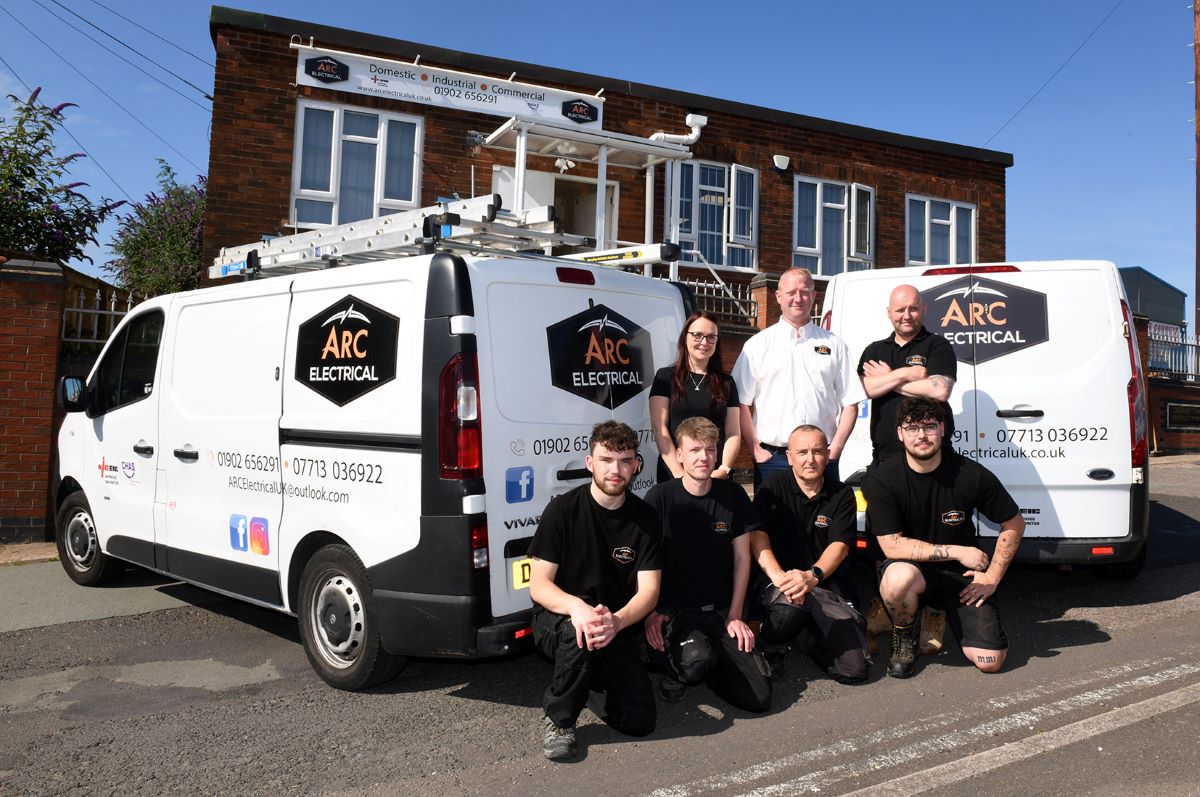
New office sparks expansion push for Arc Electrical
ARC Electrical UK Services, a fast-growing Black Country electrical specialist, has capped a record year by investing in new offices in Upper Gornal. The company, which was founded by Adam Checketts in 2021, has moved into a 2,500 square foot facility on Dormston Trading Estate, providing a larger home for the business to expand and giving it a dedicated training space for staff. The company supports the private sector and social housing providers with a range of services, including full electrical installation works, new builds, upgrades on offices and factories and Electrical Safety Reports (EICR). Clients span from Holdens Brewery and Wolverhampton Wanderers to G&T Properties, GreenSquareAccord, Black Country Housing and Utopia Maintenance. Founder of the company, Adam Checketts, comments, “We’ve come a long way since we started back in 2021, when the work I was completing on weekends and evenings got so much that I decided to turn it into a full-time venture. “Most of our growth in the early stages came from ‘word of mouth’ about our professionalism, the quality of our work and our ability to turn around jobs quickly when the rest of our sector was giving lead times of six weeks or more.” Adam continues, “We then started to win tenders for larger contracts with major organisations. That has really transformed where we are going and led to the new offices just off Burton Road in Upper Gornal. “This investment gives us a central hub to manage the different teams we have out on site, a place where we can host clients and, importantly, the capability to train our electricians. In fact, we‘ve decided to make the room available to local companies so they can train people in the community.” ARC Electrical UK Services now employs seven people, including electricians, admin staff, one improver and two apprentices - the latter a firm commitment to offer long-term employment opportunities for young people. A string of new contract wins has seen turnover rocket to £425,000 and, with a host of new projects due to kick-off shortly, the CHAS Elite and NICEIC-accredited firm is now turning its attention to taking on further admin support and two more qualified electricians. Adam concludes, “As a company, we are committed to leading our industry in safety advancements, workforce training and embedding new technology into our offer - and ultimately giving our customers access to ‘greener’ power and cost savings through more efficient lighting and systems. “We are passionate about our Black Country roots and want to grow to be one of the best electrical businesses in the region.”

Members urged to contribute to neutral current diversion research
SELECT Members are being asked to provide their feedback to help an industry-wide research project into neutral current diversion (NCD). The association is working with sector partners IET, ECA, Electrical Safety First, NICEIC and NAPIT to help shape a UK-wide picture of the scale of the issue. Contractors who come across NCD are being asked to submit their findings by clicking here. Participants will be asked to answer a short survey, including questions on the postcode of the installation, the voltage/current measured and if the incident was reported by calling 105. The research period will run for six months, during which submissions will be reviewed. Bob Cairney, Director of Technical Services at SELECT, comments, “Currently, there’s not a lot of data about NCD available in the public domain, which is why this industry-wide research is being conducted. “What happens next depends on what is uncovered; if there are lots of incidences in one area, then the DNO in that area will be made aware of the size of the problem, and if there are lots of incidences countrywide, then every DNO will be alerted. “Should the findings indicate a problem wider than expected, it may be that the group also decides to inform the UK Government.” SELECT has already issued a range of NCD resources to help contractors, including posters, a downloadable flowchart and a pocket-sized foldout that advises how to check for the issue. NCD was also among the hot topics at SELECT's recent Toolbox Talks, with technical advisers delivering an update to hundreds of Members across Scotland in May and June. For more from SELECT, click here.

ECA praises the King's Speech
The ECA has praised the King’s Speech - which took place on 17 July - for focusing on energy security and growth. The Association has reiterated the role of the electrotechnical and engineering services sector in delivering both. ECA has also welcomed the creation of Skills England, a new governance body for post-16 skills and training. A sector-wide survey carried out by ECA in early 2024 showed that electrotechnical businesses have been held back by slow growth, caused in part by a shortage of adequately skilled workers. ECA Chief Operating Officer, Andrew Eldred, comments, “We expect our Members, and the wider sector, will welcome the new government’s early emphasis on energy, transport, and housing. However, a competent, sustainable skills base is the foundation for delivering growth in these areas, and meeting net zero targets. “We urge the new government to make sure Skills England is an agile body that can move at pace. It must also be a body that listens and understands the needs of employers in the electrotechnical sector.” ECA has long called for more investment in green energy, and is hopeful that the introduction of GB Energy will speed up the country’s transition to clean electrification. With the CCC recently announcing we are no longer on track to reach its net zero targets by 2030, rapid electrification is the safest and quickest way to get back on course. ECA works closely with its Members, industry partners and Government to raise awareness of the role of electrical contractors in the transition to net zero carbon. To learn more, click here. For more from ECA, click here.

FMB comments on the creation of Skills England
Although the creation of Skills England, a new body to tackle the construction skills crisis, is being hailed by many as a positive move by the new Government - its success will be dependent on what it prioritises and having a long-term skills plan in place, the Federation of Master Builders (FMB) says. Brian Berry, Chief Executive of the FMB, explains, “Over recent weeks, the new Government has set out ambitious plans to get Britain building again, but this can only be achieved if the skills crisis is tackled. There is a serious shortage of all trades in the construction industry, with the result that we need additional 240,000-plus workers over the next four years. “The Prime Minister’s announcement to set up Skill England recognises the seriousness of the problem, but details about how Skills England will operate remain light. It will be vital that future delivery focuses on a long-term skills plan being put in place, and that plans to allow up to 50% of the Apprenticeship Levy to be redirected into other forms of training don’t result in a fall in the number of construction apprenticeships available.” Brian continues, “As part of the Prime Minister’s announcement that the Institute for Apprenticeships and Technical Education (IfATE) will be amalgamated into the new Skills England, maintaining current skill levels, and increasing numbers further, must remain a key focus. “It raises a question about what role the Construction Industry Training Board (CITB) will play in this new system. We’re still awaiting publication of the Mark Framer performance review of CITB, which may help provide some clarity. The Secretary of State for Education should publish the report as soon as possible to ensure the industry has stability about its future training needs.”

Baxi heat pumps employed in Scottish housing project
A development of 16 social homes designed and built to achieve the Passivhaus standard has been constructed in Dalbeattie, Dumfries and Galloway with the support of Baxi and its air source heat pump solutions and services. To play its part in the delivery of these new net zero homes for Loreburn Housing Association, heating contractor James Frew required a solution that would provide sustainable heat to the properties; in this case, air source heat pumps. The team then needed to find a strategic partner that would be able to offer the solutions and on-site support to implement the technology. Facing stringent design requirements to make the homes efficient and low carbon, James Frew decided to partner with Baxi to benefit from its full range of support services, training and efficient products. Designed By Architect, Robert Potter and Partners and built by main contractor Ashleigh (Scotland), the two and three-bedroom properties were to meet the highest standards of energy efficiency and comfort – part of Loreburn’s commitment to delivering new homes fit for the future. This type of home will play a key role as local authorities and housing associations such as Loreburn look to deliver new homes in line with the New Build Heat Standard (Scotland) or Future Homes Standard. Using the Passivhaus model, the entire home had to be designed around achieving the best energy efficiency as well as the heating source being a heat pump. This involved specifying not only the insulation and windows to meet the standard, but also the correctly sized heat pump for each home. Space was also a consideration in the homes. The design needed to guarantee there was ample room for the internal and external elements of the heat pump solution, without compromising on comfort for tenants. The James Frew team worked closely with Baxi’s experts – Specification Manager, Craig McVicar, and Engineering Solutions Manager, Ryan Kirkwood – to ensure the correct specification of heat pump for the design requirements of each house. Baxi’s air source heat pumps, compatible cylinders and uSense controls were specified to provide the heating and hot water provision for each of the 16 homes through three radiators. As part of Baxi’s heat pump service, the team of engineers had access to the company’s specialist training to allow them to become familiar with the specified solution and be confident in installing it before the project began. They also benefitted from expert support on site, ensuring the full system was designed correctly and could be installed within the space. Baxi’s Commissioning Engineers, Michael Murray and Adam Stock, were on hand to oversee the commissioning of each of the heat pumps and make certain they would operate as expected once in place at each home. Evan Peat, Senior Contract Manager at James Frew, says, “From tender to completion, it has been great to have the support of Baxi’s expert service throughout the process. The design support and training meant the team had peace of mind that the most suitable products would be going into the homes and that our engineers were comfortable with the installation of them. “It was also really important to have the support on site from Craig and Ryan. Having their expertise on the ground meant we were able to overcome this challenge and still meet the Passivhaus standard.” Rob Pearse, Director of Distribution Sales at Baxi UK, adds, “This innovative project is a great example of how collaboration and consultation can result in amazing results for delivering net zero social housing. As heating solutions experts, we can work closely with social housing providers and their appointed contractors to consider the different approaches for low-carbon heating, selecting the most suitable combination of solutions for the application. “Whether it is a new build project to Passivhaus standard like this one or decarbonising existing developments through retrofit, we are committed to providing the complete home service to our social housing clients.” Alison Maxwell, Project Delivery Officer for Loreburn HA, comments, “The standard of these homes is testament to Loreburn’s commitment to building warm and highly energy efficient homes, where technology and intelligent design come together to create a sustainable future for our tenants”. Speaking about his experience of living in one of the properties, Alan Vinnie, a Loreburn tenant, notes, “It will really help to lower my energy bills, which is a huge relief. You can really notice the change in the air and it’s so quiet. I think all future builds should be of this quality”. For more from Baxi, click here.