2 November 2026
Product of the Month: Amari Floodlight range by Aurora Lighting
 
23 November 2026
Advanced acquires communications specialist Baldwin Boxall
 
23 November 2026
Trades face 'skills squeeze' as apprenticeship demand soars
 
20 November 2026
Ovia: Delivering performance and flexibility across every sector
 
20 November 2026
Exclusive: how to prepare a building for future technology
 

Latest News


Hammond introduces stylish new enclosure family
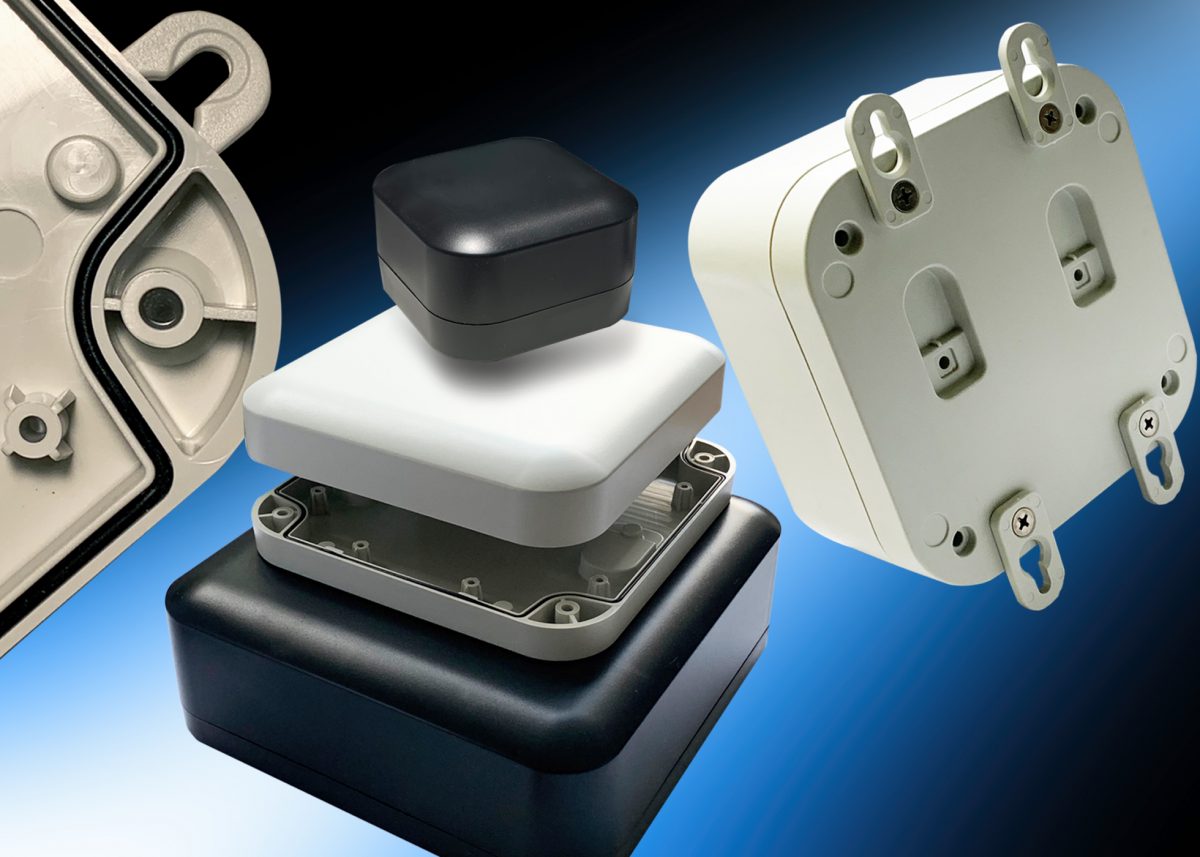
Hammond Electronics has announced its new 1557 family. Initially available in four plan sizes, each in two heights, it is available in polycarbonate, sealed to IP68, and ABS, designed to meet IP66. The sizes are 80 x 80 x 45 and 60mm and 120 x 120, 160 x 160 and 200 x 200 in heights of 45 and 70mm. All versions are available in black and RAL 7035 grey. Rounded corners and top face give a modern smooth style, and environmental sealing allows the enclosures to protect the housed equipment against dust and water entry in dirty and damp environments. The 1557 can be used as a free-standing enclosure when fitted with the supplied feet, or it can be wall-mounted with either four visible fixings or two hidden ones. A PDF showing the alternative wall mountings can be downloaded here. PCB standoffs are provided in both the lid and base. The enclosure is assembled with corrosion-resistant M4 stainless-steel machine screws, which are threaded into integral stainless-steel bushings for repetitive assembly and disassembly. The IP68 polycarbonate versions are UV stabilised for outdoor use with a UL94-5VA rating, and the IP66 ABS versions have a flammability rating of UL94-HB for indoor use.

C-TEC launches new BS 5839-6 domestic fire alarm kit
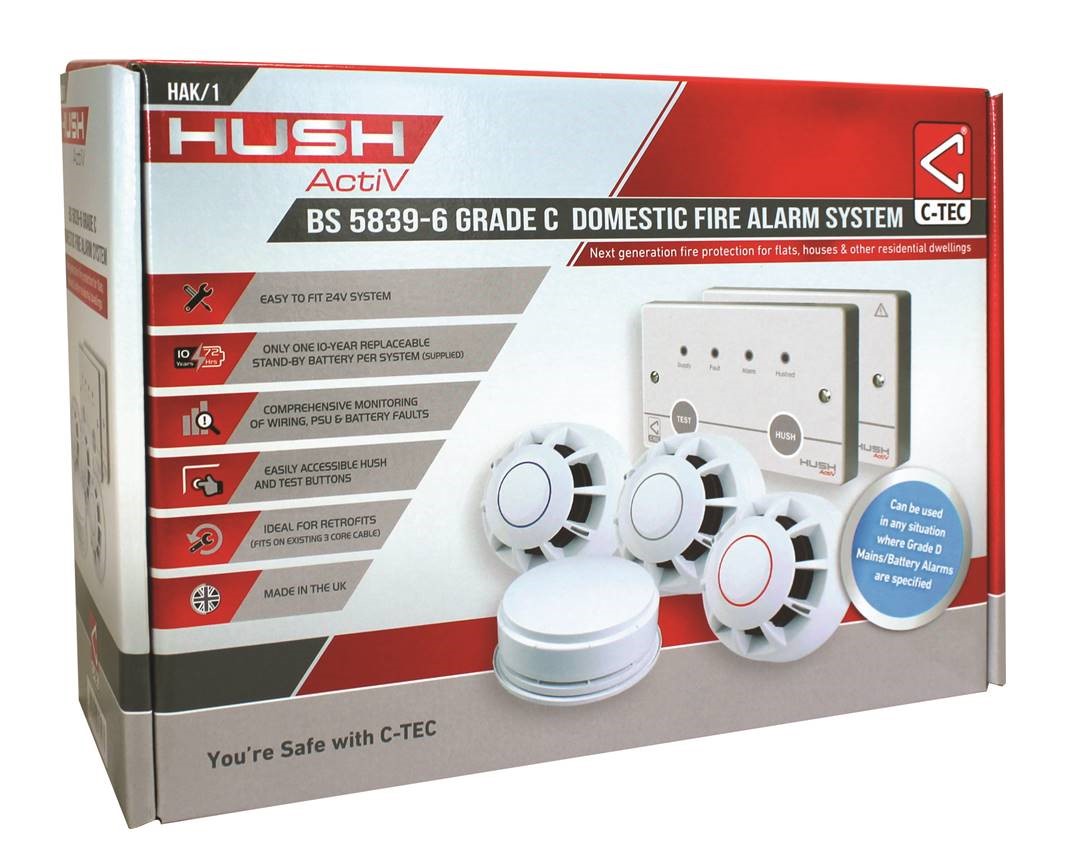
Leading life-safety systems manufacturer, C-TEC, has launched Hush ActiV, an innovative new BS 5839-6 Grade C domestic fire alarm kit. Designed to increase the level of fire protection in flats, apartments and high-rise residential buildings, each kit contains everything you need to create a LD2 standalone conventional fire alarm system in an individual dwelling – easily and very cost-effectively. Andy Green, C-TEC’s Marketing Manager, says, “We are very excited about Hush ActiV and confident it will be a hit with specifiers and installers in the domestic fire alarm market. As a fully-monitored BS 5839-6 Grade C system, it constantly interrogates the status of the system’s wiring circuits, battery and power supply, reporting any faults to the main controller. As a result, it offers higher levels of fire protection than the unmonitored Grade D mains battery alarms typically used in domestic dwellings.” A key feature of Hush ActiV is its accessibility. Residents are provided with easy-to-use detection, alarm, silencing and test facilities at light-switch level so they can test their own devices, be alerted to system faults and hush any false alarms. In addition, the fact that the controller’s Hush and Test buttons can be operated whilst standing or sitting in a wheelchair at floor level helps facilitate full compliance with the Equality Act. An eco-friendly solution, Hush ActiV offers up to a 50% reduction in the mains power of a typical Grade D system, less plastic, and just one replaceable lithium-ion battery per system (providing over 72 hours standby). Each kit contains a controller, 24V PSU, ActiV multi-sensor, heat detector, three detector bases and base sounder. Additional ActiV detection and alarm devices are available to accommodate larger systems or systems requiring LD1 coverage. To discover more about C-TEC’s Hush solutions, watch the below video on 'The Evolution of Fire Protection in Residential Dwellings’. https://www.youtube.com/watch?v=oyET4p-Kcng

2019 ‘a turning point’ for the lighting industry
A strong rebooking rate of over 50% at the LuxLive 2019 exhibition has defied the general economic narrative and demonstrated a confidence in the widely-anticipated recovery of the lighting market, organisers of the show said today. LuxLive and lightspace featured a newly launched VIP meeting programme which was widely received with commendation by the targeted buyers who took part. "The coming years will see the biggest investment in public-sector lighting in a generation", says Lux Portfolio Director, James Samuel. "And LuxLive will be a key part of that transformation. "With economic uncertainty, the continuing squeeze on public sector budgets and pressure on margins, 2019 has been a challenging year for the lighting industry in the UK. That mood has pervaded for an extended period, and no event in the sector has been immune from an understandable sense of caution. "However, despite that wariness, exhibitors who put their best foot forward had an exceptional show, with firm orders taken and great relationships established. Our exceptional rebooking rate shows that brands which market themselves positively have made significant gains and will do again in the future." Major sponsor Bluetooth described LuxLive as ‘a valuable platform’ to promote its advanced wireless mesh technology to the industry. "LuxLive’s focus on relevant and actionable content sessions and presentations from industry leaders is a big reason why it’s a standout lighting event in the UK and indeed across Europe," the tech giant said. "LuxLive provides us a great opportunity to connect with influencers in lighting and continue to promote the value proposition of Bluetooth smart lighting and its associated benefits." Daniel Carel of Ubisys said the show was "quite a home run" for the firm. The newly launched VIP meeting programme was widely received with commendation by the targeted buyers who took part. The programme was tested in a small scale this year to see how the industry would react to this type of initiative. Buyers from across industry took part in a series of targeted meetings that allowed them to increase their return on time at the event, as well as the exhibitors’ return on investment. "Perfect meeting matches," said the estate electrical officer from Kettering NHS Trust. "I already have a follow-up meeting booked with one of the exhibitors." A building surveyor from Savills said the programme was ‘very useful', while Steve Davies, CEO of the Lighting Industry Association, said LuxLive was the organisation’s ‘cornerstone promotional event’. He notes, "This year, it gave us another amazing opportunity to meet new and existing members, deliver educational content to specifiers, designers and buyers as well as update the wholesaler community through the EDA Regional Forum. "It has been a tough year for the lighting industry as a whole with economic uncertainty, coupled with increased international competition. However, if we are to take the opportunities the sector has on the horizon then we all must continue to educate the supply chain about compliance and the dangers and commercial risk of specifying poor products. "The LED revolution is all but over, but the so called 'Internet of Things' or enhanced lighting controls will keep driving our industry beyond the current political turmoil. So it is events such as LuxLive that keep our message alive and gives lighting a platform to broadcast its positive message." James Samuel adds that 2019 will be seen by the lighting industry as a major turning point: "I strongly believe that 2019 will be seen as a turning point. There are real grounds for renewed optimism and confidence for the coming year. "Political uncertainty will be partially ended with the general election, and whoever wins will end austerity with unprecedented investment in eduction, healthcare, social housing and infrastructural projects. This can only be good news for the industry." His plans for the 2020 event include a range of initiatives, such as the extension of VIP Buyer Programme and a special public-sector advisory board. He comments, "This board will comprise specifiers and budget-keepers and they will help us precisely address the educational needs in the public sector. It will target end users with responsibility for lighting in schools, universities, FE colleges, hospitals, healthcare centres, social housing, care homes and sheltered housing. "The private sector, too, has many bright spots, including warehouse, office and leisure, and we’ll be tailoring our programme to these areas too. Specifically, we’ll explore the opportunities for upgrading from traditional lighting technology to LED, the implementation of smart controls and the transformation of emergency lighting installations to current best practice." He concludes, ‘We will build on our key strength in cutting-edge lighting technologies such as IoT and smart lighting controls to deliver a future-facing event. The icing on the cake will be the expected arrival of the Elizabeth Line railway (formerly Crossrail) in the coming 24 months, which will make ExCeL one of the best connected venues in the UK."

Selco Builders Warehouse Gets The Thorn Treatment
Thorn Lighting recently supplied the luminaires for Selco Builders Warehouse as the company embarks on a branch refurbishment and expansion programme. With its 66 branches open for a combined total of more than 5,400 hours a week - or more than a quarter of a million hours a year - it is imperative the business takes a responsible and proactive approach to energy efficiency, allowing the company to keep its environmental impact as low as possible. That’s why a decision was taken last year to fit Selco’s entire branch network with the most high-tech LED lighting. More than half have already completed the change – and those which haven’t, will be making the switch in the coming months to complete the ambitious LED lighting refit programme.  Working with Grafton plc and Electricbase, Thorn supplied luminaires throughout each of the new build and refurbished developments to provide a well-lit, uniform environment that will help to increase sales whilst also providing an energy efficient lighting solution.  Selco teamed up with Thorn to bring a responsive sensor-controlled lighting system to each individual branch using HiPak Pro, Aquaforce, Julie and Omega fittings, with sensors operating in tandem with each individual LED luminaire. This enables them to react to the contribution of natural daylight delivered via the transparent roof light panels in-store, thus producing the necessary light levels required rather than constantly being at a higher fixed illumination output. By utilising daylight harvesting technology, the efficiency of the lighting system has increased between 10 and 15 per cent. Environmentally, the impact of Selco moving to LED results in a saving of almost 69 tonnes of carbon in just one store every year.  Scaled over all 66 branches, that represents the equivalent of almost 200,000 trees – or 89 football pitches full of trees. Having smart meters installed across the Selco estate has allowed the energy team to monitor energy reductions closely. a good example of savings would be Selco’s Reading branch where electricity usage has plummeted from 141,565 kWh since March 2018 to 86,774 kWh in the same period this year – a decrease of 40 per cent. Over the same period, kWh usage at the Tyseley branch has seen a decrease of more than 55 per cent and Croydon has achieved savings of almost £30,000 over the course of a year. Thorn’s IP65 rated HiPak single point suspension LED high bay luminaire has a wide optical beam and provides a direct one-for-one replacement for HID high bay fittings, providing 40 percent savings by comparison. Its precise lens technology puts light exactly where it’s needed to reduce waste light and maximise energy savings.   The IP66 rated Aquaforce is already established as the ideal luminaire for damp and dusty conditions, with a choice of light distribution options that are engineered for high efficiency in warehouse settings. Aquaforce has been designed to resist ambient temperatures ranging from -20°C to 35°C, and its clever drip-edge design avoids dust depositing on the light output surface, so that any accumulation of dirt has minimal impact on performance and, with efficacy as high as 141lm/W, it’s a highly cost-effective option too.  Part of the popular ThornECO family, Julie is an IP65 LED luminaire that offers quality, low energy lighting in wet and dusty environments. Its high quality opal diffuser provides uniform lighting and a colour temperature of 4000K. The Omega PRO LED 600x600mm recessed fitting has a slim 12mm profile and a UV-stabilised opal acrylic diffuser so it will retain its clean look. The IP44 rated Omega provides excellent glare control (UGR<19/22) and is easily retrofitted, whilst maintenance is significantly reduced by the 50,000 hours’ life of the 4000K LED lamps supplied with the fitting. Areaflood LED and now Areaflood Pro were chosen for the exterior of the building for their superior optical performance and control. The floodlights achieve optimal control of light (0cd at 90°, minimal spill light) for visual comfort from a compact housing with reduced weight to avoid additional structural costs in retrofit installations. Minimal maintenance is required due to 100k hrs rated lifetime on both drivers and LEDs. Howard Luft, chief executive of Selco Builders Warehouse, comments: “Selco has undergone huge and rapid growth over the last few years and the plan is for that to continue. The LED lighting upgrade programme has significant benefits for customers and colleagues alike. Builders’ merchants are generally poorly illuminated spaces but the new LED lighting within the Selco branch network has produced a much brighter environment, creating an improved working and shopping experience. In terms of savings, both financially and in terms of saving energy, the results have been as dramatic as they have been impressive.”  

‘Lost’ Energy Generates 117M Tons Of UK Emissions
New research conducted by Schneider Electric has found that at least 117 million tons of UK emissions were created in 2018 by wasted energy: energy that was lost in the generation and transmission process or wasted due to inefficiencies in UK buildings. The figure does not take into account emissions from energy lost in the food supply chain, industry or transport sectors.  The research findings, published in a new report:’“Rethink Energy’, examined the behaviours, priorities and investments in relation to sustainability of 400 large businesses, 120 SMEs and 2000 consumers in the UK. The research commissioned by Schneider Electric found that even though business decision makers and consumers are aware energy is being wasted in their day to day lives they are taking no steps to change consumption or behaviour. Business attitudes  Schneider Electric’s research found that on average business decision makers estimate that 36% of the energy their business consumes is wasted, primarily through inefficiencies in buildings (e.g. lights left on, heating and air con systems failing to adapt to changes in the weather, poor insulation etc).  With the average energy bill for a large business running at over £11,000/month (£136,944/year) energy waste is not just a significant cost for the planet but for businesses, too. Despite 100% of respondents believing their business wastes energy, almost half (44%) said that they hadn’t or didn’t know if they had implemented any energy saving initiatives in the previous 12 months.  A fifth of all businesses admitted they don’t currently measure energy waste within their business. The difference between the approach of big business versus small businesses is stark. 58% of SMEs hadn’t or didn’t know if they had implemented energy saving initiatives versus 39% of large businesses.  Almost three times (40%) of SMEs reported they don’t currently measure energy loss within their business, compared to just 14% of large businesses. A significant barrier for businesses to adopt energy saving measures appears to be the perceived cost of doing so.  84% of businesses said they were torn between the anticipated cost of tackling waste and doing the right thing. However, Schneider research has shown that the average project aimed at tackling waste energy pays for itself in 3 years, and a 30% reduction in energy use equates to a 10% reduction in operating costs. Whilst 85% of businesses polled claim to have policies or guidelines in place to encourage energy efficiency and reduction of waste, 64% of employees said their employer did not provide any guidance on energy consumption or were not sure if their employer had policies in place to tackle energy waste. Consumer attitudes It isn’t just businesses that are failing to tackle the issue of waste energy. The Schneider research has revealed that approximately 6.4 million adult UK consumers (12%) have no intention of curbing their energy use and 76% believe they already do enough when it comes to saving energy, recycling and curbing waste and have no plans to do more. In addition, 58% of consumers blamed others for energy waste in the home, with 25% claiming their partner or spouse was the worst culprit for leaving lights, devices or appliances switched on at home. “This research is a wakeup call.  Energy waste cannot be overlooked in our fight against climate change, just because it’s invisible,” says Mike Hughes, Zone President UK & Ireland, Schneider Electric. “We may not be able to see the impact energy waste is having on our planet as graphically as that of plastic waste in oceans or on beaches, but it is clear that reducing waste energy has a significant role to play in reducing our emissions. Furthermore, it is an easy win. It doesn’t require the same level of investment, time or rely on future innovation that is needed to decarbonise our economy. Most importantly, the effects of reducing emissions from wasted energy could be felt immediately, buying us much needed time to tackle some of the harder measures that society will inevitably have to face.”  The full Schneider Electric research can be downloaded here. 

Salus launches new Quantum thermostat
Controls specialist, Salus, has introduced a brand new, ultra-slim thermostat for the heating market. The new Quantum thermostat, which is now available across the UK, is available in four versions (SQ & WQ range), 230V mains powered and Li-Ion rechargeable battery powered radio frequency (RF) for both underfloor and boiler markets. The idea of controlling the behaviour of central heating and underfloor heating systems alone means thriftiness and ecology. However, Salus has decided to go one step further, and designed the thermostat with an internal rechargeable battery to accommodate recommendations of the European Union. In addition, the warm floor feature has been designed to overcome solar gain issues. Long periods of solar gain through large expanses of glass normally cause the floor temperature to reduce, thus causing longer reheat times. The newly developed Quantum warm floor feature, however, helps maintain warmth in the floor during these long periods. The Salus Quantum SQ version features a humidity sensor, operates with underfloor heating, smart radiator systems and is fully compatible with Salus Smart Home and Amazon Alexa. The S1 and S2 terminals are designated to provide additional possibilities to connect with, including three sensors, an external air sensor probe, external floor sensor probe and an occupancy sensor, which means the thermostat will enter the sleep state until occupancy in the room is detected. In addition, it has the possibility to connect with two switches: a light switch, a dedicated switch that might be programmed to trigger certain automation rules, scenarios, customised SMS alerts or e-mail messages; and a changeover switch, which is a simple way to switch between heating and cooling mode. With an unrivalled five-year warranty on the products, Salus expects the Quantum range to become one of the most successful thermostats ever designed. The company's European Managing Director, Dean Jepson, says, “Salus Quantum is an extraordinary thermostat designed to be multifunctional, yet the simplest to install and operate. “During the development stage, simplicity was the most important goal that we wanted to achieve. The second aim was to design it in a unique, futuristic fashion, fulfilling all of the needs of our many customers by making this thermostat the thinnest in the market. “At Salus, we are always looking for the next innovation, and we believe the Quantum is the most revolutionary thermostat to date - and we’re delighted to introduce it into the market.” The new range comes competitively priced is available exclusively from Wolseley branches across the UK.

Viva La Training For LCL Awards
LCL Awards has welcomed new Halifax-based, Viva Training Academy to its list of approved training centres. Set-up by heating and insulation business owner, Richard Firth, Viva prides itself on providing a supportive and learner-focused environment which offers a range of building services courses, including LCL Awards' New Entrants Gas MLP and Level 3 F Gas qualification. "Viva Training Academy has been put together from the learners' point-of-view," explains Richard. "We're all experienced engineers with mechanical, electrical and refrigeration backgrounds, so we understand the current marketplace and pay close attention to trends and developments in the sector."  Having gained several LCL Awards qualifications himself over the years, when Richard decided to set-up his own training centre his choice of Awarding Organisation was clear. "LCL Awards' certified courses have always been clearly structured and delivered with a refreshing approach, so when it came to choosing the qualifications I wanted to offer my learners, they were the obvious fit," he says. Tracy Harker, LCL Awards' Quality Assurance and Relationship Manager, who helped guide Richard through the process, is impressed by what he has put together: "Richard recognises that traditional methods and attitudes in training need to evolve to keep ahead of the game. He's offering our courses, qualifications and Managed Learning Programmes in an impressive environment where the learner is the focus. "In creating a training environment that is inclusive, creative and fit for purpose, Richard and his team will help to develop an impressive workforce, able to adapt to fast-paced technological changes in the years to come. We wish him all the best." Richard wants to open up opportunities for a true cross-section of society; from existing trades people to those who may not have dreamed they could achieve a rewarding career in an important and progressive sector. He is committed to helping vulnerable groups such as the homeless and ex-forces personnel back into work and developing bespoke training packages for school leavers. "We're not afraid to shake up current approaches to learning and plan to revolutionise both access to training and the way it is delivered," Richard he concludes. Viva Training Academy currently delivers LCL Awards' Managed Learning Programme (MLP) for new entrants to the gas sector, ACS training & re-assessment, plus LPG and F Gas - Viva is a Worcester Bosch Approved Training Provider. LCL Awards' oil qualifications will be coming soon.

Why Domus Ventilation Is Leading HVAC Industry
Following on from its recent awarding of a full suite of quality, environmental, management and health and safety systems certification, courtesy of the BSI, Domus Ventilation is pleased to announce the addition of ISO 45001 Occupational Health and Safety Management System certification. Domus Ventilation is one of the first companies in the HVAC sector to be accredited with this new standard.  ISO 45001 is the world’s first International standard for occupational health and safety and sets out a robust and effective set of processes for improving work safety in global supply chains, with the key aim of reducing workplace injuries and illnesses.  “It took six months of work to get there, so it’s not an easy task” comments Stephen Flood, Quality, Safety, Health and Environment Manager, “but I’m pleased to say we delivered compliance three months earlier than expected and, following a BSI five day audit, we scored 95% compliance which is exceptionally high. We couldn’t be happier!” ISO 45001 differs from its predecessor, BS OHSAS 18001 (which will, in time, be phased out), as it requires an integrated approach to health and safety across the entire business and requires top management involvement.   For Domus Ventilation this has meant a number of alterations to business practices including a greater focus on identifying internal and external risk and active involvement of the leadership team in health and safety.   Stephen explains how one such example of this translates into practical terms: “We have now introduced Manager safety tours. There’s a team for each area of the business that has a potential risk, such as housekeeping or electrical safety, and the dedicated team conducts regular tours to look specifically at these. As well as the obvious health and safety benefits of this, it’s had the added advantage of raising the visibility of the management team and promoting greater engagement with staff across all sectors of the business and at all levels.”  In addition to identifying and dealing with potential health and safety issues within the company, Domus Ventilation has also formalised its process for managing risk and safety throughout its supply chain and has evaluated its environmental impact as part of the process to achieve ISO 45001 accreditation. “Achieving ISO 45001 certification is a really positive step for us and for British manufacturing as a whole,” states Stephen.  “For customers it provides an added level of confidence in the way in which the business operates. It shows we are a safe company and provide safe product.  It makes good business sense.” In addition to ISO 45001, Domus Ventilation is proud to be certified with ISO 9001:2015 Quality Management System, ISO 14001:2015 Environmental Management System and PAS 99:2012 Integrated Management System. This range of impressive accreditations proves the company’s commitment to quality, safety and environmental considerations and shows it to be a leader in its field.  Domus Ventilation has a well-deserved reputation for quality, supported by excellent technical support, from a market leading manufacturer and designer.  It is well placed to offer immediate, practical solutions to Building Regulations Parts F & L. 

Hager's Ask The Expert - RCDs Type A
RCD selection is an important aspect of any installation, ensuring adequate protection against potentially fatal electric shocks. Paul Collins, Technical and Training Manager from Hager, covers some of the most frequently asked questions from contractors on RCDs and its recommendation that Type A selection is the best answer for the majority of electric circuits. What type of RCD should I use? RCD use has been in existence for a long time, and the revised 18th Edition regulations clarified their selection and specification to further enhance safety standards. Electrical contractors need to carefully consider the type of RCD required depending on the type of equipment which may be connected in the installation. There are four types of RCD, with each reacting differently depending on the presence of DC components or different frequencies. In order for contractors to specify the correct product, the different types of RCD can be classified as: Type AC RCD – general purpose use Type AC RCD can detect and respond to AC sinusoidal residual current only. 2. Type A RCD – equipment incorporating electric components Type A RCD can detect alternating sinusoidal residual current and residual pulsating direct current suddenly applied or smoothly increasing. It is important to remember that Type A is also suitable for Type AC applications. 3. Type F RCD – equipment with frequency controlled speed drives Type F RCD can detect and respond to high-frequency residual current as well as pulsating DC residual current. 4. Type B RCD – electric vehicle chargers, PV supplies Type B RCD can detect and respond to all types of residual current including smooth DC residual current. What does Hager recommend? Due to the style of circuits, the nature of loads connected to these circuits and the frequent use of RCDs to protect a group of circuits, Hager believes that the majority of electrical circuits in residential and commercial applications will require a Type A RCD solution. What type of equipment/load is best protected by a Type A RCD solution? Single-phase with electronic components, which would typically comprise items such as: Single-phase invertors Class 1 IT and multimedia equipment Power supplies for Class 2 equipment Appliances such as a washing machine that is not frequency controlled Lighting controls such as a dimmer switch and home and building electronic systems Induction hobs Electric vehicle charging where any smooth DC fault current is less than 6 Ma

One In Four UK Universities Has Received Fire Safety Complaints From Students
According to figures released by Eaton, the majority of UK universities are failing to invest in new technologies that reduce the risk of electrically ignited fires. This new data was obtained through a Freedom of Information (FoI) request, issued to 134 universities across the UK, with 76 of them responding. The data revealed that more than one in four universities (28%) have received complaints from students, staff or the public in the last five years regarding fire safety or building evacuation procedures.  Despite technological innovation today and the widespread availability of proven fire safety and evacuation solutions, many universities are abiding by the minimum standards required by regulation but not yet aware of or investing in existing technology which can improve safety standards for their students and staff. Modern universities are always-on environments. They are experiencing and catering to growing demand for energy given the increase in connected devices used on campus and both students and employees’ requirements for 24/7 uptime. Today’s increase in electrical device usage means the need for fire safety measures to protect against electrically ignited fires has never been more important.  Research has previously revealed that 54% of all fires in England are caused by an electrical defect. As UK universities invest in technology to support their always-on, connected learning environments, they will also need to consider the potential consequences of this shift – including how best to safeguard against electrical faults that have the potential to spark fires.  This FOI revealed that many universities have not yet invested in proven fire prevention solutions which can avert an electrically-ignited fire. For instance, the majority (63%) of responding universities do not have Arc Fault Detection Devices (AFDDs) in place.  AFDDs are considered the best practice in circuit protection due to their ability to digitally monitor the wire for specific frequencies that can indicate an arc fault. While current UK electrical regulation remains below the level required to maximise protection against electrically ignited fires, the 18th Edition to the IET Wiring Regulations – published in July 2018 – is a step in the right direction.  This new national standard included recommendations for the installation of AFDDs to mitigate the risk of fire due to the effects of arc fault currents.   Marc Gaunt, segment lead, commercial buildings, Eaton comments: “Given how recently UK regulation has recommended the use of AFDDs, it's likely that even the early adopter universities are yet to fully grasp the benefits of AFDD technology or implement it across all of their higher-risk buildings. For facilities managers balancing all the demands within a building, from maintenance to security, getting a close grip on the latest safety technology available or even the ins and outs of regulation beyond bare minimum standards can be tricky. Yet with lives at risk, it’s vital that building owners and facilities managers consider the huge safety advantages which come with implementing technology which not just detects fire but can prevent it in the first place.” The majority of UK universities (72%) today communicate their evacuation procedures proactively through written mediums. The FOI also revealed that two thirds (66%) communicate through passive written materials – for example posters in buildings – while 64% use passive digital materials, such as their website. However, this widespread focus on ensuring students and staff are aware of the evacuation procedures is not yet supported by implementing technology which helps individuals to exit a build as quickly as possible depending on the type and location of risk.  Almost all (92%) of responding UK universities do not currently have adaptive evacuation signage in place, which uses digital technology to switch between a number of predefined routes in a given circumstance and guides people towards the safest available exit. For example, the directions displayed by exit signage would change in the instance of fire on the fourth floor versus a flood on the second floor.  While 16% of UK universities plan to implement adaptive evacuation signage in the coming three years, there is a clear opportunity for facilities managers to look into the benefits of this technology – creating a safer environment for students and staff as well as reducing the likelihood of complaints around evacuation standards in future.  “Adaptive technology that responds to specific circumstances to ensure safe evacuation of occupants is particularly important for universities, considering the size and complexities of many campus buildings,” commented Gaunt.  “The changing nature of risk in today’s buildings means there are a wide range of reasons for an evacuation – from fires, to floods and terrorism. It’s important university management and facilities managers are constantly re-evaluating the evacuation procedures and newest technologies to help protect students and faculty. This means knowing where the risk is located and not falling back on a ‘stay put’ strategy. “New technologies are available that help avoid congestion or unintentionally guiding people towards the threat when trying to evacuate. In a university, where the safety of students is of the utmost importance, it’s imperative facilities managers are continually educating themselves on the newest evacuation technologies and that they are sharing this knowledge with key stakeholders.”