2 November 2026
Product of the Month: Amari Floodlight range by Aurora Lighting
 
11 November 2026
Energy, AI and smart buildings: register now for EMEX 2026
 
11 November 2026
Solar and batteries could cut electricity costs by 40%, data finds
 
11 November 2026
EIC confirmed as ECN Awards 2026 charity partner
 
11 November 2026
Acrospire to support Green Frog's European expansion
 

Latest News


ECA welcomes corrigendum to 18th Edition Wiring Regulations
The Institution of Engineering and Technology (IET) and BSI have published a new corrigendum to the 18th Edition Wiring Regulations (BS 7671:2018+A2:2022). ECA has welcomed the changes and corrections in the corrigendum, which help to clarify the requirements of the 18th Edition (BS 7671:2018+A2:2022) and the intent behind the regulations. The corrigendum makes changes to several areas of BS 7671 and comes into effect immediately. ECA advises electrotechnical and engineering services contractors to note in any relevant documentation that they are completing projects to this corrigendum, to avoid any confusion going forward. Gary Parker, Senior Technical Manager at ECA, says, "This corrigendum introduces several small, but very important, changes to the Wiring Regulations which ECA members and the wider industry need to be aware of. Among these is a change to protected escape route requirements, SPD requirements, and a brand-new regulation relating to protected escape routes for medical locations. "ECA's dedicated Technical Team will provide further detailed information for ECA members, including a breakdown of the changes and what members can do to stay compliant.” ECA’s Technical Team offers support across a wide range of electrotechnical activities. ECA members can access exclusive application guides, editable certificates, guidance notes, technical bulletins, and access to the ECA Technical Helpline. Areas of change include: Regulation 422.2 has been amended to clarify the scope of the provision. Indent (ii) of regulation 443.4.1 has been removed. The term safety service, formerly included in regulation 443.4.1 (ii), encompassed a wide range of systems. The provision, therefore, had unintended consequences for improvements to fire safety systems within installations. Table 443.2 and the note to regulation 534.4.1.1 have been amended to remove examples of equipment. Regulation 701.1 has been amended to remove the reference to birthing pools. A new regulation, 710.422.2.201, has been included in order to modify requirements in regulation group 422.2 for protected escape routes in healthcare facilities.

UK Power Networks commits to circular economy transition
A sustainable approach to the management of vital infrastructure run by UK Power Networks is helping the UK’s progress towards a circular economy. Projects such as using low carbon concrete made with waste materials - including fly ash where it is suitable - are part of the electricity firm’s continued drive to eliminate waste, pollution and drive down carbon emissions. UK Power Networks will measure and track its progress using Circulytics, the circular economy performance measurement tool launched by the Ellen MacArthur Foundation, an international charity that develops and promotes the idea of a circular economy. A circular economy is built on three principles, all driven by design: eliminate waste and pollution, circulate products and materials, and regenerate nature. The process has already seen UK Power Networks engage with companies across its supply chain to establish what they are doing and what they plan to do in order to support the circular economy. The company is also working with its suppliers to better measure carbon emissions in its supply chain. As an electricity network running essential infrastructure, UK Power Networks buys electrical equipment, like transformers and cables, which help deliver reliable electricity supplies across the communities it serves for a long time, and valuable materials are recovered when they reach the end of their useful life. Mark Norman, Head of Environment and Sustainability at UK Power Networks, says, “The world does not have an endless supply of raw materials as recent resource constraints have clearly demonstrated. So, every business should be thinking about the untapped economic potential of the circular economy to extend resources, reduce embodied carbon, regenerate nature, and increase supply chain security. “As a vital infrastructure provider, it is essential we start adopting a circular economy model, so products are re-designed to drive out waste, reduce the use of virgin materials, and are capable of being repaired, reused or dismantled for strategic spares and fed back into the supply chain. “We have a large supply chain that we can positively influence. We cannot make the changes needed in isolation, so we are seeking to work in partnership with our key suppliers.” Some already established circular economy processes at UK Power Networks include: Recovering for re-use 99.8% of its streetworks spoil Using 60% low carbon concrete compared to three years ago, reducing carbon and resources Using 280km of electricity cable ducts (pipes) using recycled materials Working with reprocessing facilities to recycle metals and other materials from distribution equipment such as transformers and switchgear Collaborating with Personal Protective Equipment supplier to replace plastic packaging with recycled alternatives, eliminating plastic waste for over 7,300 items per year Replacing hard plastic casing around power tools with cardboard packaging Introducing 2,000 reusable water bottles, resulting in a 33% reduction of single use plastic bottles Using second-hand furniture where possible at a new site in Borehamwood and choosing energy and water saving equipment in office refits

Octopus Energy and Legal & General invest in ground source heat pumps
Octopus Energy’s generation arm and Legal & General Capital are turbocharging Britain’s heat pump rollout by investing £70 million in the Kensa Group. This marks the biggest investment ever made in ground source tech in Britain. It will allow Kensa to rapidly expand and install 50,000 ground source heat pumps a year by 2030. The move will drive down costs of heat pumps and reduce reliance on polluting gas boilers. The UK is targeting 600,000 heat pump installations a year by 2028 as part of wider efforts to decarbonise the economy. Unlocking investment through deals like this will help rapidly grow the country’s heat pump industry, meet net zero targets and deliver jobs. Kensa expects its growth to create over 7,000 green jobs in the UK by 2030. By harnessing freely available heat energy in the ground or water, electrically powered ground source heat pumps work like a fridge in reverse. They produce around four units of clean heat for every one unit of electricity they consume, making them much more efficient than gas boilers. They’re recognised by the government as a key solution to tackling heating emissions and weaning the country off gas. This investment will make heat pumps even more accessible to more properties, including retrofits for social housing, terraced housing and non-domestic buildings. Finance will also be provided for Kensa to offer house builders, housing associations and non-domestic customers their ‘Networked Heat Pumps’ solution at a lower cost. This effectively creates a new renewable asset class, kick-starting a sector that could exceed £1bn by 2030. Zoisa North-Bond, CEO of Octopus Energy Generation, says, “The heat pump revolution is off to a flying start: it’s a tried and tested replacement for gas boilers and can drive down consumers’ energy bills for good. Backing Kensa will help rapidly expand Britain’s fast-growing ground source heat pump industry. This deal is a huge milestone for our exciting new energy transition fund, as we invest in ambitious companies rolling out tech to turbocharge the clean energy shift.” Dr Matthew Trewhella, CEO of The Kensa Group, says, “This is a monumental moment for ground source heat pumps. This investment will help unlock Kensa’s vision of a mass transition to low carbon heating by replacing the gas grid with its 21st-century equivalent - an ambient temperature heat network. Our approach harnesses the power of investment capital funding infrastructure, reduces the strain on our electricity grid and enables a just transition - keeping heating costs low and addressing fuel poverty simultaneously with climate change mitigation. We’re extremely proud to partner with Octopus Energy and Legal & General Capital who show incredible leadership in bringing about our low carbon energy future.” John Bromley, Managing Director - Clean Energy, at Legal & General Capital, says, “Legal & General Capital continues to invest in leading energy transition businesses capable of delivering significant economic, social, and environmental benefits for our economy. LGC first partnered with Kensa in April 2020 with the shared aim of scaling up the deployment of ground source heat pumps in the UK through their long-term solution that is highly efficient and reliable. Since our initial investment, they have grown quickly, opening a new factory and delivering some prestigious new-build and retrofit installations across the UK. We are delighted to make our third significant investment in Kensa together with Octopus Energy Generation, recognising the significant role Kensa can play in reducing UK dependence on natural gas through a transition to low-carbon heating.” This latest Kensa deal heralds Octopus Energy Group’s entry into the ground source heat pump market, and complements Octopus’ existing air source heat pump expertise. Octopus’ heat pump R&D centre is leading the way in creating a thriving low carbon heating economy, from training, engineering and installation.

HellermannTyton broadens solar offer
TIPTAG PU, the robust UV-stabilised cable marker from HellermannTyton, is the latest offering for the solar industry. A permanent marker solution, the tag is ideal for marking larger wire and cable bundles in solar applications. Made using a robust and flexible polyurethane material, the tag is ideal for use within the solar industry due to its UV-stabilised properties, which ensure the prevention of long-term degradation. The TipTag PU is designed to work with the string inverters on solar panels and is also suitable for retrofit purposes. Manufactured from a specially compounded halogen-free material, the TIPTAG PU is suitable for use where limited fire hazard properties are required and is especially suited to harsh environments as it is flame retardant, weather resistant and abrasion resistant. Mary Arrowsmith, Product Manager for HellermannTyton, comments, “We are excited to introduce the TipTag PU to our customers working in the solar industry. The renewables and solar market is a rapidly growing sector and requires continually evolving technology. As such, we have already launched various products which directly suit the requirements of those working in solar and we are confident that the TipTag PU, which is manufactured in the UK and available in a range of colours and sizes, will also meet those needs. “Designed with a UV-stabilised material to ensure its suitability for solar applications, we have also developed a specialist ribbon for the TipTag PU, which creates a tattoo effect on the marker. This ensures longevity as the marking cannot be rubbed off and is durable and resistant to harsh abrasion, making for easy maintenance for years to come.” For optimal print quality, the tags can be printed either on or off-site using HellermannTyton’s range of thermal transfer printers. Also, to allow for easy and secure identification, the tag is designed with a perforated format that includes fastening slots for easy fitting with cable ties.

Electricians pledge support for Manchester Baccalaureate
ECA has pledged its support for Greater Manchester Mayor Andy Burnham’s proposed new Manchester Baccalaureate, or MBacc. The MBacc is designed as an alternative to the existing national English Baccalaureate (EBacc) and will focus on subjects which improve young people’s chances of securing employment in the Greater Manchester economy, including in engineering. The MBacc is one of a number of proposals being pursued as part of ongoing ‘trailblazer’ discussions with Whitehall to allow Greater Manchester to take on more control and spending power over the design and delivery of technical education locally. Similar ‘trailblazer’ discussions are also under way to expand existing devolved powers in the West Midlands. ECA has welcomed the MBacc proposal, citing the urgent need for a greater focus on electrotechnical and other trade skills at regional and local levels as a necessary precondition for achieving ambitious net zero carbon targets. ECA Director of Workforce and Public Affairs Andrew Eldred says, “The MBacc has the potential to help us achieve a better balance between technical and academic routes in education. We are heartened to see Andy recognising the value of clearer education pathways for young people into trades careers. Such careers promise not only to be personally rewarding for young people themselves, but also absolutely vital for the rest of the society as we look to transition to a new low carbon economy. “As the largest trade body representing electricians in the UK, we support greater local devolution of powers as a motor for innovation in policy and significantly improved technical education outcomes.” Electrical apprenticeships are among the most successful and sought-after in England. They boast the highest take-up of any trade apprenticeship and typically represent at least 20% of all apprenticeships in the built environment. Electrotechnical skills are essential across a wide range of new technology areas, including electric vehicle charge-points, solar PV, battery storage, micro-wind and smart energy controls. However, while the electrical apprenticeship scheme in England usually recruits an average of 5,000-6,000 new people into the sector each year, that’s not enough to meet industry needs. ECA estimates that we require some 10,000 new starters in England (12,000 in the wider UK) each and every year to keep up with sector demand and to replace those changing careers or retiring. In Greater Manchester, electrical apprentice starts typically number around 300 per year. ECA believes that these must increase to something closer to 500 per year if the region is to achieve targets for low carbon energy and digitalisation of buildings and infrastructure.

Power apprentices gain royal rewards
Nine electricity apprentices who tested their teamwork during expeditions have received Gold Duke of Edinburgh Awards at Buckingham Palace. The apprentices all work for UK Power Networks and keep the power flowing to homes and businesses across London, the East and South East. The group had the honour of being given their awards by Prince Edward, the Duke of Edinburgh. UK Power Networks apprentices complete the Gold Duke of Edinburgh’s Award programme during their training as it helps develop the skills and qualities needed in their working life. Training expeditions in Dartmoor and Exmoor were followed by a final expedition hiking 50km across the Peak District over five days. Cameron Stafford, 23, says, “When you start the scheme you never really think you will get there, it’s quite challenging. But it was really worthwhile. If you have a tough day at work, you can relate it to the DofE expedition when everyone helped each other get through.” Cameron from Peacehaven, is based in Brighton and has now qualified as an overhead linesperson. As well as a five-day hike across the Peak District with a day full of walking and then camping overnight, he also volunteered by taking his neighbour’s dog for walks. The dog walks led him to lose weight, get fitter, and then take up running which helped him through lockdown. Engineering Trainees Team Leader, Lee Woods, says, “The DofE scheme develops the positive characteristics we look for in our employees such as teamwork, responsibility and resilience. That’s why we joined forces with the charity to give our young apprentices the best start to their careers with us. Already more than 100 apprentices have been through the scheme, and I would like to congratulate this group on passing both the apprenticeship and the Gold Award.” Ruth Marvel, DofE CEO says that the Gold Award recipients had to overcome the challenges of lockdown to achieve their results, which added to their achievement, and they deserve to be recognised for their passion, resilience and creativity. The recipients are: Edward Moffat from Purfleet, Bradley Symonds from Polegate, Luka Radojevic from Canterbury, Joshua McDade from Canterbury, Cameron Stafford from Brighton, Lewis Edwards from Hastings, Ross Wilcox from Stansted, Dan Murrell from Tunbridge Wells and James Ip from Chatham. Group achievements: 13,500 hours learning new skills 1,000 hours physical activities 1,000 hours residential activities 792 miles walked 360 hours on volunteer work

ElectricalDirect encourages installers to supercharge their businesses
ElectricalDirect is urging electrical professionals to embrace the business opportunities offered by electric vehicle charge point installation and is also highlighting the importance of remaining up to date on the latest requirements. As the UK drives forward with decarbonisation, the growth in the use of electric vehicles will continue to expand. The latest figures from the Society of Motor Manufacturers and Traders (SMMT) shows that the sales of battery electric vehicles are 18% higher than a year ago, with plug-in hybrids also seeing nearly a 7% increase in year-on-year sales. This is supported by consumer research carried out by ElectricalDirect, which found that of those who will buy or lease a car, more than half (56%) said it was likely they would choose a hybrid or electric vehicle next. In addition, 57% of those surveyed said they would install an EV charging point at home. This presents a new opportunity for electrical professionals to expand their businesses as the demand for EV charger installation will grow rapidly in the coming years. The research also revealed that many homeowners will look to local businesses to carry out the install. Among those asked, 30% said they would use a local electrician or one they have used before, while a fifth (20%) would use a reputable tradesperson directory to find a qualified professional. However, it is also important for installers looking to undertake this type of work to stay up to date with the current requirements and regulations. As a rapidly growing sector, the regulations are evolving, with several key changes in the last year alone. In June 2022, new product requirements were introduced around automatic scheduling and better transparency of information for users. In December, further stipulations came into force concerning the security of EV chargers. ElectricalDirect has recently launched a new range of EV charging solutions and accessories from brands including WallBox and Rolec that fully comply with the latest standards. For convenience, the retailer offers a variety of flexible delivery options available to ensure the products can be supplied when and where they are needed. In addition, to help professionals looking to expand their business into this rapidly growing market, ElectricalDirect has produced a useful buyers’ guide to becoming an EV charger installer. It includes information of the current requirements, grants available and how to recommend the right products to customers. Sophie Anthony, Category Manager at ElectricalDirect, says, “With the number of electric vehicles on the road growing rapidly and the sale of new petrol and diesel cars or vans banned in the UK from 2030, there has never been a better time for professionals to add EV charger installation to the services they offer to customers. At ElectricalDirect, we offer everything installers need to carry out EV charger installations, from advice and guidance to high-quality products that meet all the requirements.”

IET Wiring Regulations – corrigendum May 2023 explained
Following the announcement from the Institution of Engineering and Technology (IET) and BSI that a corrigendum to BS 7671:2018+A2:2022 would come into effect from 15 May, Jake Green, Head of Technical Engagement at Scolmore Group, provides some more detail on the changes. Under the auspices of the IET/BSI, JPEL64, the committee responsible for BS 7671, has issued a corrigendum to address issues raised after the publication of Amendment 2 of BS 7671: 2018. These issues fall into three specific areas: Protected escape routes – amendment to Regulation 422.2 to clarify the scope of the provision in general installations, and a new provision for medical locations (710.422.2). Birthing pools – amendment to Regulation 701.1 removing the reference to birthing pools. Provision of protection against overvoltage for safety services. Protected escape routes Regulation 422.2 has been amended to provide clarification on its application. The regulation now states: 'Cables or other electrical equipment shall not be installed in a firefighting lobby, shaft or staircase of a protected escape route…’ The text in bold italics is the amended detail. This change enables designers to better understand the scope of application of this requirement. Note 2 to Regulations 422.2 has been similarly amended, however, there are no changes to the guidance given in Appendix 13. Further to this change to Regulation 422.2, a new regulation (710.422.2.201) has been added to Section 710 covering medical locations. This new text takes account of the specific concerns of the health sector and points towards the guidance issued under HTMs (England), SHTMs (Scotland) and WHTMs (Wales). Birthing pools Regulation 701.1 in Section 701 (Locations containing a bath or shower) has been amended to remove the reference to birthing pools. This change supports the work of designers in the health sector. Protection against transient overvoltages of atmospheric origin Regulation 443.4.1 now limits the requirement for transient overvoltage protection to two conditions, (serious injury to, or loss of human life, and significant financial or data loss) by removing the reference to ‘safety services’. However, the rest of the regulation remains the same, and protection against transient overvoltages (typically using SPD) should still ‘…be provided unless the owner of the installation declares it is not required due to any loss or damage being tolerable…’ As a consequence of this change, Table 443.2 has been amended by deleting the references to alarm panels, computers and home electronics. Furthermore, the note attached to Regulation 534.4.1.1 has been amended to remove the example of ‘fire/security alarm systems’. All of these changes became ‘live’ on 15 May 2023.

Industry welcomes new fire and security apprenticeship for Wales
The Fire and Security Association (FSA) and the Security Systems and Alarms Inspection Board (SSAIB) have welcomed Welsh Government’s approval of a new Providing Electronic Fire and Security Systems apprenticeship framework. This completes the mission of the fire, emergency and security systems (FESS) sector to make a specialist apprenticeship available to employers and learners in every part of the UK. Tom Brookes, FSA Chair, says, “The new apprenticeship in Providing Electronic Fire and Security Systems marks an important step forward for FESS standards in Wales. As such, it represents a fantastic achievement for the close and effective partnership on competence and skills now developing between the Welsh Government and industry employers. We look forward to seeing this partnership continue to grow and strengthen further over time.” Trevor Jenks, SSAIB National Training Manager, says, “SSAIB are delighted to have been involved in the development of the new Welsh apprenticeship pathway in Providing Electronic Fire and Security Systems, which both aligns to the UK-wide FESS Technician Standard and respects Wales’ specific training identity and norms. The SSAIB continues to take a leading role in setting and raising of the technical standards as the whole FESS sector upskills on its route to a fully competent workforce, validated by an individual’s competency card.” Development of this apprenticeship, which was jointly funded by FSA and SSAIB, has come as a direct response to employer demand in Wales. Employers were also closely involved in the steering group which oversaw the development process. Welsh apprentices and employers will benefit from the curriculum aligned with UK-wide technical and occupational competence standards. The apprenticeship features two qualifications which have now been designated by Qualifications Wales: the EAL Level 3 NVQ Diploma in Providing Electronic Fire and Security Systems, and the EAL Level 3 Knowledge Diploma in Providing Electronic Fire and Security Systems. On completion, individuals will achieve UK FESS Technician status and entitlement to apply for a gold card under the Electrotechnical Certification Scheme (ECS). Significantly, the establishment of this new benchmark also provides a route for the existing workforce in Wales to upskill from Operative to gold card Technician level when the FESS Experience Worker Assessment route becomes widely available later this year across the whole UK. Wales’ Economy Minister, Vaughan Gething says, “The Welsh Government is committed to investing in quality apprenticeships that support economic growth. This new apprenticeship will raise standards across the fire, emergency and security systems industry and make a significant contribution to the competence and skills of the workforce in Wales. The fact the apprenticeship was jointly developed across the sector is testament to the value and strength of collaborative working in meeting industry needs.”

Two EV households can charge at the double
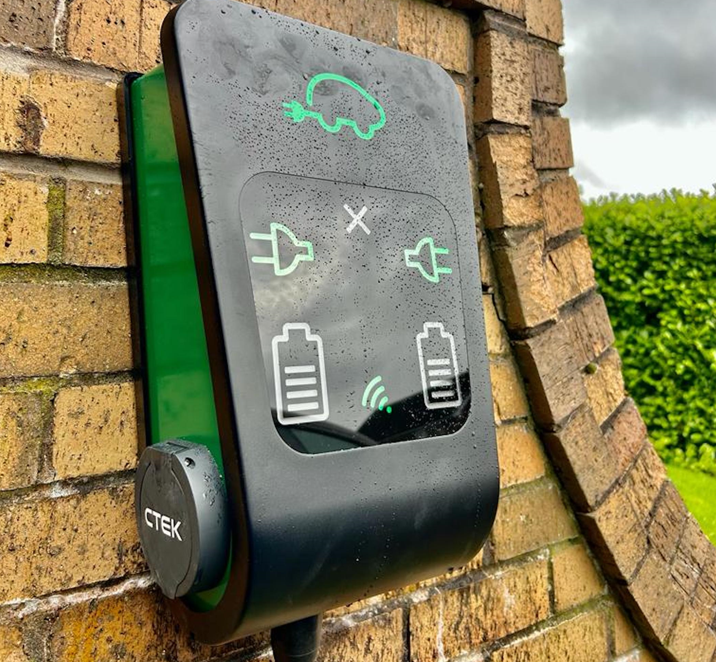
The rise of the two electric vehicle (EV) household will drive demand for home charging points with two outlets to charge two EVs at once, predicts CTEK. More and more families with one EV have already bought a second EV - Zapmap’s annual survey of EV drivers in 2022 found 10% of EV drivers had two or more EVs, up from 7% in 2020 and 9% in 2021. There are more than eight million British households with two or more vehicles. English households with two or more cars or vans are 33% of all households in the country. Cecilia Routledge, CTEK’s Global Director Energy and Facilities, says, “Early adopters of EVs tended to be home owners with access to off-road parking and therefore able to install a home charging point. Almost all the home chargers installed to date have been single outlet. “But now more and more EV driving households are adding a second EV when their secondary petrol or diesel car is due for replacement. Having two EVs on their driveway or in their garage which need charging, but only one single-outlet charge point is a problem. “For many it will mean they cannot plug both EVs in overnight to take advantage of cheaper off-peak electricity. Only one EV will be charged up fully in the morning. “We are beginning to see households with two EVs install dual-outlet charge points - either to replace a first generation charge point or as their initial installation. “Installing a dual-outlet charge point rather than two separate charging units means less new wiring is required, making it a simpler and cheaper install job. “A dual outlet charge point such as CTEK’s CC2 works best when installed with dynamic load balancing to optimise charging efficiency and protect a home’s main fuse. The load balancing monitors the incoming power to the house so the charge point draws an optimal amount to charge one or two EVs.” Case study: Peak District pioneer plugs in both his EVs overnight When Ben’s charge point failed to cope with the Peak District winter, the businessman turned to CTEK for a more robust solution that could also simultaneously charge his two electric vehicles and ensure both were fully ready for him each morning. Fed up with a single-outlet charging unit that would fail to charge, Ben did his product research and contacted CTEK, who supplied a dual-outlet Chargestorm Connected 2 and put him in touch with installer Sean from Mulcahy EV. Ben says, “I had struggled through last year, and in particular last winter, with another manufacturer’s charge point which had come from by my electricity supplier. It was failing in the colder weather. I would plug it in each evening and it would shut down overnight, so the car wasn’t fully charged in the morning. “I was running a single BMW EV for a year and decided to replace our second, hybrid car with another EV. So, I wanted the option of charging two vehicles at once overnight. I saw CTEK’s charge point on YouTube and had already had CTEK 12 Volt chargers, so I knew CTEK sold products with solid engineering. “I was reassured with how reliable the brand is and that twin charging was offered, with load balancing. I could have both EVS on overnight at 16A each and when one was fully charged, the other one could have 32A. I could also reliably pre-heat both vehicles in the morning on the AC power. “We are in Derbyshire so we do get inclement weather, but CTEK’s charge point was designed to cope with Swedish winters, so I knew it would manage the English weather, even in the Peak District. “After struggling through last winter with the old unreliable charge point I wanted CTEK’s dual one installed this spring, so I was ready for next autumn, winter and beyond. CTEK put me in touch with Sean and the installation was straightforward. I had previously jumped a few hurdles with the DNO and getting the main fuse upgraded, so it was a relatively easy install for Sean.” Sean, from electric vehicle charging specialists Mulcahy EV in Darwen, Lancashire, installed the new charge point in March. He says, “The customer’s existing charge point failed and its manufacturer wasn’t keen to get involved in a repair. Part of the selling point for CTEK’s CC2 was how robust it is. The customer’s home is in a location where it is not unusual to get quite heavy weather conditions. “We checked the supply was adequate. We had a 40A supply so could easily charge two EVs. And CTEK’s CC2 load balances, so it knows if there is one EV or two charging. That’s a big benefit. “We have done a few twin chargers in domestic settings. As more families get a second EV, they will also want the option of a dual charging unit.” Ben adds, “The software setup of the CC2 was equally as easy and Sean did a little bit of configuration using his computer and the unit was then quickly online enabled and interfacing with the Monta app. I was really pleased with his work. It hadn’t been such a good experience with the previous installation. Sean was a good recommendation from CTEK. “The charge points have worked fine. The load balancing is functioning well and the Monta app which comes pre-loaded is good. It has far better functionality than the app in the previous charge point. Overall, I’m very impressed.” Sean concludes, “The customer is happy. He had been let down by his previous charger and did not want to be messed about again I told him the CC2 is designed to keep out Swedish winters. If it works over there it will work over here, even in the Peak.”