2 November 2026
Product of the Month: Amari Floodlight range by Aurora Lighting
 
26 November 2026
Thorn scores second Highland football lighting installation
 
26 November 2026
Segen pens exclusive distribution contract with M-Rack
 
25 November 2026
Scolmore helps rejuvenate Tamworth Cancer Support Centre
 
25 November 2026
Leicester apprentice crowned 2026 SkillELECTRIC champion
 

Latest News


14% of the UK's electricians are more motivated to work amid second wave concerns
As we fast approach the winter months, millions of people across the country are hoping to get their homes in the best condition possible to prepare for the colder weather. Electrical problems, in particular, are unwarranted during this time of year and it is important that the wiring of houses is in the best possible condition - especially with concerns of a second wave of the virus. With millions of people continuing to remain in their homes as a result of the pandemic, many are finding issues with the current state of their homes, resulting in a home improvement boom. This is hugely beneficial, as the restoration of confidence has been pivotal for the recovery of consumers and tradespeople alike. In light of this, new nationally representative research from Powered Now, a mobile-based billing, invoicing and quotation application which specialises in trades, has unveiled the sentiment that Britons have towards ensuring the wiring of their houses is in the best possible condition post-lockdown and pre-winter. Key statistics: 16% of tradespeople agree that the threat of a second wave of COVID has influenced them to commence work on home improvements sooner rather than later 14%  of electricians agree 15% of tradespeople have seen their client demand increase post-COVID 17% of electricians agree 17% of tradespeople regularly work over 10 hours a day 18% of electricians agree 18% of tradespeople don’t have the time or motivation for new business development due to the sheer backlog of work they have 16% of electricians agree Ben Dyer, CEO of Powered Now - a mobile-based billing, invoicing and quotation application which specialises in trades - has offered insight into the increase in trade for electricians. "As the weather turns colder, Brits will need to make preparations to ensure that their homes will withstand the colder months. As the days become darker and shorter, more people will be using their lights and electrical appliances more, and ensuring these are in the best condition will guarantee a comfortable living environment during these months. In light of this, we are expecting one final push of trade in the coming month in the electrical sector. "The whole industry is still in catch up mode and projects delayed by the lockdown are taking priority. This has helped to spike demand and we expect it to continue in the short term. Our research has very much confirmed that Brits were eager to have home improvement jobs completed post-lockdown and pre-winter, treating themselves to a little home-based TLC. "Our SME customers are also talking about the pressure to complete jobs as people worry about a second wave. As we have seen from the sentiments established in this research, this could in fact help the trades bounce back even quicker as people will rush to hire a tradesperson for their desired work before the cooler months set in."

How can electricians earn themselves a five-star review? 
Electricians that are tidy, professional, punctual, friendly and courteous have the best chance of earning themselves a five-star customer review, new research shows. Electrical wholesaler ERF Electrical analysed 1,000 five-star Checkatrade reviews to discover the factors that make up an ‘excellent’ review. One in five customers (21%) gave top marks to those that cleaned up after themselves, with those living in Bristol valuing cleanliness above anything else. In Liverpool, Glasgow and Leeds, residents are more likely than anywhere else to praise those that are ‘on-time’; in Liverpool, punctuality was mentioned in 25% of top reviews. The research took into account 100 reviews across 10 major cities, which also included Birmingham, Edinburgh, Leicester, London, Nottingham and Sheffield. Tidiness and friendliness were among the top qualities mentioned in nine of the 10 cities. The highest-ranked qualities, according to the percentage of reviews they appeared in, were: Tidy/clean (21%) Professional (20%) Polite/courteous (20%) On-time (18%) Friendly (16%) Reliable (10%) Efficient (10%) Helpful (7%) The research also reveals that Leicester residents are most likely than anywhere else to praise those with good manners, with one in five (22%) of reviews mentioning the friendliness of an electrician. Dave Haywood, business manager at ERF Electrical comments: “This research really highlights the service levels that customer expect from electrical installers. Those working in the industry can use this analysis to their advantage; are you doing any of these things, which you can be proud of, or is there anything you can improve? “By focusing on these qualities and striving for the best possible customer service, electricians can give themselves the best chance of a glowing, five-star review.” Other five-star reviews gave credit to electricians they deemed to be knowledgeable, trustworthy and respectful.

JTL signs charter as a commitment to further improve health, safety and wellbeing
JTL, the national training provider for electrical and heating and plumbing apprenticeships, has signed the Civil Engineering Contractors Association’s (CECA) Health and Wellbeing Charter as part of its Stop. Make a Change campaign (10-23 October). The signing of the charter demonstrates JTL’s continued commitment to improving all aspects of health, safety and wellbeing. JTL will continue to illustrate what good health, safety and wellbeing activities are and utilise the CECA’s ‘conversation starter’ resources to engage JTL training officers in the campaign, as well as using them as part of the regular health and safety checks with JTL leaners. Stop. Make a Change is a national event that allows leading UK contractors, customers and suppliers the opportunity to speak directly to employees and suppliers about health, safety and wellbeing issues, and to make commitments to actions targeting improved performance in these areas. Steve Smith, Head of Health & Safety at JTL, says: “JTL recognises that mental health issues, such as stress, anxiety and depression, are more apparent in the construction industry than in others sectors, with an estimated one in six workers suffering from a mental health issue. “JTL is already partnered with the Electrical Industries Charity (EIC) to offer a range of welfare support services to all of our learners and employers working within the electrical sector and the wider building services industries. As part of Stop. Make a Change, we are now looking forward to utilising the ‘conversation starter’ resources including respiratory, electrical installations, hand injuries and working at height to further support the health and safety of both staff and learners.” Stop. Make a Change will be held between 10-23 October and the European Week for Safety & Health runs from 19-23 October. To learn more, visit www.stopmakeachange.co.uk.

Amendment 2 to the 18th Edition: what could change?
Gary Parker, ECA technical manager, highlights some of the proposed changes to the 18th Edition of the Wiring Regulations. A brief history of the 18th Edition The IET Wiring Regulations, the essential publication for all professionals in the electrotechnical and engineering services sector, underwent an overhaul when the 18th Edition (BS 7671:2018) came into full effect in 2019. Amendment 1, which concerns electric vehicle charge points, came into effect on 1 February 2020. Now, BSI is seeking views on a new set of changes to the 18th Edition – Amendment 2 (AMD 2) – which could represent the biggest set of revisions to the Regulations yet. AMD2: why now? The rationale for Amendment 2 is similar to that behind the original 18th Edition: given the way our industry operates, the roles electrical engineers serve, and the increasing speed of technological change, the Regulations must reflect these changes to ensure installations are safe, efficient, useful, and able to meet evolving standards. The key potential changes are: Mandating of AFDDs on circuits with a rated current not exceeding 32 A The proposal: Regulation 421.1.7 proposes that arc fault detection devices (AFDDs) be required on all single-phase final circuits supplying socket-outlets and fixed current-using equipment. Some exceptions to this are listed. The impact: This proposal would effectively mandate the use of AFDDs across all small, single phase circuits, whether in a domestic, commercial or industrial installation, increasing the potential for safety but also the prospect of greatly increasing cost and complexity of installations. Risk assessment for sockets The proposal: Regulation 411.3.3 would be altered to remove the option for omitting RCDs on socket outlets not exceeding 32 A in installations other than dwellings. The impact: This proposal would leave designers with no option but to install RCDs on all socket outlets - unless they raise a departure against BS 7671. However, this is something the client may not be content with. Less paperwork for EICs The proposal: To reduce the number of items on the schedule of inspections for an electrical installation certificate. The impact: The number of boxes would be reduced to 13 items, greatly reducing the time needed to complete an EIC. A list of items that should be inspected (where relevant) is available, but this does not need to be completed. New cut-off date for complying with the 18th Edition The proposal: To state a date that, after which, all installations should be installed to the 18th Edition AMD 2 - regardless of when the design took place. The impact: If an installation is undertaken after 28th March 2023 then this would need to conform to the requirements of the 18th Edition AMD 2 regardless of when it was designed. This could impact contractors working on contracts which take some years to come to fruition. Energy efficiency and prosumers The proposal: A new Part 8 would be added for ‘Prosumer’s’ low-voltage electrical installations. The impact: This proposal highlights some of the additional requirements designers and installers should be aware of when working on newer installations that can generate their own energy supply. SPD requirements The proposal: To re-write the wording in section 443, Transient overvoltages due to the effects of indirect lightning strokes, to make this element easier to read. The impact: Potentially reducing the number of mandatory SPDs required in installations, however the wording should be closely read to ensure compliance. Foundation earthing The proposal: Regulation 542.1.2.202 would require that for new premises, additional earthing, such as foundation earthing, shall be provided. The impact: Every new build would need to be provided with a means of embedding electrodes to supplement the earthing system. This will require the use of electrodes or foundation earthing, in many cases at times when electrical contractors are not on site. Protected areas The proposal: The requirements of Section 422 would be dramatically re-written to introduce the phrase, ‘protected escape route’. The impact: Removing the conditions BD2, BD3 and BD4 and using the term ‘protected escape route’ would introduce requirements for designers and installers to consider how they install circuits in areas of escape and what types of equipment can be installed. How to share your views The 2nd Amendment to the 18th Edition of the Wiring Regulations (BS 7671:2018) opened as a Draft for Public Comment (DPC) on 21 September 2020. This will remain open for comment until 11 December 2020. The DPC is available via the BSI Standards development portal: https://standardsdevelopment.bsigroup.com/ In previous years, ECA Member comments have been directly responsible for improving the Regulations and ensuring that BS 7671 remains a practical and workable document, to the benefit of both customers and contractors. Please note, this article highlights some of the proposed changes in AMD 2. There are many others in the DPC, and ECAtoday readers are advised to pay close attention to the draft. To make sure your comments are worded and presented correctly, ECA has produced a handy guide to help Members complete the DPC – this can be found at www.eca.co.uk/amd2.

Critical financial wellbeing support launched
 The Lighthouse Construction Industry Charity’s free app has been upgraded with nudge, the financial wellbeing platform, in response to feedback from the industry and findings of its latest Impact Report. One of the key findings of the recently published report was that 62% of emergency financial grants were to help pay for daily living costs including buying food, paying utility bills, and clearing rent arrears and debt. Over 50% of our construction workforce are either self-employed, agency workers or on zero hour contracts, so when things go wrong financially, issues can quickly spiral out of control. In the current climate, the app’s new feature is yet another lifeline to the industry and focuses on the need for more preventative tools and building resilience in the areas of mental, physical, and financial wellbeing. Working in partnership with nudge, the charity is now able to offer even more support to the construction community, just when it is needed the most. Information and advice around money can be complex, overwhelming and conflicting, but nudge resolves this by providing personalised and unbiased financial education in a simple way. With timely prompts (nudges) to take action and the tools to help people manage their money, this latest development will help people to understand and manage their money more effectively, boost their financial wellbeing and, in turn, their overall wellbeing. The new feature offers: nudges: When there’s something people need to know, or a financial action they ought to take, users are sent a personal, timely nudge to remind them. Education: Bite size personalised content – boosts financial knowledge, skills and confidence. Tools: Money management tools help with tasks such as budgeting or saving for goals easier. The charity’s mission is that ‘no construction worker or their family is alone in a crisis’ and this latest addition to the app certainly responds to the needs of the industry. The free app complements the 24/7 Construction Industry Helpline. The charity has also recently announced free wellbeing training to the industry for the remainder of 2020 and this includes financial wellbeing sessions. In addition to this, the fallout of Covid-19 means an increasing number of redundancies and their free wellbeing programme now also includes two sessions aimed at improving employability. Bill Hill, CEO of the Lighthouse Construction Industry Charity said, “With financial stress at an all time high, it’s vital to address money worries quickly. By making all of our proactive and reactive wellbeing support services free, we hope to remove any barriers to access so that our construction workers get the help they need quickly.”

BASEC launches cable testing and certification to the data communication market
BASEC has extended its cable testing and certification offering by investing in new service capabilities for data communications market. The new service is designed to support the growing transformation of the data communication global market. The new data communications (datacoms) capability features industry standard state-of-the-art testing equipment which will be able to test the performance of the full range of datacoms cables including: CAT 5e, 6, 6A, 7, 7A, and CAT 8. In combining data transmission testing with nearly 50 years of cable testing and certification expertise, BASEC continue to deliver testing of electrical, mechanical, material, chemical and fire performance. End users, manufacturers and re branders of approved cables benefit from the added value that cable certification encompasses rigorous process auditing alongside physically cable testing, to deliver a holistic cable assessment. Tony Lioveri, BASEC’s CEO states, “BASEC has been working in partnership with cable manufacturers for nearly 50 years, and has a strong brand and heritage of being the mark of quality and safety, to be able to leverage this cable expertise to the datacoms market is an exciting proposition for BASEC. The BASEC brand is established worldwide and is delivered through our regional offices of dedicated teams of technical experts and superior customer care. Our goal is to give confidence to end users, manufacturers and rebranders that by using the BASEC mark that they can be assured of guaranteed quality and safety throughout the supply chain.” As the demand for data is forever increasing and technological advances continue to evolve. Investing in high performance networks that can accommodate the digitalisation of operations now and in the future is more important than ever. Three overarching transmission cable standards have been developed by industry to enable manufactures to comply with application requirements and work to ensure suitable cables are installed. ISO/IEC 11801 is designed for use within commercial premises in office spaces between 50-50,000 people ANSI/TIA 568 is designed to provide recommended design and installation criteria for cabling systems that will support existing and future services EN 50173 is consistent with the above, covering the entire channel whilst adopting additional cable specific requirements Tony Lioveri goes on to say, “We are excited to be expanding into the datacoms market. The enhancement of our facilities demonstrates our long-term commitment to deliver exceptional testing and certification to all customers across multiple markets.” The datacoms scheme has been developed to offer: An in-house capability covering the full depth of testing and certification services for a wide range of cables Simplification of the certification process, combining fire testing approvals Enable BASEC to extend the superior customer care to the datacoms market

FSA calls for mandatory use of competent fire professionals
A legal requirement to mandate the use of competent fire safety professionals should be introduced, according to a submission from the Fire & Security Association (FSA) to the Government. FSA argues that only competent fire risk assessors and fire professionals (engaged by Responsible Persons) should be able to undertake fire risk assessments. FSA contends that individual competency should include holding a robust, relevant qualification. Furthermore, FSA believes that the recording of all fire risk assessments should become mandatory, and that as part of plans to strengthen the legal basis of the Fire Safety Order the introduction of an ‘approved code of practice’ would set the requirements. FSA technical director Mike Smith says: “It’s absolutely vital that urgent steps are taken to give householders confidence that buildings and installations are safe and protected against the risks of fire and electric shock. “Mandating the use of competent fire professionals who hold robust qualifications is fundamental to this approach, and FSA strongly urges the Government to legislate on this critical issue.” FSA has also outlined how the role and responsibilities of the Responsible Person for a building should be enhanced, as well as what information should be readily available to tenants and homeowners. Due to the additional risks associated with higher risk buildings, FSA believes that three additional fire precaution requirements should apply to these buildings, specifically: provision and maintenance of means of escape, provision and maintenance of firefighting systems, and record keeping demonstrating the specific requirements. Furthermore, FSA believes that a tough sanctions regime should apply, including unlimited fines for certain breaches of the regulations, such as impersonation of an inspector.

Act now to make the most of £1bn energy efficiency fund, says Priva
Time is of the essence if public sector institutions are to take full advantage of the UK Government’s £1bn funding pot for improving energy efficiency, says Priva UK. A manufacturer of intelligent building control technology, Priva is urging local authorities to move quickly to apply for a share of £1bn fund - the detail of which was published by BEIS this week. Building management systems - specifically BEMs systems which are either bureau managed, remotely managed or not managed, are listed as eligible technologies. Applications are open to eligible organisations from 30 September; closing dates depend on the type of eligible organisation - ranging from 12 October 2020, to 11 January 2021. The Public Sector Decarbonisation Scheme, which will be administered and delivered by Salix Finance, will help councils install energy efficiency and low carbon heating measures, reducing energy bills and carbon emissions. The scheme is also expected to create up to 30,000 low-carbon jobs. This scheme is designed to enable new projects and those projects already started or completed are not eligible as they do not meet the additional criteria. However, if a project is currently underway and that project can be expanded with additional scope, an application for grant funding for that expansion can be made. Business and energy secretary, Alok Sharma, says: "Our plan to upgrade the nation’s buildings and help build back better is good news for jobs, the environment and people’s back pockets, as we reduce emissions and help cut energy bills." Gavin Holvey, General Manager, UK & Ireland, believes that the £1bn funding mechanism will not only stimulate the low carbon economy, it will catalyse essential change to in the pathway to net zero by 2050. “This is a very significant pot of money,” he says. “But, the opportunity must not be squandered. We have very ambitious targets to reach net zero - and our existing built infrastructure needs a great deal of investment to bring it up to standard. We - and our network of partners - stand ready and willing to work with the public sector act swiftly and reap the rewards of modern building management technologies.” This energy efficiency plan forms part of the government’s wider efforts to ensure the UK meets its legally binding target to reach net zero emissions by 2050 and build back greener from coronavirus.

Aico releases Fifth Edition of Electrical Contractors Handybook
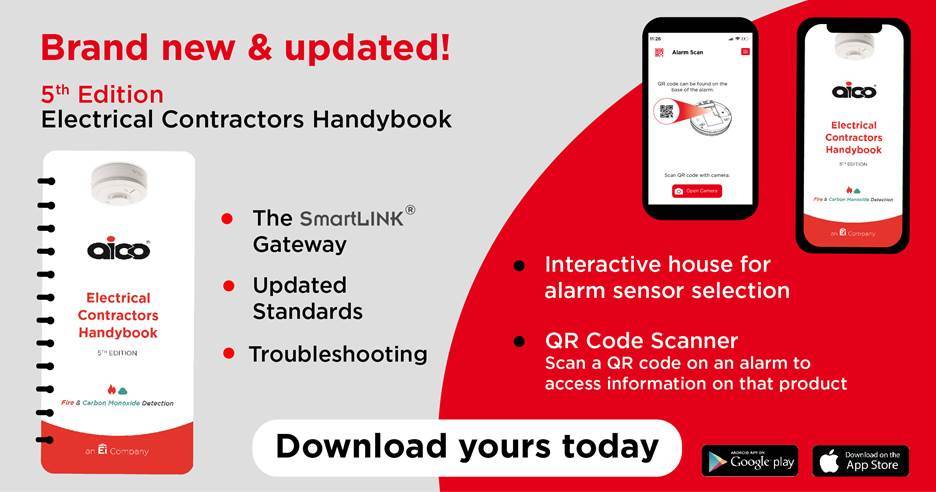
Aico has launched the fifth edition of its highly sought-after Electrical Contractors Handybook. Following on from the previous edition being designed with the customer in mind, the fifth edition compliments the new design with a wealth of extra features. The new edition has all the essential information you need to help you choose, site, install and maintain domestic Fire and Carbon Monoxide (CO) alarms and systems, along with new updates on the Ei1000G SmartLINK Gateway.The Handybook will keep you up to date with the latest standards and legislation, including the new updates in Scotland. It covers the different types of sensor available across Aico’s extensive range of fire and carbon monoxide products. It will also assist with the installation of the new Ei1000G SmartLINK Gateway, Aico’s new asset management tool that utilises their next generation of wireless technology to enable real-time notifications of fire and CO events. The fifth edition is completely free of charge and will provide extra information on the importance of testing and Aico’s wide range of accessories. Along with the physical copies, a handy PDF version is also being made available, with the Aico Handbook App also being updated. The previous version of the Handybook App was used by thousands of installers and gained great feedback. Aico has looked to go one step further with the updates, adding a QR code scanner, updated information on the Ei1000G SmartLINK Gateway, an interactive house for alarm selection and much more.

Vaillant TV campaign outlines investment in a sustainable tomorrow
With central heating making up 31% of all household emissions, Vaillant has launched its latest multimillion-pound marketing campaign, including a brand-new TV advert, to highlight the individual impact UK homeowners can make by having an efficient heating system. With its long-term strategy focused on sustainability, Vaillant will also be using its ‘Why Wait’ campaign, which began on 5 October, as an important milestone for the  industry as it becomes the first of the UK’s most popular boiler manufacturers to include renewables in TV advertising. With a strategic objective to bring low carbon technologies into mainstream consumer consciousness, the ‘Why Wait’ homeowner awareness campaign aims to educate millions of homeowners across the UK, why upgrading to a more efficient home heating system, such as heat pump or energy efficient boiler, can have a big impact on the climate and encourages them to turn to their local Vaillant installer to help them make a positive change for the future of the planet. Underpinned by extensive digital and social media advertising campaign,  aimed at homeowners who are looking for a new heating system, this latest campaign cements Vaillant’s commitment to delivering valuable support and homeowner leads to maximise the businesses of its installers and continue Vaillant’s Business Support strategy for its loyal installers. It comes after Vaillant’s entire range of domestic boilers was named the top-ranked gas boiler brand in the UK by the Which? Best Buy report 2020. This latest accolade, together with the TV ad campaign, means installers now have increased choice when it comes to specifying an efficient heating solution to their customers. Alice Woolley, marketing director at Vaillant, says: “As a business it’s important we look to the future. With the recent launch of the Green Homes Grant, together with the upcoming Future Homes Standard, the direction for our industry is clear. At Vaillant we have always had a longstanding commitment when it comes to developing innovative technology to deliver efficient and sustainable heating solutions for everyone. “Yet, while we continue to work towards a more sustainable tomorrow, we’re also focused on the ways we can continue to support our loyal installers. Our latest TV ad really brings to life how by investing in sustainability, we’re also investing in them. With a clear call to homeowners, and our recent Which? accreditation, we’re confident that the Why Wait campaign will deliver valuable leads to their businesses.” Vaillant is also offering a host of training courses specifically designed to cover low carbon heating technologies such as heat pumps and energy efficient boiler systems.