2 November 2026
Product of the Month: Amari Floodlight range by Aurora Lighting
 
24 November 2026
JTL celebrates opening of new Tyneside training centre
 
24 November 2026
LiGHT 26 welcomes record number of visitors to fifth event
 
23 November 2026
Advanced acquires communications specialist Baldwin Boxall
 
23 November 2026
Trades face 'skills squeeze' as apprenticeship demand soars
 

Latest News


IET Wiring Regulations – corrigendum May 2023 explained
Following the announcement from the Institution of Engineering and Technology (IET) and BSI that a corrigendum to BS 7671:2018+A2:2022 would come into effect from 15 May, Jake Green, Head of Technical Engagement at Scolmore Group, provides some more detail on the changes. Under the auspices of the IET/BSI, JPEL64, the committee responsible for BS 7671, has issued a corrigendum to address issues raised after the publication of Amendment 2 of BS 7671: 2018. These issues fall into three specific areas: Protected escape routes – amendment to Regulation 422.2 to clarify the scope of the provision in general installations, and a new provision for medical locations (710.422.2). Birthing pools – amendment to Regulation 701.1 removing the reference to birthing pools. Provision of protection against overvoltage for safety services. Protected escape routes Regulation 422.2 has been amended to provide clarification on its application. The regulation now states: 'Cables or other electrical equipment shall not be installed in a firefighting lobby, shaft or staircase of a protected escape route…’ The text in bold italics is the amended detail. This change enables designers to better understand the scope of application of this requirement. Note 2 to Regulations 422.2 has been similarly amended, however, there are no changes to the guidance given in Appendix 13. Further to this change to Regulation 422.2, a new regulation (710.422.2.201) has been added to Section 710 covering medical locations. This new text takes account of the specific concerns of the health sector and points towards the guidance issued under HTMs (England), SHTMs (Scotland) and WHTMs (Wales). Birthing pools Regulation 701.1 in Section 701 (Locations containing a bath or shower) has been amended to remove the reference to birthing pools. This change supports the work of designers in the health sector. Protection against transient overvoltages of atmospheric origin Regulation 443.4.1 now limits the requirement for transient overvoltage protection to two conditions, (serious injury to, or loss of human life, and significant financial or data loss) by removing the reference to ‘safety services’. However, the rest of the regulation remains the same, and protection against transient overvoltages (typically using SPD) should still ‘…be provided unless the owner of the installation declares it is not required due to any loss or damage being tolerable…’ As a consequence of this change, Table 443.2 has been amended by deleting the references to alarm panels, computers and home electronics. Furthermore, the note attached to Regulation 534.4.1.1 has been amended to remove the example of ‘fire/security alarm systems’. All of these changes became ‘live’ on 15 May 2023.

Industry welcomes new fire and security apprenticeship for Wales
The Fire and Security Association (FSA) and the Security Systems and Alarms Inspection Board (SSAIB) have welcomed Welsh Government’s approval of a new Providing Electronic Fire and Security Systems apprenticeship framework. This completes the mission of the fire, emergency and security systems (FESS) sector to make a specialist apprenticeship available to employers and learners in every part of the UK. Tom Brookes, FSA Chair, says, “The new apprenticeship in Providing Electronic Fire and Security Systems marks an important step forward for FESS standards in Wales. As such, it represents a fantastic achievement for the close and effective partnership on competence and skills now developing between the Welsh Government and industry employers. We look forward to seeing this partnership continue to grow and strengthen further over time.” Trevor Jenks, SSAIB National Training Manager, says, “SSAIB are delighted to have been involved in the development of the new Welsh apprenticeship pathway in Providing Electronic Fire and Security Systems, which both aligns to the UK-wide FESS Technician Standard and respects Wales’ specific training identity and norms. The SSAIB continues to take a leading role in setting and raising of the technical standards as the whole FESS sector upskills on its route to a fully competent workforce, validated by an individual’s competency card.” Development of this apprenticeship, which was jointly funded by FSA and SSAIB, has come as a direct response to employer demand in Wales. Employers were also closely involved in the steering group which oversaw the development process. Welsh apprentices and employers will benefit from the curriculum aligned with UK-wide technical and occupational competence standards. The apprenticeship features two qualifications which have now been designated by Qualifications Wales: the EAL Level 3 NVQ Diploma in Providing Electronic Fire and Security Systems, and the EAL Level 3 Knowledge Diploma in Providing Electronic Fire and Security Systems. On completion, individuals will achieve UK FESS Technician status and entitlement to apply for a gold card under the Electrotechnical Certification Scheme (ECS). Significantly, the establishment of this new benchmark also provides a route for the existing workforce in Wales to upskill from Operative to gold card Technician level when the FESS Experience Worker Assessment route becomes widely available later this year across the whole UK. Wales’ Economy Minister, Vaughan Gething says, “The Welsh Government is committed to investing in quality apprenticeships that support economic growth. This new apprenticeship will raise standards across the fire, emergency and security systems industry and make a significant contribution to the competence and skills of the workforce in Wales. The fact the apprenticeship was jointly developed across the sector is testament to the value and strength of collaborative working in meeting industry needs.”

Two EV households can charge at the double
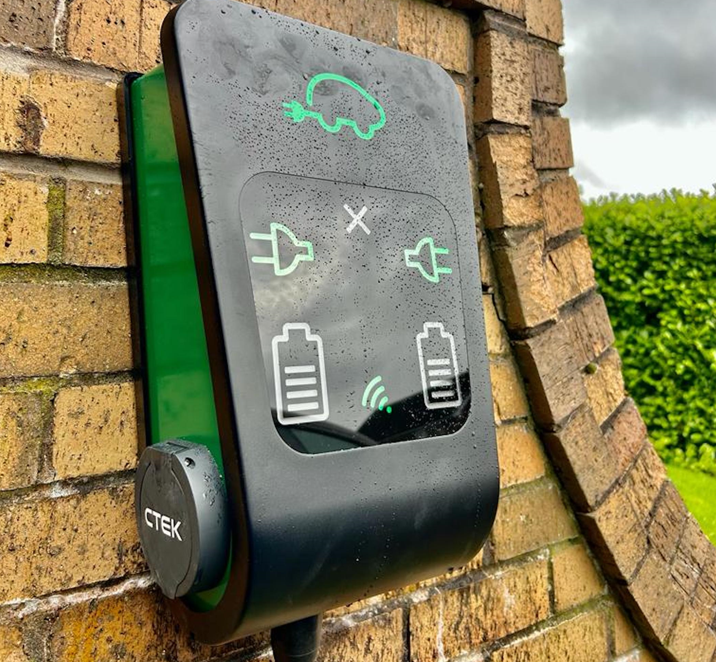
The rise of the two electric vehicle (EV) household will drive demand for home charging points with two outlets to charge two EVs at once, predicts CTEK. More and more families with one EV have already bought a second EV - Zapmap’s annual survey of EV drivers in 2022 found 10% of EV drivers had two or more EVs, up from 7% in 2020 and 9% in 2021. There are more than eight million British households with two or more vehicles. English households with two or more cars or vans are 33% of all households in the country. Cecilia Routledge, CTEK’s Global Director Energy and Facilities, says, “Early adopters of EVs tended to be home owners with access to off-road parking and therefore able to install a home charging point. Almost all the home chargers installed to date have been single outlet. “But now more and more EV driving households are adding a second EV when their secondary petrol or diesel car is due for replacement. Having two EVs on their driveway or in their garage which need charging, but only one single-outlet charge point is a problem. “For many it will mean they cannot plug both EVs in overnight to take advantage of cheaper off-peak electricity. Only one EV will be charged up fully in the morning. “We are beginning to see households with two EVs install dual-outlet charge points - either to replace a first generation charge point or as their initial installation. “Installing a dual-outlet charge point rather than two separate charging units means less new wiring is required, making it a simpler and cheaper install job. “A dual outlet charge point such as CTEK’s CC2 works best when installed with dynamic load balancing to optimise charging efficiency and protect a home’s main fuse. The load balancing monitors the incoming power to the house so the charge point draws an optimal amount to charge one or two EVs.” Case study: Peak District pioneer plugs in both his EVs overnight When Ben’s charge point failed to cope with the Peak District winter, the businessman turned to CTEK for a more robust solution that could also simultaneously charge his two electric vehicles and ensure both were fully ready for him each morning. Fed up with a single-outlet charging unit that would fail to charge, Ben did his product research and contacted CTEK, who supplied a dual-outlet Chargestorm Connected 2 and put him in touch with installer Sean from Mulcahy EV. Ben says, “I had struggled through last year, and in particular last winter, with another manufacturer’s charge point which had come from by my electricity supplier. It was failing in the colder weather. I would plug it in each evening and it would shut down overnight, so the car wasn’t fully charged in the morning. “I was running a single BMW EV for a year and decided to replace our second, hybrid car with another EV. So, I wanted the option of charging two vehicles at once overnight. I saw CTEK’s charge point on YouTube and had already had CTEK 12 Volt chargers, so I knew CTEK sold products with solid engineering. “I was reassured with how reliable the brand is and that twin charging was offered, with load balancing. I could have both EVS on overnight at 16A each and when one was fully charged, the other one could have 32A. I could also reliably pre-heat both vehicles in the morning on the AC power. “We are in Derbyshire so we do get inclement weather, but CTEK’s charge point was designed to cope with Swedish winters, so I knew it would manage the English weather, even in the Peak District. “After struggling through last winter with the old unreliable charge point I wanted CTEK’s dual one installed this spring, so I was ready for next autumn, winter and beyond. CTEK put me in touch with Sean and the installation was straightforward. I had previously jumped a few hurdles with the DNO and getting the main fuse upgraded, so it was a relatively easy install for Sean.” Sean, from electric vehicle charging specialists Mulcahy EV in Darwen, Lancashire, installed the new charge point in March. He says, “The customer’s existing charge point failed and its manufacturer wasn’t keen to get involved in a repair. Part of the selling point for CTEK’s CC2 was how robust it is. The customer’s home is in a location where it is not unusual to get quite heavy weather conditions. “We checked the supply was adequate. We had a 40A supply so could easily charge two EVs. And CTEK’s CC2 load balances, so it knows if there is one EV or two charging. That’s a big benefit. “We have done a few twin chargers in domestic settings. As more families get a second EV, they will also want the option of a dual charging unit.” Ben adds, “The software setup of the CC2 was equally as easy and Sean did a little bit of configuration using his computer and the unit was then quickly online enabled and interfacing with the Monta app. I was really pleased with his work. It hadn’t been such a good experience with the previous installation. Sean was a good recommendation from CTEK. “The charge points have worked fine. The load balancing is functioning well and the Monta app which comes pre-loaded is good. It has far better functionality than the app in the previous charge point. Overall, I’m very impressed.” Sean concludes, “The customer is happy. He had been let down by his previous charger and did not want to be messed about again I told him the CC2 is designed to keep out Swedish winters. If it works over there it will work over here, even in the Peak.”

MEGAMAN to showcase fixture range at first visit to CEF Live
MEGAMAN will be exhibiting for the first time at this year’s CEF Live, due to be held at the NEC in Birmingham on the 8-9 June. Building on the success of the Performa and Essentials fixture range launch, the Megaman team will be looking to connect with the CEF customer base and introduce its flexible fixture options. The Performa range is a selection of adaptable, high-performance fixture solutions, combining quality materials and value-added features such as motion sensors, emergency compatibility, dual beam (DBT) and colour change technology (CCT). Meanwhile, the Essentials range provides cost-effective staple products that promote reliability over innovation, making them ideal options to keep on hand in the back of the van. There for the day-to-day, Essentials deliver in terms of cost and results for both retrofit and new-build installations. In addition, Megaman will be sharing details of the INFINITE smart lighting system that is easy to set up and operate via Bluetooth from a phone or tablet. Designed for both residential and commercial spaces, it allows for the wireless control of both new and pre-existing fixtures. “We’re really looking forward to CEF Live and the chance to chat one-on-one with visitors for the first time,” comments Micaela Abbot, Sales Director at Megaman. “Our product portfolio has evolved significantly and so has our business with CEF and its customers. As such we’re keen to introduce visitors to the world of Megaman fixtures and demonstrate that our fixtures can provide the ideal solution no matter the site or budget requirements.”

BEAMA launches Future Homes Standard Report 
The government’s commitment to regulate all new residential developments to be net zero ready from 2025 is fast approaching and has laid down a clear direction of travel for building design and construction. Through the second stage of its Future Homes Standard consultation – due to launch later this year – there will be a requirement to future proof all new dwellings with low carbon heating, high performing fabric specification and a complementary ventilation strategy which will focus on the assured health and well-being of occupants. BEAMA’s Future Homes Standard Phase 1 Impact Report lays out a framework to prepare for the changes coming through from 2025, focusing on a range of technology options best suited to a variety of dwelling and occupancy profiles. The report acknowledges that the majority of technology solutions already exist today and therefore focuses on the specific enablers that will support their inclusion within the homes of the future. Subjects such as design, installation and commissioning competency; the necessity to undertake a steep evolution in SAP’s building modelling capability; and the very real challenge of preparing consumers for a new way of living, are all covered within the report. Commenting on the launch of the report, BEAMA CEO, Dr Howard Porter, says, “BEAMA has been a long-term supporter of innovation and progressive building standards. Through this report we are seeking to open a path towards collaborative discussion with, not only government, but also the wider construction industry. We share a common objective and we are very much looking forward to being a leading stakeholder in the preparation for the start of an exciting new era for energy efficiency, renewable solutions and connected flexibility infrastructure from 2025. Our efforts will not stop at today’s publication. This is the first phase of a two-step report focusing on new build compliance, with the second half of the report planned when we can complete BETA SAP 11 modelling. We have also recently become a Future Homes Hub partner, where we will be seeking to undertake a range of ‘task and finish’ projects in the coming two years to facilitate the new Standard’s success”. Welcoming the report, Ed Lockhart CEO of the Future Homes Hub, says, “BEAMA’s ‘Network to Emitter Impact Report’ provides an excellent analysis of the technology options for meeting the Future Homes Standard. It builds on the knowledge pooled through the Future Homes Standard Task Group’s Ready for Zero report. We are looking forward to working ever more closely with BEAMA, bringing the collective expertise of manufacturers and suppliers together with that of homebuilders on the journey to net zero. As we do so we must all keep a laser focus on building high quality homes and places that people love living in”.

Non-corrosive battens from Knightsbridge provide performance
The new Torlan suite of LED battens from Knightsbridge provide a non-corrosive, energy efficient and high performance lighting solution for a wide range of applications, ranging from residential to agricultural and industrial. As the heart of the Torlan collection is TorlanComm. Suitable for indoor and outdoor commercial applications, TorlanComm comes in two versions - CCT adjustable and Digital Addressable Lightning Interface (DALI) CCT - three colour temperatures and a choice of wattages. Beyond ‘standard,’ self-test emergency, microwave and microwave self-test emergency options are also available. Wattages vary from 26-62W, outputs are from 3955-9025lm, and colour temperatures offered are 3000K (warm white), 4000K (cool white) and 5700K (daylight). Bodies and diffusers are impact-resistant, non-corrosive polycarbonate with stainless steel clips (which ensure longevity), and with ceiling and end conduit fixings. The DALI version has built-in control gear for intelligent control integration. A choice of accessories permit installation onto BESA conduit boxes or suspension hanging. TorlanComm is IP65 and IK08 rated. Either side of the TorlanComm sit the TorlanEco and the TorlanPro. TorlanEco is a cost-effective IP65 and IK06 rated budget LED batten suitable for indoor and outdoor applications in residential and commercial premises. With tool-free cable termination and fast-fix fittings, it is easy to install on walls or ceilings, and comes in three lengths, three wattages (depending on length) and two colour temperatures - 4000K (cool white) and 5700K (daylight). Designed for the toughest of environments such as farms and other extreme applications that demand robust, dust and watertight, impact-resistant lighting, the heavy-duty TorlanPro is a simple but effective LED batten offering a contractor-friendly fast-fit electrical connection without opening the luminaire, easy operation and high levels of illumination. With a single power feed, low flicker and of acrylic and nylon construction, the TorlanPro comes in cool white only, and delivers 6400lm and 7175lm at 45W and 50W respectively. For suspension use only, TorlanPro is also IP69K waterproof as standard and high impact-resistant to IK08.

Recolight appoints new Operations Manager
Recolight has announced the promotion of Cindi Novell to the role of Operations and Compliance Manager. Cindi has over eight years’ experience working closely with former operations manager, Amel Gharbi, whom she replaces. Commenting on her appointment, Cindi says, “I am delighted to be joining Recolight at an exciting time, as we drive to net zero and a more sustainable, circular, and efficient service.” Announcing the news, Recolight Chief Executive, Nigel Harvey says, “With Cindi’s wealth of experience working in the operations team, she was a natural choice for promotion. Cindi will play an integral role in further enhancing the efficiency and value of our WEEE collection service.”

Screwfix Sprint delivers trade essentials to site in 60 minutes or less
Screwfix has launched a national campaign for its 60-minute delivery service, Screwfix Sprint. Sprint allows customers to have products delivered to home or site in 60 minutes or less, without breaking their stride. The trade demand quick and easy access to a broad range of competitively priced products, and Screwfix Sprint provides another option for customers to get their job done quickly, affordably and right first time. The campaign, signed off with the line ‘Don’t stop. Sprint.’, brings Sprint to life through a tv advert showing a tradesperson ordering on the Screwfix app, then dancing through the site with his team to the tune of ‘Break My Stride’ by Matthew Wilder. The classic track is an 80’s earworm, deliberately chosen to help plant the campaign into construction sites all over the country. Together with the dance moves, it’s also the hook of Screwfix’s social media influencer campaign, designed to amplify the message and underline the authenticity of the brand. Jack Wallace, Marketing Director at Screwfix, comments, “With Sprint, Screwfix is meeting the growing demand from UK tradespeople for affordable, high-quality products in their hands quickly. “For busy tradespeople, time is literally money and finding the time to pick up an essential and often unplanned item is an inconvenience that can also have an impact on project schedules. With Sprint available in over 320 Screwfix stores across the UK and just a £5 delivery charge, customers no longer need to sit in traffic when the unexpected happens, they can have it delivered in 60 minutes or less.” Over 30,000 Screwfix customers have already utilised Sprint’s convenience, with up to 80% being tradespeople. The service has become embedded into the way some customers shop with the omni-channel retailer. A Screwfix Sprint customer says, “Used this service to get a few bits that I had run out of. Saved me from having to down tools and go to the store. It was delivered within 30 minutes of ordering. Really handy if you can’t secure your workplace and need some bits and helps with workflow. I’ll definitely be using this service again.” In 2022, Sprint was awarded Best Customer Experience at the Retail Week Awards. The judges described Screwfix Sprint as ‘genius’, underlining how putting customers first led Screwfix to create a service that really makes life easier for busy tradespeople. To benefit from Screwfix Sprint convenience, download the Screwfix app or visit the Screwfix website for more information.

Cellforce chooses Siemens Xcelerator to scale EV battery production
Cellforce and Siemens have concluded a memorandum of understanding with the aim to enter a strategic partnership. Cellforce develops and manufactures high performance Li-ion battery cells for the automotive market by utilising advanced battery materials and production technologies. Siemens will become Cellforce’s preferred supplier in automation and digitalisation technology, speeding up the completion of the Cellforce gigafactory in Reutlingen, Germany. Both companies will join forces to enhance battery design, manufacturing processes and building operations, from production design, planning and simulation, to the automation of the entire production process. Both companies will also work together to create a sustainable, comfortable and safe working environment with Siemens building management technology and energy performance services. Siemens will provide a broad range of solutions from the Siemens Xcelerator portfolio, including Product Lifecycle Management (PLM), Manufacturing Execution Systems (MES), industrial edge computing, and tools for IT/OT connectivity, fire safety and security, measurement and control technologies to enhance energy optimisation for the carbon net zero battery cell factory. Siemens’ end-to-end solutions will support Cellforce to produce high performance batteries at scale, while meeting throughput, cost, and sustainability targets. “End-to-end digitalisation of design and production is key for a commercially successful battery cell production with the lowest CO2 footprint in Germany,” says Dr. Markus Gräf, COO of Cellforce.

Safer and Smarter Home: a new consumer guide
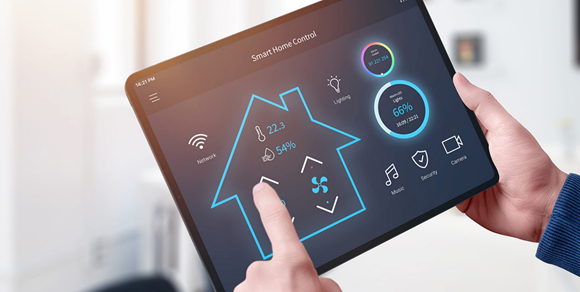
Leading companies in the smart home technology sector have created their second in a series of guides, helping consumers in the UK when buying and using smart technology in their homes. The new guide builds on its predecessor, Your Guide to a Safer, Smarter Home, to highlight to consumers examples of the benefits of smart home devices and to dispel some common myths that consumers may have. It was produced and published by The Smart Technology Product Safety Stakeholder Group, which was established by Electrical Safety First and DLA Piper in March 2019 to discuss topics that are relevant to product safety in the IoT or smart technology sector, and to develop and promote industry best practice. It is a multi-lateral group comprising a broad range of businesses and organisations operating in this space at all points in the supply chain. “Many people would welcome the benefits from making their home ‘smarter’, but there is so much misinformation about smart products and how to get them installed correctly,” explains Martyn Allen, Technical Director at Electrical Safety First and co-chair of the group. “This new guide provides information and guidance, and busts a few of the common myths that may exist when buying and using smart home devices.” Michiko Jo, another Co-Chair of the group, comments, “This ultimately will help consumers in the UK make better and more confident decisions when planning their smart home.” Mark Dewar, Partner at DLA Piper and Chair of the group’s Downstream sub-group, adds, “The smart home environment is becoming ever increasingly prevalent to the point of becoming the norm, for every day domestic devices and installations are becoming more complex. Whilst the first guide focused on plug-and-play smart devices used in the home, this guide covers smart and connected devices or systems that often need a qualified installer to design, build and to set it up properly.” The guide is available now and is free to download here.