


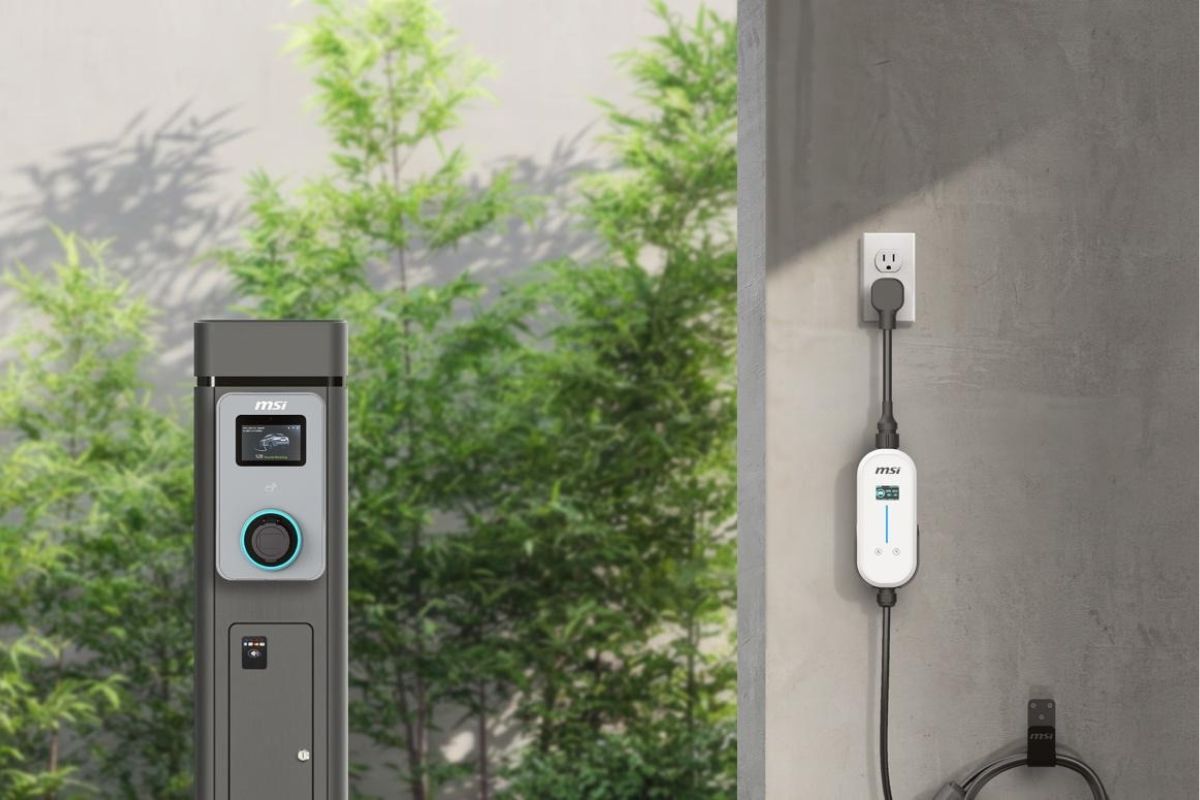
Gaming technology giant MSI has entered the electrical vehicle (EV) charging market through MSI EVSE, its dedicated EV supply division
The company is launching with two chargers, the portable EZgo, which delivers UKCA- and CE-certified charging, and the wall-mounted Eco Series.
“The UK is moving quickly towards zero-emission transport, and drivers and building owners need charging they can trust. A charger lives outdoors, plugged in and often unattended overnight, so we lead with protection,” says Kevin Yang, General Manager, MSI UK.
“The EZgo has seven built-in safety mechanisms and a three-year warranty behind it. The Eco Series is listed for UK chargepoint grants from day one, which shows our hardware already meets the standard this market expects.”
The £189 EZgo is rated IP66 against dust and water and IK08 against impact, and adjusts its output from 1.6 kW to 3 kW. On a standard 13 A Type G socket, it adds around 11 miles of range per hour. It plugs into an ordinary outlet, so drivers can charge at home, at work or on the road with no fixed installation.
The device features seven protection mechanisms which run continuously: over temperature, overload, overvoltage, undervoltage, earth fault, leakage and surge protection. If the unit passes 90 degrees Celsius, charging suspends automatically.
The Eco Series, meanwhile, is managed through the MSI aConnect app, with each unit supporting single-phase 7 kW and three-phase 22 kW from the same hardware. Auto Charge vehicle recognition starts a session the moment the cable is plugged in, after a one-time app setup.
MSI launch comes as UK moves closer to 2035 zero-emission targets
Max Home Socket and the Eco Premium Max Home Socket are listed on the UK government register of chargepoints approved for Office for Zero Emission Vehicles (OZEV) grants. Flat owners and renters with private off-street parking can claim 75 per cent of the cost to buy and install a socket, up to £500, under the current scheme, which is funded to 31 March 2027.
Most UK homes run on single-phase supply, and the Eco Series delivers a full 7 kW from a standard connection. Where three-phase power is available, the same unit steps up to 22 kW with no hardware changes. The UK models are socketed Type 2 units, so drivers can use their own cable, and they are rated to run at full power from -30 to 55 degrees Celsius and at altitudes up to 3,000 metres.
The expansion comes amid the UK Government’s plans to end the sale of new petrol and diesel cars by 2030, with all new cars and vans zero-emission by 2035. Under Part S of the Building Regulations, new homes and buildings with parking must already provide EV charging. For developers and managing agents, the question has shifted from whether to wire a building for EVs to how to deploy chargers across the building, affordably and safely.
For more on EV charging, click here.