2 November 2026
Product of the Month: Amari Floodlight range by Aurora Lighting
 
11 November 2026
Energy, AI and smart buildings: register now for EMEX 2026
 
11 November 2026
Solar and batteries could cut electricity costs by 40%, data finds
 
11 November 2026
EIC confirmed as ECN Awards 2026 charity partner
 
11 November 2026
Acrospire to support Green Frog's European expansion
 

Latest News


Majority of tradespeople are victims of tool theft or van crime
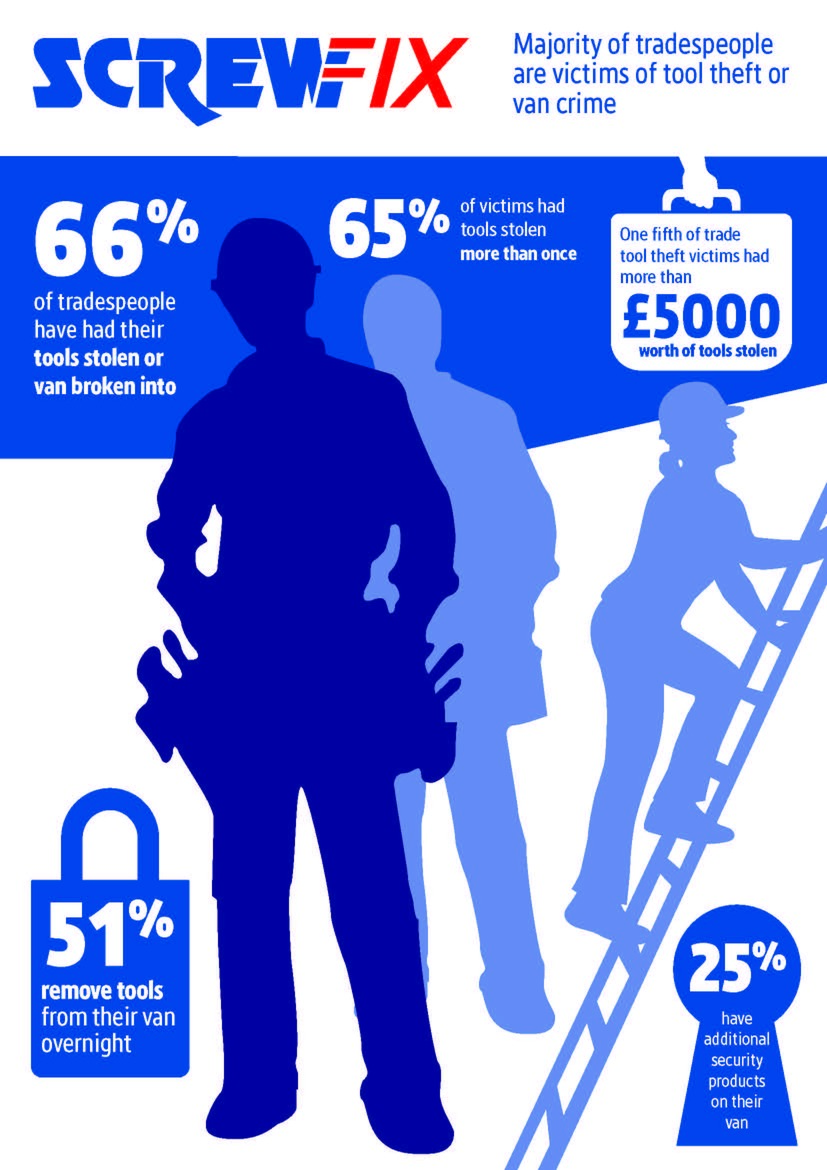
The majority (66%) of tradespeople have had their tools stolen or van broken into, a Screwfix survey has found. Nearly two thirds (65%) of tool theft victims have had their tools stolen more than once. And nearly a quarter (24%) said tool theft has had an impact on their business. For one fifth, tool theft is the biggest business worry. As a result of tool theft, two thirds (66%) of tradespeople have lost at least one working day, in addition to the loss of the value of the tools, which for three quarters (75%) was more than £500. One fifth of trade tool theft victims had more than £5000 worth of tools stolen. To protect themselves from tool theft, just over half (51%) remove them from their van overnight, 40% have CCTV at home, and one quarter (25%) have additional security products on their van. To help tradespeople protect their tools and vans, Screwfix has a range of security products including the Master Lock van padlock and hasp set 230mm. This nickel-plated, die-cast zinc padlock with hardened steel shackle and a nickel and chrome-plated hardened steel hasp is supplied with two keys and fixings and provides enhanced protection for a van. While smart CCTV kits from Swann ensure vans and properties can be monitored wherever a tradesperson is, and Van Vault products such as site security boxes and the Outback ensure tools can be kept securely whether on site or on vans. Ben Lainton, Director of Trading at Screwfix, says: “These latest findings show the concerning level of tool theft and van crime and the damaging impact they have on tradespeople and their businesses. Many of them are seeking ways to protect their tools and vans, so as a key supplier to the trade, we’re continuing to add security-focused innovations to our range to play our part and help them. The latest products from Master Lock, Swann, and Van Vault are prime examples and demonstrate how we are continuing to develop our offer to ensure we provide what the trade needs.”

Admiral Nelson’s former island given a power boost in Shepperton
Power engineers commuted to work by boat to deliver a £100,000 electricity network upgrade for residents at Pharaoh’s Island in Shepperton. UK Power Networks has installed and energised new electricity substation equipment to maintain reliable electricity supplies for residents on and off the island. The new equipment has modern automation, enabling engineers to quickly reconnect electricity supplies in the area if a power cut was ever to happen. Alex Young, a field engineer who led the project at UK Power Networks, says: “It has been a memorable job. The most challenging part is that our substation is on an island on the River Thames and the only way to get there is via a boat. “The logistics of getting a three-tonne transformer, cabling and switchgear onto the island meant we needed to hire a barge, crane and enlist specialist boat people who know the river. “I always like a challenge, so I have enjoyed working on this project.” Every day, for about three weeks, the team met at Shepperton Lock and were taken to the island by boat. They installed approximately 300-metres of new cabling and replaced a 1950s transformer with modern new equipment which can be remotely controlled from the company’s control centre. The network investment will not only improve network resilience for 23 homes on the island, but will also improve network reliability for about 200 homes in the surrounding area. In the past, if there was a fault, engineers needed to reach the island by boat to reconnect supplies. The introduction of automation will reduce the need for engineers to reach the island. Alex adds: “With automation we can restore more power supplies within the first three minutes. The new equipment has fault path indicators and tele-control, so if we can see where the fault is our control engineers can restore supplies on the healthy circuits.” Pharaoh’s Island once belonged to Admiral Nelson and was used as a fishing retreat. It was purchased by the Treasury and given to Admiral Nelson after the Battle of the Nile in 1798 and most of the island's 23 homes have Egyptian names. UK Power Networks is investing £600 million in the electricity network across the South East, London and East of England this year. More than eight million homes and businesses are connected to electricity via the company’s cables and substations and there are over 53,000 kilometres of underground and overhead power lines in the South East alone.

Marshall-Tufflex strengthens its dedication to quality
Marshall-Tufflex has formed a dedicated quality assurance team to enhance its existing offering. Reporting into Operations Director Jean Dias, the two new appointments further demonstrate the company’s continued commitment to producing high-quality products for all applications. Marshall-Tufflex has appointed Ketlyn Silva as Quality Manager and Bruna Contiero as Quality System Administrator, who will both be key in maintaining and developing the company’s quality assurance processes. With a new dedicated team in place, the appointments will provide increased focus on ensuring maximum quality and consistency that the Hastings based manufacturer is renowned for. As part of their roles, Ketlyn and Bruna will also ensure that Marshall-Tufflex maintain the relevant BSI and ISO standards, including its BS EN ISO 9001:2015 accreditation. On the appointments, Jean Dias, Operations Director at Marshall-Tufflex says, “Quality is at the heart of our offering, therefore we are delighted to welcome Ketlyn and Bruna to the business to strengthen this proposition further. With a dedicated team in place, we aim to enhance the consistent quality we already deliver, to continue to provide our customers with solutions, such as our PVC-U trunking products, which are manufactured from robust and durable recycled material originating from waste PVC-U window frames. “At Marshall-Tufflex, we place huge importance on customer satisfaction and I am confident that Ketlyn and Bruna will uphold these standards and wish them every success in the role.” In response to growing demand, Marshall-Tufflex has recently welcomed a number of new employees as part of its continued commitment to business growth and customer focus.

Domus Ventilation Revit BIM files available as direct download
Domus Ventilation has announce that its full range of Revit BIM (Building Information Modelling) files can now be downloaded directly from its website, free of charge.   BIM is a government driven shared knowledge resource, providing all of the information about every component of a building, in one easy to access place. Autodesk Revit is a BIM software for architects, structural engineers, mechanical, electrical, and plumbing engineers, designers and contractors. It is used to create co-ordinated, consistent and complete model-based designs that drive efficiency and accuracy across the project lifecycle, from conceptual design, visualisation and analysis to fabrication and construction. Using BIM data reduces the risk of mistakes or discrepancies at an early stage, making for more cost-effective, safe construction.   The Domus Ventilation BIM library features an extensive array of products, including energy saving, whole house Mechanical Ventilation with Heat Recovery (MVHR) appliances, as well as award winning Radial semi-rigid duct systems and its full range of rigid ducting and accessories, which incorporates Domus Thermal duct insulation and duct sound attenuators.   BIM ‘Object’ data on Domus Ventilation products includes detailed information such as product properties, geometry, visualisation data and functional data that enables the ‘object’ to be positioned and behave in the same manner as the product would in-situ. Airflow rates, for example, can be set at each grille or air valve, allowing engineers to easily and more accurately estimate pressure losses and velocities within the ductwork, which isn’t possible using other design packages, such as AutoCAD. Product dimensions are automatically calculated to ensure it fits into the desired design space and even the correct amount of product required is calculated within BIM to prevent product wastage. In addition, BIM enables parts to be automatically scheduled during the design process, for speed and maximum convenience.

SME builders on the verge of extinction as numbers plummet 80%
The latest research from the real estate debt advisory specialists, Sirius Property Finance, has revealed why recently introduced government measures to help boost the number of SME property developers is sorely needed, as SME numbers have plummeted by 80% since the late 80s. Defined as small to medium-sized housebuilders, SME developers typically deliver between one and 1,000 homes to market on an annual basis, with a focus on smaller projects compared to the big names in the sector. In February of this year, the government’s housing accelerator, Homes England, together with the United Trust Bank, announced a £250m fund aimed at supporting SME builders - with the additional carrot of development finance up to a 70% loan to gross development value. The market analysis by Sirius Property Finance shows why this help is badly needed in order to help boost the dwindling number of SMEs. The data shows that in 1988, there were 12,215 SMEs operating across England delivering 77,524 new homes to the market. That was 40% of all new homes with an estimated market value of over £4.6bn, a significant proportion of market activity. However, since then, SMEs have faced various challenges including red tape barriers around finance and planning, a reduced level of opportunity due to not one, but two financial crashes, complicated public procurement processes and most notably, growing competition from the big housebuilders. As a result, the latest data shows SMEs are on the verge of extinction with just 2,500 currently operational across England. That’s an -80% reduction since 1988 at a rate of 335 SME developers a year (-2.7%). As a result, the number of new homes built on an annual basis by SMEs has reduced from 40% in 1988 to just 12% today. The only silver lining is that far higher new-build house prices mean the value of this 12% is higher than the 40% built back in 1988 at almost £5.8bn. Managing Director of Sirius Property Finance, Nicholas Christofi, comments: “Although it’s great to see the government finally recognise the importance of SMEs and the role they play in delivering much needed housing stock, it’s fair to say that this support is long overdue and perhaps too little too late. In the last three decades, they’ve come close to extinction due to a range of factors, but most notably due to competition from the big housebuilders and, as a result, the number of operational SMEs has plummeted. Hopefully, we will now see a reversal in this downward trend and the number of SMEs will once again start to climb. While the big housebuilders do an admirable job, greater variety and competition within the sector can only be positive and will force standards and quality of output to climb across the board.”

Home security expert comments on £435m to prevent crime
Chancellor Rishi Sunak announced in today’s Budget that £435m is going to be spent on helping to prevent crime, protect communities and help victims in England and Wales. Speaking on the Government’s move to increase CCTV, Robin Knox, Home Security Expert and Co-Founder of the smart home security start-up Boundary, commented the following: “A large proportion of the Government’s investment into crime is going towards ramping up security on the streets, helping women to feel safer with improved street lighting and better CCTV. It’s important that women feel safe on the streets, as does everyone else, and with the increased presence of CCTV seemingly wherever you go, whether it be on the street, from your doorbell or even in the car, it’s clear that there is a demand for these sorts of cameras to provide added protection. “It is however important to emphasise that, although this constant monitoring is important for when it comes to crimes committed out on the street, those looking to keep their homes safe from crime should look for other alternatives to CCTV. Although it may be comforting to know your house is being monitored, there is a substantial lack of privacy for your neighbours, who may have not given you permission to film around your house or may not even be aware that they’re being watched. “It’s important that, when looking into outdoor home security cameras, buyers look for systems that include privacy masking to avoid recording outside of the boundary lines of the home. Otherwise, signage would be required as well as compliance with GDPR data management regulations. Motion detection zones can also be set up to reduce false alerts. “Not only should a home security system flag legitimate threats of break-ins, but they should also then proceed to provide follow-through protection, such as automatic police response. Self-monitored cameras might initially seem useful and exciting but it can be hard to always be on-duty when at work, on holiday or asleep. A professionally monitored system from a recognisable brand makes it more likely that your intruder will be initially deterred, cause less damage and ultimately increase the likelihood of being caught, thanks to a swift and reliable 24/7 response. “Consumers who are buying smart devices for their homes should consider the privacy trade off they are making. Look out for systems that have BS EN 50131 tested motion sensors as not only are these private compared to cameras, they’re able to access the fastest police response available, actually faster than a visually verified (operator viewing camera) break-in."

Knightsbridge LED mirrors reflect modern tastes
Designed to upgrade any bathroom, the ML range – the latest LED mirrors from Knightsbridge – is bursting with features the discerning householder will find appealing. The top-of-the-range models comprise a demister pad, an on/off motion sensor, and include a dual voltage 115V/ 230V shaver socket outlet with independent switch control. The mirrors themselves, constructed from a pressed-steel base and high-quality glass, can be rectangular or circular, with a mini circular LED border design or illumination from a surrounding LED border. For reference, the product codes are: MLR6045SD (rectangular, back-lit design); MLC6045SD (rectangular design); and ML500 (circular design). Practical and yet just as stylish, the VML1 vanity mirror light is equipped with a mirror that magnifies the user’s face by three while it is lit by a frosted edge diffuser. The whole, wall-mounted unit is finished in polished chrome, and is easily positioned to achieve the best angle for shaving or applying cosmetics. For those customers after a colourful experience, the RCTRGB is an edge-lit mirror with an RGB remote control to change the colour of the edge light to red, green, blue or warm white as required. The remote has a memory function to ensure that it switches on at the last setting. Whatever style, functionality, shape or size, Knightsbridge has a collection of LED mirrors that will always reflect well on the homeowner, mixing good design with utility, practicality with a bit of pizazz. [gallery columns="2" ids="27643,27644"]

myenergi set to host EV drivers en route to COP26
myenergi will welcome electric vehicle drivers from across the UK and Europe to its eco headquarters in Lincolnshire, as they travel to the COP26 UN Climate Change Conference. Part of the ‘Electric Road to COP26’, an initiative organised by EVA England, EVA Scotland, GEVA and Local EV Groups (NEXUS), the group is visiting companies operating at the forefront of the electric vehicle revolution to raise awareness of the need for faster transport decarbonisation. When they arrive at myenergi, drivers will have the opportunity to meet the green team and take a private tour of the company’s state-of-the-art facility. They will also be introduced to myenergi’s latest range of renewable energy technologies, including the eco-smart zappi EV charger. From here, the group will travel up to the Britishvolt EV battery gigafactory site in Northumberland, before arriving in Glasgow for the opening of COP26. During the two-week event, representatives will be calling for all sales of new cars and light duty vans to have a plug by 2030 and be zero emission by 2035. Jordan Brompton, co-founder and CMO of myenergi, comments: “We’re looking forward to hosting drivers taking part in the Electric Road to COP26. As well as putting on lunch, we’ll be offering guided tours of our pioneering eco headquarters, which was officially opened earlier this year. “Initiatives to raise awareness of transport decarbonisation are hugely important. Indeed, transportation accounts for 24% of direct CO2 emissions from fuel combustion globally, of which road vehicles are responsible for nearly 75%. A rapid shift to electrification is essential to combat these statistics, but legislation is critical to accelerating the transition.” Alongside hosting the Electric Road to COP26 visit, members of the myenergi team will also be attending COP26. Kate Tyrrell, events & relationship manager, will be speaking at the COP26 Ferry Event (hosted by National Grid) and promoting eco-smart technologies in the Green Zone throughout the two-week event.

Appetite for electrical careers soar in Scotland
Scotland’s electrical training body has saluted an “excellent” start to the academic year after the number of electrical apprentices and adult trainees beginning their studies reached a 12-year high. More than 800 new learners have enrolled on the Electrical Apprenticeship and Adult Trainee Programmes for 2021, with colleges and training centres reporting full classrooms as future professionals take their first steps on the electrical ladder. The intake is the highest in Scotland since 2009 – and the Scottish Electrical Charitable Training Trust (SECTT) says it’s another encouraging sign of the determination to tackle the UK-wide skills shortage . Barrie McKay, Training and Development Manager at SECTT, which manages high-quality training on behalf of the Scottish Joint Industry Board (SJIB), says: “I’ve been at SECTT for more than 20 years and it’s really encouraging to see a return to such high numbers. “The figures are particularly satisfying  given the position the industry was in this time last year, when only 500 people began training due to the impact of COVID-19. “This improved intake illustrates that people recognise that the future is electric and also understand that their personal prospects will be brighter if they’re part of a sector that is going to play a key part in all our lives.” A total of 2,158 electrical apprentices and adult trainees are currently training in Scotland, including the 715 apprentices and 126 adult trainees recruited for the 2021 intake. Barrie adds: “Not only are the numbers looking good, but the quality of the young people being taken on – both male and female – is really impressive. “The industry has been concerned for some time about skills shortages as the demand for qualified electricians accelerates, and the enthusiasm and dedication of these new recruits goes a long way to easing these fears and suggesting that there is an appetite to learn among the electrical talent of tomorrow. “As colleges continue to recover from the challenges of COVID-19, they will now help their students embrace all the modern technologies which will play such a huge part in a greener and more sustainable future.” SECTT and the SJIB praised employers for taking on apprentices in numbers earlier this year, confounding fears that recruitment could be a casualty of the ongoing effects of the COVID-19 pandemic. Both bodies also pointed towards the altered perception of employment in the sector, thanks to the long-running campaign for regulation of the electrical industry spearheaded by SELECT, Scotland’s largest construction trade association. Fiona Harper, Director of Employment & Skills at SELECT and The Secretary of the SJIB, says: “The industry as a whole is committed to the next generation of talent coming through, and employers are clearly supportive of creating a pool of highly-trained, highly-qualified personnel to take their business and the sector forward.”

Electric Vehicle owners are most 'considerate' drivers
Almost three quarters (73%) of EV owners say they are more considerate drivers having made the switch to an electric car, new research from Love my EV reveals, the UK’s only dedicated EV and green energy comparison site. EV drivers are not only playing a vital role in reducing harmful emissions, but also making roads a safer and more pleasant place to be. Over two thirds (67%) of EV drivers have completely changed their driving style since moving away from fossil fuels, now less aggressive with their accelerating and braking. This change in behaviour not only saves drivers money by reducing the frequency or length of battery charge required, but it also benefits the environment as less energy is used and wasted. There is still a role for increased driver education, however, as almost 9% of EV drivers do not realise they can maximise each charge of their battery by driving less aggressively, reducing acceleration speed and using regenerative braking. Regenerative braking improves energy efficiency and extends the vehicle’s driving range. Eight in 10 (80%) EV owners make use of regenerative braking, which turns wasted energy from braking into electricity to charge the battery and boost efficiency, with half (50%) of these drivers doing so frequently. Driving efficiently in an EV appears to be contagious and research shows that couples are competing to maximise the mileage of their vehicle per kWh. More than half of all drivers admit they compete with a partner to be the most efficient driver, by either using the momentum of the vehicle to recharge their battery and/or paying more attention to the road in order to avoid harsh braking. Mat Thomson, co-founder of Love my EV, comments: “Electric vehicles offer incredible environmental benefits in terms of lower emissions, but it is great to hear that they could also be positively impacting driver behaviour. Avoiding harsh braking and excessive acceleration not only saves drivers money by maximising the number of miles they can drive on each full charge, but it also makes for a nicer environment for all road users.” “Higher efficiency per mile means the ‘all-in’ cost of driving an EV can be much lower than many people think. Love my EV matches people to an EV that is best suited to their unique needs, whilst also finding the best value and greenest home energy to power their car and home with.”