2 November 2026
Product of the Month: Amari Floodlight range by Aurora Lighting
 
12 November 2026
Schneider Electric transforms Southampton hospital estate
 
12 November 2026
GTEC Training opens new education facility in North Yorkshire
 
11 November 2026
Energy, AI and smart buildings: register now for EMEX 2026
 
11 November 2026
Solar and batteries could cut electricity costs by 40%, data finds
 

Latest News


Appetite for electrical careers soar in Scotland
Scotland’s electrical training body has saluted an “excellent” start to the academic year after the number of electrical apprentices and adult trainees beginning their studies reached a 12-year high. More than 800 new learners have enrolled on the Electrical Apprenticeship and Adult Trainee Programmes for 2021, with colleges and training centres reporting full classrooms as future professionals take their first steps on the electrical ladder. The intake is the highest in Scotland since 2009 – and the Scottish Electrical Charitable Training Trust (SECTT) says it’s another encouraging sign of the determination to tackle the UK-wide skills shortage . Barrie McKay, Training and Development Manager at SECTT, which manages high-quality training on behalf of the Scottish Joint Industry Board (SJIB), says: “I’ve been at SECTT for more than 20 years and it’s really encouraging to see a return to such high numbers. “The figures are particularly satisfying  given the position the industry was in this time last year, when only 500 people began training due to the impact of COVID-19. “This improved intake illustrates that people recognise that the future is electric and also understand that their personal prospects will be brighter if they’re part of a sector that is going to play a key part in all our lives.” A total of 2,158 electrical apprentices and adult trainees are currently training in Scotland, including the 715 apprentices and 126 adult trainees recruited for the 2021 intake. Barrie adds: “Not only are the numbers looking good, but the quality of the young people being taken on – both male and female – is really impressive. “The industry has been concerned for some time about skills shortages as the demand for qualified electricians accelerates, and the enthusiasm and dedication of these new recruits goes a long way to easing these fears and suggesting that there is an appetite to learn among the electrical talent of tomorrow. “As colleges continue to recover from the challenges of COVID-19, they will now help their students embrace all the modern technologies which will play such a huge part in a greener and more sustainable future.” SECTT and the SJIB praised employers for taking on apprentices in numbers earlier this year, confounding fears that recruitment could be a casualty of the ongoing effects of the COVID-19 pandemic. Both bodies also pointed towards the altered perception of employment in the sector, thanks to the long-running campaign for regulation of the electrical industry spearheaded by SELECT, Scotland’s largest construction trade association. Fiona Harper, Director of Employment & Skills at SELECT and The Secretary of the SJIB, says: “The industry as a whole is committed to the next generation of talent coming through, and employers are clearly supportive of creating a pool of highly-trained, highly-qualified personnel to take their business and the sector forward.”

Electric Vehicle owners are most 'considerate' drivers
Almost three quarters (73%) of EV owners say they are more considerate drivers having made the switch to an electric car, new research from Love my EV reveals, the UK’s only dedicated EV and green energy comparison site. EV drivers are not only playing a vital role in reducing harmful emissions, but also making roads a safer and more pleasant place to be. Over two thirds (67%) of EV drivers have completely changed their driving style since moving away from fossil fuels, now less aggressive with their accelerating and braking. This change in behaviour not only saves drivers money by reducing the frequency or length of battery charge required, but it also benefits the environment as less energy is used and wasted. There is still a role for increased driver education, however, as almost 9% of EV drivers do not realise they can maximise each charge of their battery by driving less aggressively, reducing acceleration speed and using regenerative braking. Regenerative braking improves energy efficiency and extends the vehicle’s driving range. Eight in 10 (80%) EV owners make use of regenerative braking, which turns wasted energy from braking into electricity to charge the battery and boost efficiency, with half (50%) of these drivers doing so frequently. Driving efficiently in an EV appears to be contagious and research shows that couples are competing to maximise the mileage of their vehicle per kWh. More than half of all drivers admit they compete with a partner to be the most efficient driver, by either using the momentum of the vehicle to recharge their battery and/or paying more attention to the road in order to avoid harsh braking. Mat Thomson, co-founder of Love my EV, comments: “Electric vehicles offer incredible environmental benefits in terms of lower emissions, but it is great to hear that they could also be positively impacting driver behaviour. Avoiding harsh braking and excessive acceleration not only saves drivers money by maximising the number of miles they can drive on each full charge, but it also makes for a nicer environment for all road users.” “Higher efficiency per mile means the ‘all-in’ cost of driving an EV can be much lower than many people think. Love my EV matches people to an EV that is best suited to their unique needs, whilst also finding the best value and greenest home energy to power their car and home with.”

EPC rating remains important for only 30% purchasing a home
The latest research from NatWest and IHS Markit has revealed that the Energy Performance Certificate rating (EPC) of a property remained a relatively low priority among prospective homebuyers. The latest survey from the Greener Homes Attitude Tracker, based on responses from 4,500 people across the UK in the third quarter of 2021, found that only a small percentage of homebuyers considered EPC rating a 'very important' factor if purchasing a home in the next 10 years, the fourth lowest among the 12 factors surveyed. Only 15% of households said that having an EPC rating of C or above was essential when selecting a property. The EPC rating ranked below other environmental factors, such as air quality (37% said ‘very important’), amount of local green space (38%) and levels of noise pollution (41%). Out of all the environmental factors listed, risk of flooding was considered by far the most important (55%), even beating internet speed (46%) for importance. The recent rises in wholesale gas prices are another illustration of the challenges that consumers face as they try to understand what they can do to play their part, how much that may cost and how they can protect themselves from rising energy bills. The tracker found further need to raise awareness of what actions can be taken, with only one-in-seven homeowners ‘very confident’ of being able to replace their gas boiler with a more sustainable alternative at an estimated cost of £5,000. 57% were either 'not very' or 'not at all confident'. North versus South When it came to regional attitudes: 20% of Scottish households who are looking to buy a house in the next 10 years say an EPC rating of C or above is an ‘essential’ feature is when selecting a property (the highest proportion). Conversely, 10% of Scottish households say it’s ‘not at all important’, which is the highest of any region or nation. 10% of those in the North of England who are looking to buy a house in the next 10 years say an EPC rating of C or above is an ‘essential’ feature. By region, homeowners in the North of England (57%) are the most likely to have plans to make property sustainability changes in the next decade compared to 51% in Scotland. Attitudes by Age Group 18% of 35-44 year olds who are looking to buy a house in the next 10 years say an EPC rating of C or above is an ‘essential’ feature is when selecting a property (the highest proportion). 11% of 18-24 year olds who are looking to buy a house in the next 10 years say an EPC rating of C or above is an ‘essential’ feature  (the lowest). More than half of UK homeowners once again are planning to make improvements to the environmental sustainability of their property in the next decade, according to the third quarter results. Whilst this proportion (55%) has only changed slightly since the previous quarter (54%), the percentage of respondents expecting to make these changes in the next 12 months has risen to 16% (compared to 14%). Lloyd Cochrane, Head of Mortgages at NatWest says: ‘Making sustainable choices in the home can often be complex and expensive. The Greener Homes Attitude Tracker is designed to give the bank, and the wider market, a better understanding of consumer attitudes so we can ensure we support our customers in the best way. It’s one of a number of ways that we can contribute to raising consumers awareness around sustainability as the UK government works towards net zero target by 2050. 'But with COP 26 fast approaching, the tracker shows that there is a noticeable proportion of homeowners who firstly don’t consider an EPC rating or energy efficiency as important and secondly, have no plans to make improvements in the next decade. Alongside the products we provide to support customers make greener choices and the information to inform those choices there is much more we all need to do across industry and government to raise consumer awareness, provide relevant information and appropriate support. The switch to greener lives and homes should be accessible to all – not just those who can afford it.’ To address the key blockers in meeting net zero in the UK buildings environment, NatWest recently launched a ‘Sustainable Homes and Buildings Coalition’. By partnering with British Gas, Worcester Bosch, and Shelter the bank is setting out to improve UK buildings energy efficiency, to raise awareness and help customers understand the choices they have to decarbonise their homes and commercial buildings. The first report, Home is where the Heat is’ will be launched October 21st.

Multi-vehicle charging hubs are the future for commercial transport 
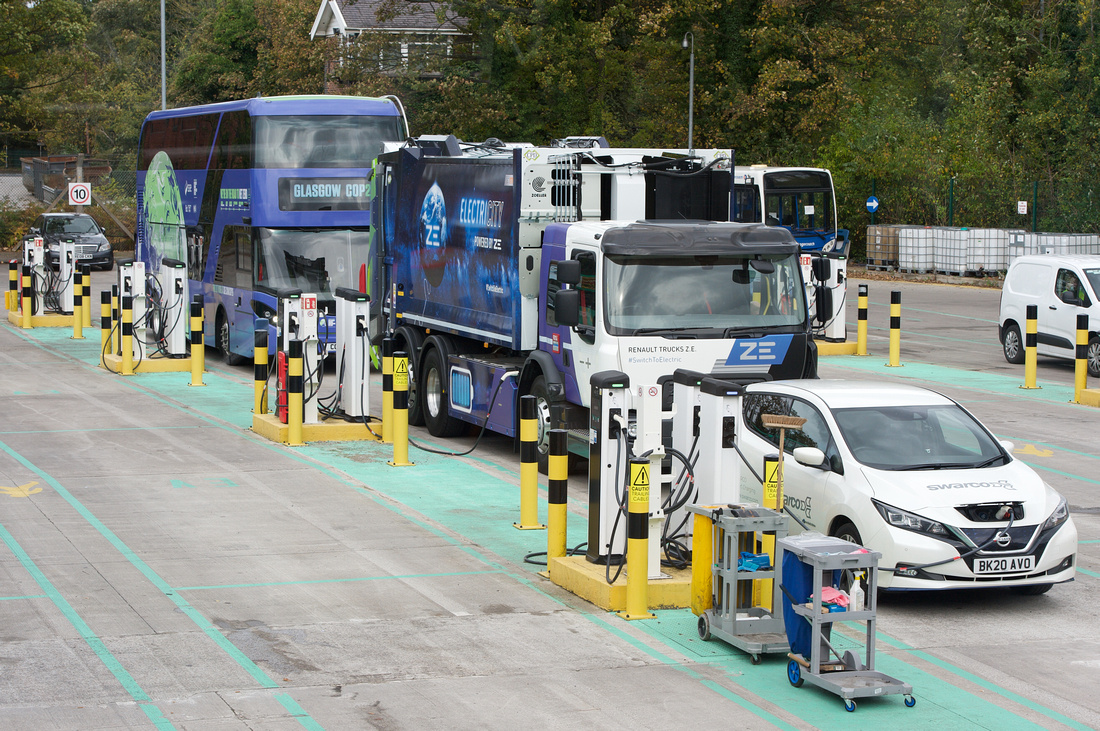
Plans being developed to open up electric bus charging hubs to lorries and vans so that any business can charge its electric vehicles (EVs) would help accelerate the UK’s transition to low carbon transport, according to energy industry leader SSE and SWARCO Smart Charging. The idea was highlighted today (25 Oct) during a visit to Sharston bus depot in Greater Manchester, which features 32 electric vehicle charging stations, making it the first sizeable EV bus charging depot in England outside London. SSE Energy Solutions and SWARCO Smart Charging are currently looking at a number of opportunities around the UK to equip bus depots with EV charging facilities which could then be made available for use by local business fleets. Two-thirds of electric cars bought in the UK are purchased by businesses, rather than private buyers, according to industry figures. Last year more than 108,000 new electric cars were registered. The Sharston site is used by Stagecoach, the UK's biggest bus and coach operator, and is the home to the region's first double-decker electric bus fleet which is estimated to save over 2200 tonnes of carbon a year. Stagecoach operates a fleet of clean, green buses across Greater Manchester. SSE highlighted the shared charging idea as part of a tour of the UK’s green energy and sustainable transport projects in the run up to the Cop26 climate summit on 1 November.  A COP26-branded electric bus drew up at the Sharston charging points alongside other commercial vehicles including a refuse collection vehicle and a car. The concept is that while buses are busy working the streets during the day, sites could be made available during daytime hours for other businesses who wish to charge their electric vehicles. It comes as SSE Energy Solutions works with Stagecoach in England to support their business cases for ZEBRA (Zero Emission Bus Regional Area) funding from the UK government.  Meanwhile in Scotland, SSE Energy Solutions has been working with Stagecoach to use SULEBS (Scottish Ultra Low Emission Bus Scheme) funding from the Scottish government. This is enabling SSE to install charging stations at Aberdeen and Perth bus depots, using chargers from SWARCO Smart Charging. Work starts on site at Perth this month (October) to install five chargers serving ten bus bays, and at Aberdeen next month (November) to install 11 chargers serving 22 buses, along with a single charger for ‘opportunity charging’ at the local bus station. Kevin Welstead, EV Sector Director for SSE Energy Solutions, says: “SSE Energy Solutions are working with Stagecoach and SWARCO on a number of sites across the UK, utilising our range of services to provide the optimal electrical infrastructure for each depot. We look forward to continuing to develop these relationships by building on our existing successes, and by working together for a green future for all modes of transport. By focussing on interoperability of chargers for electric vehicles across the network and efficient use of assets we can work together to benefit more electric vehicle users and support the nationwide transition to zero emission vehicles.” Justin Meyer, Managing Director at SWARCO Smart Charging, comments: “SWARCO is delighted to be working with SSE and others to help build a greener future for the UK transport needs. The idea of shared charging sites is being actively explored at a number of locations, to make best use of the charging assets we supply. This will undoubtedly help in the journey to net zero." Buses can be fully charged at sites such as Sharston in just a few hours. The Sharston depot also has a large solar array on the roof, generating renewable energy for the site to complement its grid connection. SSE is a major partner at COP26; and alongside the Go-Ahead group, Alexander Dennis, BYD and SWARCO Smart Charging is using an EV bus tour to showcase examples of the national effort already underway to decarbonise energy and transport. 

Extreme tools for extreme environments
For its spectacularly challenging motorsport series, Extreme E is counting on Bosch Professional to beat the elements and keep the events moving. Motorsport fans are used to roaring combustion engines and screeching wheels on blazing tarmac, but with Extreme E ‘X Prix’ races the action takes place in the wild. Extreme E is the world’s first off-road series to race 100% electric SUVs in the most remote parts of the world. In this, its inaugural season, Extreme E will take nine teams to the ends of the earth to raise awareness of climate change challenges. Together with the event crew, they have faced the desert in Saudi Arabia (Desert X Prix), the salt beds in Senegal (Ocean X Prix), the frozen ocean in Greenland (Arctic X Prix). And most recently rocky riverbeds in Sardinia (Island X Prix), with the final race taking place on the Jurassic coast in The UK (Jurassic X Prix). As official power tool supplier, Bosch Professional have been with them all the way. Ready for action – whatever the conditions “We work in some of the most aggressive environments in the world,” says Extreme E event manager Kester Wilkinson. “We need tools that can cope with everything from the sand and dust in Saudi Arabia to the cold, wind and rain in Greenland.” From deserts to glaciers, Extreme E needed professional power tools that could weather sand or storm. Bosch Professional has provided a full range of tools to make even the most difficult operations easier. With no easy access to replacement tools in the wilderness, Extreme E has no margin for error – so durability is vital. “Unless you have reliable, durable products, there’s no point bringing them,” says production crew member Dougie Dale. “You will end up breaking them and having to throw them away. But these” – he picks up a cordless Bosch Professional 18V BITURBO brushless circular saw – "work perfectly out here.” Although spare tools have been included in case of breakage, there has been no need to use them. “If a tool breaks, we need to have another one,” says Dale, “but our Bosch tools are not breaking. We have spares, but they’re still in the box.” Ultimate performance with maximum freedom At the heart of the Extreme E toolkit is a collection of Bosch Professional BITURBO tools, powered by the Bosch ProCORE18V Professional Battery System. BITURBO tools offer cordless freedom and convenience but deliver the same levels of power and performance as corded tools rated up to 1800W. Built to robust Bosch Professional quality standards, they benefit from advanced brushless motors which are much more powerful, energy efficient and longer lasting than the alternatives. The same can be said for Bosch ProCORE18V batteries, which combine perfectly with BITURBO tools to maximise each other’s performance. A key result of this is longer runtime between charges. When the power eventually runs out, full compatibility between Bosch Professional 18V tools, batteries and chargers enables quick and flexible swapping and charging. Amongst those Bosch products is the world’s fastest 18V charger. The Bosch Professional BITURBO range includes combis, drill drivers, impact wrenches, rotary hammers, saws, angle grinders and more. No power grid, no problem Of all the equipment supplied by Bosch Professional, its cordless tools are the most valuable on site. “We need tools that are reliable and can be deployed really, really quickly,” says Wilkinson. “Most of the Bosch tools we have are cordless, which means we can get them out of their boxes and use them straight away. The batteries are interchangeable, so we can just pick up a battery from one tool and put it on another. It's so easy.” Given the remoteness of its locations, Extreme E has to build sites from scratch – often without any power grid. “Obviously, having batteries that charge up and last is fantastic, because we have very little mains power out here,” says Dale. “It’s not like you can just plug a circular saw into a socket and start cutting. You need battery power, because we work in places where there’s no mains power.” In fact, as Extreme E travels from location to location on board the St Helena, a refurbished passenger-cargo ship, the batteries need to hold their charge in storage for over a month through aggressive marine environments – and be ready for immediate use upon arrival. Easy mobility After each race, the Extreme E crew has to pack up 50 containers’ worth of equipment, charge the tools and start planning for the next destination. “When the weekend’s racing is over, we need to break all the site facilities down on the Sunday night, put everything back onto the ship, and go,” says Wilkinson. “Confidence that our tools will work when we get them out in more than a month's time is absolutely essential. We’re delighted we have Bosch Professional tools which make that possible.”

Free heat pump courses from Logic4training
In recognition of the government's newly launched Boiler Upgrade Scheme and the opportunities this presents for gas installers, Logic4training is offering free Air Source Heat Pump (ASHP) training vouchers for candidates on two of its comprehensive plumbing and heating packages. Valid for life, the Air Source Heat Pump voucher can be redeemed at any time, setting recipients up for a successful career now and in the future. At present, gas is the predominant heating fuel in the UK, with 22 million homes currently on mains gas. Even once the Boiler Upgrade Scheme kicks in next April, which will offer funding towards the upgrade of 90,000 homes from fossil fuel boilers to ASHP's, gas will be the main heat source for many years to come, providing a steady stream of work for engineers - from installation to ongoing servicing and maintenance. Mark Krull, Director for Logic4training, says: "We want our trainees to feel confident that when they sign up for plumbing and heating training they are laying strong foundations for the future. For the next 20-30 years there will still be gas boilers, and if the hydrogen role out kicks off, there will be gas boilers of some description indefinitely. "Heat pumps are undoubtedly set to play a much bigger part in the UK's heating landscape, however, so installers should be getting ready for this shift. There's plenty of time, the transition away from fossil fuels will be gradual, that's why we've left the redemption of the voucher open-ended, so training can be taken when it suits business needs. "We are living through a period of great environmental awareness and when it comes to reducing the carbon footprint of our homes, heating engineers are at the heart of the action - it's time to get excited about the pace of change in our sector and embrace the challenges and opportunities that come with it."

Gripple appoints a new Ideas & Innovation Director
Gripple have appointed Gerard Shevlin as Ideas & Innovation Director. Gerard joins Gripple from Dyson, where he most recently held the role of Head of Engineering. Initially joining as an intern, Gerard held various prominent engineering leadership roles during his 23 years at Dyson, managing engineering and design teams that delivered industry leading innovations, from the original Dyson vacuum cleaner to, most recently a ventilator in response to the COVID pandemic, which accelerated from concept to production in just seven weeks. Gripple target 25% of their annual turnover to come from products less than 5 years old, ensuring consistent focus on innovation for the benefit of their global customer base. At Gripple, Gerard will be responsible for the 13 strong team of product design engineers and project managers, and will work closely with the product management, marketing and sales teams globally to drive progress against this key metric. Gerard joins Gripple during an excellent period for the business; record-breaking sales performance in 2021, continued expansion of existing and new manufacturing sites in Sheffield and Chicago, and the launch of the new and improved Fast Trak system which has been incredibly well received by the construction industry globally. Commenting on his appointment, Gerard Shevlin says; “After nearly 23 years of continuous employment, I fully intended to take some down time to spend with my family (and complete the various DIY jobs I’d been putting off for so long!), but I was immediately attracted to this opportunity at Gripple.” “After visiting Sheffield, and following many conversations with Gripple employees across the world, to say I was impressed would be an understatement. Everyone was so motivated and inspired by the future potential of the business and it was clear that nothing was out of scope in terms of exploring new opportunities, which was a hugely attractive prospect for me personally. The enthusiasm from all my now colleagues, combined with the continual year-on-year growth that Gripple are experiencing, made the role of Ideas and Innovation Director an opportunity that I couldn’t decline - the DIY can wait!” “I look forward to playing my part in continuing the growth of the business. I’m particularly excited to accelerate our current new product pipeline to the market, and even more so to begin developing new and diverse solutions to solve our customers’ problems.”

Fully Charged challenges global governments to electrify almost everything
Fully Charged has released a clean energy and transportation manifesto. Supported by some of the most pioneering businesses from across the energy and transport sectors, it challenges global governments to quit the chat and act today. From electrifying almost every form of ground transportation, to accelerating the switch to renewable energy generation, the Fully Charged team points out that in every area, proven solutions exist today. The call to world leaders is fronted by the channel’s founder – presenter and actor Robert Llewellyn – and are reinforced by CEOs of some of the foremost providers of renewables, electric vehicles, and clean energy. Robert Llewellyn, Fully Charged joint CEO states: “I’m terrified of COP26 being a platform for posturing, posing and pontificating. We need action from leaders across the world today to curb the impact we’re having on our planet. The crazy reality is, we already have all of the answers! Today, there are electric vehicles that are more capable than traditional cars; means of renewable energy generation that could easily fuel our lifestyles; and viable heating technologies that eradicate the need for gas. Our message to world leaders is simple – Stop Burning Stuff and Electrify Everything – TODAY!!!” The Fully Charged YouTube Channel and the brand’s global live events focus on the technologies that already exist to help consumers, businesses and governments think differently about mobility, energy generation and domestic use of clean energy. Ahead of COP26, Fully Charged is driving home the immediacy of the climate crisis, plus the urgency to switch to existing solutions. Simon Lomax, CEO of British ground source heat pump manufacturer and installer, The Kensa Group, says: “The UK’s pathway to reach net zero through the phase out of gas and the deployment of heat pumps is welcome, but it doesn’t go nearly far enough. The overdue Heat and Building Strategy, a pillar for the UKs COP26 commitments, is underwhelming and lacks both ambition and scale. To reach the 600,000 heat pump installations required by government per year by 2028, we require mass adoption. To achieve this, Kensa’s vision is networked ground source heat pumps; a scaleable, street-by-street approach, with individual ground source heat pumps in each home connected to a separately owned, funded and maintained underground infrastructure, mimicking and replacing the gas grid approach. This solution can be delivered immediately.  Indeed, Kensa has already completed large scale installations in all types of housing.  Introduce into this model smart controls, flexible tariffs, and the use of waste heat, and you have the lowest cost heat decarbonisation pathway that supports the electrification transition. Kensa’s ‘Welcome to Green Street’ augmented reality experience will be unveiled at COP26, firmly putting heat on the COP26 agenda and directly into the hands of world leaders, epitomising the optimum energy solution to affect change.” The collective voice, expressed in a special edition of the Fully Charged Show (live from 08:00BST on 26 October) makes the point that governments around the world are not acting with sufficient urgency and are often wasting time on the wrong technologies. The eyes of the world are on COP26 as a once in a generation opportunity to affect change. Businesses putting their name to supporting this effort to achieve change include: BritishVolt, GRIDSERVE, myenergi, Polestar, EAV, Kensa Heat Pumps, Mixergy, Octopus Energy, Ripple, Tepeo, Volta Trucks. [embed]http://www.youtube.com/watch?v=6k865qo-6mw[/embed]

TRILUX solution whets the appetite and increases sales
Boley Park has recently become Central England Co-operative’s flagship community store as part of a £3 million development. The new store features a redesigned interior, eco-friendly fridges, a free water refill station, a phone charging area, customer seating inside and outside of the store as well as self-scan checkouts. As part of this development the design team were looking to use TRILUX lighting to enhance the modern, high-quality feel and to draw attention to products. The Co-op design team had previously used spotlights to light their stores but found that the circular beams created non-uniform areas, with shading around the edges, and required additional lighting as in-fill. It was initially the square distribution of the TRILUX GRADO range that caught the attention of the team as this meant spotlights could be aligned with no shading around the edges and the design of the units met the modern design ambitions. However, the deciding factor to proceed with TRILUX was the quality of light from the Grado range, particularly the Brilliant Food option which has been used over the produce displays. It is important to draw the customers to these areas with the help of high-quality lighting. The LED module BRILLIANT FOOD now emphasises colours even more expressively and whets the appetite for fruit and vegetables. Whites stay white whilst other colours are richer. Red shades, in particular, have an intense effect without being obtrusive. TRILUX also proposed lighting solutions and products for all areas, from the fresh food counter, assortment aisle and checkout as far as the car park, cold-storage room and office. The whole store has been lit purposely to highlight goods but create a variation in illumination giving personality across the space. Interest was added with the suspended Limba which gives a decorative feel whilst still providing very energy efficient lighting with good colour rendering. ‘The impact of the store lighting on the customer experience is fantastic.’ says Luke Olly, Energy and Environment Lead. ‘On the opening day we had a lot of positive customer feedback on how good the look and feel of the store is and with a 60% increase on sales compared to the previous year, the retail team have been very pleased with the final results.'

How to keep construction workers safe during cold winter months
The construction industry has withstood many changes during the coronavirus pandemic, and now there is no shortage of projects to keep up with. But as companies work to keep to their deadlines, it's important to take the time to keep employees safe during the colder months. You probably have safety measures in place on all your sites, but these processes should be reviewed and adapted specifically for winter to ensure that your workers are as safe as possible. Here, tools, equipment, and PPE supplier Zoro summarises some of the key things you can do as the weather turns cooler. Prepare before winter hits When the weather starts to get colder, you should start to make preparations for the upcoming months. Good measures to take are purchasing grit, salt, or sand to make walking on-site safer — this way, you will have it ready as soon as you need it. Check that any machine fluids (such as engine oil and hydraulic oil) are manufactured to withstand the expected temperatures. Then, conduct a survey of all the heaters in the cabs of any vehicles to be sure that they are working, arranging repairs as necessary. Lastly, ensure that you have the necessary tools to deal with melting snow and ice. Pooling water can slow down construction as well as making it unsafe for workers, so review your plans for water run-off to see if these areas can  cope with the additional water during winter rain and snow. Prevent falls Falling and slipping is one of the most common issues that employees face on construction sites throughout winter. One of the easiest things that you can do to lessen the likelihood of your workers falling, is to salt and grit as many walkways, scaffolding platforms, and steps are less slippery. You should also make sure that your workers are wearing hard hats at all times on-site, as one of the biggest dangers when people fall is that they can hit their heads. To remind people to use gritted walkways, and wear hard hats, it's useful to have a designated safety point with a whiteboard that summarises that site's safety protocol. This should include instructions for what to do when someone has a fall, such as not moving them if they are struggling or unconscious, and calling NHS 111 for advice if they or a colleague notices any injuries or mental fatigue after falling while working. Provide warm gloves and clothing Lots of the tasks on construction sites require people to be dexterous with their hands, so it's important to keep them warm. It's not only unpleasant to have cold hands, but it's also a hazard, because workers' hands seizing up can lead to accidents and injuries due to slower reactions. As well as this, if workers have their body temperature reduced very frequently, this can cause illness over time, leading to more sick leave and low morale. So, provide gloves for employees that provide both warmth and agility. Communicate to people that it's important to keep their gloves on at all times, and this is especially important when climbing scaffolds or ladders, or operating equipment. Then, instead of just buying reflective jackets, buy waterproof or fleece-lined ones. It's useful to have one set of reflective clothing for summer, and one for winter. Encourage employees to wear at least three layers in the cold weather, as well as telling them how important it is to bring extra waterproof clothing in case anything gets wet. Conduct regular safety checks In the summer, the main worry when working outside is avoiding heat stroke and dehydration. But in the winter, the hazards are more numerous. To prevent your construction site becoming unsafe, it's important to conduct regular safety inspections to check that equipment is working (and placed in safe areas), and that walkways and steps are gritted and not slippery. It's easy for snow and ice to make scaffolding, steps, and walkways dangerous. Placing additional signs around your site can also be helpful, as it draws attention to new hazards that are easily missed. For example, if there is an area that tends to ice over when the temperatures drop at night, adding a warning sign nearby can alert workers to being more careful there. It can also be useful to use signs to remind people of new protocols, such as turning off heaters. Set realistic goals Remember that it's not viable or safe for workers to finish projects in the same amount of time that they would do during dry summer weather. It's important to draw up realistic timetables that account for the fact that sites may be slippery, icy, and wet. Give teams more time to complete their tasks if necessary and tell your employees not to rush. Having workers tripping and injuring themselves on-site will only delay deadlines more, so it's much more productive to keep to a safer pace. It can also be useful to organise team meetings where you can check in and see how everyone is doing. Ask your workers how fast projects are moving, and arrange any extra safety precautions with them so that everyone is informed of how to work safely and effectively.