2 November 2026
Product of the Month: Amari Floodlight range by Aurora Lighting
 
12 November 2026
Schneider Electric transforms Southampton hospital estate
 
12 November 2026
GTEC Training opens new education facility in North Yorkshire
 
11 November 2026
Energy, AI and smart buildings: register now for EMEX 2026
 
11 November 2026
Solar and batteries could cut electricity costs by 40%, data finds
 

Latest News


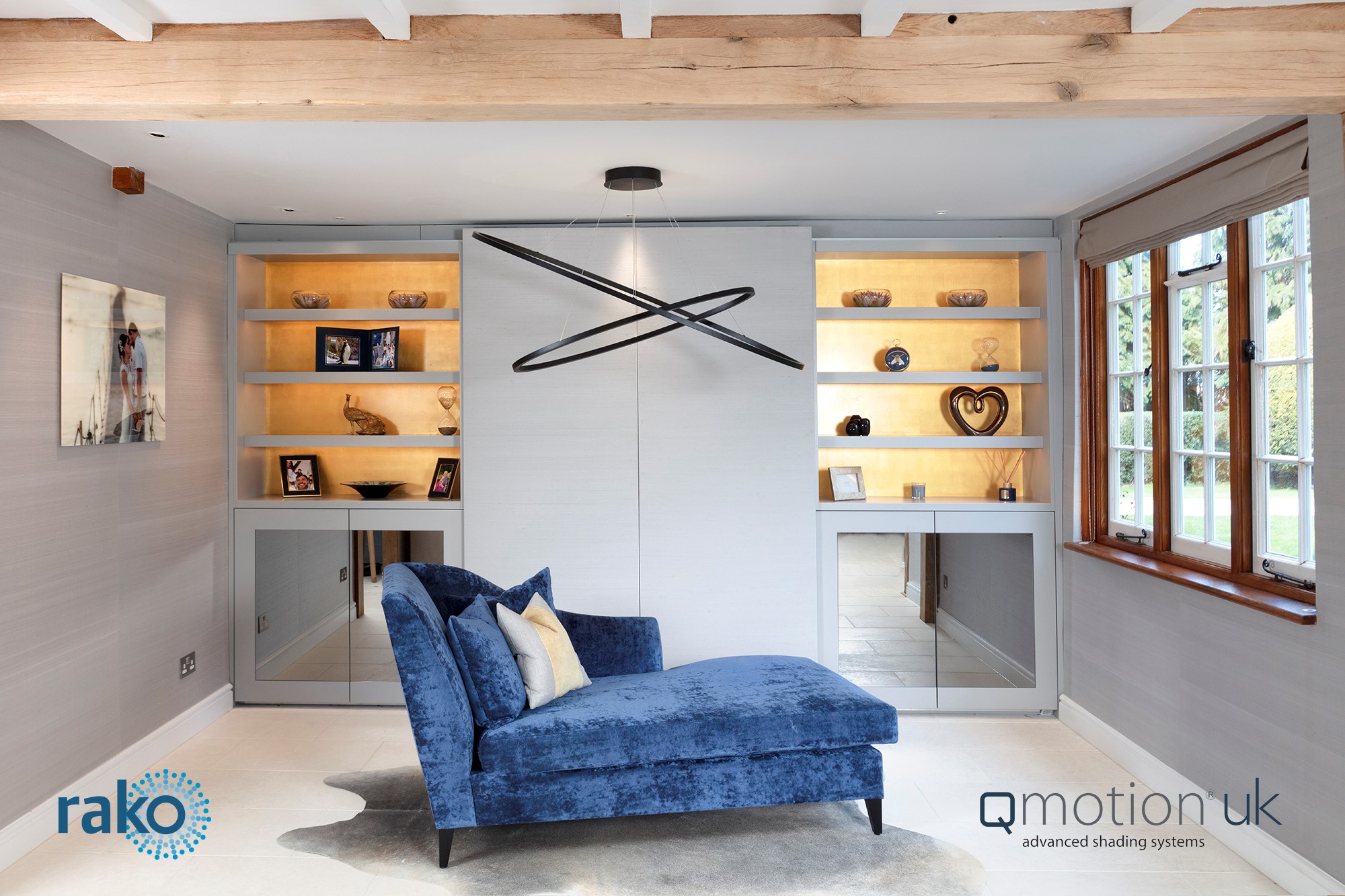
Rako launches supply partnership with QMotion UK
Rako has introduced a new partnership offering automated wireless blinds, powered by QMotion UK, a specialist in premium quality automated window coverings. This partnership builds on the established synergies between these two complementary brands and will provide dealers with a seamless experience when specifying and installing lighting and wireless blind control on a project. QMotion FM Roller and Roman blinds can already be natively integrated via the Rako RK-HUB or WK-HUB into Rako wired and wireless lighting control systems, without the need for special drivers or additional interfaces. Now, Rako customers will be able to access QMotion wireless shading solutions via Rako as well as training, sales, technical support and additional window treatment offerings. Industry leading wireless shading systems from QMotion feature a patented, single tube design which offers the most aesthetically refined, slimmest and unobtrusive blind solution on the market, perfect for windows ranging from 400mm to 3800mm in width. This elegant, single tube design also houses the alkaline batteries which drive the motor to support the low energy QMotion counterbalancing mechanism operating the blind. As a result, battery lifetime typically extends for up to three years with the batteries fully recyclable, when depleted, and easily accessible for replacement through the tube compartment. “We’re all about making life easier and more efficient for our dealers and their end clients,” says Paul Wafer, Director at Rako Controls. “Lighting control and automated window treatments work seamlessly together to increase comfort, security and well-being for clients in many modern smart homes. Since Rako and QMotion UK shading systems integrate so effortlessly with each other, and because QMotion’s wireless blinds are clearly the best in the sector, it’s a natural step to offer a one-stop sales and support solution for wireless shading that will help our dealers. This will save them even more time and hassle when specifying and installing on site.” “We’re delighted to support Rako’s dealers with high quality, automated wireless blind technology that’s backed by exemplary service, powered by QMotion UK,” adds Ian Claxton, Director at QMotion UK. “This move will deepen our alignment, provide strong benefits for Rako dealers and, ultimately, leave the client delighted with the best looking, most reliable and sustainable wireless blinds on the market.”

Nissan Gigafactory essential to UK EV battery supply chain development
Nissan’s commitment to the UK automotive sector’s electrified future is essential for the development of the UK’s EV battery supply chain and of major importance to both the UK government’s domestic decarbonisation of mobility strategy and post-Brexit industrial policy. From a practical perspective, it is essential to the competitiveness of UK automotive production that the largest domestic automakers commit to producing EVs in the market and manufacturing their costliest and most politicised component (the battery) internally, in Nissan’s case through an extended joint-venture with Envision, who already produce battery cells for the Nissan Leaf at the Sunderland plant. The 1bn investment, which is expected to create up to 6,200 new jobs and is thought to have received specific financial support from the UK government, takes the UK’s planned and operational battery-cell production capacity to around 43GWh, accounting for around 6.3% of the European total. As part of the agreement, Envision has the option to future-phase investment in the expansion of the site where potential capacity could be as much as 30GWh by 2030. We expect to see more details on the development of a localised battery materials supply chain for UK gigafactories (all of which that have been officially announced are in the North-East of England) over the coming quarters, as automakers seek to limit their exposure to external commercial and political supply-chain pressures. This focus on localisation is creating sub-regional hubs for EV battery manufacturing – we contend that the North-East of England is fast becoming one. Home to all 3 of the UK’s formally announced gigafactories, including a 30 GWh site from start-up Britishvolt, the region’s increasing prominence in this sector supports our contention that the primary pull factor for battery manufacturers will shift from low labour costs to the availability and cost of renewable energy. Battery manufacturing and recycling are energy intensive processes. Increased automation, an increasingly restrictive emissions environment and increased ESG-related considerations among policymakers, manufacturers and consumers has and will continue to drive this shift. The region along England’s North-East coast will therefore continue to benefit from its access to a diverse energy basket that includes the increasingly decarbonised grid, offshore wind and a North Sea link to Norwegian hydropower. The announcement will be heralded as a vote of confidence in the UK’s post-Brexit industrial future and will help Nissan as it mitigates the onset of increasingly stringent local content requirements for EV components agreed in the EU-UK Trade and Cooperation Agreement (TCA) over the coming years. We have previously highlighted how the TCA commits to a phasing-in of local content requirements for EVs, EV batteries and their components, though does not allow for diagonal cumulation with common trade partners, creating risks to the long-term competitiveness of UK EV exports. From 2027, in order to qualify for tariff free export to the EU (by far the UK automotive sectors largest export partner accounting for around 58.0% of total UK vehicle exports in 2020), 100.0% of battery materials must be sourced in the UK or EU. This is emblematic of the European region’s target to attain strategic autonomy in the EV battery supply chain, which has become heavily politicised and of critical importance both to domestic EV penetration prospects and the development of the energy storage industrial sector which is essential to broader decarbonisation initiatives. We expect the battery chemistry focus to remain on a dominant high-nickel variation of the NMC (Lithium Nickel Cobalt Manganese Oxide) which has been used in the long-range Leaf to date. We expect to see details emerge pertaining to the UK government’s support for the investment, which we have noted must become increasingly specific. Lastly, we expect to developments in the associated supply-chain over the coming quarters, specifically for raw materials extraction, refinement, processing and recycling after use. While geology will limit the extent to which the extractive element of the upstream can be localised, we expect the strategy of regonalising EV supply-chains to sustain.

Aico host Shropshire Fire and Rescue Service Business Education Seminar
Aico recently welcomed members of the Shropshire Fire and Rescue Service to their headquarters in Oswestry to host their Business Education seminar. Hosted in Aico’s flexible meeting room, in accordance with Government guidelines, the seminar was held for the purpose of educating local business owners and responsible persons on the legislative requirements around fire safety. Aico, the European leader in home life safety, has the primary aim of making homes safer, and strive to educate and inform the community, from electrical contractors to landlords and their residents. Aico were pleased to support their local Fire and Rescue Service in raising fire safety awareness. This opportunity arose from Aico’s new campaign, which aims to increase support to the Fire and Rescue Service across the UK. The campaign launched in September 2020 with the focus of offering increased support to each of the 52 Fire and Rescue Brigades across the UK, through the provision of Aico’s Fire Industry Association approved CPD training based on BS 5839-6:2019+A1:2020, use of Aico’s Mobile Training and Demonstration Units and access to office space at their Centre of Excellence, as well as homeowner and tenant safety packs. Martin Huckle, Watch Manager and Inspecting Officer for the Shropshire Fire and Rescue’s Protection Department adds “This is a busy time for all sectors of business as we emerge from the pandemic, and we were really pleased that local businesses took time out to come and listen to the presentation and hopefully take something away to make their premises safe for the people who use their buildings. Although we have made the presentation available online these live seminars provide the best opportunity for businesses to engage with the Fire Service in an open session of questions and answers to help employers have a better understanding of how to make their premises safe and comply with Fire Safety Legislation.” Aico’s Operations Co-ordinator Ryan Evans who joined the session commented “It was great to see so many local businesses engaged and learning about fire safety, it is really encouraging to see them taking time out of their busy schedules to keep up to date with the latest changes. As restrictions ease, we look forward to welcoming more of the community to use our facilities here in Oswestry”. As the government moves towards lifting all restrictions, Shropshire Fire and Rescue Service will be planning further live seminars.

Ansell Lighting expands senior team in Warrington
As part of its ambitious expansion plans, Ansell Lighting has made two senior appointments to its Warrington headquarters. Pete Blackburn has joined the business as Head of Product Development and Jane Rylands has been named Head of Marketing. Pete joins Ansell with more than 15 years’ experience, starting his career as a lighting designer at Whitecroft Lighting, before progressing to Global Product Manager at GE lighting and most recently, Global Product Manager at ACDC Lighting, part of the Zumtobel group. In his new role he will be responsible for leading the development of innovative new Ansell lighting products for the UK and international markets. Newly appointed Head of Marketing Jane Rylands joins Ansell from manufacturing giant Glen Dimplex Home Appliances, where she was Head of Marketing Communications, overseeing the marketing strategy for household names Morphy Richards, Stoves, Belling, Lec and Britannia Living. Jane will lead the development and implementation of Ansell’s marketing strategy both domestically and overseas. Mark Abbott, Managing Director at Ansell Lighting says: “Both Pete and Jane are at the top of their respective fields and their appointments are a demonstration of our ambitious growth plans for Ansell Lighting and the Ansell brands. I have every confidence that Pete’s innovative approach and Jane’s strategic expertise will push us forward in achieving our commercial goals for the business.”

54% of Brits confused about upcoming UK green home targets
As the UK government looks to transition to net zero greenhouse gas emissions by 2050, a number of green deadlines are approaching. Recent research from Checkatrade has shown that awareness of these upcoming changes amongst homeowners is low, with 54% of respondents admitting they find the concept of ‘greener’ homes confusing and believe there needs to be more clarity around what this means. With a plan already in motion to ban the sale of gas boilers in UK homes by 2025, currently only one in four Brits (24%) know exactly what the proposed boiler ban means and how it will affect them, showing a lack of awareness around the upcoming deadline. Additionally, by 2035 all social housing should be achieving between A-C rated Energy Performance Certificates, indicating high energy efficiency and lower running costs of heating, lighting and hot water. According to the Checkatrade study, only 22% of respondents stated that they understand what this deadline means and how it will affect them. However, despite this confusion, over half of respondents (55%) stated they were interested in undertaking sustainable improvements on their homes, and 56% would be interested in hearing about what changes they can make to their homes now to make them more sustainable. The findings also revealed that there are more benefits to making sustainable changes to the home aside from increasing energy efficiency and saving money, as 40% say they would be happy to pay more to buy a home that is ‘greener’. The top ‘green home’ features that Brits would consider installing include: Solar Panels – 55% Smart Thermostat – 52% Heat Pumps – 49% Electric Vehicle Charging Points – 47% Electric Boilers – 46% Biomass Boilers – 44% Ceiling Insulation – 43% Wall Insulation – 34% Double or Triple Glazing – 30% Meanwhile, 63% of respondents also agreed that they would need an expert tradesperson that is well-versed in sustainable home upgrades to carry out these improvements. CEO of Checkatrade, Mike Fairman, says: “Demand for energy efficiency-related projects has risen greatly in recent years – at Checkatrade we’re seeing a huge uptick in searches for sustainable home improvements, including a 28% increase this most recent quarter. It’s likely that consumer interest in sustainable homes will continue to increase, as protecting the environment becomes a larger focus for the public. However, there is a clear need for education amongst consumers on the concept of greener homes– this is where skilled tradespeople can play a key role to help raise awareness. With the UK’s upcoming green deadlines, it’s more important than ever for homeowners to have access to vetted professional to successfully implement these green changes – such as installing electric heat pump boilers – in their homes to comply with rules and regulations.’’ To help ease consumer confusion around green homes, Checkatrade has created a range of useful cost guides on everything from eco-friendly building materials to installing solar panels, giving Brits a helping hand on their journey to creating sustainable homes.

Selco forest paves route to sustainable future
Selco Builders Warehouse has stepped up its commitment to delivering a sustainable future for the business, its customers and colleagues by planting a new forest. In what is believed to be the most significant development of its kind in the builders merchant industry, Selco has directly supported the planting of more than 100,000 trees across 100 acres at a site near Jedburgh in the Scottish Borders to create the Selco Forest. The trees will offset around 8,000 tonnes of carbon during their lifecycle, the equivalent of almost two years of Selco’s customer deliveries, and forms part of a wider package of measures designed to reduce the company’s carbon footprint. Howard Luft, chief executive of Selco Builders Warehouse, believes it is vital the company accelerates its sustainability programme as it looks to its long-term future. He says: “We are proud to be a forward-thinking organisation and there is no doubt in my mind that tackling climate change is the next major global challenge we will face. “Our resilience as a business has been demonstrated throughout the COVID-19 pandemic, during which we have delivered a response built around protecting our customers and our people, the two mainstays of our business, and we will adopt the same strategy around sustainability. “The effect our operations have on the environment has been on the agenda for a number of years but we recognise there is more that needs to be done. “The current priority is to address our carbon emissions. Planting the Selco Forest marks a step change in our actions on this front and we will be planting many hundreds of thousands more trees across the UK in the coming years to extend this project. “However, work on lowering our carbon footprint doesn’t end there. We have already taken steps towards achieving that, including installing LED lighting and a new gas management system across our entire branch network. “We are also overhauling our transport fleet by utilising alternative fuel vehicles – including Compressed Natural Gas and fully electric – in our fleet and removing single fuel petrol and diesel cars from our company car list. “This sustainability journey is a long-term vision and isn’t restricted to the local communities in which we operate but also incorporates the wider Selco family, including manufacturers and suppliers.” Selco has joined forces with the landowner and key timber supplier BSW Timber, together with BSW Timber’s subsidiary companies Tilhill and Carbon Store, to make the Selco Forest a reality. Carine Jessamine, Selco’s marketing director and head of sustainability, adds: “The Selco Forest is an important milestone for our sustainability strategy and there will be more announcements on the wider programme in due course. “What is without doubt is that we are committed to continuing our investment in the future by playing our part in protecting our people, the environment and the planet.” With hundreds of trade brands always in stock, Selco’s 70 UK branches are firmly focused on helping tradespeople complete their jobs as quickly and effectively as possible. As well as offering trade services, Selco also has a strong digital presence including Click & Deliver, a Click & Collect service and a new website.

Birkdale acquires Ellumiére garden lighting systems
Birkdale has announced its acquisition of garden lighting systems brand Ellumiére. The move expands Birkdale’s portfolio even further with products that include deck lights, spotlights and illuminated bollards. Combining quality with simplicity, Ellumiére is a specialist garden lighting brand that provides easy to install LED lighting solutions. Crucially, Ellumiére products do not require a professional electrician to install them. This is because by simply plugging the transformer into a waterproof socket, it will convert 240V to just 12V, ensuring a safe, easy and reliable mains powered lighting system. Furthermore, the technology involved in the design of all Ellumiére lighting systems allows up to 12 LED lights per transformer in any configuration, for optimal design flexibility. With energy efficiency built in, ease of use and flexibility - Ellumiére offers further assurance with a two-year warranty on all its products. Birkdale’s acquisition of the lighting brand means the Ellumiére product range will now be available via Birkdale’s impressive merchant supply-chain, allowing the products to become more accessible to landscape gardeners, fencing contractors and trade professionals. “Our acquisition of Ellumiére marks an important step for the growth of Birkdale and its product offering,” comments John Abernethie, Managing Director of Birkdale. “With this innovative plug-and-play lighting range now sitting alongside our existing product portfolio, we are providing the trade with yet more ways to enhance a project with well-designed and simple to install solutions.” Ellumiére will now function as Birkdale’s fifth product range – Ellumiere By Birkdale – alongside its existing ranges, GATEMATE, FENCEMATE, SITEMATE, and DURAPOST. Find the full range on the company's website here.

Smart meters can speed up power cut fixes
Smart meters help you keep an eye on energy consumption, and now they’re being used to help check the cause of any local power cuts. UK Power Networks, the electricity distributor for London, the South East and East of England, is now using information from the meters to better support customers if they experience a power cut. People usually ring 105, or go online to report a power cut to UK Power Networks, but the company can now check smart meters using a 'ping' function allowing them to quickly see if the property has; A power cut requiring UK Power Networks engineer to attend A problem with internal fuses at the property requiring an electrician to attend, or A problem with the meter needing the energy supplier to assist. Since December 2020, the company has assisted 25% of all customers with a smart meter and aim to increase this over the next year. Currently there are 3.36 million homes (43%) with a smart meter installed across London, South-East and East of England. UK Power Networks forecasts that by May 2024 this will rise to 6.8m smart meters - which will allow it to provide extra support for customers, and in particular vulnerable customers on its Priority Services Register, where the firm can give then specific assistance in relation to the problem that is identified at their property. The company would also make proactive calls to its most vulnerable customers and then activate any support that would be relevant. Saleem Naeem, smart network operations manager at UK Power Networks, says: “This new system means we can adopt an agile approach to improving customer service and response time. It helps us investigate the cause of power cuts and know if an engineer needs to visit, and it speed up the response for customers. Having this greater understanding will help us to effectively adapt to new demands on the network, and subsequently support the government's net zero target by allowing customers with a smart meter to better minimise waste and reduce their bills.”

Electrical market prospects are positive following COVID-19 pandemic
The electrical wholesale market contracted by 16% in 2020, due to the disruption to construction output caused by the COVID-19 pandemic, but forecasts are looking positive as the market is expected to return to modest growth in 2021. The performance of the electrical wholesalers’ market is intrinsically linked to the performance of the construction sector, with the majority of its products required in new build and RMI activities. COVID-19 led to a significant curtailment of construction activity and electrical wholesalers’ business operation. As trading gradually returned to more normal conditions in the latter part of 2020, supply shortages were experienced in many key product areas, leading to price rises. Electrical wholesalers are the main channel for the distribution of electrical products as they are the principal source of supply for contractors and installers, especially smaller ones, as well as distributing to panel builders and OEMs. The number of electrical wholesalers establishing e-commerce operations will increase and will no longer be confined mainly to larger national and regional chains. However, trade counters will continue to be the main focus of business for most smaller regional and local wholesalers for the near future at least. This will be accompanied by further growth in digitisation of business processes. Together with greater usage of e-commerce, larger wholesalers will find that more efficient stock management processes, with enhanced logistics systems for moving products from central distribution centres, will lessen reliance on an extensive branch network. There will be an increasing focus on higher value, specialised products, for example through products aimed at the industrial automation sector. Other growing product sectors markets are likely to include home automation and building management systems, electric vehicle charging products and renewable energy products, such as those associated with heat pumps. Abdul Tantouch, Market Research Analyst at AMA Research comments, “Following the substantial downturn caused by the COVID-19 pandemic, only modest improvement is forecast for 2021, before economic recovery drives more robust growth from 2022. Though construction output growth will drive advance in the electrical wholesale market, market value is constrained by intense price competition, especially from online channels, with wholesalers focusing on high value product areas, such as home and industrial automation, as well as value added services, to maintain and improve profitability.” The electrical products market will remain highly competitive with increasing competition from non-specialist and online retail channels. Margins are expected to remain tight in most product areas, and wholesalers will seek to increase profitability through growth of high-value or niche product markets or development of added value services.

Prysmian Group's sustainability agenda increases momentum
As part of its sustainability drive, Prysmian Group has begun an initiative to reduce the amount of unnecessary paper and plastic used in the packaging of its communications products. Progress tracking only began officially at the start of March 2021, but already the totals in saved paper encompass more than 51 trees. The main elements of the agenda include streamlining the numbers of unnecessary plastic bags in boxes of products and the inclusion of QR codes instead of printed installation guides to cut down on paper used. Paper installation guides can range from one double sided sheet to 25 pages, depending on the product. “The initiative to introduce the QR codes allowing customers to download installation guide PDFs was the beginning of this journey, starting in 2019,” explains Kris Roberts, Connectivity Research and Development Manager for Prysmian UK, Telecom Solutions. “We have been aware that the amount of paper used within our product packaging had to change, and this development is a great milestone for us in becoming a more sustainable company. “The events of 2020, though stressful for everyone, has accelerated both our sustainability and digital agenda in a very positive way, as increased digitisation has become essential to our way of working. The two projects have come to work hand in hand.” “Installation guides are often lengthy, and because they are produced in multiple different languages, this often triples their size. Offering digital versions of these guides allows us to include more detail as we don’t have to consider the paper required and end users can download them in their own language with ease.” The initiative is part of an ongoing review, with a promising trajectory. In May this year, 313,641 pieces of paper were saved, compared to March’s figure of 228,574. The number of bags and labels saved in March and April jumped from 44,097 pieces to 67,245, respectively, whilst in May, a further 18,528 bags and labels were added to this. On an individual product level, plastics bags have gone from numbering up to 20 in one box to just three. These savings have resulted in a CO2 reduction of 6418kg since tracking started. Marcello Del Brenna, U.K CEO of Prysmian Group comments: "Prysmian Group is accelerating its Sustainability Agenda, with very ambitious 2030 targets in all areas. These range from Diversity & Inclusion to Carbon Footprint and Social Responsibility, which are deployed across all regions. In the UK, our products are a key pillar of our Sustainability roadmap: to improve their carbon footprint, be it in their packaging, their specifications and/or their performance, means to actively contribute towards the country's Net-Zero ambition." Prysmian Group’s sustainability drive is set to accelerate even further in the latter half of 2021. One project currently underway is to make video guides available to download, also by QR code, to further enable customers access to information while continuing to keep paper and plastic use to a minimum. Eco labels for all products are also in the pipeline, which will detail the sustainability benefits and impact of each product.