2 November 2026
Product of the Month: Amari Floodlight range by Aurora Lighting
 
12 November 2026
Schneider Electric transforms Southampton hospital estate
 
12 November 2026
GTEC Training opens new education facility in North Yorkshire
 
11 November 2026
Energy, AI and smart buildings: register now for EMEX 2026
 
11 November 2026
Solar and batteries could cut electricity costs by 40%, data finds
 

Latest News


ECA calls for urgent energy price reform
The ECA has warmly welcomed the urgent reform of electricity pricing recommended by The Climate Change Committee (CCC). The latest CCC report to Parliament recommends that future energy pricing must remove current fiscal disincentives to electrification, boosting the deployment and use of low carbon electrical energy across the UK. The CCC report also recommends examining existing energy taxes, such as the Climate Change Levy, to standardise carbon prices, noting that energy price incentives and carbon pricing will lower the current price barriers to electrification. Steve Bratt CEO of ECA, welcomed the recommendations in the CCC report. He says: “There’s no doubt that the UK is undergoing an electric revolution. We urge the government to act on the latest recommendations of the CCC report and to urgently reform electricity pricing. This will speed up the switch to an electric, low carbon future.” The CCC also supports a national electric vehicle (EV) charging strategy, with a widespread infrastructure of fast public charging points. In particular, it wants to see a better customer EV charging experience with more access to smart-charging. Steve adds, “We need an integrated plan to install a comprehensive UK charging network to ensure that customers make the switch to EVs in the numbers required and over a timescale that will help to rapidly decarbonise UK transport.” More widely, the CCC applauds the UK’s ambitious climate targets but says the UK government needs clear policies and better application to achieve its goals.

New appointments for ESP as business growth continues
As demand for its products across all categories continues to rise, ESP has made another new appointment within the sales team to strengthen its support for existing customers and continue to target and develop new business opportunities. Joe Ryder has been appointed area sales manager for the Home Counties region. His career in the industry started when he joined one of the country’s leading electrical wholesalers on their graduate scheme and worked his way up to manage one of their most successful branches. He has also spent time with a lighting manufacturer, reaching new business development manager level with responsibility for some major city centre lighting schemes. He will be utilising this valuable experience in his new role with ESP, where he will be helping to promote and expand the growing ESP portfolio of products which currently includes CCTV, Access Control, Fire Protection, Emergency Lighting, Essentials and Sangamo. A new member has also been added to the expanding purchasing department, with Elliss McKenna joining the team as purchasing and logistics co-ordinator. She will be an important asset to help meet the demands on the department as the business continues to flourish.

Renewable duo shortlisted for prestigious UK award
Jordan Brompton and Lee Sutton, co-founders of eco-smart technology pioneer myenergi, have been named as regional finalists in the EY Entrepreneur Of The Year 2021 UK programme. For more than 20 years in the UK, the programme has been celebrating the UK’s most exciting entrepreneurs and business leaders. Recognising their ambitious journeys, disruptive thinking and commitment to making a positive impact on the economy, each finalist has been chosen for their relentless drive to bringing new innovations to market. Representing the ‘North’ region, Jordan and Lee are joined by entrepreneurs from a diverse range of industries, each renowned for their game-changing businesses. Four regional judging panels will convene virtually in June to select the regional winners. These entrepreneurs will then progress to represent their region at UK judging in October and the EY Entrepreneur Of The Year UK overall winner will be announced in November. Jordan Brompton, co-founder and CMO at myenergi, comments: “When Lee and I founded myenergi, the vision was simple – create a positive impact, push the boundaries of possibility and change the world through pioneering green technology. “I’m so proud to have been named as a finalist in the Entrepreneur Of The Year programme– it’s a real honour. Being nominated alongside my business partner Lee is a true reflection of our dynamism, passion, enthusiasm and the success story that we’ve collectively created. “As society transitions away from fossil fuels and towards the zero-carbon world of tomorrow, we want to provide the technologies to make eco-smart home management simple and achievable. Our innovative products are built on a commitment to circularity and a vision of sustainability for generations to come.”

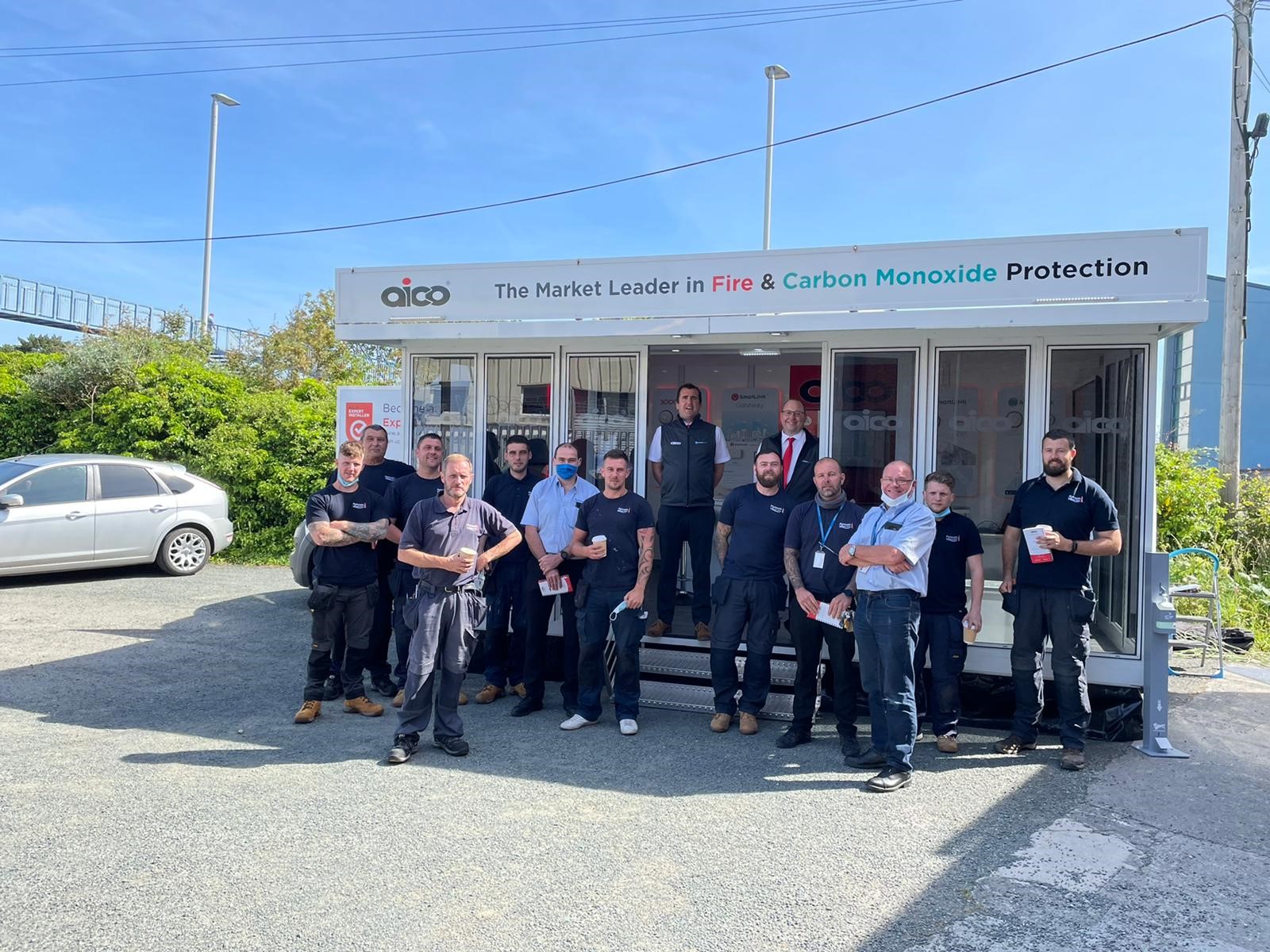
Aico's mobile training and demonstration units are back!
After having the breaks on for the past 16 months, Aico’s bespoke, state-of-the-art Mobile Training and Demonstration Units are back out on the road. Since acquiring their first Mobile Unit in 2017, Aico have expanded their fleet to four units, that cover the length and breadth of the country. Each of the units are fully equipped for hands-on training, providing customers with a complete overview of Aico’s products and technologies and enables the delivery of their award-winning Expert Installer training. Education is part of Aico’s core ethos, and their Mobile Units are also utilised across the UK to engage, educate and inform members of the public. Fire safety sessions to promote awareness of fire and Carbon Monoxide within the home are vital to encourage active involvement from children and students, as well as residents. Aico also take their Mobile Units on tour, travelling to various locations throughout the country to raise awareness in support of key campaigns such as Gas Safety Week, highlighting the dangers of Carbon Monoxide and the importance of alarms. To date, Aico’s Expert Installer training scheme has trained over 30,000 industry employees in domestic Fire Alarm specification and installation and is FIA approved with many of the modules CPD accredited, enabling installers to earn CPD time. 2020 saw the Expert Installer training go digital, with the unprecedented times caused by the pandemic. However, this week Aico were able to return to in-person training across different locations including City Electrical Factors Dartford, Edmundsons Electrical Torquay and Fife College. Aico colleagues have strictly followed the Government COVID-19 guidelines in order for their customers to use the Mobile Units and facilities safely. Daren Newcombe of Plymouth Community Homes who utilised the Mobile Unit on Tuesday 15th June says “We have specified and installed Aico alarms for the past 15 years and this is the third time we have had the Mobile Unit, this is an excellent opportunity for our engineers. We always receive first class support from Steve Bulley who is our local Regional Specification Manager (RSM), who has extensive knowledge and is always there when we need him.” RSM for the South West Steve Bulley comments “Plymouth Community Homes are a key partner of Aico in the South West. They are a fantastic organisation to work with, who always put safety and well being at the forefront of all they do. I would like to thank Roger Hewit, Daren Newcombe and all the engineers for the attendance and support on the Mobile Unit.” Thursday 17th saw RSM for the West Midlands Julie Weaving visit City Electrical Factors in Stafford delivering an Expert Installer session. Julie was delighted with response from customers and said, “Having the Mobile Unit back out and about again this week after 16 months, delivering our CPD training face-to-face and having the interaction from electrical contractors has been fantastic.” Nick Edwards from JNR Contractors Ltd who attended the Expert Installer session says “Great CPD training, very informative and interactive, in a fantastic setting – thank you to Julie Weaving and Aico.”

30 not out! BCIA celebrates landmark anniversary
This year marks the 30th anniversary of the Building Controls Industry Association (BCIA), which has grown from 11 members in its earliest days to around 120 members, accounting for 80% of the UK’s building controls market. Originally launched as the Building Controls Group (BCG) by Secretary of State for Energy John Wakeham in 1991, the BCIA has become a single voice in the Building Energy Management Systems (BEMS) sector to promote better understanding, application and use of building controls. Before its inception many companies operating in the controls sector had felt for some time that there was no single focus for their efforts to strengthen and develop the technology. It was subsequently decided to set up a new group within the Energy Systems Trade Association (ESTA). The new group’s key objectives were to establish a professional Code of Conduct, and advance technical standards, contract conditions and training and marketing the benefits of controlling energy usage and making potential users aware of the technology available to them. These core aims are still at the heart of the BCIA’s activity 30 years later, something which the organisation is proud to celebrate annually with the BCIA Awards, first hosted in 2007 and now attracting record breaking numbers of entries and guests year after year. A number of well-known celebrities have also appeared as guest speakers at the Awards, including presenter Steph McGovern and comedians Lucy Porter and Holly Walsh. BCIA President Terry Sharp believes the 30th anniversary is something for all BCIA members to be proud of: “For the BCIA to be going strong after all these years is a tremendous achievement only made possible by its members and their devotion to its cause,” he says. “Not only are we still going, but the rate at which the BCIA has expanded and increased its presence and influence within its own sector and in the wider industry owes a huge credit to the efforts of the members, committees and working groups involved in its ongoing success.” There have been some interesting industry developments during this period. For example, soon after the Association started, a second group of control system specialists was formed amongst the then installers of BEMS. Back then, the market was dominated by the controls manufacturers and names like Satchwell, Honeywell, Landis & Gyr, Staefa and Tour & Andersen held the majority share. These days over three-quarters of controls installations and servicing is done by the independent sector and most controls manufacturers focus on product development and distribution. Technological advancements have also changed the marketplace, as Sharp observes: “Perhaps one of the most marked areas of progress is the emergence of affordable open communications standards that allow hybrid systems and brands to coexist within a BEMS. Gone are the traditional motor control centre (MCC) panels which housed the starter gear and large data gathering outstations of the early BMS. These days smart plant, often with individual remote controllers, share operational data over IT networks or edge-technologies directly to the cloud.” In recent years, one of the BCIA’s most significant contributions to government policy has been towards a review of the proposed changes to Part L of the Building Regulations. This year also saw the launch of the BEMS Controls Engineer Apprenticeship Standard, in partnership with training provider Group Horizon, designed to address an industry wide shortage of BEMS Controls Engineers who will use the technical skills they learn on the Apprenticeship to keep the buildings of the future running efficiently. Terry Sharp concludes: “The BCIA has played a crucial role in shaping our built environment. I am proud of the organisation’s past, motivated by its present and excited for its future. It is my hope and firm belief that in 30 years’ time somebody will be in my shoes heralding the 60th anniversary of the BCIA!”

Bellshill manufacturer hits green light on growth plans  
A lighting manufacturer based in Bellshill is embarking on growth plans following an increase in business this year. Hostwave, which was established in 2009, specialises in emergency lighting products, working with hospitals, universities, offices and warehouses providing innovative lighting solutions. In the last year, Hostwave has seen a substantial increase in business, working with building services engineers and local authorities to provide emergency lighting. Clients include the NHS, Network Rail and Glasgow Caledonian University. In just seven months, Hostwave has made more than 90% of its yearly target profits and is preparing to expand its workforce by taking on five new staff to help keep up with demand. Also contributing to the increase in business is a breakthrough new product aimed at reducing the spread of COVID-19. Last year, Hostwave launched SanificaAria, an indoor air purification system that uses UV light to eliminate bacteria and viruses in enclosed spaces by more than 99%. Created in Italy, the innovative system is suitable for both domestic and commercial use and can be used in schools, shops and bars. Tommy Flynn, Co-Founder at Hostwave says: “The last 14 months have been extremely challenging for businesses around the world and, although we’ve worked very hard throughout the pandemic, we recognise that we are lucky to have experienced such a strong period for sales. “Both our lighting systems and UV air purification products have proven to be very popular in the last year. Moving to a new unit in Grovewood Business Park to allow us to process a higher volume of products was the first step in our growth plan, and we are looking forward to welcoming new people to our business in the coming months.” Terry Quinn, regional executive at UKSE, says: “Hostwave is a fantastic example of how businesses have adapted their products and approach during the past year, in order to cater for the changing nature of demand. We’re very pleased to have welcomed Hostwave to our Grovewood space and are looking forward to seeing what the future holds for them.” Grovewood Business Centre recently underwent a major refurbishment and offers a range of office and workshop accommodation to small and medium-sized businesses.

JTL launches free central heating course to support the changing needs of electricians
JTL is continuing to support the changing needs of electricians with the launch of its latest free, bite-size digital course, ‘An introduction to central heating’. This new course is part of its Power Up offering – JTL’s initiative to further support the building services engineering sector by offering free advice and educational resources. It has been designed to allow electricians to follow the practical examples of boiler controls and wiring. This will aid the ‘smarter homes’ learner journey and equip electricians with the tools to advise customers and install systems. The course will help installers understand the different components of gas central heating systems and the wiring requirements of S and Y arrangements. It also explores wet and electric underfloor heating and how it is installed, as well as highlighting some of the features of smart thermostats. After completing the short 30-minute course, electricians will have a clearer understanding of how heating systems work and the wiring involved, as well as how they can be controlled by a smart thermostat. This course has been produced to facilitate the learner’s journey towards Continuing Professional Development (CPD). Liam Sammon, director of learning and innovation at JTL, says: “As a charity, we are always looking at ways we can support the changing needs of electricians, so we are really excited to launch our latest free bite-size course on central and underfloor heating. The course will not only aid the learner journey towards CPD but will also steer them through additional JTL courses, should this be of interest. “One of the many things that the last 18 months has taught us is the importance of gaining new skills and how we can acquire them online. Whenever and wherever you are, this course has been designed to make accessibility as easy as possible. This, along with the other courses, can be accessed via mobile, tablet or desktop, so each course can be completed at your own pace and in your time.” The introduction to central heating bite-size digital course is now available on JTL’s new online learning portal.

UK construction companies increase R&D spend by £70m
UK construction companies are increasing their investment in innovation, with R&D expenditure rising by £70m, according to new figures released by HMRC. Analysis by IronmongeryDirect has revealed that in the first part of 2018/19, construction firms spent £1.36bn on qualifying projects. Even though many claims have yet to be submitted for that financial year, this is already 5.4% more than the whole of 2017/18 (£1.2bn). Using the government’s R&D Tax Credit Scheme, companies can claim back up to 33p for every pound spent on R&D activity. This includes any project that aims to advance the industry by researching or developing a new process, product or service, or improving an existing one. For such work completed during 2018/19, construction companies have already claimed £235m of Corporation Tax relief. More companies in the sector are starting to take advantage of the scheme, as the latest data shows overall number of claims is also on the rise. So far, construction businesses have made 3,340 claims for R&D funding, which is a year-on-year increase of 1.8% (60). The industry now represents 5.7% of all R&D claims in the UK. The majority of the construction-related R&D projects are classed as ‘specialised construction activities’. These account for two-thirds (66%) of the sector’s claims, way ahead of ‘construction of buildings’ in second place (21%). However, the most valuable construction R&D claims are those labelled as ‘civil engineering’. Across the whole industry, the average R&D claim in 2018/19 was worth £70,359 - almost 5% higher (£3,286) than the year before (£67,073) - but the figure is far greater for civil engineering projects. The typical amount of tax relief awarded to such work is £129,412. The totals also vary significantly across the UK. The most innovative area is London, with more claims made in the capital than any other part of the nation (455). But it is Northern Ireland where construction represents the greatest percentage of a region's total R&D claims. More than one in 10 (11%) of the country’s qualifying projects fall within the industry (180/1,605). Despite only making the fourth highest number of claims, construction firms in the North-West of England are investing the most money in innovation. Its businesses have already registered £145m of R&D spend for 2018/19 – more than any other area.

Is social media the new way to plug the gender skills gap? 
On International Women in Engineering day (23 June 2021), ECA asks, does social media break down the gender divide for female apprentices? In the case of Tianna, an apprentice from Birmingham, her social media network has been a lifeline during lockdown. “Without a doubt, ours is the fastest changing industry there is”, says Eddie Clemmens of Pegasus Electrical, who has been a practising electrician for 35 years. Pegasus is based just off Junction 2 of the M5 in the West Midlands. During the pandemic, Eddie was active on Twitter and later Instagram, posting photos of his electrical systems. He gained a large following of apprentices interested in his images. Many were on furlough, and while able to continue their studies, their opportunities for hands on experience were limited. The photos of circuits were a great way to learn things they were not seeing in real time. Like many in the industry, he is concerned the sector, which already has a skills shortage, will lose a generation of new talent unable to pass practical exams because they’ve not been in a work environment. He believes the trade must find new ways to plug the skills gap, saying, “It will be a long haul to regain the quality of practical skills lost this year, unless we support each other now”. One of his Instagram followers is a woman called Tianna, known as Tee. She is in the fourth year of her apprenticeship. Tee saw Eddie’s photo of conduit bender instructions and messaged him directly. She was desperate to get the hands-on experience of conduit bending to complete her practical exam, AM2. Eddie had a brainwave - he decided to speak with one of his wholesalers, Edmundson Electrical in Wolverhampton, who was happy to help. The company supplied Eddie with a conduit bender, complete with conduit and boxes at cost price. This was delivered to Tee, free of charge, and #AM2LoanRangers was born. Tee was pleased to be a guinea pig for the new idea. She tested the kit for a couple of weeks, but it was soon in demand by other apprentices. It was clear the board must be portable and include a range of bending skills needed for both the AM2 and the real world. Demand for the practice board has been largely driven by social media. There is a waiting list for the upgraded practice board and kit, which goes on loan for two or three weeks. But Tee will get the equipment back before her AM2, to ensure she gains the skills to pass the test. Tee said it has been great working with Eddie, and if it hadn’t been for him, she wouldn’t have got through the last year. “He’s made me practice, practice, practice.  As a woman in a mostly male industry, I need to be on top of my game and have experience of all types of wiring I might be faced with. When I started out, someone told me I’d never make it, but I’m determined to prove them wrong”. Eddie has made Tee see there is a vast array of electrical opportunities ahead of her.  When Tee finishes her apprenticeship, she plans to work in the growing field of installing electric vehicle charging points. As a lifelong learner himself, Eddie knows the importance of keeping up to date with his trade. He is a member of ECA, the Electrical Contractors’ Association, who he says has has opened his eyes to the rapid shift that is taking place, as technology changes the way electricians work.

World-first trial paves the way for new renewable energy market
Innovative trials on the South East’s electricity network have set the foundations for a world-first short-term market for renewable energy sources. Power Potential - a joint project between National Grid Electricity System Operator (ESO) and electricity network operator UK Power Networks – is demonstrating how wind and solar farms can dynamically feed in power to provide voltage control services to balance the system and help the grid run more efficiently. Power Potential was developed to help manage the rapid increase in wind and solar farms, and battery storage connecting to local electricity networks. The South and East of England has seen a significant rise in these during the past decade, with more than 7GW of electricity produced by renewable energy generators across mainly the South East and East of England. That’s almost as much as the UK’s entire nuclear power output. The project team built a Distributed Energy Resources Management System (DERMS), developed by technical specialist ZIV Automation. This successfully enabled wind, solar and storage batteries across Kent and Sussex to provide market-based reactive power services, being paid to address voltage challenges on the national electricity system. Academic project partner Energy Policy Research Group based at the University of Cambridge, concluded that a new regional reactive power market in the South East alone could save £19.5 million by 2050 and close to £100 million if rolled out across Great Britain, when compared to the long-term alternative of investing in traditional devices. By addressing voltage challenges, Power Potential could also enable an extra 1.5GW of green energy to be generated in the region – that’s enough to power well over a million homes. With the live trials now complete, National Grid ESO will use the insights to inform its Future of Reactive project. This looks at how to introduce a competitive market for buying reactive power across Great Britain. Partner companies are also now investigating how to use and develop the services as part of their Regional Development Programme partnerships in the South Coast. Ian Cameron, head of customer service and innovation at UK Power Networks, says: “This is an incredible milestone in our work to deliver a net zero emissions electricity system that works for all. Power Potential has been one of our most ambitious projects ever, and its success is down to the dozens of dedicated experts who worked tirelessly throughout. Together, we’ve shown how a Distribution System Operator can enable new services and create tangible benefits, a win for consumers, a win for networks and a win for clean air.” Graham Stein, network operability manager at National Grid ESO, says: “Power Potential is a fantastic example of energy resource and network experts working together to deliver something important and new. The project’s output will facilitate the continued growth of renewable energy, inform effective development of Distribution System Operator capability and help us achieve zero carbon. It also demonstrates the value of challenging the perceived constraints of organisational and technical boundaries and how risks can be managed with diligence and shared ambition.” Adrian Kearney, managing director of ZIV Automation UK says: “This is a ground-breaking project, demonstrating the viability of delivering aggregated services from distributed network resources. It has been a significant step forward in the DSO transition and in the flexible services market. It shows what can be achieved using advanced technology and a fantastic team of experts from UK Power Networks, NG ESO and ZIV Automation working in collaboration. ZIV Automation is proud to have made a significant contribution to the success of the project.”