2 November 2026
Product of the Month: Amari Floodlight range by Aurora Lighting
 
12 November 2026
Schneider Electric transforms Southampton hospital estate
 
12 November 2026
GTEC Training opens new education facility in North Yorkshire
 
11 November 2026
Energy, AI and smart buildings: register now for EMEX 2026
 
11 November 2026
Solar and batteries could cut electricity costs by 40%, data finds
 

Latest News


myenergi redesigns products in response to global chip shortage
myenergi has today completed a major product redesign project in response to the challenges caused by the global silicon shortage. With lead times for some microprocessors now exceeding 52 weeks, the silicon shortage is causing significant production issues for companies across the globe. At the same time, myenergi is experiencing growing demand for its energy control products as the world races towards Net Zero Carbon, Electric Vehicle (EV) adoption gains momentum and consumers become more conscious of their energy use at home. To future-proof the business and ensure that demand would not outstrip supply over the long term, myenergi’s innovative team of engineers tackled the impending supply issue head on, working round the clock to completely re-design its product range. The updated designs operate on a new, more powerful microprocessor which is not affected by the silicon shortage. Alongside enabling the increased production of myenergi’s zappi, eddi, harvi and hub products, the more powerful microprocessor will facilitate additional features over time, giving customers greater control over their energy consumption at home. Dr Chris Horne, Chief Technology Officer of myenergi, comments: “The global silicon shortage has caused difficulties for numerous sectors globally, with ever growing lead times for critical microchips leading to car production being halted, a shortage of consumer goods and massive price rises in computer components, to name just a few. “As a key component for our products, we had been building stock to offset the shortage and cover our plans to boost output, but we knew this problem would persist for the foreseeable future. In light of this, we moved quickly to change our operating platform, completing the project in just three months. We’re now in a strong position to meet the increasing demand for our range of efficient energy control products, which continues to grow as the global push towards Net Zero Carbon gains momentum.” Jordan Brompton, co-founder and CMO of myenergi, adds: “We have effectively innovated ourselves out of a challenging situation, demonstrating the pace and flexibility needed to excel in today’s rapidly-developing technology landscape. Thanks to the dedication of our R&D division, each product in our range has been redesigned to ensure compatibility with a new, more powerful, less utilised type of microchip, making our products capable of even more than before while providing a whole host of additional features and customer benefits.”

Ovia's Flameguard downlights now with push-fit Flow Connectors
The company was the first to bring a fire-rated downlight to market back in 2005 with its award-winning Flameguard fixed, integrated, fire-rated LED downlight, and now 16 years later, Ovia is still investing in the range to further enhance its features and benefits. All Flameguard fire-rated downlights are now supplied pre-wired with fast fit Flow connectors which feature push-in, low maintenance terminals to offer another time-saving benefit for installers. In a speed test carried out by Ovia, installation times were compared for these fast fit connectors, versus the equivalent screw terminal versions and typically the fast-fit versions were completed in around half the time. Products that incorporate Ovia’s award-winning Flameguard system technology, benefit from a 30, 60 & 90 minute fire rating - including I joists, metal web joists and solid timber. They also have an acoustic rating (0dB) and are airflow compliant. The Flameguard intumescent seal, when exposed to fire, forms a dense carbon char which separates and insulates the substrate from the heat of the fire. The expanded seal eliminates the flow of air through the void and thereby starves the fire of vital elements for combustion. There are four versions of the Flameguard LED downlights in the range – GU10 cast fixed, GU10 fixed, GU10 cast adjustable and GU10 adjustable - and they are available in a choice of chrome, satin chrome and white. They have an IP rating of up to IP65 and come with a five year warranty.

Mental Health First Aid instructors programme delivers £5.5 million of value
Building Mental Health, the CITB and the Lighthouse Construction Industry Charity have published a report detailing the social value of their Mental Health First Aid Instructors Programme; an initiative to train 288 construction industry dedicated Mental Health First Aid Instructors. The Social Value Report shows that for every £1 invested there has been £5.50 of Social Value to society. This amazing result is despite the challenges presented by the Covid-19 pandemic, which meant that the programme had to be extended by a year. The programme achieved 99% of its target for training instructors and 166% of its target for training Mental Health First Aiders (MHFA) to operate in the industry on a daily basis. ‘Building Mental Health’ was launched by a working group of construction industry leaders and experts in 2018 in response to findings published the previous year in the ‘Thriving at Work’, Stevenson/Farmer review of mental health and employers. Commissioned by the Government, the report looked into how employers could provide better support to employees, including those with poor mental health or wellbeing, to remain in and thrive at work. The Thriving at Work review identified not only the immediate human cost of poor mental health at work, but also the knock on impacts for society and the economy. It cited that employers are losing billions of pounds because employees are less productive, less effective, or off sick. In construction alone, stress, anxiety and depression accounts for a fifth of all work related illness. One of the key objectives of the Building Mental Health Programme was to address the findings of the Thriving at Work report and provide companies of all sizes a portal of free and easily accessible information so that they could develop a positive mental health culture in their organisations. Contributions from across the industry ensured that an array of comprehensive support and expert guidance was easily accessible by all. The programme also includes a 5-step framework to better mental health, which focussed on the importance of pro-active training to support the industry. To help support the aims of the Building Mental Health framework, a specific training project was created and managed by the Lighthouse Construction Industry Charity and funded with £1m from the CITB in May 2018 to deliver a programme of bespoke construction-based instructor courses to achieve the following key objectives: Train 288 Mental Health First Aid Instructors Trained instructors to subsequently train 3,000 Mental Health First Aiders (MHFAs) in the industry To encourage the industry to engage and embrace the mental health agenda and raise awareness of mental health issues in the industry in general To make best practice and information readily and wherever possible freely available To ensure that the industry takes a huge leap forward to reduce the stigma surrounding mental health by getting the conversation started while educating as many as possible about where and when to seek help. The MHFA Instructors course lasts seven days but is delivered over a six week period to allow for reflection on the complex issues raised. Attendees said that hearing first hand from guest speakers who were prepared to share their personal mental wellbeing experiences provided invaluable insight into real life journeys and helped to get behind the raw figures. Many reported that being on the course was both emotionally challenging and life changing. Key Achievements of the MHFA Instructors Programme 284 Mental Health First Aid Instructors trained resulted in £1,215,141 of social value Instructors delivered training to 5,318 Mental Health First Aiders, outperforming target by 66% and resulting in £3,638,842 of social value 3349 Mental Health Awareness courses delivered £654,730 of social value Total social value of the Mental Health First Aid Instructors Programme £5,508,713 The report clearly shows that expectations have been surpassed, but there is no room for complacency. Bill Hill CEO of the Lighthouse Construction Industry Charity adds, “As one of the founder members of Building Mental Health we are delighted by the social value this training programme has delivered and we now have another 5000 front line mental health first aiders. The report cites that the instructors trained are under no illusion that the industry still remains much closer to the start of the journey towards de-stigmatizing poor mental health than the end, but there are extremely positive outcomes so far. Together, we have been able to offer a fresh, industry-wide approach to ensure mental health support is available for all and to drive a more inclusive and caring cultural change in our industry for this generation and the next.”

Travis Perkins relocates to Minworth, creating 10 new jobs in boost for area
Travis Perkins is set to relocate from its existing site at Goosemoor Lane, Erdington to a bigger location at Forge Lane, Minworth and is set to open to customers from 1st September. As part of the relocation, Travis Perkins is recruiting for ten new roles, in addition to transferring 13 colleagues to the new site. The roles include full-time positions for a branch supervisor, a Toolhire Fitter Driver and a HGV Class 2 driver, while part-time and flexible roles include two Customer Yard Assistant positions and a Counter Sales position. Branch manager Mark Burns says “We’re looking forward to opening the doors of our brand new branch in September. The new site has more than doubled in size, will be open for longer hours and includes a Tool Hire section. Recruiting more colleagues to join our experienced team means we’ll be able to add to the expert knowledge and advice that serves our local community.” The new site is 2.25 acres in size and is close to the M6, serving Minworth, Sutton Coldfield and Erdington. The branch will feature a tools and plant hire section, up to 50 different types of bricks and an extensive landscaping display.  Boasting  extensive bricks, timber and blocks, it offers a fast and convenient one hour click and collect service and next day delivery. Customers can choose to shop online, in branch or by using the new Travis Perkins app. The industry-first app has been designed in conjunction with customers to help them save time and work smarter by managing their account on the go. Customers can shop online and easily manage their trade account, wherever they are. Travis Perkins Minworth will be located at Forge Lane, Minworth, B76 1AP and will open its doors on the 1st September. Travis Perkins has been certified as a 2021 Top Employer for the 12th consecutive year. The award from The Top Employers Institute recognises the work culture of Travis Perkins including diversity, inclusion, training and development, wellbeing and the work environment.

Together in electric dreams
Becoming a fully-accredited EV charging point reseller could be easier than you think. Green mobility is the future of transport in the UK. While the number of new petrol and diesel cars finding their way onto our roads continues its decline, the size of the Electric Vehicle (EV) car parc is expanding dramatically. With ‘Zap-Map’ data showing half a million registered EVs on our roads and only 23,700 charging points to keep these zero emissions vehicles moving, there is a need to grow the UK’s charging infrastructure – rapidly. The explosion in EV uptake offers ambitious electrical contractors an opportunity to break into the profitable, rapidly-expanding, futureproof charging point reseller and installer market. It also provides another service that can be offered to existing customers. innogy eMobility UK, a division of European electric utility powerhouse E.ON, is supporting the growing number of electrical contractors that have identified the long-term growth potential within EV. Once a company has been identified as a viable charging point reseller and installer, innogy eMobility UK provides the training to equip the electrical contractor for success in the EV field. And this comprehensive training package is free. “Once we’ve checked the electrical contractor meets the requirements of becoming an EV reseller and will be able to deliver the volume of sales that our business is familiar with, it’s a streamline process to train them for business installations,” explains innogy eMobility UK Technical Manager, Luke Williams. “The first step for a prospective reseller and installer is to undertake our AC or DC training. This is currently taking place on MS Teams but as restrictions ease we will resume face-to-face training. “The training allows them to understand the products we offer, the installation requirements, how to configure them and how to successfully commission them. “All partners must also complete a City & Guilds Electric Vehicle Charging course which is mainly theory based but builds on the installation expertise and insight we provide. “Gaining the City & Guilds qualification is crucial because it allows the installer to claim installation grants from the Government’s OZEV (Office for Zero Emission Vehicles) scheme.” And that’s the beauty of the current EV revolution. Not only is the Government incentivising consumers and fleet operators to switch to ultra-low emission vehicles, it’s also supporting the businesses that are providing the early market products and skills to expand the UK’s EV infrastructure. OZEV has ring-fenced £900 million to position the UK at the global forefront of ultra-low emission vehicle development, manufacture and use. Once an innogy eMobility UK-trained reseller has received their certificate of qualification and letter of accreditation, they can register as an OZEV-authorised installer and apply for Government grants via its Workplace Charging Scheme (WCS) or Electric Vehicle Home Charging Scheme (EVHS). “Once a business has chosen an OZEV installer to install their charging point, the installer can apply for a Government grant on the customer’s behalf,” says Karl Anders, Managing Director of innogy eMobility UK. “The installer can then invoice the customer for the price of the installation – minus the grant amount. “The scheme, which offers up to £350 per socket (and up to 40 sockets per company) towards the upfront purchase or installation fee, rewards EV customers for their commitment to a green mobility future. And it ensures installer business remains buoyant because the Government is offsetting some of the customer’s initial costs. It’s a win-win situation for all parties.” As well as training, innogy eMobility UK can provide its resellers with expert guidance on how to manage the daily operating requirements of the charging point, encompassing the optimisation of charging hours and tariffs – on commercial premises.  This further expands the electrical contractor’s service offering and creates a recurring revenue stream. Recognising that electrical contractors joining the EV market may need a little extra support when they first enter the installation field, innogy eMobility UK operates an ‘open door’ policy around its training. It also grants its accredited resellers access to a reseller partner portal that contains a raft of support and marketing material. Luke Williams says: “For the first couple of installs, I always make myself available to give guidance during the process – if our new partner feels its required. We don’t just leave the installer to fend for themselves. “We recognise the importance of having a competent network of resellers representing the innogy brand, that can deliver at volume and maintain the very highest standards of customer service. “I’m always available to oversee any stages of the customer delivery and fitment process or to answer any questions the reseller may have.”

LIA responds to Government press release on new lighting regulations
The Government has issued a press release outlining the impact of the upcoming new lighting regulations. The Lighting Industry Association has said that the press release contains a number of errors which is causing confusion among suppliers and consumers alike. To clarify the situation, the LIA has released the following statement: The UK legislation, due for publication in the summer, mirrors that also applying in the EU and relates to the 'placing on the market' of products, this allows products in stock at manufacturers, retailers etc. to continue to be sold until stocks are exhausted. It is not an instant sales ban! Note: There is a legal definition of ‘placing on the market’ which may mean that certain goods in suppliers’ warehouses are already considered as such. The proposed UK legislation which applies from 1st September is expected to have a one month transition allowance. The following lamps cannot be placed on the market after 1st October 2021: Self-ballasted Compact Fluorescent retrofit lamps (caps B22, E27 etc) Linear Halogen R7s lamps over 2,700 lumens 12V Halogen reflectors lamps (MR11/GU4, MR16/GU5.3 etc) Lower performing LED lamps The following lamps cannot be placed on the market after 1st September 2023: Linear fluorescent lamps T8 2 foot, 4 foot, 5 foot Mains voltage Halogen capsules with G9 cap 12V Halogen capsules with G4/GY6.35 cap Note: There are several exemptions in the regulations for specialist lamps and applications. Lighting fixtures/fittings (luminaires) with non-replaceable/fixed lamps are not banned but this type of design is being discouraged in the future with a technical justification being required for these designs. The following errors in the Government press release are those leading to the confusion: Halogen light bulbs to be banned from this September – with fluorescent light bulbs to follow suit This suggests that all halogen lamps are banned from this September - this is not the case, some will continue until 2023. Those lamps that are banned from September 1st may still be available for sale if they were first placed on the market before that date. Legislation being brought forward this month will also include the removal of fluorescent lights from shelves from September 2023. This is also not the case, only some lengths of T8 fluorescent lamps will be banned from September 2023, other types of fluorescent lamps will still be available. The new legislation would mean retailers will no longer be able to sell the majority of halogen bulbs for general household use in the UK from 1st September. This is incorrect, retailers will be able to sell through existing stocks and any products placed on the market before 1st September may also be sold. Some types will continue to be allowed after 1st September (as above). The plans also include a ban from September on the sale of lighting fixtures with fixed bulbs that can’t be replaced – meaning the fixtures have to be thrown away. This is misleading – new measures have been introduced which encourage the design of light fittings which can be repaired, or the light source and control gear replaced. There is not a blanket ban on lighting products where these components cannot be replaced if the manufacturer provides a technical justification for this case such as safety, water ingress or other reason. The LIA says that it has communicated these errors to the Government department responsible for the press release.

Tried and tested solutions for trying times with EIC
All of us may experience financial hardship in our lives but for some of us the consequences of the pandemic hit hard. Many of our sector colleagues who were self-employed or furloughed struggled to make ends meet and with a 20% reduction in wages for some coping day-to-day was difficult. From March- December 2020, the Electrical Industries Charity awarded 1,343 grants to industry members to support them through this trying time. Tim and his two daughters received an emergency financial assistance grant after Tim caught COVID-19 in May 2020. Tim had worked as a self-employed electrician for five years and continued to work during the pandemic as he was considered an essential worker. Tim was a single father and both his young daughters attended school during the period. Unfortunately, while within school, his eldest daughter contracted COVID-19 which quickly spread throughout the household. Tim had to isolate within the home for 14 days. While at home Tim’s condition worsened. He became increasingly breathless, suffered with relentless coughing fits and struggled to take food or water. Concerned, Tim rang NHS 111 and was hospitalised. Tim’s sister moved into his family home to care for his daughters. After a stint within ICU Tim was discharged after a fortnight’s stay within hospital. Once home Tim was incredibly weak, and his sister was furloughed so she could continue to care for Tim and her nieces. Tim’s financial resources were significantly depleted. Work had been scarce throughout the pandemic and now he had been unable to work for almost a month. Him and his children were depending on his sister’s reduced wage. Tim’s financial worry was hindering his recovery, so he contacted the Electrical Industries Charity. The Electrical Industries Charity assigned Tim a caseworker who established Tim’s financial circumstances, income, and expenditure. It was clear Tim needed some financial aid to support his family and safeguard his recovery. Tim completed a financial assistance form provided by the charity and he was awarded a grant to support his income in the short term. His charity case worker also helped Tim to apply for universal credit which would help him get by until his circumstances improved. The Electrical Industry Charity case workers are well versed in the welfare systems in place and can help sector colleagues to understand what benefits they are entitled to and how they can receive them. The charity also encouraged Tim to speak to his bank for a mortgage holiday. Mortgage holidays do not affect your credit score or interest rate but provide a period of respite for those struggling to meet their mortgage payments. By the Summer of 2020 Tim was ready to return to work and he was able to find a contract role which provided some stability and security for his family. The Electrical Industries Charity had since closed Tim’s case and Tim was grateful for the financial support and guidance provided by the charity team.

Aico back out on the road in their new community car
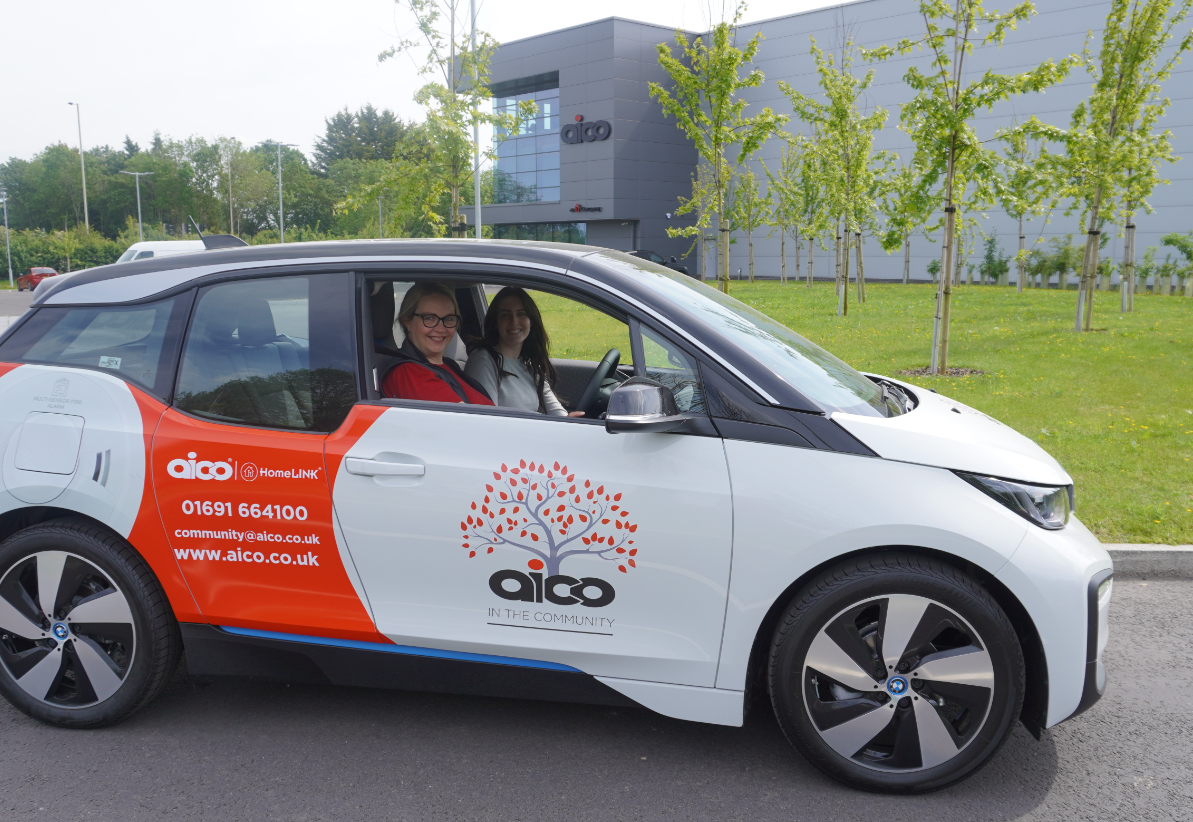
Aico’s Corporate Social Responsibility (CSR) initiative, ‘Aico in the Community’, like everything else, was slightly stunted during the pandemic. The need to support local businesses, charities and schools increased but had to be done in the virtual world, in a new way. Aico were still able to show their support in various ways including virtual fundraisers, marketing support to smaller charities and online educational encounters with several schools but were unable to complete what they had prospected for the year. With restrictions easing and lockdown coming to an end, Aico want to ensure their support to the Shropshire community and beyond is more impactful than ever. In order to support these goals, Aico have provided their CSR colleagues with a new fully electric, branded Community Car. Aico understand the importance of sustainability and one key focus of their CSR programme is the impact that the business has on the environment. Aico have recently been nominated as a Net Zero Business Champion, with a pledge to become carbon neutral by 2030. With this in mind, it was important that their new community vehicle would be completely electric and will add to the company’s increasing fleet of electric and hybrid cars across the UK. Jane Pritchard, Community Liaison comments “We are delighted that Aico have provided us all with this fantastic car. This will give us the chance to help even more in our communities, whether that is charitable volunteering or the educational support we are able to provide in schools and colleges. We are really looking forward to getting back out on the road!”. All colleagues at Aico are encouraged to get involved in their CSR initiatives and are granted three days outside of the regular working schedule in order to volunteer in their own communities, giving their time and supporting in various ways. With the pandemic having a significant impact on fundraising and support to charities and organisations, Aico are keen to get back out into the community and increase their support through education, business enterprise, charity and volunteering.

'We connect', The Journey of Innovation- 16th June 2021
Panduit’s We Connect: The Journey of Innovation, live event on Wednesday 16th June 2021, will be streamed in real-time from four Customer Briefing Centres in EMEA, and its global headquarters in Chicago, USA. The 300 minute event has been designed to offer partners and customers a virtual journey through the latest data centre and industrial electrical infrastructure technologies. Regional product break-out sessions are tailored to language specific markets, and are supported by a platform of industry roundtables and interviews with thought-leaders and innovators. The event opens from Frankfurt’s Customer Briefing Centre, with Panduit’s General Manager EMEA, Ralph Lolies, keynote, ‘The passion for innovation as a key success factor in turbulent times’. This is followed from London, by the data centre roundtable ‘How are colos meeting the evolving customer requirements?’, hosted by Dan Loosemore, COO, DataCenterDynamics, and offering an insightful market discussion with: David Hall, Fellow, Senior Technologist, Equinix; Emma Fryer, Associate Director, techUK; and Michael Akinla, Networking Infrastructure, Panduit. Audience questions to any session can be pre-posted, or taken live. The event provides a wide ranging agenda with sessions including Atlona’s showcase ‘Office 2.0: Transition to a hybrid workplace’ – or how to return to the workplace after COVID-19 with easy-to-use AV solutions. And the content keeps on coming, and includes a roundtable on ‘Short Circuit Protection promoting electrical safety and capabilities for industrial and data centre environments’. Later in the agenda, presentations on the latest technologies in networking and electrical infrastructure applications. Market specific sessions will be streamed from Panduit Milan and partner EGAL in Ljubljana. The afternoon session continues with a link up to Panduit headquarters in Chicago, and includes Dr. Rick Pimpinella, Fellow, Optical Research Engineer, Panduit discussing ‘Driving the IEEE to Establish the Future of the Fastest Connectivity’, and Ronald Greaves, Alternative Energy Lead, Panduit discussing ‘Engineered Solutions for Renewable Energy’. And the final keynote is given by Andrew Caveney, Executive Chairman, Panduit on ‘Innovation Makes the Difference for a Sustainable Future’. With 26 individual Plenary Sessions streamed live over a 300 minute programme, We Connect- The Journey of Innovation, offers a vision of how customer knowledge and the drive to sustainability is a spark for innovation in the network and industrial electrical infrastructure sector.

Seven in ten welcome the prospect of hybrid heating
Almost three quarters of people are interested in low carbon hybrid heating - but comfort and reliability are ‘must haves’, new research shows. The results are from more than 1,000 survey responses gathered by electricity network operator UK Power Networks and gas network Wales & West Utilities as part of their HyCompact project. The trial which runs until March 2022, is researching consumers’ attitudes and live testing low carbon hybrid heating systems in UK homes. Hybrid heating systems work by switching between gas and electricity to guarantee lowest cost and carbon emissions. The research also suggests people will only buy low carbon heating systems if they are cheaper, more reliable, or easier to install than conventional systems. It found 72% of respondents say hybrid heating systems are either moderately or very appealing. However, the most popular reasons for switching are comfort and reliability (both 96%), plus cheaper running costs and ease of use (both 94%). The vast majority (85%) said they are satisfied with their current gas system, while around four in five would only consider switching if their current boiler stops working. If a breakdown happened, just over 80% would be interested in hybrid heating if it was less disruptive than installing a new gas boiler, underlining the need for low carbon systems to improve on products already on the market. Lowering carbon emissions from heat is vital if the UK is to achieve Net Zero emissions targets and avert the climate crisis. Currently 85% of UK homes are supplied by natural gas for heating and cooking, with conventional gas boilers burning gas and producing emissions from each home. Another four million properties are ‘off-gas grid’ and use fossil fuels for heating and cooking. Heat accounts for around a third of all UK emissions. HyCompact trial participant Steve Keating, who works as energy manager at Pembrokeshire County Council says: “Net Zero can’t be achieved by ignoring it, we all need to take ownership of it so it feels really good to be part of something that’s aiming towards that end goal of Net Zero.” Ian Cameron, head of customer services and innovation at UK Power Networks, comments: “These insights are a powerful reminder we’ve got to put customers first in the transition to Net Zero emissions. We need to invest in our network, make it easy for people and deliver an exceptional customer experience so people see real benefits when they switch to low carbon heating. A one-size fits all approach just isn’t going to work, and that’s why we’re partnering with Wales & West Utilities to explore the issue as widely as possible.”