2 November 2026
Product of the Month: Amari Floodlight range by Aurora Lighting
 
12 November 2026
Schneider Electric transforms Southampton hospital estate
 
12 November 2026
GTEC Training opens new education facility in North Yorkshire
 
11 November 2026
Energy, AI and smart buildings: register now for EMEX 2026
 
11 November 2026
Solar and batteries could cut electricity costs by 40%, data finds
 

Latest News


Brexit effect drives up earnings for electricians
The cost of hiring electrical contractors has risen by 3.1% in a month, according to the latest analysis of pay trends in the construction industry. Hudson Contract said average weekly earnings increased to £1,063 during May. The figures showed growth was twice as fast in London – the cost of hiring electrical contractors increased by 6.5% in the capital. Ian Anfield, managing director, says: “We are starting to see the impact of people leaving the UK ahead of the EU Settlement Scheme deadline on 30 June and not being replaced by incomers. “First and foremost, this is affecting London which has the highest concentration of foreign construction workers and the most transient labour market. “There is shedloads of construction work about and growing pressure on the availability of both labour and materials. “We expect some respite for construction companies with the closure of the government’s Self-Employment Income Support Scheme in September which should encourage claimants back onto projects.” Hudson delivers the most accurate indication of subcontractor pay trends across the construction industry, publishing the average pay for a spectrum of 17 different trades split across 10 regions in England and Wales. It supplies statistics to the Bank of England to keep policymakers updated with real-time insights on demand for skilled labour.

Norway's number one EV charging company seeks talent for expansion
Easee, the company behind ‘the world’s smartest EV charging robot’, is recruiting for a number of new roles following an organisational restructure designed to prepare the business for a period of rapid UK growth, and expansion into new global markets. Easee was founded in Norway, where it already accounts for one in every two domestic EV chargers. Effie Vraka, previously Head of UK Operations, has been promoted to UK Country Director, while Alan O’Donnell, who was Country Director, has been promoted to take a global role as Technical Director, New Markets. Easee has also taken on a new Head of Sales and Marketing, Christian Georgeson, in a bid to take the company’s mission to a wider audience. Easee is recruiting for two new teams in the UK, Sustainable Operations and Integrations Taskforce. The Sustainable Operations team will support Easee’s increased focus on sustainability throughout the supply chain and production process, and the Integrations Taskforce will focus on developing new EV charging solutions and services using Easee’s open API. The recruitment drive offers an opportunity to join a company that genuinely sees the wellbeing of its staff as crucial to the success of its mission. Effie Vraka says: “At Easee, employee wellbeing and sustainability isn’t something we talk about and then forget – it’s built into our business model. Our organisational culture is based on openness, honesty, transparency, vulnerability, love, and humility. As we grow, our number one priority is to remain true to these values. To demonstrate our commitment, our CEO recently changed his title into Chief Caretaker.” The Easee Charging Robot is designed to enable developers to install EV charging infrastructure quickly and easily. Alan O’Donnell explains: “With continuing innovation and success across multiple territories we have received great demand from both new geographies and segments. To meet these demands we are focusing resources and developing new roles and new Easee products to take our innovations to more people, in more sectors, in more geographies.” Due to its success in Norway, Easee is confident that its electric vehicle charging solution will play a big role in helping the UK prepare for the 2035 ban on the sale of petrol and diesel cars. Christian Georgeson says: “Our organisational re-structure is designed to prepare us for rapid growth in the UK. We are already market leaders in Norway – which has the highest density of EVs in the world. We would like to achieve the same in the UK. When people think EV charging, we want them to think ‘Easee’. We have a lot of new and exciting role openings soon, so keep checking our site or subscribe to our careers page to make sure you don’t miss out.”

ECA calls for a network of electric vehicle charging points
According to survey figures just released, just over half (51%) of NHS Trusts have now installed EV Charging Infrastructure (EVCI) for their staff, patients and the wider community. The ECA has welcomed the uptake of EVCI by the Trusts as a positive move towards net zero carbon, but according to ECA’s Energy advisor Luke Osborne, “We need a coordinated plan for EV charging to help the public sector and the UK to achieve its decarbonisation targets. Hospitals are integral to their communities, so their plans must reach out more widely to include the wider road network.” The latest data was obtained through a FOI request by power management business Eaton, issued to 173 NHS Foundation Trusts across the UK, with 142 of Trusts responding. Gearing up for more EVCI The ECA, which represents a range of businesses that major in EV charging installation, regards an integrated UK EV charging network as vital to enabling the planned national shift to fossil fuel-free motoring. While half (51%) of NHS Trusts already report EVCI on-site, a further 43% plan to install charging facilities on-site within the next five years. Just 6% of NHS trusts had no plans to introduce EVCI. However, when asked about the impact of EVCI on their existing electrical infrastructure, half (53%) of NHS Trusts flagged that they would need more electrical capacity, while two thirds (41%) said it may incur additional energy costs through greater peak demand. Just a quarter (24%) saw potential to create new revenue streams from new EV charging facilities. The FOI also revealed that very few NHS trusts (11%) are currently selling energy to the grid through energy storage technologies, including vehicle to grid. One fifth (23%) plan to use energy storage to start selling energy to the grid in the next five years, but two-thirds (65%) have no plans to do so. ECA’s Luke Osborne adds, “Vehicle to grid technologies allow electric vehicles to store energy and discharge it back to the electricity grid when it is most needed, creating bi-directional supply that offers financial opportunities for public sector and other operators”. Yet despite significant progress with EVCI, over half (53%) of the Trusts reported they are either behind on their wider decarbonisation targets or do not have clear emissions reduction goals. Just two fifths (38%) are on track to meet their carbon reduction goals, while only 5% said they are ahead of their target.

New Ovia Lighting division has been launched in Ireland
Click Litehouse, part of the Scolmore Group, continues to enjoy year on year growth and as grows and develops the business, the company has identified an opportunity to capitalise on the growing demand for the Ovia range of lighting and lighting control products across Ireland. This has resulted in the setting up of a brand new operation – Ovia Ireland - which will bring the extensive range of Ovia lighting products to the whole of Ireland, via a dedicated team and through the various channels that serve the requirements of the industry across the country. The new Ovia Ireland division is headed up by Dan Hope, a well-known figure in the lighting industry, who will operate as national sales manager for the new enterprise. Ovia Ireland will operate as a stand-alone business that fully replicates the Ovia business operation in the UK with access to the same products, marketing support, technical support and new product development. Dan has a wealth of experience, industry knowledge and contacts to bring to the new role. He joins from Ansell Lighting where he spent time as an area sales manager before being promoted and completing four years as national sales manager. He holds the LIA Certificate – considered the gold standard in lighting training - and is also a fully qualified emergency lighting commissioner. Whilst Dan will be responsible for developing sales and contacts across the northern half of the country, Paul Healy has been recruited for the role of area sales manager, covering the southern half of Ireland. Through the Ovia operation, Dan is keen to get the message across to the wholesalers that Ovia Ireland will have a focus on the contractor – in other words the products and service offered through the wholesalers are designed to help contractors get the most out of Ovia, with the right products, education and support that will help them take on more ambitious projects, safe in the knowledge that a trusted brand is behind them. The new Ovia business will be officially launched in September and operate from a new facility in Dublin which is currently being refurbished. A significant stock holding is already in place to meet the demand from the sales team who are now out on the road generating sales and enquiries for the comprehensive product range.

Achieving optimum UPS efficiency
The UK is firmly focussed on its 2050 net zero targets. Although ambitious, if all industries come together, adopt sustainable practices and work to deliver optimum efficiencies, these carbon neutral goals will be well within reach. Like so many others, the ECA has shown its commitment to a low carbon economy but has highlighted a number of areas in need, including skills training and practical knowledge on where more efficiencies can be gained. As expected, Secure Power Ltd is placing great emphasis on helping businesses understand the true cost of power and, in particular, where efficiency gains can be easily recognised. This starts with the more obvious electrical framework and ensuring all elements within the electrical path are not only fit for purpose but also operating correctly. The not so apparent efficiency gains lie within the backup power equipment that supports these elements. Did you know that wasted UPS (Uninterruptible Power Supply) energy is one of the biggest costs associated with running an emergency power system? Today, manufacturers of UPS solutions boast 90–98% efficiency when operating at full capacity. However, it is recommended that UPS systems are not fully loaded and that a 20% margin is allowed, which does beg the question – why not just state true efficiency levels? For example, a UPS system that is rated at 98% efficient should in fact only be able to ever deliver 78% efficiency. This immediately delivers 22% of wasted energy. It is therefore critical to understand the load requirements and to have these regularly reviewed. Secure Power’s service manager Nick Morely comments: “Load requirements are becoming increasingly difficult to manage and many businesses are falling victim to running their UPS at significantly lower loads than intended. As efficiency improvements are continuously being made to electrical devices, these will be updated and often replace more inefficient equipment. When this happens, the impact to the UPS load is often overlooked. “Efficiency issues have been further compounded by the recent COVID-19 events that have shutdown many operations. UPS solutions, in many situations have been left running, despite their dependent applications being dormant. This has resulted in huge numbers of UPS systems wasting enormous amounts of energy, which is not only costly financially but also to the environment. “With an instant 22% of energy being wasted, it becomes even more imperative that no additional energy is lost through heat dissipation and other condition factors. With large UPS systems, even a relatively small percentage of increased efficiency can result in major cost savings, so UPS maintenance and ensuring UPS systems are replaced every five to eight years or when they become less efficient will help to keep running costs down. “We offer regular UPS health checks and are coming across an increasing number of inefficient UPS solutions. Luckily for those that have chosen to have a review or had a UPS service visit, their inefficiencies can be addressed quickly. To put it into perspective, the efficiency of a UPS can be greatly enhanced by adjusting its load requirements, ensuring it is operating in an optimal environment and by having regularly serviced UPS parts. If UPS efficiency is improved by even 1-2% the value of this could be up to £5k per annum. “Secure Power wants to help industries realise how achieving superior UPS efficiency will significantly contribute towards reducing the UK’s overall carbon footprint. It does need to be a collective effort though and our experience in helping businesses realise true operational efficiencies will benefit our partners and clients.” The company maintains UPS efficiency throughout the lifetime of the UPS solution by carrying out regular UPS health checks, maintenance and servicing. It also has one of the largest certified UPS parts and authorised UPS solution portfolios in the country and has direct stock availability for line interactive UPS systems to online double conversion, scalable modular UPS and containerised back-up power.

SELECT opens its Wall of Support to industry contributors
Campaigning trade association SELECT has welcomed a number of new additions to its Wall of Support which promotes its ongoing crusade for regulation of the electrical industry. Scotland’s largest construction trade association has responded to demand from those who work in the industry by allowing qualified electricians to add a digital ‘brick’ to the online resource to show their support for protection of title. Several electrical businesses and individual electricians have now put forward their names to show their support, including: Atalian Servest AMK Stensons John Noble Electrical Contractors Ltd. Calder Electrical David W H Smith Heating and Electrical Services E Rae & Son A E S Electrical Ltd Robert A S Crockett & Partners Ltd Unitech Services Ltd Macform Ltd Ness Electrical 2 Core Electrics Alistair Grant Electrical Powertec Electrotechnical Services Ltd Logic Systems Electro Installations (Scotland) Ltd GP Services (Dumfries) In addition, leading trade bodies the National Federation of Roofing Contractors and The Scaffolding Association have also added their names to the online Wall. These new signatories join more than 50 politicians, trade unions, professional bodies and other organisations that have already indicated their support for SELECT’s campaign for regulation of the industry. Their public stance underlines their backing for legislation in Holyrood which would make it an offence for someone to call themselves an electrician when they have no, or inadequate, qualifications. Alan Wilson, Managing Director of SELECT, says: “We are delighted that these key organisations, electrical businesses and individual electricians have joined our campaign by showing public support for regulation of the industry. “Our campaign has already made a huge impact, not least in its progress through the Scottish Parliament, and it is imperative that we continue to build momentum. “To this end, we are widening access to the Wall of Support, in order that that the groundswell of opinion in favour of regulation which we know is out there is able to achieve its maximum expression. “By taking a brick in the Wall, individuals and businesses will be able to show the strength of feeling that exists over this issue and the immediate need to improve safety for both domestic and commercial consumers across Scotland.” As well as more than a third of MSPs, other bodies that have contributed a brick to the wall include the Electrical Safety First, The Royal Institution of Chartered Surveyors, the Scottish Association of Landlords, the Specialist Engineering Contractors’ Group and the Energy Saving Trust. SELECT has been campaigning with other leading industry bodies, such as the Scottish Joint Industry Board (SJIB), Unite the Union and the Scottish Electrical Charitable Training Trust (SECTT) to make sure that those who work in the industry do so in a safe and competent manner.

Carl Kammerling International - Supporting ‘Bright Sparks’ of the Future
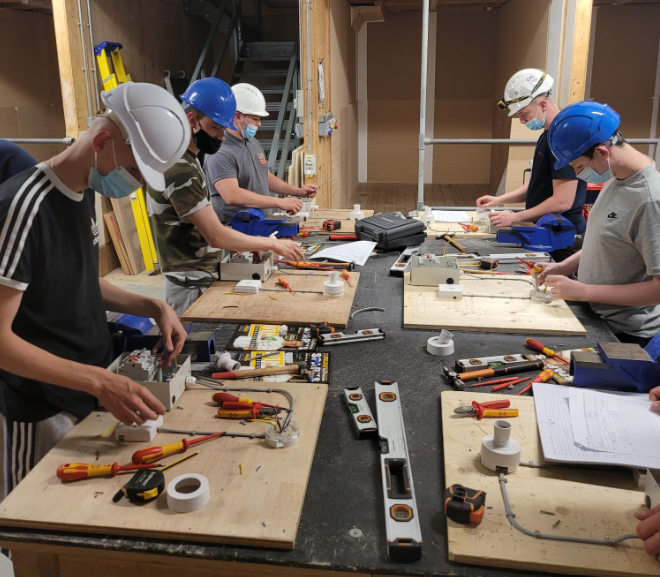
Carl Kammerling International remains fully committed to supporting the next generation of professional electricians, and was delighted to receive a ‘Business Recognition 2021’ award for its work with Leicester College. ‘Bright Sparks by CKI’ college sponsorship scheme began in 2003, and has provided Leicester College with quality hand tools and training resources to help students develop their skills. ‘Bright Sparks by CKI’ has a great future and this year exciting new elements will be added allowing students to benefit even more during their studies. About the ‘Bright Sparks by CKI’ Scheme Since the ‘Bright Sparks by CKI’ scheme began in 2003, Carl Kammerling International has supported over 50,000 apprentice electricians and now provides sixty colleges across the UK and Ireland with free professional standard C.K tools for use in their workshops. The Bright Sparks by CKI initiative continues to flourish and supports the continued development of students whose aim is to become the best professional electricians within the industry, whilst also providing and promoting the importance of the use of professional standard hand tools. A Course Tutor’s Insight Neil McManus, Construction T level Programme Area Manager at Leicester College comments: “The Bright Sparks scheme helps to support students by providing them with C.K industrial standard tools made of high quality materials to use in our workshops. This makes learning new practical skills easier to achieve, and enables the College to support and sponsor students with tools for use on site or into employment. The scheme also builds student confidence to carry out electrical skills by using first class tools. They look professional and the insulated tools keep students safe on site. “Access to the Productwise website at Carl Kammerling International supports learners with knowledge, which hopefully helps them to attain high grades in their final exams. The website also supports CPD for staff and students and provides certificates of achievement for students to use when applying for work.” What’s New About Bright Sparks by CKI? This year Bright Sparks by CKI is set to be further enhanced, to enable students to get the most out of the scheme.  There will be a strong focus on educational aspects, which will continue to provide C.K hand tools for practical lessons, with the addition of knowledge designed to support theory-based lessons. A series of educational posters will be available, as well as full access to Productwise, a great online learning resource packed full of useful information. Staying connected will become an integral part of the Bright Sparks by CKI scheme, bringing together a community of Bright Sparks colleges using social media to highlight student progress, news of special events, such as award ceremonies with presentations of C.K Tool kits and certificates for exceptional students, in recognition of their efforts and progression during the college year. Next year will see Carl Kammerling International celebrate its 20th year in partnership with Leicester College, and they are looking forward to continuing that successful relationship to help support the professional electricians of the future.

Mercedes-Benz Dealer Orwell Truck & Van makes all the right connections
A winning combination of fixed costs, product reliability and good honest customer service means highways services specialist Electrical Testing has now resolved to switch its entire fleet to Mercedes-Benz vehicles from Dealer Orwell Truck & Van.   The manufacturer’s representative in East Anglia has just supplied the Norwich-based  company with eight small Citan vans. Another 12 are scheduled to enter service before the end of July, with six more ordered for the autumn. Orwell Truck & Van has also delivered 11 larger Mercedes-Benz Sprinters over the last year. Established more than 25 years ago, Electrical Testing’s success has been based on foundations of trust, performance and unparalleled customer service. A significant independent player in the world of electrical inspection and testing of street lighting in cities and on roads across the country, it works with a range of clients including local authorities, main contractors and consultants. All of Electrical Testing’s new Citan vans, and all but four of its Sprinters, are the subject of flexible, competitively priced Operating Lease agreements with Mercedes-Benz Finance. Those that work from the company’s head office are being maintained by the workshop team at Orwell Truck & Van’s Norwich branch, while others allocated to field-based operatives around the country are serviced by the most conveniently located Mercedes-Benz Dealers. Electrical Testing operates more than 50 vans in a range of sizes and configurations, that work throughout most of the UK. Traditionally, the fleet has been split between leased and short-term ‘spot-hired’ vehicles, with a number of brands represented. Recent business ‘wins’, though, have prompted a change in acquisition policy. Operations Director Ben Humphrys explains: “We’ve picked up more longer-term contracts so the need for spot-hire flexibility has diminished. This, coupled with the fact that many of our vehicles were coming to the end of their terms, has allowed us to commit to more lease agreements with Mercedes-Benz Finance. “We were looking to sign-up to a 12-month replacement programme with fixed rates and a delivery model that suited our needs, but other suppliers were unable to meet our timescales – some were quoting lead times of six months or more, and were unable to guarantee rates beyond the first year. Frankly, I became bored of hearing Brexit given as an excuse for delayed delivery and fluctuating prices. “There were no such issues with Orwell Truck & Van, though. Sales Executive David Wooldridge was willing and able not only to support our requirements for fixed pricing, but to hold vehicles for delivery until the optimum time for us. “It was this flexible and honest approach from the Dealer, initially during negotiations over the Sprinters, and then with the Citans, that convinced us to award it our business. Our experience with Orwell Truck & Van has been so positive that we now plan to switch the entire fleet to Mercedes-Benz over the next two to three years.” Electrical Testing’s Sprinters are 314 CDI models, with long L2 bodies and fuel-efficient 143 hp 2.0-litre engines. They are assigned to jointing teams, which carry out connections to electricity mains for replacement street lights. The Citans, meanwhile, are 109 CDI PURE models also have long L2 bodies, while their 90 hp engines offer outstanding economy of up to 65.7 mpg. These are driven by electricians, and structural testing operatives, who carry out routine inspections and tests on street lights. All of these vehicles are fully ply-lined, and fitted with LED beacons and high visibility ‘Chapter 8’ chevron markings. “In the year or so that we’ve been dealing with Orwell Truck & Van we’ve been very impressed,” continues Mr Humphrys. “David’s support has been excellent, and we’ve benefited from the fact that senior colleagues of his have also taken a keen interest in our business. It’s a level of engagement I’ve never experienced with any other supplier. “Our Sprinters have proved significantly more reliable than the vehicles they replaced, and I’m confident the same will be true of the new Citans. As a business, it’s important that we provide our operatives with vehicles they can trust, with high levels of comfort and safety that encourage them to look after their vans. They’re delighted with Mercedes-Benz, and so are we.”

FOI reveals half of NHS trusts are charging ahead with EV infrastructure
According to figures released today by power management leader Eaton, half (51%) of NHS trusts in the UK have installed EV Charging Infrastructure (EVCI) on-site for their staff, patients and the wider community. While this is a positive step towards a low-carbon future, a similar proportion (53%) of NHS trusts are either behind on decarbonisation targets or do not have a clear set of emissions reduction goals in place. This new data was obtained through a Freedom of Information (FOI) request, issued to 173 NHS Foundation trusts across the UK, with 142 of them responding. Gearing up for more EVCI installations While half (51%) of NHS trusts already have EVCI on-site, a further 43% either plan to install charging facilities on-site within the next five years or are in early stage planning around how best to integrate such capabilities. In fact, just 6% of NHS trusts had no plans to introduce EVCI at the moment. This promising trend towards upgrading facilities to meet the public’s changing needs while reducing overall emissions is positive news for consumers thinking about switching to an electric vehicle. Marc Gaunt, segment lead, commercial buildings, Eaton, comments: “Concerns around the UK’s lack of EV charging infrastructure have inhibited EV adoption due to range anxiety: the fear that an EV would have insufficient range to reach its destination and leave the driver stranded. Yet EVs and their underlying infrastructure are a vital piece of our route to a low carbon future. EVs offer a cleaner mode of transport while smart charging infrastructure not only powers the future of travel but embeds more flexibility into our energy grid to enable decarbonisation at a national level.” Falling behind on decarbonisation targets, but measures are in place The FOI revealed that over half (53%) of NHS trusts are currently behind on their decarbonisation targets or do not have clear emissions reduction targets in place. Just two fifths (38%) are on track to meet their goals while only 5% are tracking ahead at the moment. However, when asked about the decarbonisation measures currently in place, the vast majority of NHS trusts reported that they have either already installed, or will be installing, lighting upgrades (93%), increased building control and automation (90%) and upgrades to insulation (69%) within their facilities over the next five years. Only one responding NHS trust reported having no initiatives in place or planned at all. More opportunity within EVCI When asked about the impact of EVCI on existing electrical infrastructure, half (53%) of NHS trusts flagged that they would need greater electrical capacity, while two thirds (41%) said it may incur additional energy costs through greater peak demand. Just a quarter (24%) recognise the potential to create new revenue streams from new charging facilities. Vehicle to grid (V2G) technologies allow electric vehicles to store energy and discharge it back to the electricity grid when it is most needed, creating a bi-directional relationship that offers up new opportunities for estate and facilities managers. The FOI revealed that very few NHS trusts (11%) are currently participating in selling energy back to the grid through energy storage technologies. One fifth (23%) plan to use energy storage to start selling energy back to the grid in the next five years, but two-thirds (65%) have no plans to do so. Marc concludes: “Estate and facilities managers often consider building energy first when considering decarbonisation, but travel and transport is a vital consideration. NHS trusts are adopting EVCI rapidly and offering staff, patients and visitors a cleaner alternative to significantly lower their total carbon footprint. Public and commercial buildings will need to follow suit. Every building – not just hospitals – will need to play its part if we are to meet the challenges presented by the rapid adoption of EVs and accelerate the UK’s path to a low carbon future.”

Economic upturn masks mental health crisis
The economic recovery is concealing a growing mental health epidemic among construction SMEs, according to a new online survey carried out by pollsters YouGov. Despite an upbeat forecast for growth across the UK economy this year and a rapid recovery for construction and its related sectors, firms are continuing to report serious conditions amongst workers, including panic attacks, insomnia, and depression. Employees in construction SMEs are more than twice as likely to have suicidal thoughts as people employed in other sectors. Displays of extreme anger resulting from late payment are also 50% more likely in SME construction firms, than in businesses of a similar size in other industries, according to the survey. Construction is reporting its fastest rate of growth in almost seven years with house building and infrastructure work moving at record pace; and repair and refurbishment projects also picking up fast. Although most firms are optimistic about their short and medium-term business prospects, many SMEs are also reporting rising levels of mental health problems among staff and management. Rather than improving the situation, the speed of the sector’s recovery seems to have added to the stress experienced by many construction SMEs and the perennial problem of late payment is the main culprit. Late payment The survey, which was commissioned by the Building Engineering Services Association (BESA) and the Electrical Contractors’ Association (ECA), during Mental Health Awareness month, revealed a strong link between late payment practices and serious mental health issues. It showed that extreme responses, such as suicidal thoughts, depression, and panic attacks, in construction SMEs are now 6% higher than in sectors experiencing a slower economic recovery. More than a third of SMEs in construction, who responded to the survey, reported chronic mental health conditions in their workforce. Poor mental health increase physical health and safety risks putting even more lives in danger. Many constructions sites remained open during the pandemic, in particular smaller sites where, social distancing was easier. Construction workers were, therefore, less affected by mental health triggers such as isolation, but the YouGov research still showed that mental health in the industry was at “crisis point”. A further worrying finding showed that construction workers were more than twice as likely to have a harmful response to restlessness as a result of furlough, by misusing drugs or alcohol, than those in other sectors. Larger construction firms are taking steps to address the problem by introducing ‘Mental Health First Aid’ courses, for example, but cash flow issues mean that smaller firms lack the financial stability to be able to provide the right level of support to staff, according to the trade associations. “This is a hugely worrying situation,” says BESA chief executive officer David Frise. “It is to be expected that the extreme situation of lockdown would have a negative impact on mental health, but we certainly hoped the start of the economic recovery would have improved things. “Yet, at a time when we should all be pulling together to support the recovery and encouraging better working practices, we are once again grappling with the late payment culture of some that leads to untold levels of human misery. The government really needs to get much tougher on this issue and quickly.” Steve Bratt, chief executive officer of the ECA, said he was very concerned to see members and others struggling because of the way construction does business. “Good mental health and wellbeing is fundamental to the long-term success of the recovery. We must start treating mental health as we would treat a physical illness. The health of our people is the basis of a resilient, innovative, and economically buoyant economy,” he adds. You Gov asked ‘Which, if any, of the following health issues has anyone at your business experienced as a result of late or unfair payments?   Construction SMEs Other SMEs Suicidal feelings 5% 2% Extreme anger 12% 6% Harmful response to furlough restlessness (e.g. misuse of alcohol, drugs, etc.) 7% 3%