2 November 2026
Product of the Month: Amari Floodlight range by Aurora Lighting
 
12 November 2026
Schneider Electric transforms Southampton hospital estate
 
12 November 2026
GTEC Training opens new education facility in North Yorkshire
 
11 November 2026
Energy, AI and smart buildings: register now for EMEX 2026
 
11 November 2026
Solar and batteries could cut electricity costs by 40%, data finds
 

Latest News


The 10 electrical appliances and brands electricians should watch out for
A new study reveals that faulty household appliances cause 38 electrical fires A DAY in England, and big name brands are responsible. Electrical wholesaler, ElectricalDirect, analysed fire and rescue statistics collated by the Home Office and UK government between April 2019 and March 2020 to find out just how many everyday appliances were the root cause of electrical fires in the home. The research found that household appliances caused a total of 15,000 accidental fires in homes across England. But when called out on the job which appliances, and brands, should electricians look out for the most? Faulty appliances accounted for 15% of appliance fires The biggest culprits were washing machines, accountable for nearly a quarter (23%) of the faulty appliance fires. Tumble dryers (20%) and cookers (9%) followed suit. Of the accidental appliance fires in 2019/20, 2.2k (15%) of them were caused by the appliance being faulty, which is 43 a week. The top 10 appliances that caused the most fires due to being faulty Rank Appliance Type Number of fires due to being faulty (2019/20) 1 Washing machine 520 2 Tumble dryer 459 3 Cooker incl. oven 201 4 Fridge/Freezer 181 5 Dishwasher 171 6 Extractor fan 118 7 Grill/Toaster 116 8 Other domestic style appliance 96 9 Microwave oven 74 10 Washer/Dryer combined 54 (Number of faulty household appliances caused in England in 2019/20) The top 10 household appliances most likely to cause an accidental fire Rank Appliance Number of fires caused in 2019/20 % change Y-O-Y 1 Cooker incl. oven 8,001 -3.50% 2 Ring/ hot plate (separate appliance) 1,581 -2.95% 3 Grill/Toaster 1,368 -4.00% 4 Microwave oven 922 -7.80% 5 Tumble dryer 668 4.70% 6 Washing machine 624 6.85% 7 Fridge/ Freezer 215 -6.11% 8 Dishwasher 194 -7.62% 9 Deep fat fryer 186 2.20% 10 Extractor fan 182 -0.55% (Number of household appliances that caused fires in England in 2019/20 and percentage difference in 2019/20 vs 2018/19) The study revealed that cookers, toasters, and hobs were the most likely to cause fires. Cookers were responsible for 8,000 accidental fires in 2019/20, 53% of total appliance fires in England. Hot plates and toasters came second and third, causing 11% and 9% of fires respectively. The most common causes for accidental appliance fires were placing household items too close to sources of heat, misuse of appliances and reported faults. Hotpoint appliances caused the most fault-led fires in 2019/20 Rank Brand Number of faulty appliance fires (2019/20) 1 Hotpoint 311 2 Indesit 183 3 Beko 150 4 Bosch 100 5 Hoover 93 6 Candy 59 7 Zanussi 47 8 White Knight 39 9 Whirlpool 33 10 Bush 32 (Number of faulty household appliances by the brand that caused in England in 2019/20) Hotpoint appliances were found to cause the most faulty appliance fires last year, with 311 recorded in 2019/20. The majority of which were washing machines (112) and tumble dryers (105). Popular household name, Indesit followed with a total of 183 reported fires. The biggest offenders were tumble dryers (69) and washing machines (67). Beko came third, whose goods caused 150 fires in 2019/20. Of these, the majority were washing machines (52) and tumble dryers (29), although dishwashers (27) and fridge/ freezers (26) weren’t far behind.

Police Alarm Receiving Centres to be ECHO-connected by October 2021
ECHO have announced that Essex Police and the Metropolitan Police have jointly issued notice to their registered Alarm Receiving Centres (ARCs) to be ECHO-connected by 1st October 2021. Chief Superintendent Ewen Wilson, Head of Contact Management Command, Essex Police says “From the outset we have been at the forefront of the transition from existing telephone call handling of alarm activations to a modern, fully automated solution providing tangible benefits, including the reduction of call handling demands and police response times. Having been the first police force in the UK to successfully test and adopt the new process, we have every confidence in the delivery of this new automated service.  After careful consideration, Essex Police are now giving notice to registered ARCs that we expect them to become ECHO-connected by 1st October 2021 in order to retain police response for verified alarm activations of Intruder and Hold-Up Alarm Systems.” Following recent successful ‘end to end’ testing of ECHO’s new automated alarm signalling transmission service, these two police forces are now accepting Intruder Alarm System (IAS) and Hold-Up Alarm (HUA) activation alerts directly into their police control rooms, without the need for manual call handling. From Friday 1st October 2021 both police forces expect all alarm signals from approved ARCs to be transmitted in this way via the ECHO platform, prioritising and increasing speed of police response. The introduction of the ECHO-connected service is the alarms industry response to the NPCC Requirements (‘Police Operational Advice and Security Industry Requirements for Response to Security Systems 2020’). Section 3.1.4 of the Requirements states ‘all Intruder Alarm System (IAS) and Hold-Up Alarm (HUA) activations be electronically transmitted to police control rooms…should the police force concerned be able to receive signals in this form’. In 2016 Operational Advice envisaged the potential benefits to the alarm user, industry and police service of the automatic electronic transfer of alarm signals, in eliminating communication errors and delays associated with manual telephone call handling, to ultimately provide a quicker police response. Alarm Receiving Centres registered with the Metropolitan Police Service and/or Essex Police requiring assistance to transmit alarm signals via ECHO should contact their alarm monitoring software provider.

New partnership helps Age of Light Innovations deliver rays of light
Founder and Managing Director of the Age of Light Innovations, Dr Shelley James, has today announced a powerful new partnership with creative agency, Parrot PR and Marketing, who together share an intrinsic passion for lighting. Individuals are becoming increasingly aware of the impact light has on our brains and bodies. This has resulted in a new understanding of the environmental impact, particularly the way we light our homes and cities. With a clear vision and shared ambition to build communities and ignite an enthusiasm for light and wellbeing in this new digital age, the Age of Light Innovations and specification industry specialists, Parrot PR and Marketing, will work together to deliver a series of interactive campaigns and pioneering initiatives which have been thoughtfully curated to light up the year ahead, and help others realise the transformational effect lighting has on our wellbeing. Most recently, Dr Shelley James has partnered with London Light and the UNESCO International Day of Light to launch Lighting Up 2021. This exciting initiative invites entrants to submit a short video to demonstrate their passion for light, while detailing a specific dimension of light that creates fascination, intrigue or delight. Submissions will be judged by a panel of experts including: Lighting Designers, Paul Constable and Mark Major; Physicist, Dr James Millen; Astronomer and Founder of the Commission for Dark Skies, Bob Mizon OBE; and Colour Specialist and Creative Director of Dulux, Marianne Shillingford, and Dr Shelley James. The deadline for entries is Friday 23 April 2021 and successful candidates will be selected by the panel for a special screening which will open a public debate on the shared language of light at 4pm UK time on Thursday 20 May 2021. For more details, please see the London Light website. Alongside this collaboration, Age of Light Innovations unveiled the overwhelmingly successful Luna Golightly campaign which seeks to put the ‘human’ back into human-centred lighting. Concerned by the impact of lockdown during the winter months, and a significant reduction in children’s exposure to natural light, Dr Shelley James launched a series of infomercials to help young people and their caregivers understand the importance of light on their wellbeing, and how to take simple and effective steps to improve exposure to positive sources of light. Sponsored by some of the world’s leading lighting organisations; Fagerhult, Seoul Semiconductor and Signify, Luna garnered further support from scientists and educational experts from across the world including Harvard, Manchester and Bristol Universities and UCL, the Finnish Institute for Health and Wellbeing, Royal College of Art, and Women in Lighting to name a few. Since launch in 2021, Luna™ has achieved global recognition, reaching over 1.7 million 13–19 year olds worldwide and securing more than 260,000 ThruPlays in total. Building on the resounding success of Luna and the growing commitment to the Well standard, Age of Light Innovations is preparing an exciting new initiative with a coalition of leading organisations from around the world to raise awareness of the underlying principles of human-centred design - the ‘why’ of WELL. To celebrate our shared experience of light, Age of Light Innovations and the London Light network of scientists invites you to join them to celebrate the international day of light on 16 May 2021. Dr Shelley James, Founder and Managing Director of Age of Light Innovations comments: “The world has faced a number of unprecedented challenges over the last year as a result of the global pandemic. During this time, it is evident that one's own wellbeing must now take priority. I am fascinated by the impact lighting has on an individual, and it is a real honour to work with likeminded individuals and organisations, such as Parrot PR and Marketing, to deliver these initiatives to further educate communities and provide accessible support.” Eve Gaut, Founder and Director of Parrot PR and Marketing adds: “We are thrilled to have been appointed by the Age of Light Innovations to assist in the delivery of these inspired campaigns. We are passionate about all aspects of lighting and very much look forward to this innovative and rewarding partnership with Dr Shelley James.” Register your interest for more information on Dr Shelley James’ upcoming initiative which will seek to convince specifiers about the benefits of healthy light.

NAPIT calls for Enhanced Electrical Safety Standards throughout the UK
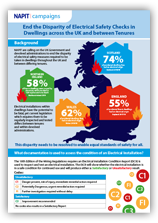
Electricity is in use all around us, it can be dangerous and has the potential to be fatal, yet the legislation surrounding the safety standards of electrical installations in dwellings differs throughout the UK and between tenures. NAPIT are calling on the UK Government and devolved administrations to end this disparity to enable parity of safety for all. In a recently published infographic, NAPIT examines the disparity of electrical safety standards within the UK, and within the 3 typical housing settings: owner occupied, social housing and the private rented sector. The summary clearly highlights the risk to life posed by electricity, with the number of fires in dwellings from an electrical origin being over 50% across all administrations. Yet, only England and Scotland have Regulations which require the regular inspection and testing of the electrical installations within privately rented homes at least once every 5 years, and only Scotland requires the regular inspecting and testing of electrical installations in Socially Rented Homes. There is currently no legal requirement to undertake any electrical safety checks in owner occupied dwellings, but with the current focus on Building Safety Reform, and enhancing safety standards in Higher Risk Buildings, NAPIT are supporting recommendation 188 from the Housing, Communities and Local Communities Select Committee’s pre-legislative scrutiny of the Building Safety Bill to: “recommend that the Government include supplementary provisions in the Bill for mandating regular electrical safety checks in higher-risk buildings.” This needs to be regardless of tenure to ensure the same safety standards are applied to all properties for parity. Four key requests: UK wide legislation to require every electrical installation in socially rented dwellings to have an electrical inspection and test, in the form of an Electrical Installation Condition Report (EICR) carried out by a competent and qualified electrical inspector at least once every 5 years. Legislation to require every electrical installation in privately rented dwellings to have an electrical inspection and test, in the form of an EICR carried out by a competent and qualified electrical inspector at least once every 5 years. (Needed in Wales and Northern Ireland) Legislation to require an EICR is carried out prior to the sale of all dwellings to protect the purchaser from potential electrical hazards. Legislation to require every electrical installation in dwellings within a Higher Risk Building, as defined by the Building Safety Bill, to have an electrical inspection and test, in the form of an EICR carried out by a competent and qualified electrical inspector at least once every 5 years. Commenting on the release of this infographic, Frank Bertie Chairman of The National Association of Professional Inspectors and Testers says: ‘Choosing to enhance the safety of electrical installations in dwellings can be a matter of life and death. Protection from electrical dangers should not be dependent on where you live. Policy alignment in this area is key to improving the electrical safety in dwellings and should build on the positive steps taken by the UK and Scottish Government’s in recent years, but it must go further. Unity provides clarity and consistency and must be adopted to provide assurance that regardless of the tenure or location of the home people live in, they are equally protected from electrical risks.’

Housing developers urged to end fossil fuel heating systems earlier than 2025
With the government setting a UK target to achieve net zero carbon emissions by 2050, it is no surprise that both businesses and consumers are seeking ways to contribute towards reaching this goal. In order to help achieve this target, the government has also announced a series of further goals such as the Future Homes Standard, due to come into play in 2025, which will require new build homes to be future-proofed with low carbon heating and world-leading levels of energy efficiency. Keith Bastian, CEO and founder of Fischer Future Heat, an expert in dynamic heating, explains why housing developers should be putting an end to using fossil fuel heating systems as soon as possible. When fossil fuels such as coal, oil and gas are burned, they release carbon dioxide and other harmful greenhouse gases, all of which trap heat in the atmosphere. Because of this, fossil fuels are the main contributor to global warming, climate change and an increased carbon footprint across both the UK and the globe. Currently, around 95% of homes have central heating, many of which will rely on gas or oil, and home heating is responsible for around 15% of the UK’s total greenhouse emissions. To reduce the UK’s carbon footprint, the Future Homes Standard sets out to ensure that all new homes built as of 2025 will have 75-80% less carbon dioxide emissions than homes built to current regulations. Although this is impressive, and it will make a phenomenal difference, what are we waiting for? Why not start now? Whilst it may appear that the responsibility lies with heating and energy providers to offer sustainable and cost-effective solutions, and to some extent it does, it is also down to the housing developers to build houses and homes that allow for newer, more sustainable heating systems. For newer homes, it will be relatively easy and affordable to change old fossil fuel heating systems to something a lot less damaging. However, for older homes, it can be quite the opposite. Because of traditional fireplaces and other energy escape routes through the fabric of the home, it can be extremely difficult for homeowners to make sustainable changes to their heating systems. The first step should always be – insulate, insulate, insulate. With approximately 247,000 houses being built in England and Wales each year, we can’t afford to wait until 2025 to become more eco-conscious. In today’s world, we are fortunate that eco-conscious consumers are beginning to desire more sustainable homes, so it seems obvious that housing developers should first and foremost be implementing eco-friendly heating systems. This will ensure the properties they are building are not only more desirable, but futureproofed when it comes to buying and selling on the property market. With the need for sustainable homes on the rise and somewhat of a necessity moving forward, eco-homes are continuing to prove popular. Using 50% less energy and 50% less water compared to houses being built to contemporary Building Regulations, housebuilders such as Gusto Homes are continuing to lead the way for sustainable housing. By maximising energy sources such as solar panels, minimising heat-losses from north facing elevations and concentrating on the overall eco-performance and waste-water heat recovery systems, Gusto Homes is transforming the industry and other property developers are slowly starting to follow suit. With this in mind, housing developers and homeowners alike should aim to install independent heating systems, with the likes of electric German clay heaters. Eliminating the inefficiencies that come with fossil fuelled heating systems, electric heaters are smart and sustainable room powered radiators that are more efficient for both the environment and people’s pockets. As well as helping to reduce the UK’s carbon footprint, electric heaters provide seasonal comfort. With traditional heating systems, you may struggle to find the perfect balance in room temperatures to suit the time of year, but with electric heaters, you are able to do exactly that. Electric heaters, combined with renewable energy sources such as wind and solar and the impending introduction of the Future Homes Standard, are a sure-fire way to contribute to the UK’s target of net zero carbon emissions by 2050. Why wait until 2025 to introduce such initiatives? Start now and make a real difference. The future is electric.

Industry backs SELECT campaign for regulation of electricians
Campaigning trade association SELECT has welcomed the results of the latest consultation on regulation of the electrical industry in Scotland, which again shows an overwhelming majority of respondents in favour of legislation. The outcome of the latest Government consultation, which closed on 12 February, reveals that, out of the 100 organisations and individuals who took part, the “vast majority” thought that voluntary measures don't work and that regulation was required. And Scotland’s largest construction trade association insists the latest findings are another pivotal step in the long-running campaign for legislative action. Alan Wilson, Managing Director, says: “There is a sense that the campaign is gathering increasing momentum and the strength of the consultation responses illustrates that our conviction is shared by the majority of those in the sector. “While we would all like to think that voluntary action would work, it’s quite clear from the responses that the sector needs government legislation to bring about ‘comfort and security’ for customers across the country and end the scourge of unqualified people passing themselves off as electrical professionals. “We have been hugely encouraged by the levels of support we have received, particularly cross-party parliamentary support, and the impressive range of people who have publicly backed us through channels such as our Wall of Support. “The result of this consultation is another enormously significant advance and we would like to thank all those parties who took part.” The encouraging results were revealed to members of the parliamentary Electricians Working Group in a letter from Jamie Hepburn MSP, the Minister for Business, Fair Work and Skills, who set up the consultation. Mr Hepburn's letter revealed that, of the 100 responses, 40 were from organisations and 44 were from individuals, the majority of whom were in favour of regulation. The Minister now wants the Working Group to reconvene to discuss the responses and says that it will be the responsibility of whoever holds his office after the Holyrood elections in May to decide the next steps. The results follow a previous consultation by Conservative MSP Jamie Halcro Johnston, which closed on November 10 last year and received more than 140 submissions, more than 90% of which were positive. Alan adds: “Poor quality electrical work carries huge risks and it is vital that both businesses and consumers are able to make informed choices whenever they employ an electrician. These responses add enormous substance to that imperative. “It has been clear to the industry for years that those who work in the industry must do so in a safe and competent manner.” SELECT has been campaigning for years with other leading industry bodies, such as the Scottish Joint Industry Board (SJIB) and Scottish Electrical Charitable Training Trust (SECTT), to ensure that those who work in the industry do so in a safe and competent manner. Its campaign, which has been raised in the Scottish Parliament, is being backed by membership bodies, industry figures, professional services and individuals from across the country – and has received unprecedented levels of cross-party support from politicians.

COVID-19 has caused a 14% increase in home daytime heating
A new study from tado° has found that UK homes had their daytime heating on 14% more this winter in comparison to the previous year. Despite financial and environmental savings made with less driving, home energy bills have gone up as heating use has increased. The study sampled approximately 65,000 UK and 300,000 European homes. It found that Italian and Spanish households faced the biggest increases in home heating with Denmark and Sweden among the lowest. In the UK, homeowners turned on their heating 14.3% more than in the same period the previous year. This was despite the fact that this winter was on average 0.6°C warmer than the previous winter in Europe. In the UK and Europe, heating and cooling in buildings and industry accounts for half of the UK and Europe’s energy consumption, making it the biggest energy end-use sector ahead of both transport and electricity. Heating and hot water make up approximately three quarters of a home’s energy use and two thirds of the energy used for the heating, cooling and hot water in residential buildings still stems from fossil fuels. “We’ve seen a massive transition from office to home working over the last year and this has a significant impact on heating and hot water costs,” says tado° Co-founder and Chief Product Officer Christian Deilmann. “The good news is that there are technologies that improve energy efficiency in homes. This saves people money while keeping homes nice and warm.” There are many cost-effective ways to save money on heating and hot water. Turning the thermostat down by one degree can save around £60 a year on an average family home but savings don’t have to come at the cost of comfort. Using your heating and hot water only when they are needed can save much more. Switching to a smart thermostat can ensure that only occupied homes and rooms are heated, while also making additional savings through weather adaptation, open window detection and other features. Studies have shown that this can reduce heating bills by up to 31% without the homeowner or tenant giving up an inch of comfort.

New EV charge point protection and safety solutions from Brandsafe
Improved levels of protection for electric vehicle (EV) charge points installed in warehouse and distribution centre car parks are provided by a new range of high-performance solutions from Brandsafe, the UK impact protection equipment specialist. There are currently in excess of 30,000 electric vehicle charge points across the UK in over 11,000 locations. Furthermore, the Department for Transport has allocated £10m to local councils to fund the installation of an additional 7,200 commercial charging stations by 2021. The resilient, cost-effective and flexible EV charge point protection range from Brandsafe is ideal for the all round protection of new or current EV charge point installations from vehicles in car park areas and features an array of durable and impact resistant bollards, wheel stops and Armco barriers. For light and medium duty applications, such as private office or public car parks, ImpactSAFE Protection Posts are available in either 600mm, 800mm or 1000mm height options. These bollards are strong and robust and feature different colour options to suit individual requirements, offering added safety and visibility for vehicle drivers when they are either reversing up to or pulling alongside a charge point. In heavy-duty applications, where there is a higher risk of impact damage, ImpactSAFE Heavy Duty Bollards should be utilised. These bollards, which are available in 1000mm, 1300mm or 1600mm height options, are highly reflective and feature shock absorbing rubber buffers to deflect the force of impact away from critical areas, offering the requisite protective benefits for industrial use. Vehicle traffic routing Armco safety barriers can also be installed in industrial areas to protect either individual or multiple charge points, providing a further level of protection against vehicle impact damage. The barriers come with hardwearing and weather resistant polyethylene corner and end sections to further protect electric vehicle (EV) charge points from collision damage. A selection of highly visible and hardwearing vehicle wheel stops, which are quick and easy to install and moulded from recycled truck tyres, are also available as part of this new range. These can be specified to suit all applications, with solutions available to accommodate everything from domestic vehicles to commercial vans and HGVs. As with the bollards, various colours of wheel stops are available to match the client’s requirements. Standard product packages have been created by Brandsafe to suit the application and location of EV charge points, but customers can also opt for bespoke solutions to suit their individual requirements. Paul Roehricht, UK strategic account manager for Brandsafe, says: “The EV market in the UK is growing rapidly and operators need to protect their charge points from damage and loss. Our new range of added value impact resistant solutions offers a comprehensive, cost effective and accessible way to safeguard these investments.”

Government boosts energy efficiency spending to £1.3 billion
£300 million of extra funding is to be invested to cut greenhouse gas emissions from the nation’s homes through energy efficiency and low carbon heating schemes. The funding will focus on delivering energy saving upgrades and low carbon heating to homes through local authorities in England, meaning tens of thousands more low-income households will be able to be upgraded. Following a review, the Green Homes Grant Voucher Scheme launched last year will close to new applications on 31 March at 5pm. The scheme was designed to provide a short-term economic boost while tackling our contribution to climate change. Applications made before the end of March deadline will be honoured and any vouchers already issued may be extended upon request. Today’s announcement takes the total government funding for energy efficiency and low carbon heating in 2021/22 to over £1.3 billion, with the remainder of the funding having been pledged through the decarbonisation fund. This is up from the £1 billion announced in the Prime Minister’s Ten Point Plan and exceeds the Government’s manifesto commitment in these early years of the parliament. Home upgrades can help households save over £300 a year on their energy bills. This announcement is part of the Government’s manifesto commitment to pledge over £9 billion to increase the energy efficiency of homes, schools and hospitals to work to build back greener, which will support around 58,000 jobs. Business and Energy Secretary Kwasi Kwarteng says: “Upgrading the country’s homes with energy efficiency measures means we can cut emissions and save people money on their energy bills. “Today’s funding boost will mean even more households across England are able to access these vital grants through their local authority. “This latest announcement takes our total energy efficiency spending to over £1.3 billion in the next financial year, giving installers the certainty they need to plan ahead, create new jobs and train the next generation of builders, plumbers and tradespeople.” The original £500 million Green Homes Grant Local Authority Delivery Scheme is already helping around 50,000 households in England with an annual income of under £30,000 save hundreds of pounds each year on their energy bills by making their homes more energy efficient. Through the extended scheme, tens of thousands more households on incomes of less than £30,000 will not have to make any financial contribution to energy efficiency improvements to their homes. Delivered through the Green Homes Grant Local Authority Delivery Scheme and Social Housing Decarbonisation Fund Demonstrator, this will include green home improvements such as deep insulation, heat pumps and solar panels, helping cut over 70,000 tonnes of carbon from the atmosphere each year. Through the Prime Minister’s Ten Point Plan for a Green Industrial Revolution and the Energy White Paper, the Government has set how it plans to decarbonise the nation’s buildings, including its aim to deploy 600,000 heat pumps a year by 2028, and to get as many homes as possible to Energy Performance Certificate Band C by 2035. Decarbonising the country’s roughly 30 million buildings is essential if the UK is to meet its commitments to eliminating its contribution to climate change by 2050.

An improved pre-qualification (PQ) standard launches
A new industry-wide pre-qualification (PQ) system is now fully up and running, simplifying a complex system for the benefit of everyone in the construction sector. The rollout of the Common Assessment Standard will significantly reduce the duplication of time, effort and resources that are costing the sector up to £1 billion a year. Major contractors and clients – including Balfour Beatty, Costain, HS2, Mace, Multiplex and Skanska – have all adopted the Common Assessment Standard meaning that members of their supply chains will need to obtain just one certification to tender for work with them. This follows the recent implementation of a new data sharing solution, which enables contractors and clients to obtain key PQ data from any one of three Recognised Assessment Bodies: Achilles, CHAS or Constructionline. The Common Assessment Standard is an industry-agreed question set with two levels of certification – desktop and site-based – and companies can apply to any Recognised Assessment Body to get the appropriate level dependent upon their trade, size and requirements of their clients. Created by Build UK, of which ECA is a key member, with the support of CECA, the Common Assessment Standard is endorsed by the Construction Leadership Council (CLC), which is actively seeking its adoption throughout Government construction procurement, including the Construction Playbook. Paul Reeve, CSR Director of ECA and deputy chair of the Cross-Industry Body, says: "We welcome the introduction of data sharing to the Common Assessment Standard. Data sharing paves the way for increased specification by main contractors and other buyers and offers suppliers more choice about who carries out their prequalification assessment. It will also help to deliver the savings and efficiencies that the supply chain has long been looking for, by reducing the need for multiple PQ questionnaires and schemes." Jo Fautley, Deputy Chief Executive of Build UK, comments: “We’re delighted that the new system is now fully up and running and already being used by major contractors and clients. It’s been a collaborative effort, involving companies across the whole sector, and the new system is a huge step towards more efficient working, which is more important than ever in the current challenging economic climate.” Andy Mitchell, Chair of the CLC, says: “The CLC is delighted to endorse the Common Assessment Standard which is set to transform the construction PQ process. It is a real and practical way of reducing bureaucracy and improving quality in the industry and it comes at just the right time. Companies will be able to demonstrate that they meet an agreed industry standard, and clients and contractors will be able to rely on the certification. The CLC will be encouraging the adoption of the Common Assessment Standard throughout public and private sector procurement.”