2 November 2026
Product of the Month: Amari Floodlight range by Aurora Lighting
 
12 November 2026
Schneider Electric transforms Southampton hospital estate
 
12 November 2026
GTEC Training opens new education facility in North Yorkshire
 
11 November 2026
Energy, AI and smart buildings: register now for EMEX 2026
 
11 November 2026
Solar and batteries could cut electricity costs by 40%, data finds
 

Latest News


Facilitating change: The smart benefits of going green
The UN Paris Agreement in 2015 aimed to limit the average rise in global temperatures to 2°C above pre-industrial levels, trying to keep the increase below 1.5°C. Since then, the issue of climate change has come to the fore for nations and, by extension, their enterprises. In 2019, the UK made laws to commit to achieving net-zero emissions by 2050. With an ever-increasing focus on carbon footprints, what should facilities managers be doing now to take advantage of climate change regulations, avoid penalties and taxes, and reduce their carbon footprints? Changing for climate and COVID In 2018, Britain’s commercial sector was responsible for 18% of carbon dioxide emissions, just behind homes. According to the UK committee on climate change, it will be primarily up to businesses to deliver on net-zero targets and provide the required investments. One could also argue that the coronavirus pandemic has accelerated the rate of change in the way people view public places, offices and workspaces. To reduce the spread of COVID-19, facilities managers are looking at ways to redesign workspaces with more space, better air ventilation and use more sustainable materials. Smart facilities managers are also using the opportunity to create greener and more sustainable work environments. Buildings are increasingly embracing what’s known as “biophilic design”. This is the concept of bringing the health benefits of the outdoors indoors, while cutting down on energy consumptions and costs and boosting employee health and productivity. Changing for cash  And if facilities are not voluntarily working towards low-carbon targets, regulations will force the issue. The Government’s environmental taxes and tax reliefs are there to encourage businesses to operate in a more environmentally friendly way. There are opportunities for organisations to pay less tax by applying for schemes that demonstrate that they are operating more efficiently and producing less damaging waste. Now is the time to act! Bearing in mind business’ carbon obligations, associated regulations, and the coronavirus pandemic’s impact, creating more sustainable environments should be high on every facility manager’s list. The good news is that now is also the time of smart, connected technology, which is making it ever-easier to commit to (and demonstrate) “green” measures. Below are some examples: Air quality As demonstrated by numerous new studies, coronavirus outbreaks can be attributed to droplet transmission through the air. With good ventilation and air monitoring solutions, you can observe and monitor your air quality in real time and reduce the spread of infection. IoT-connected air quality monitoring sensors give facilities managers full visibility of the air quality in different areas of the property. Real-time notifications provide immediate alerts if the air is compromised in any way. Having more control over air-conditioning and HVAC units can also help reduce energy consumption. Occupancy sensors can trigger room temperatures and circulation automatically, instead of leaving systems running unnecessarily. And with more windows being opened for ventilation, it’s important that room controls are adjusted automatically to prevent wastage. Water quality The concept of biophilic design often incorporates indoor water features like ponds and waterfalls. It’s important that, along with COVID-19 prevention, water safety remains a priority for facilities managers. It’s a legal obligation for business premises to demonstrate that they have mitigated any risks associated with legionella bacteria. This includes regular water temperature testing and keeping records for five years – a tedious process if done manually. That’s why many facility managers are looking to automatic flushing and temperature testing systems that can be controlled, managed and reported on remotely. Along with improved accuracy and saved time, automated flushing and temperature testing also saves water, and thus helps facilities become more energy efficient. With manual testing, every outlet in the building (hot and cold) needs to be run for two minutes to test the temperature, wasting both water and energy. With an automated testing system, thermometers are able to capture accurate temperature readings from pipe sensors and wireless tank temperature sensors. Smart lighting According to research published in the Journal of Clinical Sleep Medicine, employees who are exposed to natural light in offices sleep better because the light improves circadian rhythms. Working in a room with natural light also helps boost productivity and mental health. Allowing natural light in through sunroofs and windows also reduces the need for electric lighting, and thus energy consumption. With smart lighting controls, lights can be dimmed according to the amount of natural light at any given time, ensuring an adequately-lit working environment without wasting energy when it’s not needed. The colour of the lighting can also be adjusted automatically, providing different colour temperatures to keep the body’s internal clock in line. As a result, smart lighting not only reduces energy consumption and moves buildings closer to net zero targets, but also leads to greater productivity and a more comfortable environment. It’s time to act and adapt It’s simple: businesses that do not adapt will be at risk; those that embrace change will unlock greater opportunities. Lowering the carbon footprint of buildings and creating healthier working spaces is made simpler, smarter and more attainable through IoT connected devices.

Ellis patents repays furlough funds
Ellis Patents has repaid the furlough funds it has used since the Government’s Coronavirus Job Retention Scheme was announced by Chancellor, Rishi Sunak in March 2020. The cable cleat manufacturer, whose products are in demand around the world, utilised the scheme between March and September 2020 in order to protect its workforce from the consequences of fluctuating demand caused by the pandemic, but decided in a board meeting in December to repay in full the £130,000 claimed. Richard Shaw, chairman of Ellis Patents, says: “This Pandemic has created an unprecedented period of uncertainty for business, but the message from  Government has been clear – they wanted to protect people, save lives and protect as much of the economy as possible to prevent a post-COVID catastrophe.” “We followed Government guidance and did not close. We used the furlough scheme as intended, to protect our workforce through the leanest period. At the peak we furloughed 44 per cent of our employees.” Remarkably, Ellis Patents has come through 2020 in better shape than could possibly have been conceived in March, but there have been sacrifices all round.  There was no annual pay review for employees, no returns have been delivered to shareholders and cash has been conserved by reducing capital expenditure to essential items only. “In December we looked at the improving picture and paid a one off COVID-19 bonus to our employees with a promise of a pay review in March,” continues Richard. “While we also knew that we should consider our shareholders, whose continued support has been unstinting, we noted the impact of the furlough scheme in artificially inflating our bottom line. It was the unanimous decision of the Board that the Company had a social obligation to return this money to the Government before paying any dividend.” Already this year Ellis Patents has announced a big order for its Cable Guide Clamps to be installed in the Sotra Connection – an infrastructure project in Norway that has been described as the biggest in a generation. This news came hot on the heels of a series of significant orders from Latin America during 2020.

The construction playbook
The Government has recently published a Construction Playbook outlining how government will work with the industry to improve standards in public projects with the objective of delivering these faster, better and greener. Construction will be key to the UK’s recovery from COVID-19 and this follows Boris Johnson’s announcement to “build, build, build” while also recognising the importance of building back better to bring down emissions for greenhouse gases and reach net zero carbon emissions by 2050. Measures include: Focusing on longer term contracting to give necessary certainty to business, improve productivity and increase efficiency Encouraging innovation Modern methods of construction and increased use of BIM and digital technologies Focus on direct employment, apprenticeships and training and value for money in public developments The Joint Industry Board (JIB) has been speaking to government, through the Department for Business, Energy, Innovation and Skills, and the Construction Leadership Council (CLC), about the gold standard for employment JIB member companies achieve operating under the National Working Rule Agreements. This includes the excellent reputation JIB member companies have for direct employment, apprenticeships and training and JIB member companies are well placed to meet the terms of the Construction Playbook. Andy Mitchell, industry-side co-chair of the Construction Leadership Council, says the Playbook “aims to embed a new approach to the procurement and delivery of construction projects and programmes, which is more collaborative, engages the whole supply chain, encourages investment in innovation and skills, and supports a more sustainable, resilient and profitable industry, capable of delivering higher quality, safer and better performing built assets for its clients.” He continues: “It will create the foundation for a new approach to construction, where we can utilise digital and offsite manufacturing technologies to increase the capability of the industry and accelerate the delivery of built assets. It will also aim to deliver a better and fairer industry, with stronger and more open relationships between the industry and its clients, fewer disputes, and more equitable contractual terms, that ensure prompt and fair payment and a balanced allocation of risk, where these are managed by the organisation best placed to do so. Finally, it will help ensure that investment in construction projects creates the greatest economic, social and environmental value possible, and contributes to the delivery of strategic policy objectives such as our legal obligation to achieve net zero carbon by 2050 and levelling up across the UK.” The Construction Playbook also references the minimum weighting of 10% social value which should be applied to procurement for central government contracts under Procurement Policy Note 06/20, which again puts JIB member companies in a strong position to highlight the benefits of direct employment, apprenticeships, industry recognised terms and conditions, modern slavery and skills development.

Charities secure more than £175,760 to combat fuel poverty in COVID-19
Nine non-profit organisations and community groups have secured £175,760 in funding to help combat the growing issue of fuel poverty during the coronavirus pandemic. The grants from UK Power Networks will be used to target hard-to-reach communities including people who have disabilities as well as those who live in cold, damp homes. The aim is to support services such as energy efficiency advice, interventions, tariff switching, time of use tariff awareness and support for frontline workers. The electricity firm’s Power Partners community scheme invests around £300,000 a year, with individual grants of up to £20,000 available. Citizens Advice estimate 600,000 people in the UK have been plunged into fuel poverty during coronavirus. As a result, helping consumers cut their energy costs, is more important than ever. Funding is available to groups based across UK Power Networks’ distribution area of London, the East and South East of England. One organisation that is benefitting this round is Groundworks South. The company will use its £20,000 grant to help the vulnerable in Kent reduce their energy bills and improve the energy efficiency of their home. Diverse FM, a radio station with strong background in community engagement in the East of England, will use their £16,500 grant to create a new team of multi-lingual energy champions and engage and support hard to reach individuals and communities in and around Luton. Giulia Privitera, social sustainability strategy and programme manager for UK Power Networks, comments: “Our fuel poverty strategy is built around the evolving needs of our customers and relies on creating strong partnerships with local organisations who deliver energy advice and support out in the communities where it is needed the most. “Since 2019 our Power Partners projects have explored new ways to tackle fuel poverty and have already made a real impact for people who struggle to pay their energy bills. The growing financial difficulties caused by an unprecedented pandemic means that providing accessible and timely support in helping energy consumers cut their costs is more important than ever. “For this reason, we decided to increase the funding granted for the fourth round of Power Partners to be able to support more individuals or communities who are experiencing emerging vulnerabilities or entering into fuel poverty as a result of the pandemic. Year on year, through our Power Partners and other energy saving initiatives, UK Power Networks continue to deliver tailored support to hard to reach communities that otherwise could have been left behind.” Bridget Newbery, senior project manager at the Centre for Sustainable Energy adds: “We have been working for the last 40 years to tackle fuel poverty and climate change, and we’re really pleased to be administering the Power Partners scheme. “This funding means a wide range of organisations can support individuals at a time when saving energy is more of an issue than ever. Funded organisations are helping people with things like tariff switching, understanding energy bills, and using energy at home more efficiently.”

Schneider Electric supports sustainability, topping Corporate Knights index
Schneider Electric has doubled down on its long-standing strategy to embed environmental, social and governance considerations into every facet of its activities – and to assist its customers and business partners in achieving their own sustainability objectives. The announcement coincided with the news that Corporate Knights has for the first time recognized Schneider Electric number one of its annual index of “the Global 100 most sustainable corporations in the world”. A jump from 29th position the previous year, the top ranking for 2021 represents an important external recognition of Schneider Electric’s early and sustained commitment to ESG issues. It also highlights the company’s transformation into a leading provider of digital solutions that facilitate energy efficiency and sustainability. “The core of our strategy is to build a sustainable business and company. Customers, employees, partners and investors have never been more focused on ESG considerations than they are now. Schneider has long embraced those issues, and we keep raising the bar for ourselves, and for our customers and partners,” says Jean-Pascal Tricoire, Schneider Electric’s Chairman and Chief Executive Officer. “When we introduced our first sustainability barometer in 2005, we were an early adopter of ESG matters. But ESG commitments cannot just be a one-off, and we have reinforced ours every three years. All of us – companies, governments, individuals – can contribute to make the world greener and more inclusive. Our new commitments define the next steps of our contribution.” The new Schneider Sustainability Impact program will span 2021-2025 and amounts to an acceleration of previous targets. It is built on six long-term commitments, which are set to deliver on each of the United Nations’ Sustainable Development Goals. These commitments are to act for a climate-positive world; to be efficient with resources; to live up to its principles of trust; to create equal opportunities; to harness the power of all generations; and to empower local communities. Eleven concrete targets, deliverable by 2025, underpin these commitments. And, for the first time, leaders of the more than 100 markets in which Schneider operates will set local targets to address grassroots-level needs in their communities. Schneider Sustainability Impact program 2021- 2025 Schneider says that it will continue to report on its extra-financial performance on a quarterly basis, as it has done since launching the world’s first corporate sustainability barometer in 2005. In just the past year, Schneider already stepped up on its own decarbonization roadmap and became a signatory of the Climate Pledge; was the first company to issue an ESG-linked convertible bond; was also ranked Corporate Disclosure Project (CDP) A-List for environmental transparency and action for the 10th year in a row; and was included in the Financial Times’ Top 50 Diversity Leaders ranking.

Hager’s rewards programme continues to gain momentum and support electricians
Hager’s recently launched rewards programme has seen major success in the months following its launch. With sign-ups increasing every week and more electricians using their hard-earned points to redeem rewards, the programme has provided Hager with an engaging way to continue to support customers. Hager Gang Rewards is available online at hagergangrewards.com, and builds on the success of #HagerGang - the company’s thriving social media community. The new rewards programme is a further show of appreciation for hard-working electrical contractors who purchase Hager products for their projects. With every pound spent on a Hager product, contractors will earn one Hager Gang Reward point. The points can then be collected and redeemed against a range of rewards and offers that include Hager screwdrivers and more. Hager will also be rewarding electricians with points for other reasons too. For example, it will be running a series of monthly competitions and awarding spot prizes, which will celebrate and share some of the fantastic work by electrical contractors. ‘Install of the Month’, which is a popular event on Twitter among #HagerGang, will reward the winner with points to redeem against items from the rewards store. Ian Smith, Marketing and Support Services Manager at Hager, says: “We appreciate that times have been tough for electricians recently and we are very appreciative of the continued loyalty many have shown to Hager. To recognise all electricians that continue to use our products, we wanted to give something back and Hager Gang Rewards is our way of doing so. “Every Hager product purchase made via a wholesaler generates points that can be redeemed quickly and easily online. Signing-up is easy, so contractors can start earning points straightaway to get their hands on some of the great rewards we have on offer.” To sign-up for and redeem Hager Gang Rewards visit hagergangrewards.com

SJIB says there is 'overwhelming support' for regulation of electricians
The Scottish Joint Industry Board (SJIB) says there is now “overwhelming industry support” for regulation of the electrical industry and is urging professionals to make their voices heard. The leading construction body insists protection of title is vital to protect consumers across Scotland – and points to a recent consultation in which 90% of respondents said they were in favour of the measure. The consultation by MSP Jamie Halcro Johnston, which closed in November, received 141 submissions, 121 of which were fully supportive, 10 partially supportive, one neutral, three partially opposed and only three opposed. Fiona Harper, The Secretary of the SJIB, says: “It was heartening to see such a high level of responses from a wide cross-section of the industry and to see so many organisations and individual electricians taking a real interest in the future of our industry. “The responses show that there is a real appetite to deliver a bill through the Scottish Parliament as soon as possible to secure the safety of consumers and the integrity of the electrical sector in Scotland.” Fiona also urged electrician to take part in a second consultation on regulation, launched by Jamie Hepburn, MSP, the Minister for Business, Fair work and Skills, which closes on 12 February. She adds: “These consultations are a major step towards a safer industry and we look forward to welcoming a new dawn for electricians and their customers in Scotland. “At present, anyone can claim to be an electrician and work on an electrical installation. It cannot be right that those who have completed a full apprenticeship and who work in the industry in a safe and competent manner, can be compromised by those who call themselves electricians but who have no or inadequate qualifications. “Industry research suggests that the net benefits to Scotland from proper regulation of electricians will total around £58million. We would also benefit from higher electrical standards, a reduction in the number of injuries and deaths, better functioning installations, less need for call backs or for poor/unsafe work to be repaired, leading to improved customer satisfaction.” The Bill would be the culmination of a long-running campaign by the SJIB, SELECT and other leading industry bodies to make sure that those who work in the industry do so in a safe and competent manner. SELECT has spent the past few years campaigning with other leading trade bodies for the introduction of regulation, with its many supporters listed on the online Wall of Support. In its own response to the consultation, the SJIB comments that regulation would “significantly enhance consumer, client and public protection and safety while deterring unqualified individuals”. “The SJIB already gives support to the ECS [Electrotechnical Certification Scheme] which accommodates and recognises the diverse array of electricians operating within the electrotechnical industry. With some additional safeguards, the SJIB could develop a very robust scheme at little additional cost” concludes Fiona.  

Knightsbridge points the way to helping the homeless
Homelessness is always hard – not least at Christmas and certainly not least in the midst of a pandemic. In response to this crisis, Knightsbridge has donated a percentage of sales revenue from its weatherproof range to Signposts, a Dunstable and Luton charity dedicated to supporting the homeless in the company’s local area. Signposts doesn’t simply provide accommodation to its clients: it offers a wider range of support that seeks to holistically address the causes and consequences of homelessness such as social isolation, mental ill health and substance/ alcohol abuse through a strengths-based approach which includes learning, sharing, developing and using skills. The £12,000 donation stems from Knightsbridge’s social responsibility initiative Committed to a Brighter Future, which encompasses charity work, increased sustainability – such as a move to sustainable packaging that is both 100% recyclable and made from 100% recycled materials – and research into and investment in energy-efficient products. The donation will be used as a starting point to set up ‘Knightsbridge bursaries’, a service that relieves the stress of electricity, gas, and food costs for people who have come into accommodation directly off the streets. Tim Archbold, Chief Executive of Signposts, comments, “We are so grateful to Knightsbridge for their support. These bursaries will make a real difference to people’s lives and enable them to get back on their feet and back into society.” Other Knightsbridge milestones realised under Committed to a Brighter Future so far include a 95% reduction in single use plastics, 98% of packaging being biodegradable; and contributions in both goods and volunteers that have helped feed over 1300 people at the company’s local food bank.

DS Smith and Signify makes packaging sustainable
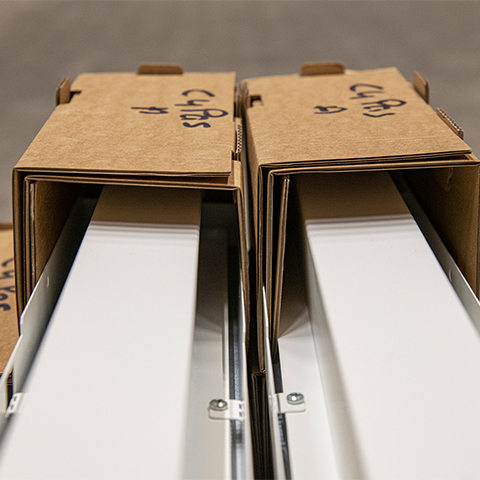
Signify recently achieved CO2 neutrality supported by its partnership with sustainable packaging manufacturer, DS Smith. The companies streamlined the packaging process and made shipping of LED luminaires more sustainable to help drive the transition to the circular economy. Signify actively strives to reduce the environmental impact of its products, reducing emissions by over 70% 2010. It recently presented a new five-year plan, in which the company aims to double the positive impact of its operations on the environment and society. Johan Damkot, Senior Buyer at Signify, underlines the role that shipping packaging plays in the  process towards sustainability: "The DS Smith packaging specialists have built up a strong reputation within Signify and by working with our engineers, designs are aligned from the start and never use more material than strictly necessary. This process tackles everything from bespoke solutions for complex LED fixtures to modifying product design to reduce empty space in the transport of goods." This approach led to innovative and practical solutions such as the 'end caps' for LED packaging, which only need to be placed on either side of the products and require 76% less packaging material. In addition, the packing process of the products is ergonomically better and the packaging itself is more stable when stacked, which reduces the risk of damage. In terms of circularity, the percentage of recycled raw materials was an important part of the process and a solution that is recyclable. Finally, the ordering process and delivery performance were also streamlined. Johan Damkot explains: "Delivering on time is not simply a matter of delivering before the deadline. With packaging, just in time is the perfect time and ensures it is at peak performance for all our deliveries. You need partners who deliver the goods flawlessly, 100% in time, just in time. Not once, but year-in-year-out ". The collaboration with DS Smith started in the late 1980s, when Signify began to increasingly specialize in custom-made lighting solutions. Both global players are leaders in their respective fields and have ambitious sustainability goals in the areas of circular economy, CO2 reduction and recycling. Signify introduced the Circular Lighting Principle with which lighting is no longer discarded but reused after use. DS Smith introduced the Circular Design Principles last year, supporting the transition to a circular economy for packaging users and the packaging sector.

UK skills-base ill-equipped for Net Zero according to new report
Almost half (48%) of electrotechnical and engineering services employers have said there is ‘insufficient training’ available to enable electricians and other installers to deliver the technologies necessary to achieve Net Zero. The Skills4Climate industry report, which surveyed a range of businesses in the electrotechnical and engineering services sector, showed that despite overwhelming support from respondents (88%) for a green UK economic recovery following the coronavirus crisis, a quarter (25%) said they would struggle to find workers with the necessary ‘green’ skills to meet demand. The report highlights the need for more effective collaboration between installers, manufacturers, the education and training sector and Government agencies to define and deliver the low carbon skills necessary for Net Zero Carbon. Andrew Eldred, ECA’s Director of Employment & Skills says: “Despite a powerful consensus in favour of transition to a low carbon economy, skills policy and delivery in this area remain sub-optimal, with insufficient engineering services sector input and buy-in. “A more inclusive and strategic approach is required to encourage more engineering services employers to upskill their current workforce to deliver a low carbon revolution, and to recruit and train the next cohort of school leavers for secure and meaningful careers for the future.” ECA Energy Solutions Advisor Luke Osborne adds: “There is a disconnect between the engineering services industry and the much-vaunted technologies that will take us to Net Zero Carbon by 2050. This year especially, with COP26 around the corner, we need to work with others to provide the necessary skills capacity to enable engineering services businesses to pivot into EV charging, heat pumps, smart systems and renewables.” With regard to meeting growing future demand for skilled employees who can install green solutions, half of respondents said their strategy would be to ‘recruit from the current market’. Over half (54%) believe the UK would benefit by looking at how stronger national skills systems, notably those in northern Europe, approach the challenge.