2 November 2026
Product of the Month: Amari Floodlight range by Aurora Lighting
 
12 November 2026
Schneider Electric transforms Southampton hospital estate
 
12 November 2026
GTEC Training opens new education facility in North Yorkshire
 
11 November 2026
Energy, AI and smart buildings: register now for EMEX 2026
 
11 November 2026
Solar and batteries could cut electricity costs by 40%, data finds
 

Latest News


Reflect, regroup and refocus
There is no doubt that 2020 will be remembered for decades. The impact of the global COVID-19 pandemic and subsequent restrictions imposed nationwide would have been unimaginable to most and have impacted the country in ways which will be felt for years to come, so now is a time to reflect. With the first lockdown coming into effect on the 23rd March 2020, forcing all non-essential businesses to close and requiring people to stay home, the economy was hit hard. It took some time to clarify whether construction work was essential, and the rules differed between devolved administrations. Many contractors were forced to close their businesses, some chose to for health reasons and some remained open, just responding to emergency situations. With confirmation that construction work could continue provided COVID-19 secure procedures were in place and the continued easement of the lockdown in July, we could see our members workloads increasing again and although life had by no means returned to normal, the restrictions on the Construction and Repair, Maintenance and Improvement (RMI) sectors had eased. With the subsequent lockdown in November 2020 and the current lockdown in January 2021, clarity was provided that ‘you should go to work, if you can’t work from home’ allowing contractors to continue working. With COVID-19 secure measures becoming the norm, work has continued within the Construction and RMI sectors but not without hesitation. The term ‘new-normal’ has been banded around a lot as this pandemic has gone on - and frequently in connection with homeworking. Prior to lockdown, 68% of British employees never worked from home, but once the crisis is over 57% wish to be able to continue to work from home in some capacity. This is an interesting statistic, and hints at the social change that we could expect to see within 2021 and beyond. The desire for home working will undoubtably put a demand on the Construction and RMI sectors as people require home office solutions and more space. The impact of Covid-19 on the Construction sector has certainly been felt with 31% of construction businesses reporting a reduced turnover, but is slight when compared with the accommodation and food sectors with recent Office of National Statistics data showing 85% of construction businesses are currently trading compared to 59% in the accommodation and food sectors. Looking ahead to 2021, there will be challenges to face and getting through the next 3 months will be tough, however there are hints of a promising outlook for our sector. As Albert Einstein once said, “in the midst of every crisis, lies great opportunity”. Those who succeed will embrace the change and seek opportunities. Moving quickly to amend working practices to implement COVID-19 secure operations, continuing to provide great customer service and being dynamic and proactive will undoubtably stand you in good stead. With the advancement of online meeting solutions, virtual training courses and training centres remaining open, now could be a good time to consider expanding your company’s knowledge base and retrain, refresh your training or learn a new skill. With PricewaterhouseCoopers predicting that in 2021, one in eight cars newly registered in Great Britain are likely to be electric or hybrid, the demand for Electric Vehicle ChargePoint’s is set to grow. The Government’s commitment to installing 600,000 heat pumps per year by 2028 also presents a growth opportunity for the sector. Support from the Government Green Homes Grant Scheme and Green Homes Grant skills training competition, which provides funding for programmes to deliver a suite of training solutions to support the Green Homes Grant scheme, provides access to subsidised energy efficiency installations, training and certification. Following the approval of two COVID-19 vaccines, and the national deployment plan there is hope that as we enter Spring, restrictions will be eased further allowing for more freedoms and flexibility to return to our daily lives. Taking time to reflect on 2020, regroup and refocus on the year ahead could help reset your priorities and identify any opportunities. If the last year has taught us anything it was resilience and adaptability, and whatever further challenges arise in 2021, we can face them together.

BCIA adds two new members to its management committee
The Building Controls Industry Association (BCIA) is delighted to announce the addition of two new members to its Management Committee; Peter Beck, UK Sales Director at Sauter Automation, and Gavin Holvey, General Manager UK & Ireland for Priva UK. Peter Beck started in the controls industry in 2005 as an area sales manager for Trend Controls and also worked at Cylon, Lloret, SSE and Eton Associates. Peter then joined Canary Wharf Contractors Ltd in 2015 where he was the design and project manager for the construction division responsible for the specification and procurement of BMS, Fire and Security across the new projects at Southbank Place, Bank Street, Newfoundland and Wood Wharf, before joining Sauter Automation in April 2020. Peter comments: “Having seen the BMS industry from a number of different perspectives with manufacturers, installers and a developer I believe gives me a unique insight into some of the challenges they each experience. I hope to add value to the role within the BCIA and look forward to getting started.” Since the 1970s, Gavin Holvey has worked for some of the biggest names in the sector, including Satchwell Control Systems/TAC, Landis & Gyr, York Controls Group and DWEC/Matrix Control Solutions Ltd. His main focus of professional interest falls into two areas: technology innovation particularly in relation to cloud-based services, IoT and digital transformation. And, secondly, in relation to sustainability within the built environment. Gavin adds: “I’m actively working with my colleagues around the globe to help customers get a grip on their net zero transition to meet emissions goals. I’d be delighted to bring my industry experience to the table at the BCIA.” The BCIA is run by its members for its members and appointment to the Management Committee is by election. The Management Committee provides the governance of the BCIA to ensure members’ objectives are met. It appoints and steers the BCIA’s professional service providers and oversees finance, membership and compliance issues. Terry Sharp, President of the BCIA, says: “It gives me great pleasure to welcome Peter and Gavin on to the BCIA Management Committee. Their career track records are exemplary and I look forward to working with them to help shape our industry for the 21st century and beyond.”

St John's Wood benefits from £33m electricity upgrade
Thousands of residents across central and West London are benefitting from an upgrade to the electricity infrastructure that is vital to keeping the economy going. UK Power Networks, the firm that keeps power flowing across London, the South-East and East of England is delivering a £33million project that powers the capital’s entertainment and shopping district. At the heart of the work are new electricity supply points and underground cables that will provide power to businesses in areas including Kensington and Leicester Square. The project is due to finish in 2025. Engineers from the power firm will also be excavating in various locations to join the new circuits to the existing supply point at St John’s Wood. This move will ensure new state-of-the-art equipment that will power the centre of London for decades to come. Tom Parminter, assistant project manager at UK Power Networks, comments: “Thousands of people in this area of London rely on us to supply their electricity safely, reliably and efficiently, and we are working closely with our contractors to deliver these vital upgrades. “When we both complete our work we will have commissioned a new electricity supply point which will supply local communities and businesses well into the future.” This network upgrade project is part of the company’s £600 million investment in its electricity networks this year. The UK’s largest electricity distributor delivers electricity to 8.3 million homes and businesses and employs 6,200 staff and contractors to maintain the London electricity network for 2.4 million customers. In London alone, UK Power Networks’ cables stretch across more than 37,000 kilometres.

A quality first approach to EV charging
As sales of electric vehicles (EVs) continue to rise, and the government brings forward its ban of petrol and diesel cars to 2030, more and more companies are switching onto the benefits of EV charging points; whether to encourage footfall, drive sustainability or improve engagement with employees. But to create a world-class charging infrastructure, duty holders must ensure they take a ‘quality first’ approach to installing and maintaining these fast charging points. The adoption of EV technology continues to move at a rapid pace. Earlier this month, the UK government unveiled its ten point plan for a green industrial revolution, which included bringing forward the ban of the sale of new petrol and diesel cars from 2035 to 2030 in order to speed up Britain’s transition to zero emission vehicles such as EVs. There are now around 339,000 registered EVs in the UK, with pure electric models the only category of growth currently in the UK. With such a dramatic rise in vehicle sales, it was evident that the UK’s charging infrastructure would need to increase to cope with demand. In many ways, the private sector has led the way, supported by generous incentive schemes. From offices, supermarkets and car parks, to retailers, business centres and universities, organisations across a wide range of sectors are installing EV charging points. The benefits include income generation, increased footfall, improved sustainability across fleets and even better staff engagement. And with incentives of up to £14,000 per organisation available through the Government’s Workplace Charging Scheme, many would argue that for any organisation with the space and resources to install EV charging points, there is no better time to invest. McDonalds is one major organisation which agrees. In June, it announced plans to introduce of charging points at both new and existing drive-through restaurants in the UK. And clearly it is not alone. Recent statistics from Zap-Map show there are now 33,779 charging points for electric vehicles in the UK, up 39% in the last 12 months alone. The Government has pledged to invest a further £500m in the rollout of new rapid electric charging hubs to ensure drivers are never more than 30 miles from being able to charge their car. A quality first approach As with any rapid deployment of relatively young technology, the onus now is on the quality and safety of such installations. Like any fixed electrical installation, duty holders are required under the Electricity at Work Regulations 1989 (EAWR) to ensure the safety of EV charging points. This includes maintaining systems to prevent, so far as is reasonably practicable, any danger to employees, visitors or other persons. In addition to EAWR, there are a number of other documents used for guidance and to demonstrate compliance, including BS7671 Requirements for Electrical installations, Guidance Notes including GN3 (IET) and BS7671 Section 722 – Electric Vehicle charging installations. Notably, duty holders should take into consideration that EV charging points are a high use asset, often installed outside and therefore vulnerable to mechanical damage and ingress of water. Periodic inspection and at least annual testing are critical to help maintain the long-term integrity of charging points. Support from electrical experts Of course, this expertise is not always available in-house, which is why Bureau Veritas has launched a new independent inspection offering for EV charging points to help duty holders ensure all installations are compliant with relevant regulations. This new service provides an independent assessment of all new installations to identify any issues that may present an electrical safety risk. Conducted by Bureau Veritas’ electrical engineers, the testing and inspection programme includes a thorough internal and external visual inspection, together with earth continuity and, polarity confirmation, and functional testing. Checks on residual current devices and earth loop impedance are also included - all designed to help maintain the safety and long-term integrity of these vital assets. It offers a trusted service from a global leader in testing, inspection and certification, helping organisations to identify faults earlier and maintain compliance with workplace and electrical safety legislation. Not forgetting access to a full range of fixed electrical testing and inspection services from Bureau Veritas experts. Future of EV charging At a time when more and more organisations are installing EV charging points to tap into the benefits and keep up with the UK’s shift to electric, a quality first approach is the key to unlocking the potential and maintaining the long-term integrity and availability of our charging infrastructure. The technology and the incentives are now firmly in place to continue the roll-out of EV charging points across the private sector, in line with EV sales. We must make sure the quality and safety of installations are keeping pace.

Back to the future with NAPIT
Until now, all NAPIT’s publications have centred around its core business, that being site-based guidance for electricians (On-site Solutions), periodic inspections (EICR Codebreakers and Landlords Private Rented Sector Guide), and understanding risk assessments (Risk Management Code of Practice). The one book missing from this list, and enforcing what NAPIT stands for, is a definitive, purpose-written publication covering how to inspect and test an installation, either from an initial verification or periodic perspective. What’s new? NAPIT’s technical authors have put together its latest publication covering everything you need to know on how to carry out an initial or periodic inspection and test a circuit. We are pleased to announce the launch of our latest publication, Guide to Initial Verification and Periodic Inspection and Testing of Electrical installations. Back to Basics: What is test equipment? The book goes into detail to explain all the separate pieces of test equipment we use. Often taken for granted is a multifunction tester, we mustn’t forget that individual test equipment was where it all started and is still of great value now. Many electricians new to inspection and testing find it difficult to understand the different tests and instruments that give the required measurements. The best way to deal with this is to breakdown each piece of test equipment and the tests they’re used for and explain them in detail. NAPIT’s latest publication, Guide to Initial Verification and Periodic Inspection and Testing of Electrical installations, does exactly this; in easy to read steps. Next Steps: What are the tests? After the test equipment, the most daunting part of the testing process is understanding the different tests, when to apply them, and how to do them. NAPIT’s new guide gives an in-depth explanation of all the individual pieces of test equipment required to comply with BS 7671, plus a few extras that are important to have, or at least know how to use. Along with individual pieces of test equipment, we also cover the more familiar multifunction installation testers (MFTs) that are most common in our industry today. There are also many different test types required by BS 7671, and we explain what all these are, how to carry out each one, and when to use them. Time to Inspect After explaining all of the different tests and their respective pieces of test equipment, we need to look at the different inspections. Although we technically inspect before we test, we need to know what the tests are before we start, which is why we explain them first. There are essentially two inspections to carry out before any testing takes place: 1. Initial verification inspection 2. Periodic inspection Different inspection schedules cover the two inspections, and although mostly similar, some distinct differences need to be understood. All these differences and schedules are dealt with in detail to give the user an in-depth understanding of the two inspection types and how to carry them out. Before you start inspection and testing Before any inspection or testing is carried out, there are a few things we need to confirm for either initial or periodic inspections. Initial verification is a very different process to periodic, and so are the outcomes and the certificates or reports that are produced on completion. We explain all these differences and the Legislation that needs to be taken into account before any work starts. Especially where periodic inspection is concerned, the work that needs to take place before the inspection and any testing starts is very important and can’t be skipped; it’s OK though, we’ve covered this also. Who is it for? As we all never stop learning, our new guide has been written to support those just starting off in inspection and testing, those undergoing any training courses which are specifically for inspection and testing, or for the experienced inspector or tester. In our opinion, this new guide gives the best advice for inspectors and testers currently available. It complies fully with BS 7671:2018 + Amd 1 and is a must-have toolbox book for any electrician. When is it available? The publication is now available to pre-order. The list price is £14.99 for members and £16.99 for non-members. All fees states above exclude any necessary delivery fees. Pre-order price is for a limited time only and is only available to pre-order as a print version of the publication. Digital e-book and bundles will be available for release in general sale due February 2021.

SELECT joins with construction to ask chancellor to withdraw legislation
SELECT has once again joined forces with more than 40 contractor and trade association members in writing to the UK Government demanding the withdrawal of proposed Reverse Charge VAT legislation. It is the second time the influential trade bodies have felt the need to press the case for a rethink with the Chancellor of the Exchequer, Rishi Sunak, MP, in the absence of a reply to a detailed argument they sent him in a letter dated December 20 last year. The latest appeal, sent on January 13 this year, reiterates the fact that Reverse Charge VAT will restrict cashflow in a vital and socially contributory industry, especially to the smallest firms, at just about the worst possible time. The letter, led by the Federation of Master Builders, again emphasises that the policy – due to come into force on March 1 – risks reversing what modest recovery the industry has made from the pandemic and will limit the scope for protecting and creating jobs at a time when the country needs this most. John McGhee, SELECT’s Director of Finance and Resources and Association Secretary, acknowledged an earlier delay in introducing the changes and also other UK Government aid to the sector, but says: “Introduction of Reverse Charge VAT now would be seriously detrimental to the economic recovery.” VAT reverse charging means that businesses which are both VAT and Construction Industry Scheme registered will no longer pay VAT to most of their subcontractors. Instead, VAT will only be paid to firms which supply only labour (employment businesses) and to the merchants and businesses that sell building materials only without any fix. John adds: “The proposals will substantially increase the burden on business and restrict cash flow in what is already an extremely difficult economic climate. “The legislation will particularly impact SMEs that provide both services and materials. This is because they will have to pay VAT on the materials they purchase, including extremely costly elements such as steel, cladding and concrete, but will not be paid the VAT by their customers. For a significant number of companies this will be unsustainable.” SELECT and the other trade bodies argue that their member companies are already subject to independent scrutiny which limits fraudulent behaviour and the introduction of Reverse Charge VAT unfairly penalises those that pay their VAT and comply with their obligations. The campaigning electrotechnical association has also alerted its 1,250 member companies to the gravity of the legislation and its imminent implementation and has pledged to continue to fight for fair treatment for responsible firms.

Siemens tech boosts energy efficiency in Alpine hut
The “Bergkristall” (Mountain Crystal), a mountain hut situated at an altitude of 2,883 meters in the Monte Rosa Massif of the Valais Alps, has been largely energy self-sufficient since 2010. Along with thermal solar collectors, a photovoltaic system integrated in the hut’s southern facade ensures a high degree of energy self sufficiency and a reliable energy supply. Since 2010, all of the building’s performance data, such as solar energy generated and battery capacity, have been bundled in Siemens Navigator, the cloud-based building performance platform. Lithium instead of lead Ongoing analysis of the energy flows revealed that the lead batteries in use since the hut’s opening would soon reach the end of their life. This prompted the operators to put a new solution in place. Siemens was awarded the contract to design the entire solution and replace 48 lead batteries with 14 lithium iron phosphate (LFP) batteries with a capacity of 215 kWh. Thanks to regional airline Air Zermatt, approximately 8.6 tons of lead batteries were transported out and the nearly 2.7 tons of lithium batteries helicoptered in to the Monte Rosa Hut. Following an initial trial with two batteries, technicians successfully connected the newly installed batteries to the energy supply system in just two days. The new battery solution has pushed the hut’s energy self-sufficiency to even greater heights by lightening the load on the generator used in bad weather. In addition, the new batteries offer more usable capacity. The completed project considerably boosts the Monte Rosa Hut’s secure, energy-efficient and sustainable energy supply at any time of day and in any weather condition. Monte Rosa Hut: key figures • Opened in 1895 as Betemps Hut, renamed Monte Rosa Hut in 1940. • Planning and development of a new “mountain hut of the future” by the Swiss Federal Institute of Technology (ETH) in Zurich. • Opened in July 2010; old hut demolished in 2011. • 120 beds, approximately 8,000 overnight stays per year. • High degree of energy self-sufficiency, 215 kWh battery capacity. • Waste water treatment and ventilation run autonomously, even in winter. • All technical systems are digitalized and can be controlled remotely.

Building back greener in 2021 with the JIB Skills Development Fund
With the UK showing a commitment to tackling the climate crisis by setting a target to meet net-zero emissions by 2050, the Joint Industry Board (JIB) is urging electrical contracting companies to evolve and broaden their skill sets. The JIB believes that the increasing adoption of greener technologies presents contractors with a number of opportunities to upskill and open up their services to new markets. In 2020, Chancellor Rishi Sunak announced a £3bn boost to the UK green economy to be spent on decarbonising buildings and introducing modern systems to save homeowners on their energy bills and kickstart the sector. We have also recently seen the Government get behind plans to support up to 220,000 British jobs in the green sector with the release of the Energy White Paper in December pledging another £6.7bn in support for this sector. The intention is to create a greener and more sustainable energy network in the UK for which environmental technologies such as solar photovoltaics, electric vehicles and battery storage will play a part. Environmental skills and qualifications are part of continuing professional development (CPD) for many electrotechnical operatives and can be recognised within an ECS registration and on the reverse of an ECS card. The JIB is, therefore, encouraging member companies to take advantage of the JIB’s Skills Development Fund, which provides financial assistance for courses for those undertaking further education and training in the electrical industry. The following green technology qualifications are accepted by the JIB Skills Development Fund as eligible courses: Solar Photovoltaic Installation and Maintenance Electric Vehicle Charging Point Installation (City & Guilds 2919-01) ONC/HNC/Degree courses in sustainable engineering ECS cardholders are also encouraged to highlight and show off their hard-earned qualifications and skills by including these in their ECS card renewals and updating their registration. Darren Crannis, Managing Director of CTS Electrical, was funded through the JIB Skills Development Fund to undertake the C&G 2919-01, and he believes all electrical contractors can benefit by improving their knowledge on electrical vehicle charging equipment. Darren says: “The EV market is constantly evolving and it is going to play a crucial role if the UK is to succeed in hitting its net-zero target by 2050. It really makes sense for installers to become familiar with EV technology as early as possible and it has certainly opened up a profitable new avenue for our business.” He adds: “The Level 3 City & Guilds 2919 is a two-day in-depth course on the design and installation of EVCE. There is access to funding via European Social Fund (ESF) from training providers and if you are a JIB company this course is eligible for JIB skills funding, which reduced the cost of the course significantly for me.” Andy Reakes, Head of Growth at the JIB and ECS, comments: “Once Covid-19 has been dealt with there will be a real move to set our attention again on Net-Zero by 2050 and climate change. The Energy White Paper is another example of the microgeneration and environmental market receiving further Government support into 2021.”

NICEIC and ELECSA campaign, linking good lighting and mental health
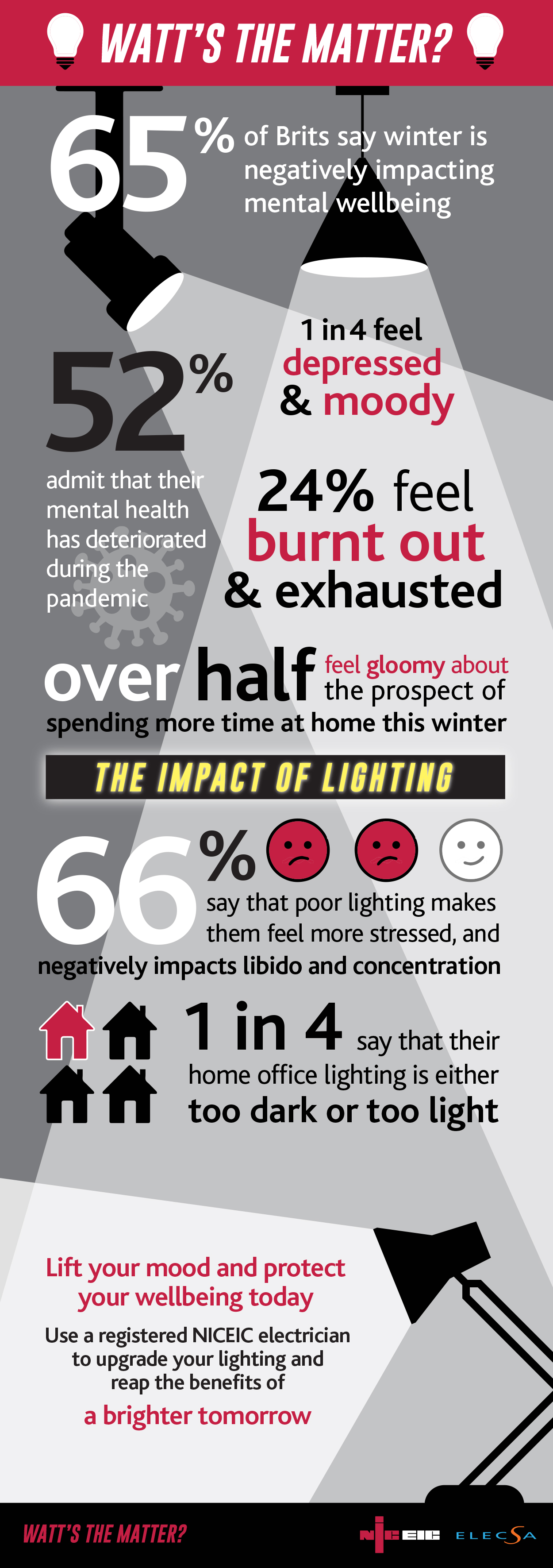
With 2020 hailed by many as ‘the worst year ever’, a record number of Britons have said their mental wellbeing is at an all-time low this Blue Monday, a new study has revealed.   According to stark new research by NICEIC and ELECSA, for many homebound Brits working from makeshift offices in kitchens or spare bedrooms since last year, poor lighting in the home is making matters worse. Two thirds of respondents (66%) admitted poor home lighting was negatively impacting their concentration levels and making them feel more stressed. Luckily, as record spending on home improvements continues, lighting has become a priority as almost one in four (24%) of those surveyed stated good home lighting made them feel better during the winter months and almost one in three (27%) said good lighting made them happier and more energetic. In response, and just in time for Blue Monday, the most miserable day of the year, NICEIC and ELECSA have launched their ‘Watt’s the Matter?’ consumer campaign. The campaign highlights the positive impact improvements in home lighting can have on the nation’s collective mood - while warning the public of the importance of using a registered electrical contractor for any planned electrical work. Paul Collins, NICEIC and ELECSA’s Technical Services Manager, comments: “With 2020 being one of the most challenging years in recent history, it’s unsurprising that just weeks into January, the mental wellbeing of a record number of Brits is at an all-time low this Blue Monday. “With the national lockdown and the fact that huge swathes of the population are still working from home, often in makeshift offices, the problem is clearly intensifying with many experiencing the detrimental impacts poor home lighting can have on mood. “As our electrical contractors are keenly positioned to help our ‘Watt's The Matter?’ campaign aims to address the problem and provide safe solutions, guiding consumers to registered electricians such as those registered with the NICEIC and ELECSA. “To help amplify the message we encourage all NICEIC and ELECSA registered contractors to take this opportunity to talk to their customers about effective lighting in the home. Through education and good advice collectively we can do our part and help lighten the mood this winter” Today’s findings come as a quarter (25%) of homeworkers admitted that the lighting in their home office was either too dark or too light, with just over a half (52%) revealing they regularly suffer from headaches, migraines or eye strain when working. Despite this, although almost a half (47%) of homeworkers bought a new desk, laptop, screens, or printers, just 9% have upgraded their lighting to make their home offices as comfortable as possible. This looks set to change, however, with around 65% of Brits surveyed saying upgrading lighting is now just as important to their home as painting, laying new carpets, and buying new furniture. The survey of 2,000 consumers reveals the nation’s collective weariness this winter, with some surprising disparities: 70% of 45-54admitted upgrading lighting was just as important to their home as painting, laying new carpets, and buying new furniture Brits located in Yorkshire and Humber regions have reported worst deterioration in their mental wellbeing and feel the gloomiest about spending the winter at home. Those living in the West Midlands are suffering most from poor lighting, with a fifth (20%) confessing it is making them feel depressed and moody. 46% of women said the coronavirus pandemic continues to make them feel anxious/fearful, compared to just 28% of men. In terms of mental wellbeing, the pandemic is having the worst impact on those aged 18-44, with 21% revealing they are suffering from Seasonal Affective Disorder (SAD).

Sheltering the Electronic Security market from COVID-19 impact
2020 has seen a sharp contraction in the electronic security market size, though the focus on replacement sales has to some extent sheltered the market from the even steeper fall in new construction output. COVID-19 has even created a surge of interest in pandemic-related products such as thermal imaging to measure body temperature and analytics to monitor occupancy levels.  Manufacturers have responded to the COVID-19 pandemic by launching or promoting products designed to provide appropriate security measures, such as AI software to monitor numbers of people entering or occupying a building and to ensure social distancing, thermal imaging cameras to provide a temperature screening solution, or touchless access control.  The electronic security market grew strongly from 2016 to 2019, particularly in services, CCTV and access control. It has been boosted by a healthy construction sector though construction output growth slowed in 2018 and 2019 compared with the previous three years as political and economic uncertainties associated with Brexit held back the UK economy and affected business confidence and consumer spending. In particular, the key end use sectors of offices and retail saw a decline in new build output in 2018 and 2019. Fiona Watts, Editor at AMA Research, comments on the market “growth has been driven by technological advancements increasing replacement demand, as well as a largely buoyant construction sector, despite a slowdown in construction output in the key end-user sectors of offices and retail in the past two years. However, the level of growth has been constrained to some degree by the intensity of price competition triggered by the market entry and increasing dominance of Chinese manufacturers.” Due to its essential nature, security equipment markets have historically been able to weather recessions somewhat better than most other industry sectors, and the economic downturn caused by the COVID-19 pandemic is likely to be no exception. In addition, the rapid pace of technological development will fuel growth of the replacement market. Looking ahead, recovery in the security market and in the wider economy will be gradual, only gathering significant pace from 2022 onwards. Though the interest in pandemic-specific solutions will wane, increasing adoption of advanced technologies will continue to drive growth in replacement sales, particularly in CCTV and access control.