2 November 2026
Product of the Month: Amari Floodlight range by Aurora Lighting
 
12 November 2026
Schneider Electric transforms Southampton hospital estate
 
12 November 2026
GTEC Training opens new education facility in North Yorkshire
 
11 November 2026
Energy, AI and smart buildings: register now for EMEX 2026
 
11 November 2026
Solar and batteries could cut electricity costs by 40%, data finds
 

Latest News


Schneider Electric Announces ‘Advanced Buildings’ Webinar Series
Schneider Electric, the leader in digital transformation, energy management, and automation, has announced a series of webinars that explore the benefits and pitfalls of incorporating modern technologies into building systems. Schneider Electric is looking to support facility managers to develop strategies for creating the next generation of buildings. The ‘Advanced Buildings’ webinar series includes three interactive, digital webinars, led by industry experts, advising industry professionals on incorporating technologies that create more efficient, sustainable and secure building systems. The three webinars include: Cyber Security Tuesday 12th May, 11:00 BST - Delivering Sustainable Buildings with a Cyber Supported Infrastructure Workplace Technology Thursday 14th May, 10:30 BST - Workplace Utilization Management for Data-driven Decision-making Thursday 14th May, 14:30 BST - Creating Seamless Tenant Experience via Modern Technologies Kas Mohammed, VP of Digital Energy at Schneider Electric, comments, “When it comes to real estate portfolios, exploiting space to its fullest is crucial. However, maximising the profitability of buildings needn’t be at the expense of sustainability. To align the two, embracing technology that enables data-driven decisions is imperative. “We hope the educational series will provide tenants, workplace professionals and building owners with an understanding of modern building management systems and their potential.”

New Posters To Protect Employees On-Site
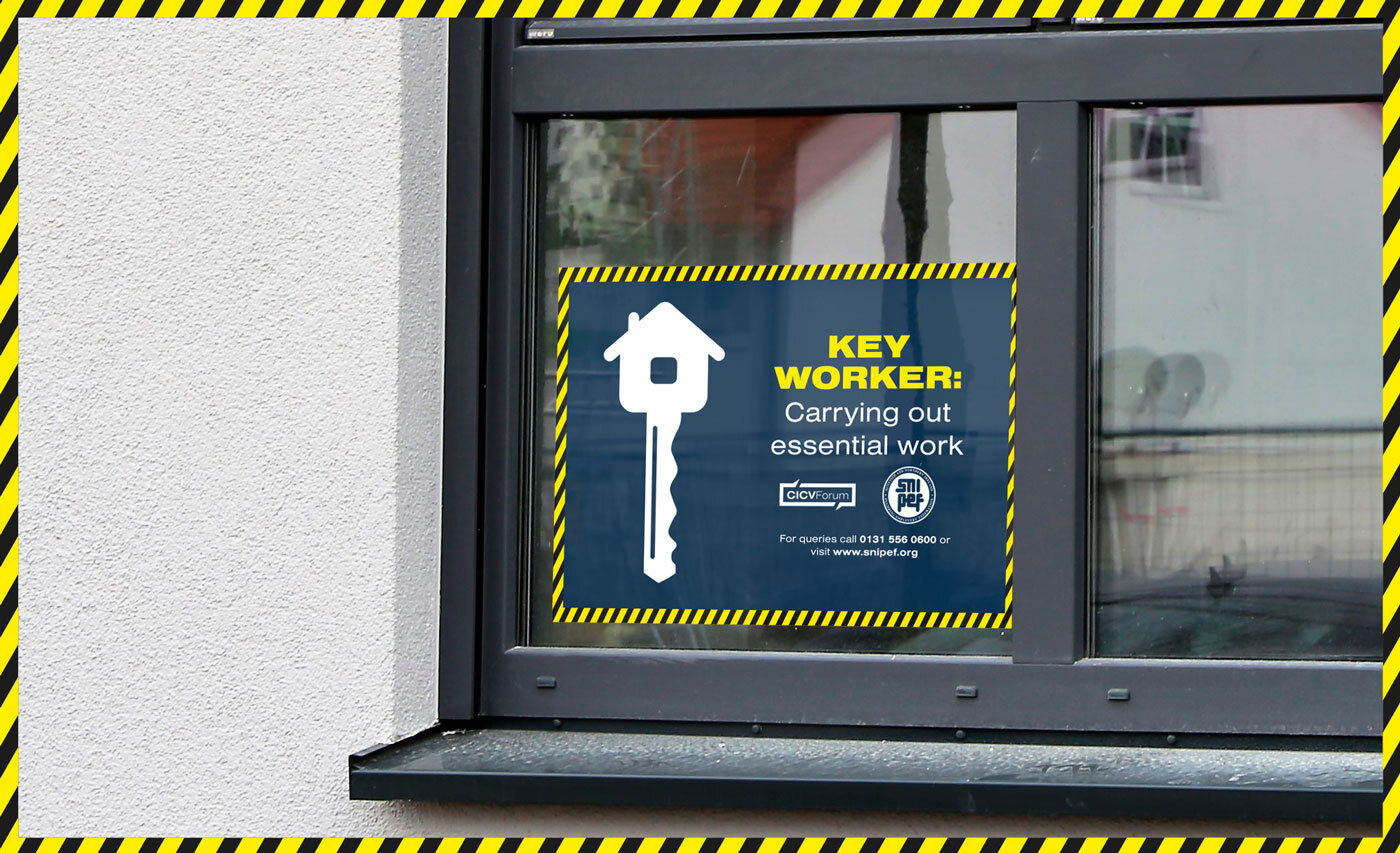
In another initiative to support the construction sector in Scotland during the COVID-19 pandemic, the Construction Industry Coronavirus (CICV) Forum has started distributing protective signage for key workers carrying out emergency and essential projects. The posters, designed to be displayed on sites or on vans, carry the legend – Key Worker: Carrying out Essential Work. They are designed to deflect reported harassment and abuse which has been directed at employees by members of the public. The Forum, made up of 23 trade and professional bodies as well as scores of companies and individuals, has been lobbying vigorously on the industry’s behalf since Holyrood shut down the construction sector, apart from work on hospitals and emergency interventions. The signage will alert the public to the fact that workers they see in the streets or on sites are not flouting the rules but instead are performing vital roles, in line with guidelines, to ensure that the fabric of the country remains in good condition during the lockdown. John McKinney, Secretary of Forum members the National Federation of Roofing Contractors, the Stone Federation and the Scottish Contractors Group, says, “As a consequence of mixed messaging from government, there has been some confusion among certain members of the public about what is essential working. “However, that is no excuse for harassing people who are going about their legitimate business, and we hope these signs, which carry an information helpline number, will help clarify the situation.” Ian Honeyman, Commercial Director of the Scottish Building Federation, adds, “This is a time when we should all be working together and the Forum is keen to reduce any possible tensions between key workers and misinformed members of the public. “In a period when the Scottish Government is asking people to remain in their homes, it is important that these homes are watertight, safe and have essential working facilities, such as water, gas and electricity, and that is what the construction sector’s key workers are ensuring.” The CICV Forum, which was set up two months ago, now has 23 trade and professional bodies as full members. A further 27 organisations have input on its seven influential sub-groups, dealing with mission-critical aspects such as health and safety, skills and future planning.

Heat Pumps – Type F or Type B RCDs?
By Chaz Andrews, Technical Manager of Doepke UK Inverter speed controlled pumps and compressors circuits require specific types of RCD. The characteristics of the equipment will determine if you require Type F or Type B RCDs and any associated restrictions on RCD sensitivity. Check with the manufacturer before quoting for the installation. Equipment design characteristics Appropriate planning at the quotation stage saves time and unforeseen expenses on site at a later date. The installation design, equipment to be connected and any RCD requirements including the 'Type' and 'Sensitivity' must be considered together, not in isolation. Equipment may be self-contained for small installations or have sperate units with standalone inverter drives for larger installations. Inverter based equipment connected to three-phase supplies, that does not include an isolating transformer (see manufacturer's information) can only be used with type B RCDs - see BS 7671 531.3.3. This is explained in detail in Doepke Techpub-17 – http://doepke.co.uk/download/download.html. For single phase equipment, the use of  type F or B RCDs is governed by the level of smooth dc residual current produced under certain fault conditions. This fault current is related to the value of the “dc link voltage” (see below) i.e. it is function of the equipment design. The operational leakage current (PE current), must be compatible with the installation design and associated RCD sensitivity – see 531.3.2. Take into account the possible addition of leakage currents when adding new equipment to an existing installation. The addition of three-phase non-linear loads increases the harmonic content and associated leakage currents - see PDS (Power drive system) – RCD Sensitivity. DC link voltage -  Type of RCD Figure 1 (below) gives a generic example of a single phase combined compressor and fan unit. The dc voltage output from the rectifier will be a minimum of 1.41 x ac rms voltage. Some designs may have a step-up voltage section, to increase the dc voltage, before it is fed into the control section. A capacitor connected across the dc bus provides a power reservoir (smoothing), for the control section during the non-conducting period associated with the AC supply. A fault to earth on the dc link section results in a smooth dc residual current flowing in the PE conductor, back to the source earth and returning via the line conductors through any upstream RCDs. For smooth dc residual current < 10 mA (defined by the manufacturer of the equipment), you can use Type F RCDs – see BS7671  531.3.3 (iii) Note 2. For smooth dc residual > 10 mA or it is not defined i.e. the manufacturer does not specify the type of  RCD, 531.3.3 (iv). Note 3 refers to the use of type B RCDs. PDS  - RCD sensitivity Elements of the PDS and the associated environment e.g. filters, inverter, motor cable, motor, existing supply quality, harmonics and ambient conditions, determine the total leakage current present during fault free operation of the equipment. This results in the fluctuation of the leakage current, consequently 531.3.2 (ii) recommends that you do not exceed 30% of the RCD sensitivity to achieve reliable operation of the equipment. Type F and Type B RCDs are designed to respond to the sum of the leakage / residual currents generated at various frequencies by inverter controlled equipment  – see Figure 2 (below). Before making a final selection and purchasing equipment, check the installation manuals to verify the type of RCD and the minimum sensitivity requirements. If it is not in the manual, ask the supplier to provide this information before you purchase. Operational leakage currents BS7671 543.7.1 places limits on the operational leakage current, based on the method of connection: Conventional 13 amp plug <3.5 mA and suitable for connection to a circuit protected by the appropriate Type of 30 mA RCD. Equipment with leakage currents > 3.5 mA requires permanent connection to the supply, or the use of 60309-2 plug and socket – see 543.7.201. This equipment may not be compatible with the appropriate Type of 30 mA RCD. Relatively small inverter setups may require a minimum of 300 or 500mA RCDs, but check first - don’t make assumptions. See 531.3.2 with regard to the design of the installation to avoid unwanted tripping. Note the points about the accumulation of earth leakage currents and consideration for separate feeder circuits, protected by the correct Type of RCD i.e. you cannot install Type F or B RCDs down stream of Type A or AC RCDs. Conclusion Check the details first - don’t guess or make assumptions.

Bureau Veritas Encourages Locked Down Electrical Industry To Upskill
As the electrical industry, as all others, continues to adjust the new ‘normal’ of life during lockdown, Bureau Veritas is keen to remind any homebound electricians, duty holders and property managers on how they can use the extra time at home to their advantage by upskilling.  Inherently, by the nature of electrical work which typically involves working in people’s homes or commercial, industrial and building sites, the majority of which are now temporarily closed, many electrical firms have had to either limit work or place it on hold altogether for the duration of the lockdown.  In response, leading electrical safety expert, Bureau Veritas is keen to remind those electricians, duty holders and property managers who are homebound, either in working at home or having been furloughed for the present time, of the opportunity to use the extra time to invest in their own professional development.  Michael Kenyon, Technical Lead at Bureau Veritas says, “These are certainly testing times as we continue to try to navigate our way through this unchartered territory – and our sympathies remain wholly with those workers who have been affected.  “While we eagerly await further details from the Government, our priority remains on helping support the electrical industry in whatever way we can. With this in mind, we are actively encouraging electricians and other industry professionals to make the most of the vast learning resources available to them.  “From free training courses, webinars, podcasts and live Q&As, there is currently a plethora of great online content emerging due to the lockdown. Many industry experts are creating digital content, easily available on social media and other platforms, which has been designed to help those at home to enhance their knowledge base at this time. “At Bureau Veritas, for example, we are holding a free webinar on the 20th May specifically designed for electricians, supervisors, managers and business owners on the complex world of electrical compliance, including duty holder responsibilities. Plus, we recently launched a new electrical guide designed to support duty holders in understanding how to reduce risks within an organisation – a great tool for electricians to have in their armoury when making compliance recommendations.” This latest activity comes as the electrical industry continues to adapt to a fast changing climate, such as with the ongoing introduction of new renewable, low carbon technologies and the movement towards electrification, particularly Electrical Vehicle (EV) adoption. Kenyon adds, “The modern electrician’s task is a complex one. Not only do they need to manage the complexities of electrical installations but they must also have a thorough grasp of new technologies, the different offerings and benefits of each, as well as an understanding of the impact of new legislation on both them and the customer. “With this comes greater onus on investing in upskilling to ensure they remain fully informed. As such, we would urge all those electricians that remain at home to use any extra downtime to their advantage by taking stock of the wealth of support out there – in that way they can ensure they are one step ahead of the competition and ready to take the lead when works recommence in a post-coronavirus UK.” Details of Bureau Veritas’ upcoming Understand Electrical Duty Holder Responsibilities webinar, due to take place on 22 May at 12pm can be found here. Meanwhile, the new Electrical Safety Guide is available to download here.

WEEE Announces Interest Free Loans
The Waste Electrical and Electronic Equipment Fund (WEEE Fund) has announced its WEEE Support Grants and Loans Package to support waste electrical and lamp recyclers during the coronavirus crisis.  With many household waste recycling centres closed and other waste electrical collections reduced, the flow of electricals and lamps for recycling has significantly reduced. The new facility will provide up to £5million of interest free loans to waste electrical and lamp treatment facilities.   The loan finance derives from the WEEE Compliance Fee, which is paid by WEEE schemes that do not meet their WEEE collection targets. Scott Butler, Executive Director, WEEE Fund, says, “This is a fund that has been made available to provide rapid help and support the electrical waste recycling sector as a result of the impact of the coronavirus. The loans will be 100% backed by the WEEE Fund -funded by producers of electricals.” Environment Minister Rebecca Pow adds, “Right across the waste sector, I’m hugely grateful to the enormous effort being put in to keep crucial services running; and in such unprecedented times I understand the pressure the industry is under. This fund will help the sector to weather the effects of the coronavirus outbreak. Crucially it will also enable people to do the right thing and recycle more as we move towards a more circular economy.” Nigel Harvey, Recolight CEO adds, “Recolight has worked hard to help set up this new loan scheme.  When the coronavirus restrictions are lifted, the WEEE system will need a dynamic and competitive WEEE recycling market, with the capacity to cope with any post-crisis spike. The loans should help to minimise the risk of WEEE recycling business closures, and a rapid start-up of operations when this is required.” Recolight has previously contributed to the fund which finances the loans but is not eligible for a loan. Applications are open now and can be accessed by emailing info@weeefund.uk Applications are open until the end of May 2020.  

Gary Worrall Named New ECA President
Senior business manager and engineer, Gary Worrall, has become the new President of ECA, the UK’s leading engineering services trade association. Over 30 years ago, Worrall became an engineer for Lorne Stewart Engineering, a prominent M&E business and longstanding ECA Member. He progressed through the business to become CEO of Lorne Stewart PLC’s engineering division, having held several senior management roles along the way. Worrall takes over the ECA Presidency from Jim Pridham, who played a key role during the past 12 months, most notably through his promotion of industry training and apprenticeships. Worrall comments, “As someone who is passionate about electrical and engineering services, I’m delighted to be taking over this prestigious ECA role as an industry advocate and leader. The industry currently faces unprecedented challenges, and I am determined to play a role in supporting ECA Member businesses and the industry through these extremely difficult times.” The full ECA Presidential team for 2020/21 is as follows: • President – Gary Worrall (Lorne Stewart) • Senior Vice President – David Lewis (Chancery Contracts) • Vice President – Steve Murray (WT Jenkins) • Immediate Past President – Jim Pridham (JR Pridham Services) ECA CEO, Steve Bratt, adds, “We are delighted to announce Gary Worrall has become our new ECA President. The entire ECA team looks forward to working with Gary to further develop what the ECA delivers for its members, and in support of the wider engineering services sector. “I would also like to welcome long-standing ECA advocate Steve Murray to the role of Vice President, and to thank Jim Pridham for his valuable contributions to ECA’s national and regional activity during the past year, and for his support for the ECA team.” The new ECA Presidential team was confirmed on May 6, 2020, and first publically announced on May 11, 2020.

Lighthouse Construction Industry Charity Offers Free Wellbeing Workshops
This year’s Mental Health Awareness Week is 18-24 May, and to support the campaign’s theme of ‘kindness’, the Lighthouse Construction Industry Charity is hosting a series of free online lunchtime mental health training workshops.   From mindfulness and meditation, to resilience and controlling stress, anyone working in construction can take part in these bite-sized online sessions, The interactive courses will start at 13.30 each day and last for 45 minutes.  To take part all you need is access to an email address and the internet, whether via smartphone, tablet or laptop. Course Information: Monday 18th May -Coping with stress – covers pressure and stress, causes, coping mechanisms, and how we can build our resilience to stress. Tuesday 19th May -Work, life balance – what is good ‘work life balance’ and how to achieve it. Wednesday 20th May -Mindfulness – what is mindfulness about and how you can implement mindfulness into your day. Thursday 21st May - Resilience –  how to build resilience and top tips to take away to implement to keep your resilience growing. Friday 22nd May - Meditation -A simple introduction to meditation from a construction professional explaining how a consistent practice can benefit your mental health every day. Compared to this time last year, calls to the charity’s 24/7 Construction Industry Helpline have increased by 55%, reflecting the rising levels of anxiety and insecurity within the construction industry and the dramatic impact of the COVID 19 pandemic.  Bill Hill, CEO of the Lighthouse Construction Industry says, “Our mission is to ensure that no worker feels alone in a crisis and as part of our charitable giving we look after the physical, mental and financial wellbeing of our construction community in the UK and Ireland. Now, more than ever we need to ensure that our construction families in crisis receive the support that they need and so the theme of ‘kindness’ for this year’s Mental Health Awareness Week resonates perfectly with us. We are delighted to be able to offer our wellbeing workshops completely free of charge to help our industry during this very difficult time.  If you need support now, or know someone that does, the charity provides a 24 /7 Construction Industry Helpline; UK 0345 605 1956 and ROI 1800 939 122 which is the first point of contact to access a range of free and confidential support services including; emergency financial aid, advice on welfare and mental wellbeing and support on legal, tax and debt management matters. If you’re not ready to talk then there is the helpline mobile app which helps people experiencing stress, anxiety or depression as well as providing access to other areas of support such as anger management, drug and alcohol dependency, debt management, legal advice, and emergency financial aid.  Book your workshop now.  

CICV Forum Welcomes Support For Conflict Avoidance Pledge
The Construction Industry Coronavirus (CICV) Forum has welcomed the news that the Construction Leadership Council (CLC) is backing the new Conflict Avoidance Pledge. The CLC this week announced their support for the pledge, which sees clients and contractors committing to implementing conflict avoidance measures in their contracts and on site. The measure, which was developed by the Royal Institution of Chartered Surveyors in the wake of the covid-19 pandemic, will reduce the financial cost of disputes and help projects be delivered on time and in budget. Alan Wilson, Chair of the CICV Forum and Managing Director of SELECT, says: “The introduction of an early intervention process into the sector is very welcome news for the construction industry in Scotland, as is the endorsement of the CLC. “The timing of this is perfect given the current circumstances and all construction companies can use this process to resolve any contractual and payment issues. Members are encouraged to sign the Conflict Avoidance Pledge”. Len Bunton, Forum member, and one of the country’s most experienced dispute resolution consultants added his support. “This pledge means that we now have in place a proven and cost-effective process to resolve any contentious issues on construction projects and importantly to preserve relationships. I also encourage all construction organisations to sign the Conflict Avoidance Pledge.” Andy Mitchell, chair of the CLC, adds, "Preventing the escalation of problems with the delivery of construction projects into disputes is in the best interests of the whole supply chain and will save the industry significant time and money. "The pledge has already delivered measurable results for those organisations that have used it, and we hope others will adopt it and help to build a more collaborative and stronger industry.” The Conflict Avoidance Procedure has been designed to help parties avoid disputes and agree a settlement by mediating discussions, providing impartial and objective assessments of the issues, recommendations for bases for settlement and providing expert advice. Organisations signing up to the pledge are encouraged to work collaboratively and use early intervention techniques throughout the supply chain to try and resolve issues before they escalate into disputes. Several professional bodies in the construction and engineering sectors have already signed up, including the ICE, the RIBA, Transport for London and Network Rail. Firms can sign up on the RICS website.

VIDEO - ESP's Magduo Two-Wire Fire Alarm System
ESP’s MAGDUO two-wire fire alarm system enables easier, faster installations and significant cost savings. Neil Baldwin, Managing Director of ESP, takes a look at the range and how it fits into the company’s growing fire protection collection. As a leading supplier of security and fire protection solutions, ESP is committed to developing new and improved products that not only bring the latest technologies to market, but are designed to offer speed, flexibility and cost-efficiency to installers working across a range of projects. The introduction of the MAGDUO two-wire fire alarm system added a totally new collection of products to the company’s growing MAGfire Fire Protection range. MAGDUO sits alongside the existing MAG conventional fire alarm products and the MAGPRO addressable range, fulfilling the increasing demand from customers for this latest technology. https://www.youtube.com/watch?v=I_LlX84XDag&t= Fire alarm systems are broadly divided into two main groupings - 'conventional' fire alarm systems, and analogue addressable 'intelligent' systems - with each type best suited to different kinds of premises. Conventional, or four-wire, fire alarm systems are used in smaller properties such as shops and restaurants. They work by dividing the building into a number of detection zones, with the detectors and call points within each zone hardwired on dedicated two-core cable to the control panel. There may be multiple detectors on a single zone. A separate two-core, fire-protected cable for the alarm’s sounders is required as they are wired on different circuits. If a detector is activated, the control panel identifies the circuit that contains the triggered device and so indicates the zone from which the fire alarm has originated, but the area then has to be manually searched to pinpoint the individual device. Addressable or 'intelligent' fire alarm systems are designed for large commercial premises and more complex networked systems. They are much more expensive and more complicated than conventional four-wire systems, having increased flexibility, intelligence, speed of identification, and scope of control. In addressable systems, different types of initiating devices are wired in one or more single loops around the premises, requiring less cabling than conventional systems, with each detector or call point having its own unique address. The fire control panel receives information and status reports from each device and indicates its exact location if there is a fault, contamination or activation via smoke or heat detection. Because analogue addressable fire alarm systems offer a greater degree of flexibility, intelligence, speed of identification and the extent of control, they are the preferred option for specifiers and contractors working on bigger and more intricate projects as they overcome the limitations of conventional fire alarm systems. ESP’s MAGDUO Two-Wire fire alarm system is aimed at small to medium contractors, offering them a highly flexible and adaptable system that will save them time and money on the installation process. Two-wire fire alarm systems are based on standard conventional system technology. Unlike standard conventional four wired systems where the detectors, call points and alarm devices for each zone are wired on separate circuits, MAGDUO utilises intelligent two-wire technology, which allows all devices to be wired on the same set of two-core zone cables back to the control panel - enabling it to use a single circuit per zone both for detection and to power the sounders. This advanced technology can reduce both installation and material cost. The system is ‘two-wire’, meaning that all system devices can be installed on the same circuit with the capacity for up to 32 devices per zone. This, however, is dependent on the Device Loading Unit (DLU).  Full information is provided within the product technical specification details. MAGDUO will support 2-8 Zone applications. In total, ESP’s new range will comprise some 25 separate products, including: 2-Zone, 4-Zone and 8-Zone fire panels (available in a grey or black finish) Repeater panels – also offered in grey or black (4 and 8 zone panels able to support up to 8 repeater panels) FlexiPoint detector – programmable to seven different modes including smoke and heat detection. Ceiling sounders (available in red or white) Sounder and strobe low profile Wall sounder (available in red or white) Strobe IP55 Sounder IP55 Call Point A key benefit is the alarm confirmation feature, which offers the ability to select a confirmation period for individual detectors and therefore confirm if the smoke/heat detected is an actual fire – and not a false alarm. Using the built-in alarm confirmation feature, until an alarm has been confirmed within an individual area, only that area is evacuated. At the same time, if an alarm is confirmed in a common area, the device initiates a full alarm evacuating all surrounding areas. This unique conventional panel feature is vital where two-stage alarms are required. The FlexiPoint detector brings further versatility and convenience to this new range. As well as offering seven different modes of fire detection, including combined heat and smoke, the FlexiPoint detector is also available with an inbuilt sounder or inbuilt sounder strobe, which will assist with a compact install solution (as the detector and sounder is all-in-one as opposed to separate units). Due to the different options, FlexiPoint offers convenience for wholesalers and installers, as they will not be required to carry a complete range of devices. With its adaptability, speed of installation and cost-effectiveness, MAGDUO provides an ideal fire alarm solution for a range of small to medium sized projects such as restaurants, retail outlets, schools, offices, apartments and hotels. We are able to provide training on the new system to all wholesalers and installers.

JTL Recognises Pivotal Role Of Electricians During Pandemic
JTL has launched a campaign to recognise and support trade professionals during this unprecedented time. Its new campaign, ‘You’re our heroes of today, help us train the heroes of tomorrow’, recognises the pivotal role electricians and plumbing and heating engineers play in keeping people safe and warm whilst the nation stays at home.  Liam Sammon, Director of Learning & Innovation & Director of Develop Training at JTL, says, “The work of trade professionals is not only essential but is making a positive difference at this difficult time. From offering NHS workers free emergency repairs to raising money while self-quarantining – they are in fact heroes, whether they consider themselves one or not. A shining example of this is the 400 joiners, plumbers, engineers, electricians and military personnel who have built the NHS Nightingale Hospital in Birmingham. We are extremely proud that two of our very own apprentices from Interserve worked as part of this team.”  With many businesses facing uncertain times including reduced workloads, job cancellations and navigating the new furlough scheme, JTL is offering advice to those in the industry, including help with the 18th edition and other training needs, as well as with apprenticeship queries. For welfare support services, JTL’s learners and employers can also receive free and confidential advice through its partner charity, the Electrical Industries Charity (EIC). This support service is available for those working in the building services industries who may be struggling with personal or work-related challenges, whether financial, legal, emotional or health related. Sammon adds, “We recognise that this is a worrying time for many and want to do all we can to support and help employers. We will pull through this and when we do fresh talent will be needed more than ever. As part of our support offering, we’re also on-hand to chat to employers who are keen to invest in the training and development of an apprentice to ensure the pipeline of skilled tradespeople continues.” JTL is currently creating a free online portal where installers can access free industry-related taster sessions for engaging in continued professional development (CPD) and up-skilling in the sector, which is set to go live this summer.