2 November 2026
Product of the Month: Amari Floodlight range by Aurora Lighting
 
12 November 2026
Schneider Electric transforms Southampton hospital estate
 
12 November 2026
GTEC Training opens new education facility in North Yorkshire
 
11 November 2026
Energy, AI and smart buildings: register now for EMEX 2026
 
11 November 2026
Solar and batteries could cut electricity costs by 40%, data finds
 

Latest News


The Future Looks Bright For The Co-op
Zumtobel Group, lighting brands Thorn and Zumtobel, recently created a versatile energy efficient LED lighting system for new and refurbished Co-op stores throughout the UK.  Working closely with everyone involved in the project, from the Co-op through to the contractor, Zumtobel Group came up with a solution that would meet all the requirements of the scheme. This included achieving the required illuminances and a light distribution that enhances the products and attracts the customer, whilst maintaining the business’s green credentials. The lighting provided by Thorn and Zumtobel optimises the aesthetics of the stores to show the merchandise at its best and enhance the customer experience, whilst ensuring significant savings in both energy consumption, reducing costs and reducing the Co-op’s environmental impact.  Thorn’s Primata, a complete, plug and play trunking system for rapid installation, illuminates the critical sales floor areas, to reduce glare and show the merchandise in the best possible light. Primata is an ‘all-in-one’ solution that combines track, batten, optic and LED to produce continuous and seamless light lines. When installed, Primata gives a fully illuminated line of line with no breaks or dark spots via dedicated “Shelf Beam” optics. The system provides excellent energy efficiency of up to 140Llm/W, a log lifetime of 50,000 hours colour temperature of 4000K and CRI of 80.  Meanwhile, Zumtobel track mounted VIVO spotlights have been utilised to highlight the fresh produce, in-store bakery and beers, wines and spirits section. The VIVO LED spotlight, uses cutting edge IR and UV-free technology that makes it possible to provide high power accent lighting for sensitive products.  Recessed Thorn Omega Pro, an LED edge lit flat panel, illuminates the office areas as its glare control is perfect for computer use. PopPack, with an increased efficiency (>110Llm/W) that exceeds the current building regulations and provides up to 67 percent reduction in energy consumption, has been chosen for back of house in the stores, WC’s and stairs.  With PopPack, maintenance expense and time is further reduced as the light engine is manufactured to run for 50,000 hours at L70 (equivalent to 10 years at 16 hours per day, six days per week operation) which substantially decreases the cost and time spent on lamp replacement and general maintenance.  Thorn Leopard IP65, vandal resistant LED bulkheads have also been utilised on the project, to ensure maximum energy savings.  Thorn Voyager ‘route’ luminaires in the main sales areas and Thorn Voyager Sigma for the exit points provide the emergency lighting throughout the stores. Thorn Areaflood illuminates the goods in and delivery areas and Thorn Eyekon around the perimeter of the stores.  For sites that have car parks, column mounted Thorn R2L2 luminaires provide the exterior illumination for the area. For stores where there are petrol stations, the canopies above the pumps are illuminated with Zumtobel’s IP65 CRAFT recessed LED high-bay luminaires. Zumtobel Group holds dedicated stocks at the Company’s Group Distribution Centre in Spennymoor specifically for the Co-op’s ongoing requirements to ensure that the very tight delivery deadlines are always met. Ian Russell Key Account Manager at Zumtobel Group comments: “One of the key elements to ensuring a successful programme is the very close cooperation between the Co-op PMs and QS teams along with the contractors and the Zumtobel Group team”.  

SME Apprenticeships: Are The Funds There?
ECA has warned that proposed increases in funding for non-levy paying employers to invest in apprenticeships may not be enough to address the sector’s current and future needs. The comments follow a call from Jennifer Coupland, the new chief executive of the Institute for Apprenticeships and Technical Education, for an additional £750 million for SME apprentices. Coupland made the remarks during an interview with the Financial Times shortly after her appointment. Meanwhile, the Treasury has indicated that the upcoming March budget will have a strong focus on skills, notably on apprenticeships and the upskilling of existing workers. Andrew Eldred, ECA Director of Employment and Skills, comments: “National Apprenticeship Week is a time for celebrating apprentices and the businesses who invest in employing and training them. At the same time, we cannot afford to ignore the worsening shortfall in funding available to small firms outside the scope of the apprenticeship levy. The cat is now out of the bag, with the Institute for Apprenticeships’ own Chief Executive calling for an extra £750 million for non-levy employers. In fact, according to the Association of Employment and Learning Providers, we need double this amount. “The electrotechnical sector currently creates over 6,000 apprenticeships annually, the vast majority recruited and trained by small employers. If the Government is to have any chance of meeting its policy objectives on public infrastructure, housing, green energy, digitalisation and building safety, then this number needs to be even bigger. Prolonged uncertainty about non-levy funding is putting all this at risk.” The number of apprentices currently recruited each year is insufficient to meet projected demands, according to the Electrotechnical Skills Partnership (TESP). Research suggests that even if an extra 5,000 new apprentices qualified by 2023 (representing a 33% increase), this would still leave a shortfall of 7,500-10,000 electricians. A labour market report on the electrotechnical industry carried out by TESP in 2019 estimated that between 12,500 and 15,000 additional skilled electricians will be needed over the next five years to accommodate forecasted growth. National Apprenticeship Week is taking place from 3 to 9 February 2020.

ECS Check system now available in Northern Ireland
The Electrotechnical Certification Scheme’s ECS Check system is now operational and approved as a pilot that meets the Licence to Practise (LtP) requirements on government public sector construction contracts in Northern Ireland. ECS Check is recognised by the Northern Ireland Government as meeting procurement guidance note 01-16, and electrical contractors can now meet their LtP requirements free of charge. The ECS Check system also offers value-added benefits to help improve visibility and productivity. ECS Check will quickly display details of qualified electricians, other electrical workers and apprentices employed on multiple projects. Employees who don’t hold an ECS card can easily apply online, or employers can use the ECS Employer Portal system to manage the ECS cards of employees. For details on how to apply, visit www.ecscard.org.uk/content/how-to-apply. To use ECS Check, all the user needs to do is simply make a request (to the main contractor or project originator) that ECS Check is used to comply with the LtP requirement under PNG 01-16. If the user is already using the Employer Portal, this function will be added to their account. ECS Check offers a number of benefits, including: Free access An easy to use e-portal Visibility of workforce employed on-site Multi-site visibility A single portal to access all projects in Northern Ireland, England and Wales A smartphone app enabled for real-time on-site auditing The ability to verify/validate ECS Cards issued by the JIB To find out more about ECS Check, visit www.ecscard.org.uk/ecscheck.

Elmhurst Welcomes Energy Efficiency Consultation
Elmhurst Energy has welcomed the Scottish consultation, Improving Energy Efficiency in Owner Occupied Homes, which proposes that all homes sold in Scotland from 2024 be C rated. The proposals in the consultation would bring the owner-occupied housing sector into line with the standards set for private and social landlords. Currently, 62% of homes in Scotland are owner-occupied, but of those homes, only 38% have an Energy Performance Certificate rating of C or above. Improving energy efficiency in owner-occupier dwellings will therefore play a significant role in reducing emissions in the residential sector. There consultation includes 32 questions covering the mandatory standard being proposed, how it will be applied and seeking views on how homeowners can be supported in bringing their homes up to the standard. Elmhurst Energy will now spend time fully analysing the document and will inform its members of the implications. “We welcome this statement of intent from Scotland and we will, as always, thoroughly analyse the consultation and listen to our members before responding,” says Stuart Fairlie (pictured above), Technical and Operations Director at Elmhurst. “This is a massive sign of policy intent, and it really sets Scotland’s vision apart. There will be some challenges to deliver this, but it is definitely in the right direction if Scottish homes are to be warmer and cheaper to run. We look forward to working with Scottish Government and our members to make this happen.”

ECIC Issues Tool Protection Warning
ECIC, the specialist insurer for the building services sector, has issued a new warning to contractors to protect their tools from theft, following claims from the Criminal Bar Association that theft is being decriminalised due to the police failing to pursue prosecutions. ECIC claims data shows that insurance claims for theft from vans increased by 55% in 2019 compared to 2018, with the average claim for theft of tools reaching £2,685. Recently published crime figures show that the chances of a theft resulting in a prosecution has dropped from 10.8% in 2015 to 5.4% in 2019, with the former Metropolitan Police Commissioner, Lord Stevens, saying that the figures exposed the ‘perfect storm’ of rising offences and falling prosecutions overall. In response, ECIC is urging subcontractors to strengthen their security measures to reduce the risk of tool theft from vans, highlighting basic actions that can be taken to deter thieves: • Use tints on windows so thieves can’t see into the vehicle or install internal metal grills to make it more difficult to break in. • Ensure that all tools have identification marks using the latest smart technology. • Remove tools from vehicles and store securely elsewhere over night or between jobs –a secure box fixed inside the vehicle is also a secure way of storing your kit. • Park vehicles in a well-lit area with CCTV with the sliding or rear doors close to a wall where possible. Richard Forrest Smith, CEO of ECIC, notes, “Losing valuable tools is disruptive for businesses, impacting on cash flow and work schedules. By following some of our tips, contractors can help to reduce their risk of being a victim of theft. “Contractors also need to make sure that their insurance policies are up to date and reflect all their needs just in case the worst does happen. A regular review of insurance cover with your broker is essential.”

New ready-to-go commercial SPD boards from Hager
Mike Lawrence, Marketing Manager – Commercial Buildings at Hager, explains how the company’s new market-leading surge protection device (SPD) boards for commercial installations are offering electrical contractors a ‘ready-to-go’ integrated solution. Hager now offers one part number for every size of its TPN distribution boards with the incomer and surge protection kits factory fitted, saving contractors time otherwise spent installing the individual elements. A combination of full surge protection device integration within the panel board, and a number of features and benefits to improve surge protection effectiveness, means electricians and end users can be assured that fitting a Hager commercial SPD board guarantees the very best surge protection. One of the consequences of the 18th Edition of the Wiring Regulations has been an increased focus on equipment protection against surge transient voltages. In commercial installations, the regulations clarified why and where a surge protection device should be fitted, and outline that it is the responsibility of the electrical designer to ensure the installation is compliant. The regulations are clear. Protection against transient over voltages needs to be provided where the consequences caused by overvoltage could: Result in serious injury, or loss of human life, or Result in interruption of public services and/or damage to cultural heritage, or Result in interruption of commercial or industrial activity, or Affect a large number of co-located individuals Such scenarios account for the majority of commercial installations, ranging from public buildings and business premises, and require the inclusion of surge protection. In the unlikely event that a non-domestic installation is not covered in the four scenarios above, then a risk assessment needs to be performed. Should the outcome of the risk assessment indicate that surge protection devices are needed, then it will be a regulatory requirement that they are installed. Likewise, if the risk assessment is not performed, then surge protection devices should be installed. New from Hager – full integration of SPD kits within the distribution panel board To support electrical contractors to reduce installation times, meet compliance responsibilities, and alleviate the need to purchase and fit separate protection device items for boards, the industry can now benefit from Hager’s factory fitted and fully integrated commercial SPD board to provide optimum surge protection performance. The new commercial boards have been enhanced to enable all surge protection kits to fit within the distribution board - as opposed to being located in a separate enclosure. This innovative and market-leading solution provides the shortest connections to the surge protection device from the incoming supply, and better performance when it comes to protecting important and often valuable equipment. No secondary upstream protection devices required In the past, surge protection devices required an MCB/MCCB or fuses in the distribution board to provide backup protection using one of the outgoing ways in the distribution board. The new Hager solution removes this requirement. For example, a four-way board retains the ability to be used for four TP ways rather than only three due to the SPD requiring one dedicated way. Removing the requirement for a secondary upstream device simplifies and speeds up installation timescales. SPD kits for TPN boards Hager’s Type 1 SPDs have been tested to ensure they work effectively in conjunction with a Type 2 SPD in a downstream TPN board. With the new regulations advising that SPDs should be selected from a single manufacturer to ensure they work together, Hager has gone further with verified testing to ensure effective co-ordination. All Hager Surge Protection kits are CT2 type arrangements To conform to Section 534 of the 18th Edition, the new Hager surge protection kits included in the commercial SPD boards are CT2 type arrangements. This means Hager SPD devices are applicable for all common UK earthing arrangements such as TNC-S (PME), TN and TT earthing systems and remove the risk of incorrect selection. Hager has also introduced solid copper earth links in all SPD kits, achieving a best in class up effective performance measured at the main busbars of the distribution board. To ensure optimum surge protection performance and reliability so that equipment can be fully protected, Hager’s new solution offers factory fitted and full SPD device integration for ‘ready-to-go’ installations, the removal of the need for secondary protective devices, the use of shorter conductor paths, and the inclusion of solid copper earth links. It all adds up to a powerful, practical and effective surge protection solution that will aid professional contractors and reassure end users alike.

FIA To Host First Northern Ireland Fire Industry Conference
As part of the FIA’s Northern Ireland Week, the FIA will be hosting their very first Northern Ireland Fire Industry Conference (NIFIC). The Northern Ireland Fire Industry Conference will take place on Thursday April 23 at the Titanic Centre in Belfast, a monument to Belfast's maritime heritage on the site of the former Harland & Wolff shipyard in the city's Titanic Quarter where the RMS Titanic was built.  In today’s competitive and ever-changing industry, it is now more important than ever to keep up to date with the latest industry developments, which is why this conference serves as an opportunity to all fire industry stakeholders.  Aimed at all individuals already working in the fire trade; whether that be maintenance, installing, commissioning, designing, portable extinguishers, extinguishing systems or fire risk assessment and also those looking to move into the industry, the FIA’s NIFIC agenda should appeal to all. The NIFIC will commence at 08:30 with registration and finish at 16:15. This content-rich conference has a whole host of varied and important topics to engage with, starting with a discussion around competency - which is currently the most important word in the industry. This will be followed by two seminars on BS 5839-1:2017 and its equally important counterpart BS 5839 - 6. This serves an opportunity to better understand what has been our iconic guidebook for decades; they are both recognised as being at the forefront of every decision made on the: design, installation, commissioning and maintenance of fire detection and alarm systems.  In the afternoon, NIFIC will cover all the transformational recommendations and changes that will come from the Dame Judith Hackitt’s ‘Building a Safer Future: Independent Review of Building Regulations and Fire Safety’. The conference will then explore a variety of the FIA’s research projects where we have collaborated with our members and other organisations to discover meaningful insights into the industry. The FIA is proud to announce that the NIFIC will be free to attend for all delegates and that all seminars that take place will count towards your Continuing Professional Development (CPD) hours.  

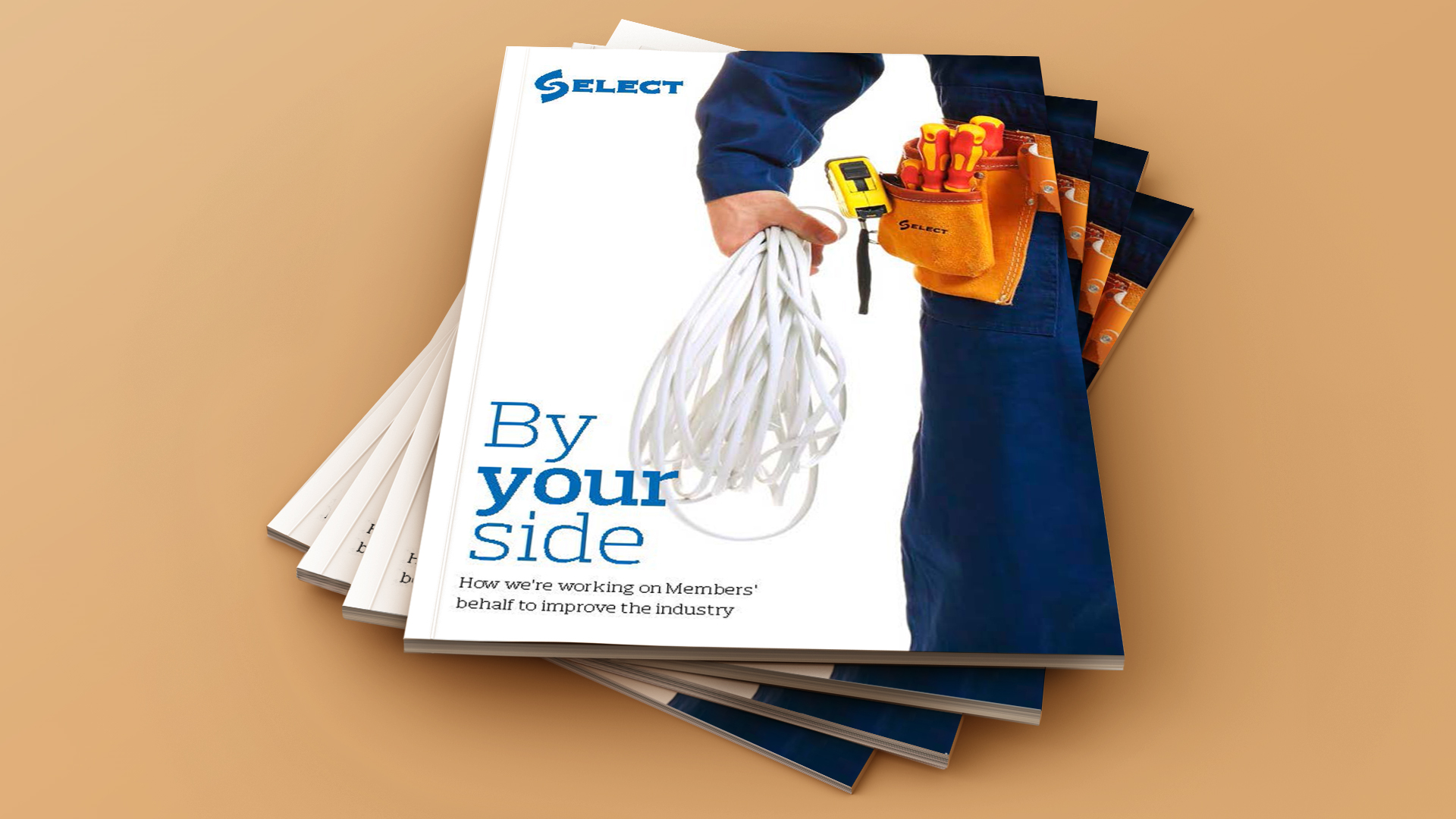
Select Stays By Your Side In New Behind The Scenes Publication
A new brochure has been produced that explains some of the vital work that Select carries out behind the scenes. The new publication, called By Your Side, outlines the many different ways that Scotland’s biggest trade association works to help improve the electrical landscape for both its members and the wider industry. It reveals how Select is a tireless campaigner for regulation, presses for payment change and carries out political lobbying in Scotland and beyond. It also explains the vital work the association does to raise industry standards, improve working conditions and aid skills development by building relationships and serving on respected industry bodies. Iain Mason, Select Director of Membership & Communications, comments: “Our experts promote our Members’ interests in a variety of ways, from advising on essential technical and employment matters to conducting political lobbying. However, this dedication often happens unnoticed behind the scenes – so this guide explains exactly how we’re always working on our members’ behalf. “It explains clearly how we work around the clock to give our members and the wider industry a strong collective voice, putting the needs of electricians first and creating a brighter future for us all.” A digital copy of the new brochure can be found here.

Red Arrow Tackles Emergency Lighting Legislations
Red Arrow Electrical Distribution is helping contractors install reliable and sufficient emergency lighting.  Defined by BSi as “the generic term for equipment that provides illumination in the event of failure of supply to the normal lighting,” emergency lighting is a complex area that generally requires a degree of additional wiring and expertise. According to Red Arrow, all commercial and industrial premises require mandatory emergency lighting, but with many businesses below standards due to poorly maintained or insufficient products. These days, all new builds have emergency lighting installed during construction – with design and type specified by an electrical engineer to meet Building Regulations and Local Authority requirements – but each site still has its own unique needs.  To support the general lighting in case of emergency, it’s important to address the differing levels of light required for varied needs and uses to ensure the appropriate amount of emergency lighting is installed.  Alongside different lighting specifications, risk assessments should also be carried out regularly, particularly if the structure or usage of a building changes. Failure to implement this legal requirement can result in many long-term problems, lengthy site revisits, increased workloads and costly repairs.  It’s also worth remembering that all those involved in designing, installing and manufacturing emergency lighting systems are responsible for complying to fire safety assessments and legislation, making the IET Electricians Guide to Emergency Lighting, BS 7671, BS 5266 and EN1838 essential reads for contractors installing emergency lighting. Relating to hotels, clubs, hospitals, nursing homes, schools, colleges, licensed premises, offices, museums, shops and multi-story dwellings, this focuses on: ⦁ Installing emergency lighting in accordance with regulatory requirements  ⦁ Testing the system  ⦁ Maintain ongoing inspection and necessary updates Which emergency lighting? According to the BSi guide to emergency lighting, there are two main types of emergency lighting:  Emergency escape lighting  Part of the fire safety provision of a building and a requirement of The Regulatory Reform (Fire Safety) Order 2005, this provides illumination for the safety of people leaving a location. Escape route lighting must be sufficiently lit to enable swift and safe evacuation of a building by illuminating its escape routes, such as corridors and stairways.   ⦁ LED Emergency Maintained Exit: Available with a three-hour emergency duration and IP20 rating. Ideal for offices, schools and hospitality. ⦁ Emergency LED Twin Spot: With a lightweight polycarbonate body for easy mounting and installation, this is designed for commercial sites, warehouses and retail units.  ⦁ Sentinel Emergency: Lightweight and compact, these professional emergency downlights are perfect for locations where higher EM illuminance is required  Standby lighting  Although not a legal requirement, standby lighting is often installed to enable normal activities to resume in the event of failure in the normal mains supply. However, it should be noted that as this type of emergency lighting is normally handled by Generators or a UPS (Uninterruptible Power Supply), battery-based products are not suitable alone.  ⦁ LED Emergency Maintained Recessed Lighting:  Perfect for leisure centres and hospitality, this lighting is available in 25W LED, with a 297 lumen output and an emergency duration of three hours.  With a range of exit signs, twin spots, popular bulkheads and downlights with specially designed escape route optics, Red Arrow are experts at providing emergency lighting, while supporting the growing demand that contractors are facing. 

Insulated jackets and trousers from Snickers Workwear
Street-smart, stylish looks and market-leading Gore-Tex and 37.5 fabric technology make these jackets and trousers from Snickers Workwear a must for winter on site or for outdoor leisure activities. You’ll stay warm and dry in this layered clothing that’s robust, waterproof and windproof too! The design and fabric combinations will keep your body in the optimum comfort zone as the weather conditions change on site. They’ve got all the features and functionality that you’d expect in Snickers Workwear jackets and trousers. They’re great looking garments that will keep you feeling comfy wherever you are and whatever you’re doing at work in cold weather. With a range of winter accessories to choose from as well, Snickers Workwear’s FlexiWork and ALLroundWork garments feature contemporary designs packed with must-have features that focus on fit, comfort and freedom of movement; as well as using innovative fabrics that deliver long lasting protection.