2 November 2026
Product of the Month: Amari Floodlight range by Aurora Lighting
 
12 November 2026
Schneider Electric transforms Southampton hospital estate
 
12 November 2026
GTEC Training opens new education facility in North Yorkshire
 
11 November 2026
Energy, AI and smart buildings: register now for EMEX 2026
 
11 November 2026
Solar and batteries could cut electricity costs by 40%, data finds
 

Latest News


Tamlite Lighting welcomes investment in wellbeing
Research which identifies the start of a three-year phase of significant investment in wellbeing across the UK’s built environment sector has been welcomed by Tamlite Lighting. Published last week, the report from the Urban Land Institute (ULI) - a global non-profit research and education organisation focused on the built environment - presents data from the first ever comprehensive survey of leading property experts into understanding health and wellbeing. It looks at the way the wellbeing agenda is influencing investment decisions across the real estate industry. Entitled, Picture of health: the growing role of wellbeing in commercial real estate investment decision-making, it reports on survey responses and interviews with more than 100 investors, developers, fund managers, consultants, valuers and analysts. Of particular note is that 86% of the survey respondents expect to increase their investment in wellbeing in the next three years, with 17% anticipating this increase to be ‘significant’. For Tamlite, a company that has long-championed the benefits of investment in more ‘human centric’ approaches to building services, such as lighting, the survey’s key findings are welcomed, but not surprising. Commenting on the report, Debbie-Sue Farrell, Head of Wellbeing at Tamlite Lighting, said, “Tamlite has spent the last 12 months talking to architects, consultants and building owners and operators about the benefits of investment in wellbeing. Clearly, we wanted to lay clear the commercial business case; a key message is that improvements to office environments, particularly in terms of lighting, offer a way to enhance UK workers’ daily experiences of the workplace. “The feedback from our engagement with the market shows us that the agenda is moving on at some pace; more and more companies are now looking for new ways to enhance the workspaces they offer. It is therefore no surprise that the demand for ‘better spaces for better people’ is now shifting to building owners and real-estate investors. To stay competitive and attractive to tenants, commercial landlords simply have to provide the type of spaces that end-users want. Wellbeing measures are one of the best ways to do this.” Victoria Lockhart, co-chair of ULI UK’s Sustainability Forum and Director of Market Development at the International WELL Building Institute, adds, “The increased interest in health and wellbeing we are already seeing from major players in the real estate industry cements the fact that wellbeing is becoming central to development and investment strategies. “As companies seek to attract top talent, wellbeing is increasingly prioritised as fundamental to environmental, social and governance (ESG) factors. Companies are looking closely at the workspaces they offer, as well as how the workplace can help translate a company’s values and build a culture of health.” To download the full report, visit uk.uli.org or click here.

ECA issues five-point plan for new Government
A five-point plan for the new Government to improve the UK’s built environment has been set out by leading engineering services body, ECA. The proposals include reforming cash retentions, reducing false self-employment, and preventing the use of unskilled labour. ECA CEO, Steve Bratt, comments, “If the new Government is to deliver a range of key infrastructure projects, such as high-speed rail, major housing developments and renewable power generation, then it needs to promote a competitive market based on quality and innovation. Unfair, unsustainable practices such as false self-employment, cash retentions and reliance on unqualified, incompetent labour need tackling as a priority. “The engineering services industry plays a fundamental role in improving the UK’s built environment, which in turn is the engine of progress and growth across the economy. Businesses stand ready to support Government to reach its ambitious climate targets and deliver key infrastructure, but change is required to make this a reality.” ECA’s five-point plan is as follows: Reform cash retentions. Cash retentions are held by private and public sector clients against their subcontractors, with some £7.8bn unpaid in the last three years. This has severely hindered business growth and in some cases, led to insolvency. ECA, BESA and a coalition of more than 90 other bodies, with the backing of more than 275 MPs, have long been pressing Government to reform this practice. Make buildings energy efficient. To deliver on the ‘net zero’ carbon emissions commitment by 2050, the Government needs to put in place a clear plan to deliver more energy efficient buildings. This needs to include policy shifts to help decarbonise buildings, and ongoing monitoring to check whether targets are being met. The use of green finance initiatives could help to achieve this. Build more houses. It is widely recognised that house building needs to increase to 300,000 every year if supply is to meet demand. Government needs to incentivise house builders and housing associations in order to meet this target, as well as encouraging the use of modern methods of construction, such as modular housing. Reduce false self-employment. ECA, alongside influential business leaders from across the construction sector, has called for higher levels of direct employment to be implemented across the supply chain, and less reliance on agency labour. Doing so will help boost productivity and innovation, strengthen health and safety on-site and deliver improved outcomes for clients, including the Government. Ensure operatives are suitably competent. The clear view of ECA and industry partners is that the best and most practicable way of assuring competence is by individuals holding the relevant qualifications, which is often an apprenticeship or equivalent. This will help ensure work is of a higher quality, create safer buildings, and preserve standards when firms are tendering for business. This five-point plan is clearly on top of the Government’s need to resolve the current Brexit impasse, and therefore bring certainty to businesses”, adds Steve Bratt. “The industry is increasingly keen the new Government focus on delivering a compelling domestic programme for enhancing our infrastructure and boosting the built environment”.

NICEIC renews sponsorship with Luton Town
IMAGE: Paul Collins (left) pictured with Luton Town defender, Sonny Bradley (centre) and Luton Town’s manager, Graeme Jones (right). NICEIC has renewed its deal to sponsor newly-promoted Championship side Luton Town FC. The NICEIC logo will appear on the back of the Hatters’ shorts and away kits for the 2019/20 season. The latest deal marks a decade of continued sponsorship between NICEIC and the club. This season’s partnership will kick off in style, with Luton taking on Middlesbrough live on Sky Sports on Friday, August 2. Paul Collins, Communications Manager at NICEIC, comments, “We are delighted to once again support Luton Town FC, and couldn’t ask for a better start. Luton will be kicking off the new season in front of a TV audience of millions. It will ensure great coverage for the NICEIC brand, and promotion to the Championship will bring further TV exposure throughout the season.” In addition to the shirt deal, NICEIC will be updating its boards around the ground, including new LED adverts promoting NICEIC registered contractors. There will also be increased advertising in the club programme and around Kenilworth stadium, where Luton regularly attract crowds in excess of 9,000 for every home game. Collins adds, “We are committed to promoting our contractors in new and innovative ways, and will continue to push the benefits of using an NICEIC registered electrician. We would like to wish the management and players at Luton Town FC all the best, and we are looking forward to another great season working together.” David Hoskins, Commercial Manager at Luton Town FC, notes, “We are delighted to have NICEIC on board again. It is a great supporter of our club, and has been with us all the way, from our time in the Conference to where we are today. It has been a positive journey for both organisations, and we look forward to more success over the next few years.”

CEF invites customers to opening of new store
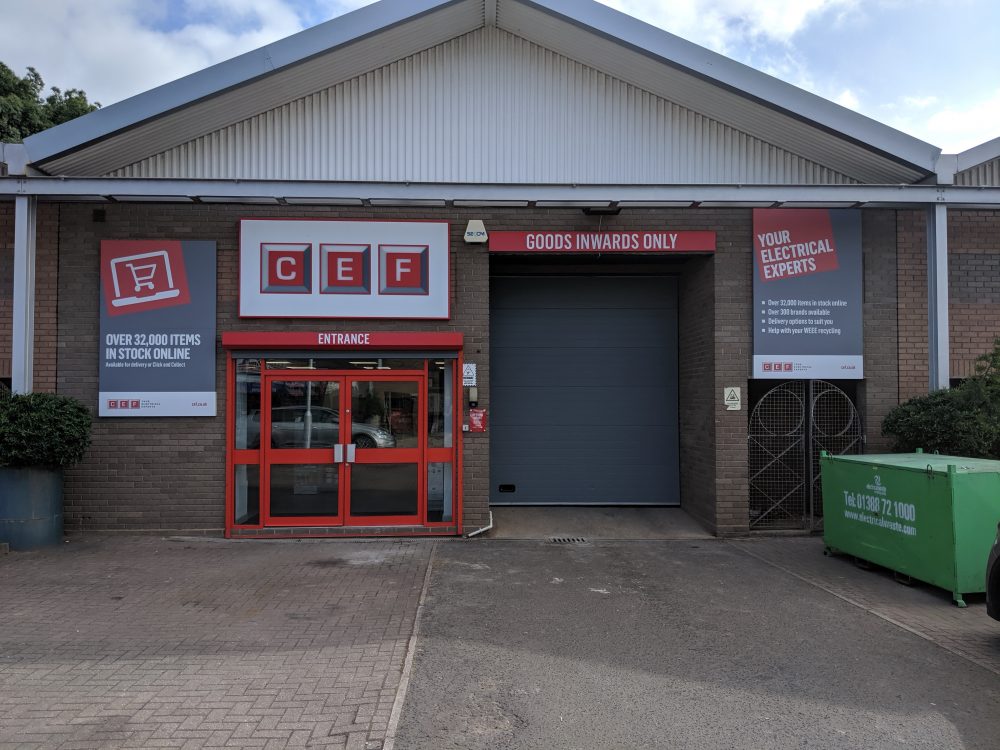
CEF, the UK’s leading electrical wholesaler, has opened a brand new store in Stratford-upon-Avon and is inviting local customers to its official opening this August. CEF – which has nearly 400 stores nationwide – supplies everything from cable and lamps to sockets, ventilation, heating and switchgear, and its new store in Stratford-upon-Avon is already fully stocked and ready to supply to customers at the trade counter. Moving from its previous location on Western Road Industrial Estate to new premises on Avenue Farm Industrial Estate gives the CEF team more space to keep an even greater number of products in stock. On Friday 16th August, the electrical wholesaler is celebrating the opening of its new premises by inviting local electricians and tradespeople to an official opening, packed with food, drinks and special offers. New opportunities CEF states that the new store is an asset to the Stratford-upon-Avon area, bringing valuable electrical expertise and resources to the local trades, as well as new job opportunities to the area. The team has already hired one local candidate and is on the lookout for more enthusiastic, customer-focused people to join them. Dave Cooper, Store Manager at CEF Stratford-upon-Avon, comments, “We’re delighted to be able to offer our extensive local stock and outstanding service to customers in our new and improved location, together with our online range of almost 30,000 products – all available next day at everyday value prices. Our customers are at the heart of everything we do at CEF, and this store has been designed with tradespeople in mind, making sure we’re ready to respond to every individual’s needs. “At CEF, we believe in building relationships with our customers, so we’re really looking forward to welcoming people to our official opening on Friday 16th August. We’ll have some exclusive product offers available on the day, as well as food and drink, so we hope to see lots of people there.” “As a local store, we’re keen to employ local people and have just welcomed one new person from the area to our team. Anybody who is passionate about providing excellent customer service, and who is interested in joining our dedicated, expert team, is welcome to get in touch.” The new CEF store is located at Unit 9 Swan Trade Centre, Avenue Farm Industrial Estate, Birmingham Road, Stratford-upon-Avon. Its opening hours are 7am to 5.30pm on Monday to Friday, and 8am to 12pm on Saturdays.

Tridonic opens lighting academy and tech hub
Tridonic UK, a manufacturer and enabler for smart, connected lighting, has opened a technology hub at the Business Design Centre in Islington, London and invested in a new Connected Lighting Academy, in its Basingstoke headquarters. These investments are central to its digital and business transformation strategy, designed to help support and educate its OEM partners through training on the company's latest products. This includes net4more and basicDIM wireless, and will enable partners to learn more about the opportunities for connected lighting and how best to sell these complex, integrated lighting solutions. Simon Blazey, Strategic Solutions Sales Manager at Tridonic, says, "The ubiquitous nature of light, in our buildings and the wider urban environment - combined with advancements in technology - means that lighting is set to be the communications backbone for the smart buildings and smart cities of the future. The London hub is intended as a ‘think tank’ to help incubate ideas around real business issues, through demonstrations of our technology, and help visitors to gain an understanding of how the many building technologies deployed today can interoperate." He continues, "Our first OEM has already undergone training at the academy, and they were excited about the new opportunities that are opened up with our products and solutions." - Tridonic has also welcomed Chris Slattery to its team. He takes on the role of OEM Controls and Solutions Manager, and was previously Emergency Lighting Product Manager. Slattery comments, "I enjoyed the challenge of bringing innovation into the emergency lighting sector and now look forward to using my experience and technical and business knowledge in this new position. Our latest solutions including basicDIM wireless and sceneCOM, alongside net4more offer great opportunities for OEM's looking for innovation and wanting to expand their offering beyond the traditional lighting market."

Homing in on surge protection
On the back of a 20-year partnership, Hager and Taylor Wimpey, one of the UK’s largest housebuilding companies, are working together to ensure safety remains the number one priority for the owners of the developers’ newly built homes following recent electrical industry regulation changes. As a result of the introduction of the 18th Edition of the Wiring Regulations, all new Taylor Wimpey homes, where construction was started after January 2019, will benefit from an ‘as standard’ installation of a surge protection device within the property’s consumer unit as an extra safety precaution. The new 18th Edition regulations state that all new build properties should have surge protection unless a risk assessment is carried out by electrical contractors to look at the likelihood of lightning strikes and other geographical factors that could result in short, disruptive and excessive voltage levels. The risk of such occurances can adversely affect properties and their contents such as electrical devices like laptops, and TVs. From this assessment, electrical contractors can decide if the consumer unit installation warrants the cost of including a surge protection device to help protect potentially expensive household technology items from damage due to an unpredictable spike in voltage. However, committed to the highest levels of customer service, Taylor Wimpey has taken the strategic decision to phase in the roll out of consumer units prefitted with a surge protection device across its new build developments going forward. As well as offering complete peace-of-mind for the new property homeowner, by specifying Hager’s Design 30 consumer units, electrical contractors can benefit from a straightforward and fast on-site installation process as the surge protection devices come pre-wired. This helps to keep the construction programme on schedule and allows purchasers to take ownership of their new homes without any undue delay. Ian Smith, Marketing Manager at Hager, says, “The introduction of the 18th Edition regulations mean many in the electrical industry supply chain have had to reassess their specification and installation processes to comply. Surge protection was an area of major change, especially with the onus on contractors to carry out a risk assessment before the installation of a consumer unit. “While this could lead to potential confusion among the market, Taylor Wimpey, as a responsible developer, has taken the decision to ensure all its new homes offer increased electrical protection. The company’s judgement to install the Hager Design 30 consumer units with factory pre-wired surge protection on a blanket basis, means it has removed any doubt about the best course of action. “The impact of the 18th Edition changes can be seen by the fact that production of Hager’s surge protection-ready Design 30 consumer units has increased ten-fold, as the electrical industry gets to grips with the new regulatory landscape.” A spokesperson for Taylor Wimpey comments, “By taking the strategic decision to install 18th Edition-ready consumer units into all of our new build homes where initial construction has started after January 2019, we are able to assure our new homeowners that their property and valuable items are better protected from unpredictable surges in voltage. We also take the pressure off electrical contractors. They no longer have to make the decision around the suitability of surge protection for a home following the risk assessment. They can simply get on with the installation. “Our long-standing relationship with Hager means we are totally confident we are specifying a quality, high performing solution thanks to the Design 30 consumer unit.”

Electrical contractors show further fall in reportable accidents
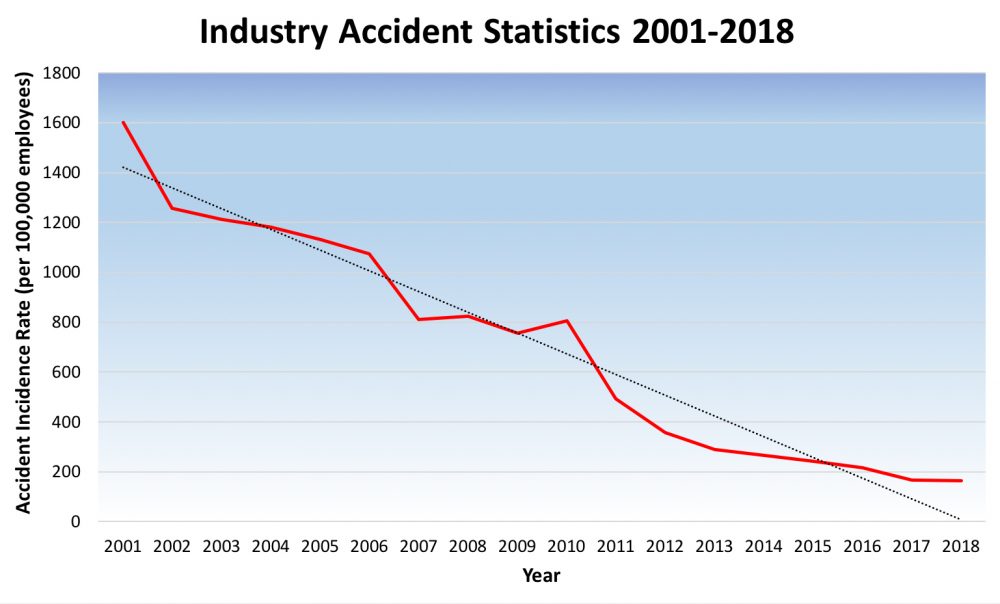
The latest accident statistics for electrical contracting businesses, employing over 13,000 operatives in total, show a further reduction in the accident rate in 2018. The figures, collected by the Joint Industry Board (JIB) on behalf of leading electrotechnical trade body ECA and Unite the Union, show that the rate of RIDDOR-reportable accidents fell once again, to 164/100,000. Significantly, no fatalities were reported during 2018 and the rate of specified (major) accidents was also lower than in 2017 at just over 52/100,000. The main causes of injury were falls, slips and trips, and there was one reportable injury due to electric shock. Steve Brawley, Chief Executive of the JIB, comments, “It’s very encouraging to report that the rate of reportable accidents in our industry continues to fall, and it means that the rate of these accidents is now, remarkably, only slightly more than 10% of what it was in 2001, the year we started to collect data for the industry’s highly successful ‘ZAP safety initiative.” Paul Reeve, ECA Director of CSR, adds, “Since the turn of the millennium, there has been near continuous improvement in the accident rate reported by participating companies. The 2018 figures mean that the accident rate has fallen nearly 90% since 2001, which is a great achievement. In fact, the number of RIDDOR-reportables – in a sample of over 13,500 operatives – is now so low, that in 2019 we will be asking companies for additional details of any ‘over one day accidents’. While these accidents are not RIDDOR-reportable, this will give us more data to work with in future.” Rob Miguel, Unite National Health and Safety Advisor, notes, “While these new figures are very welcome and show huge improvements in safety in the electrical contracting industry over the last two decades, JIB is also working to improve occupational health. “The JIB occupational health scheme provides operatives employed by a JIB member company with the opportunity to receive a fully funded occupational health assessment every three years. This facility, funded through the JIB Benefits Scheme, will deliver various benefits including improved compliance with health and safety law, meeting client and main contractor requirements, and helping people to identify and remedy health issues at an earlier stage. This assessment looks for the effects on health that might be caused by situations people are exposed to at work, and highlights action which employers will need to take to protect the health and wellbeing of their employees and our members.” To download the accident report visit: www.jib.org.uk/jib-accident-survey

Apprentices deliver clear ROI, new research shows
Companies that recruit apprentices can see a return on investment (ROI) as soon as year two of the apprenticeship programme, according to new figures from The Electrotechnical Skills Partnership. Using scenarios based on low, medium and high charge-out rates for unskilled and skilled work, the overall net costs and benefits of apprentice recruitment have been projected. At the lowest rates, an apprentice delivers a net benefit of around £11,400 over the four years, and starts to make a return in year three of the apprenticeship. At higher charge-out rates, the apprentice begins to pay for themselves in year two, and by the end of year four, has created a net total benefit of just over £34,000 at medium charge out rates and £56,700 at high rates. Research specialist, Pye Tait Consulting, carried out the analysis on behalf of TESP after speaking to 20 companies of different sizes and specialisms. Each company was asked about the weekly wages of apprentices over the course of the apprenticeship, as well as additional costs for course fees, travel, equipment, in-house training and the time spent by supervisors and other skilled staff for mentoring and support. The calculations take into account the weekly costs of an apprentice and supervision, the percentage of time spent on supervision, and the increasing amount of time the apprentice spends completing the work of a qualified electrician. With 95% of training costs in England now funded by the Government for apprentices of all ages, these new figures provide a strong case for employers to consider apprentices as a means of bringing new skills into the business. For smaller companies that often struggle with the resource for managing the apprenticeship and initial impact of productivity, TESP believes these projected returns demonstrate that, with the support of a quality training provider, an apprenticeship will eventually pay off. “Although it is a commitment, which can be daunting to small businesses in particular, investing the time and resource into apprenticeships will ultimately drive business growth,” says Ruth Devine, Managing Director of SJD Electrical and Chair of TESP. “As a small business owner, I have experienced first-hand that, over time, apprenticeships increase capacity and strengthen the business culture. “A strong relationship with a quality local FE college or training provider is vital, however. Industry organisations such as the TESP partners are also happy to help and give advice. When I first started at SJD, I found the supportive network of fellow ECA members invaluable to navigate some of the challenges of managing apprentices and providers; it’s always good to benefit from others’ experience.” Leading apprentice training providers, JTL and Focus Training, also welcomed the release of the ROI figures to support their employer recruitment efforts: “The report is really helpful to us as a training provider. We’ve never been under any illusion about the value of apprentices, but the analysis will help us to convince employers of the tangible benefit to taking on an apprentice,” comments Liam Sammon, JTL’s Director of Learning and Innovation. Bernard Collins, Curriculum and Quality Director at Focus Training Group, adds, “It is great to see evidence that having an apprentice not only delivers an individual who fits in with the companies’ ethos and work ethic, but also provides an appreciable financial return, even after making allowances for support and expenses.” To read the report in full, visit www.the-esp.org.uk/ourwork/lmi

Schneider Electric collaborates with Edmundson Electrical to open EV centres
Schneider Electric has collaborated with Edmundson Electrical to open four electric vehicle (EV) centres of excellence. Partnered with Schneider, the new centres in Manchester, West Bromwich, Glasgow and Twickenham, will develop expertise around smart, interoperable EV charging systems. The companies say that these efforts will support contractors in meeting growing EV infrastructure and energy demands. Since 2015, the number of ultra-low emission vehicles has quadrupled. Along with this continued market growth, the demand for EV energy management system knowledge will too increase. As EV charging systems scale in size and complexity, the opening of the centres will enable Edmundson Electrical and Schneider to deliver expertise, training and support to the UK EV charging installation market. “With the growth of low emission vehicles across the UK, we need to have the best possible knowledge base. Investing in the creation of excellence centres with Schneider Electric means we can utilise their knowledge to ensure we can help our contractors develop new skills, broaden our customer base and improve standards,” comments Andrew Fawcett, Business Development Manager at Edmundson Electrical. Danny Winn, Business Unit Director, eMobility at Schneider Electric, adds, “Edmundson have recognised the emergence of EVs in the UK and have reacted in the most positive way possible. With this partnership we can share our expertise and they can have a competitive advantage for the future. At Schneider Electric we are committed to making the UK as energy efficient as possible. This partnership is another step in the right direction.”

ECIC urges electrical contractors to declare diversification
As new laws have been announced to guarantee payment for solar homes providing excess electricity, demand for solar panel technology from homeowners is expected to increase. This will in turn present a number of new opportunities for electrical contractors looking to broaden their contract opportunities. ECIC, the specialist insurer for the building services sector, is encouraging electrical contractors who are diversifying into renewable technology to make sure that their insurance reflects the new work they are undertaking, to help ensure they are adequately protected if they need to make a claim. New government legislation states that all new solar homes and businesses exporting electricity to the grid will be guaranteed a payment from suppliers. What is being described as the Smart Export Guarantee (SEG) will ensure that the owners of small-scale electricity generators with a capacity up to 5MW will be paid for each unit of electricity they sell to the grid - tracked by a smart meter. Consequently, demand for renewable technology that generates this electricity is anticipated to grow, creating an opportunity for electrical contractors to fulfil this demand. However, change in work changes the insurance risk and under the Insurance Act 2015, contractors are under a duty to ensure that they present a ‘fair presentation of risk’ to their insurer. This means declaring changes in the type of work contractors are taking on. Richard Forrest Smith, CEO of the ECIC, comments, “This new legislation has the potential to create a number of new business opportunities for electrical contractors. However, these opportunities can only be capitalised on if the contractors themselves are properly accredited and insured. Fitting solar panels and other renewable technologies have different risk factors, so insurance covers need to be adapted accordingly. Declaring these changes to their broker or insurer is essential to ensure the contractor is properly protected in the event of a claim.”