2 November 2026
Product of the Month: Amari Floodlight range by Aurora Lighting
 
26 November 2026
Thorn scores second Highland football lighting installation
 
26 November 2026
Segen pens exclusive distribution contract with M-Rack
 
25 November 2026
Scolmore helps rejuvenate Tamworth Cancer Support Centre
 
25 November 2026
Leicester apprentice crowned 2026 SkillELECTRIC champion
 

Latest News


NAPIT launches new digital member ID card 
NAPIT have introduced a new membership identity card app to make it quicker and easier for customers to verify the competence of NAPIT members. NAPIT electrical members can now access their new digital ID card anytime and anywhere, be it online or offline. The introduction of this new digital ID card makes NAPIT the first certification body in the electrical industry to offer this service. Mike Andrews, CEO at NAPIT Group, says: “Our world today is undeniably one which is focused and reliant on digital technologies and advancements. With this in mind, we are very proud to launch our digital ID app that allows our electrical members to access their membership ID card on-the-go via their smartphones, with or without internet connection. As a business, we are committed to enhancing safety and promoting competence in the sector. This digital ID app allows our members to demonstrate their certification scope in a clear and easy way to their customers. The additional benefit of a QR code, on the card, allows the customer to verify the members identity and competence enhancing this offering further.” NAPIT services such as technical support and customer services are also easily accessible via the app. NAPIT now provides all its registered electrical operatives with a digital ID card and understands that some of its members may need or want to carry a physical ID card as well. Therefore, it is providing them with the option of either or both cards via a new preference section within the members area on the NAPIT Online portal. "NAPIT strives to serve the individual needs of members. Providing them with both options, therefore, works to their advantage," adds Mike. As well as the added benefits to members of this App, NAPIT hopes that by making this switch the printing and postage of plastic ID cards will be reduced in line with their corporate responsibility to protect the environment. Also, in order to speed up production, NAPIT has outsourced its physical ID card fulfilment to MBA, an established and progressive Document Management, Print and Digital Communications specialist, providing solutions for a number of known brands including National Trust, the NHS and United Utilities. “We are committed to becoming a truly sustainable business and we will continue to provide our customers with high quality sustainable products and services in ways to protect the environment and help reduce all our carbon footprint,” emphasises Mike. If you are a NAPIT electrical member you will be invited to access the member portal giving you instructions on how to download the app and update your preferences. The digital ID card app is now available to download on both the Apple App Store and Android Play Store.

Annual review showcases JIB's commitment to delivering for its members
The Joint Industry Board (JIB) has released its 2021 Annual Review, which highlights key achievements delivered for its members with Direct Employment featuring as a key story from the year, as well as the JIB’s crucial actions in response to priorities identified in the 2020 JIB Membership Survey. The priorities for members were the increased promotion of the benefits of Direct Employment, enhanced engagement with industry, improved visibility of JIB members to clients and more focus on Continuing Professional Development (CPD). In February 2021, the JIB published its ‘authoritative and compelling’ report into the benefits of Direct Employment. Following publication, the JIB has been actively involved in promoting the benefits to over 1,500 key stakeholders and Chaired a Construction Leadership Council group on Direct Employment in September. This gave the JIB a unique platform to lobby directly to Government and an influential and diverse stakeholder group from across the supply chain. The JIB is continuing this work to rebalance the industry and re-establish the founding principles of direct employment, apprenticeships, and high standards of training and qualifications. JIB also responded to members’ feedback by hosting a series of relevant webinars which attracted over 500 people. A pilot Forum was hosted in June, which had insights from the Bank of England on the current economic impact and the Electrotechnical Certification Scheme (ECS) launched a new CPD digital system allowing all individuals to digitally record their ongoing skills and knowledge for the first time. There were some significant landmarks to celebrate as well. ECS Check, the free online system that provides necessary insight and visibility through all levels of the supply chain, recorded its 1,000th registration since its launch in early 2020 and the ECS Remote Invigilation service, offering ECS card holders and employers the opportunity to take their assessments without having to travel to an assessment centre, was also launched giving card holders greater flexibility than ever before. Remote Invigilation services are already seeing thousands of users per month taking advantage of this industry-leading technology approach, helping members save time and money. The JIB Skills Development Fund proudly supported a record 55 people undertaking skills development and CPD as part of their career progression. The charity also provided crucial financial assistance to those out of work and looking to upskill to re-enter the workforce. Jay Parmar, Chief Executive of the JIB, says: “The JIB has been working extremely hard to make the electrotechnical industry a healthier place as things start getting back to normal, and we have continued to play an active role in upskilling the industry and in the development of sector-specific competence frameworks. This Annual Review is a round-up of all the JIB’s news, campaigns and progress taken in 2021 and I hope that it will inspire some positivity for all JIB members and employees as we look forward to 2022.” The JIB Annual Review can be read here.

EV Charging as quick as refuelling thanks to High Power Chargers, reports IDTechEx
High Power Chargers (HPCs) refer to Level 3 DC fast charging at a rate of 50 kW or more. In general, because vehicle range and battery capacities are increasing, there is an increased ability for vehicles to accept higher charge rates. Based on a variety of industry announcements, using variants of current battery chemistries and battery pack designs, the time to recharge is expected to be reduced to below approximately 15 minutes to charge to 80%. Corresponding with these general goals, the number of vehicle models that are able to accept higher power is expected to increase in the next several years. However, in the near term, many existing low-range electric vehicles will not be able to take advantage of chargers operating at 350 kW. A mix of charging speeds available at a charging site, controlling power output at a single charger, or sharing power among a group of chargers will usually satisfy the mix of vehicles that arrive with the ability to charge at their maximum power acceptance rate. Installation and the idea of coverage versus capacity   Currently, there are major deployments of fast chargers worldwide, often funded by government at the local, regional or national level. The growth in the number and location of fast charging has occurred organically or as a result of national plans. However, fast charging makes up only a small fraction of all-electric vehicle charging and requires more expensive hardware and higher utility costs than Level 1 or Level 2 charging in most settings. Distribution lines and the final transformers are the most likely to require an upgrade to accommodate fast chargers, alongside installing separate power cabinets to the charge post itself. The new report “Charging Infrastructure for Electric Vehicles and Fleets 2022-2032” by IDTechEx takes a deep dive into the costs and footprints associated with HPCs in addition to the charging market in general. These impacts can be mitigated with several strategies including choosing locations with low grid impacts, smart charging, combining fast charging with energy storage, and applying time of use rates. As the population of BEVs increases within a country, one HPC can support more BEVs. Initially, sufficient geographic coverage is needed even for a small number of vehicles. Initial stations are likely to be underutilized. As the number of BEVs grows, the increased BEV population may pioneer new locations but is likely able to more fully utilize the original locations. Eventually, a station reaches capacity at a location, and instead of adding a station in a new location, additional HPCs can be added to address capacity concerns in the same location. Another major benefit of HPCs is their modularity - most of the chargers are available in 50/75 kW step power units which are connected to meet the required power demand and can be scaled up or down based on utilization. Cooling technologies will be crucial   Charging a battery with too much power could cause lithium plating and dendrite formation around the anode, permanently reducing capacity; at a pack level, it can cause cells to age at different rates and pack overheating. To ensure the longevity of the power electronics, HPCs also require some sort of cooling technology to ensure optimal performance at high-efficiency levels. To support high power charging, efforts are being made on both the vehicle and charger side to prevent overheating. Solutions include preheating batteries, liquid cooling, and using intelligent battery and charger management software as covered in the IDTechEx report. Connectors and standards are gearing up for future power levels   There are five different types of DC fast-charging plugs that can transmit power above 36 kW. These plug types are referred to as CHAdeMO, the European Combined Charging System (CCS type 2, or sometimes referred to as “Combo”), the U.S. Combined Charging System (CCS type 1),  Tesla, and GB/T. The CHAdeMO and  Tesla systems are used in many markets, and the GB/T system is only used in China. New standards are enabling the maximum energy transfer rate for each plug type to increase. While CHAdeMO plugs support 1000 Volts and 400 Amperes, enabling a maximum power of 400 kW, CCS type plugs can now support a maximum voltage of 1000 V at 500 A, enabling a maximum power of 500 kW. However, typical market power for CHAdeMO does not exceed 150 kW whereas CCS is now the preferred connector type for high power chargers offering power levels in the 150-350 kW range. Tesla has been incrementally increasing the power output of its supercharger network, with the V3 supercharger capable of delivering 250 kW of peak power. China is also developing the ChaoJi protocol to achieve harmonization between GB/T and CHAdeMO standards. It sets out a very ambitious target of 900 kW and would also be capable of charging large commercial vehicles such as buses and trucks. The CharIn association has developed the High Power Charging for Commercial Vehicles (HPCCV) standard which will be used for charging in the range of 200-1500 V and 0-3000 A enabling up to 4.5 MW of power delivery. The latest IDTechEx report on Charging Infrastructure for Electric Vehicles and Fleets 2022-2032 provides a comprehensive overview of various fast charging technologies and standards globally, including hardware benchmarking, key market player analysis and regional public fast charging deployment.

How to limit outdoor light pollution with the Zenith Wallpack
Area lighting is an essential part of outdoor lighting installation but choose the wrong luminaire or lighting design and you could be generating unnecessary light pollution: at great cost to the environment, and potentially your customers. Red Arrow’s new Zenith provides a simple solution, with its high-performance lens creating a targeted downward 110° beam angle. Is area lighting a light pollution nuisance? Area lighting and floodlights are the most common causes of light-pollution related complaints to local authorities in the UK. Yet they are also essential fixtures to keep a wide variety of locations safe and usable after dark, particularly in the depths of winter: from social, public and commercial centres, including car parks, to critical operation centres like transport hubs. The challenge for electricians installing environmentally-friendly outdoor lighting is to ensure that the design – and the luminaire it uses – target the area that needs to be illuminated and doesn’t spill into surrounding areas. If not, the light risks becoming a ‘statutory nuisance’ under the Clean Neighbourhood and Environment Act 2005 as well as a hazard for wildlife, and could be removed or adjusted after installation, at cost to the customer. According to research by the British Astronomical Association’s Commission for Dark Skies, at least 30% of outdoor lighting is wasted thanks to poor shielding and positioning, resulting in atmospheric pollutants like sky glow and light intrusion. That’s why Red Arrow have addressed this issue with the new Zenith architectural wallpack, available from January 2022. The Zenith: a more environmentally friendly luminaire The Zenith’s high-performance lens, with a downwards 110° beam angle, works to direct the light to illuminate the desired area, and not the spaces around it, generating less light pollution from sports stadiums, private pathways, public cityscapes, building perimeters and a whole host of other locations where area lighting is key to safety and security. With CCT (colour appearance) switchable between 3000K and 4000K, the luminaire can also be easily set to warmer colour temperatures to complement hard landscaping materials in public space design, or for areas where wildlife needs to be protected, as outlined in the Institute of Lighting Professionals (ILP) and Bat Conversation Trust’s 2018 guide to ecological lighting design. The Zenith’s environmentally friendly credentials don’t end there: thanks to the latest LED technology, this luminaire is also more energy efficient, operating at 125-139 lumens per watt. The fitting’s lumen output is also switchable, giving installers and designers flexibility for different project requirements and further energy saving.  Photocell options are available to save further energy by activating only when there is insufficient daylight. Integral emergency versions offer even greater flexibility, safely lighting to emergency muster points in the event of a mains power failure.

Apprentices of the year crowned by SJIB and Edmundson Electrical
Two young electricians have been recognised for their exceptional talent in the Scottish Joint Industry Board (SJIB) Apprentice of the Year awards, sponsored by Edmundson Electrical. Cameron Wood and Patrick Henderson were presented with their awards and certificates in special ceremonies with their respective employers. Cameron proudly lifted the 2021 trophy, while Patrick received the 2020 award which had to be delayed due to lockdown. Both also received £500 from the SJIB and £500 from Edmundson Electrical. Fiona Harper, The Secretary of the SJIB, comments: “The SJIB Apprentice of the Year awards, sponsored by Edmundson Electrical, celebrate the best new talent in our industry, and both Cameron and Patrick have both demonstrated excellent skill and dedication. “We were disappointed that we were forced to postpone the 2020 ceremony, but we are equally delighted that Patrick has now been recognised for his exceptional talent.” Derek Allen, Scottish Regional Director of Edmundson Electrical, added: “Both winners should be rightfully proud of their achievements, and their employers and college lecturers should also be praised for continuing to help develop the talent of tomorrow.” Cameron is now a qualified electrician who works for JS Hardie Electrical in Lauder, Berwickshire, after completing his studies at Borders College in Galashiels. The 21-year-old says: “I was really surprised when I found out I’d won this award; I definitely didn’t expect it and it’s made all the hard work and sleepless nights worthwhile! “I really enjoy my job. I do mainly domestic and agricultural work as well as the occasional new-build – it’s always different and I like the challenge and variation. I don’t know what the future holds and don’t have a solid plan but I have plenty of time to think about it.” David Hardie, Director at JS Hardie, adds: “Cammy’s a worthy winner of this award. He picks things up well, isn’t scared to ask when he doesn’t know something and his knowledge of the regulations is brilliant. “He’s also very particular and conscientious – everything’s always very neat and tidy and all his customers say he’s a good worker. I’m sure he’s got a great future ahead of him and that he’ll do well whatever path he follows.” After successfully completing his training, 2020 winner Patrick now works for Atalian Servest AMK in Loanhead, Midlothian, after studying at Forth Valley College in Falkirk. The 23-year-old says: “When I started my apprenticeship, it didn’t even cross my mind that I’d win an award like this. I just saw it as a job but it turns out I was good at it! “It does feel strange to actually receive the award now because I’ve qualified, but I’m happy to finally get my hands on it! A lot of the credit goes to the training I got at college, plus all the support from Atalian Servest AMK and my colleagues. “I enjoy the challenges the job brings and want to go as far as I can in my career. I’m currently doing my HNC in electrical engineering and am really pleased this is the path I followed; I feel like I’ve made the right choice.” Atalian Servest AMK Director, Mike Stark, comments: “We’re all so proud that Patrick’s finally received his award. From day one, he knew what he wanted to do and what his end goal was. When he started, he pretty much said he wanted my job and that’s what I wanted to hear – it shows his approach to things.” Mike adds: “I’ve also got so much respect for what the SJIB and Edmundson are doing to recognise the achievements of electrical apprentices like Patrick and Cameron despite COVID-19. They deserve it.”

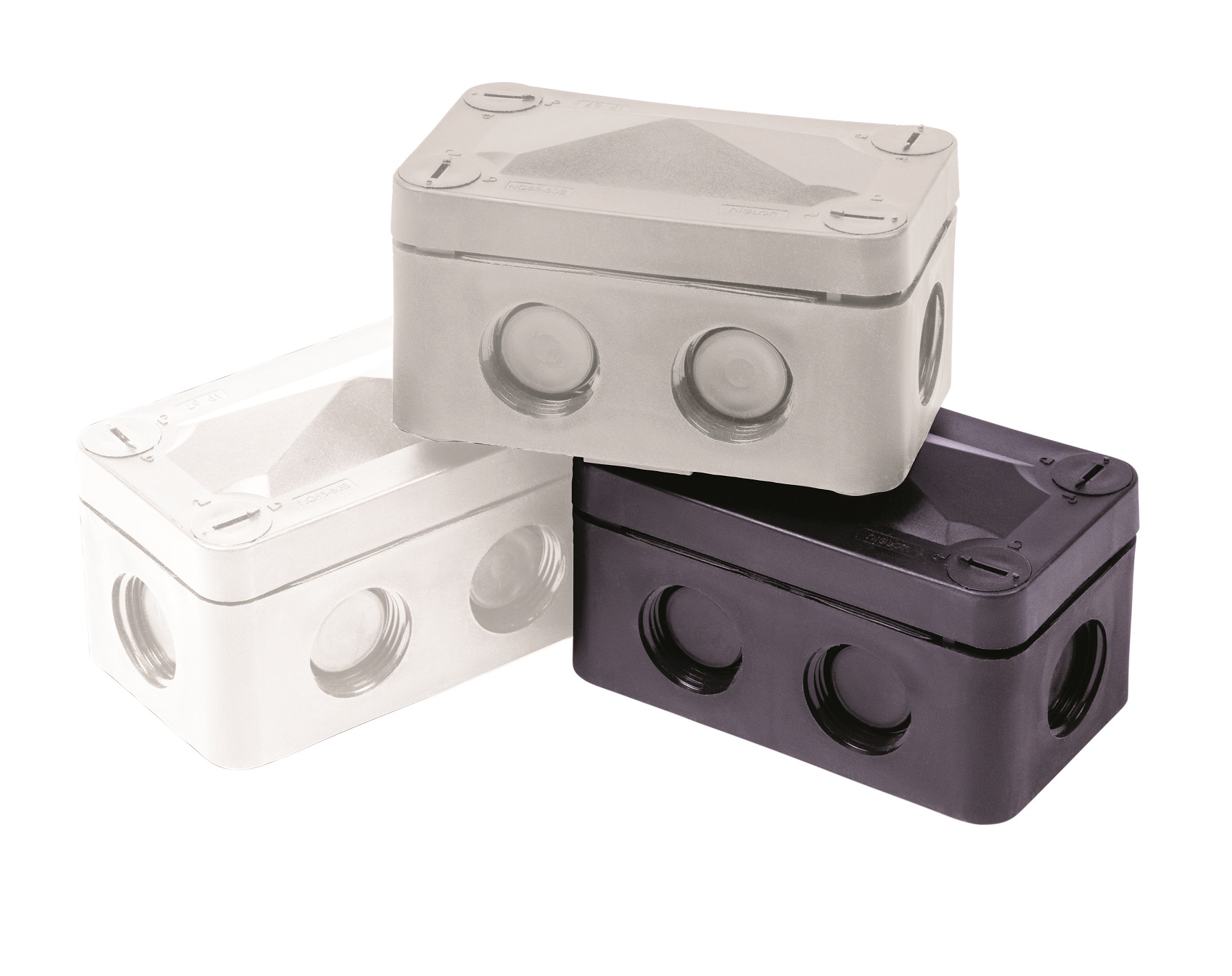
Niglon launches new connection boxes
When it comes to connection boxes, there are now even more options to choose from. The Niglon team has launched its IP66 Membrane Moulded Boxes, available in black, grey or white, which are weatherproof and UV resistant meaning they’re ideal for use outdoors. An integrated gasket to ensure the perfect seal, dual option cable entry, and quick fixings mean the product couldn’t be simpler to install. Niglon’s Commercial Director Paul Dawson comments: “We are committed to extending our ranges to ensure we’ve got the right products for every installation. And we’re also committed to thoroughly researching and testing each new launch, so we can be proud to put the Niglon name on every single product.”

North-West Londoners to benefit from £1 million scheme
North-West London is set to benefit from a new £1 million investment to upgrade the electricity network. Work is currently underway to install a new grid supply point in Willesden. The new equipment replaces existing equipment which has been installed for decades and will be decommissioned. This will help to meet future demand of local power supplies in Willesden and the surrounding areas. The project, by electricity distribution firm UK Power Networks, started in May 2020 and is due to finish in March 2022, providing power for the equivalent of 2600 homes. As part of the scheme, the firm has consulted local councils and other interested parties to ensure that people experience as little disruption as possible while installation work takes place. Joshua Alderdice, project manager at UK Power Networks, says: “This cable upgrade is part of our ongoing investment in the network to maintain reliable power supplies. The aim is to test the cable connections as we go along, to ensure a smooth transition for when the project is completed next year.” UK Power Networks is constantly working to improve the performance of its network and to meet future needs for power. This network improvement project is part of the company’s £600 million investment in its electricity networks this year, to help local communities achieve their decarbonisation ambitions; so as more customers turn to low carbon technologies such as electric vehicles, they have a supply and infrastructure that’s fit for purpose.

CPP Group UK signs new deal to provide insured manufacturer's warranty
CPP Group UK has signed an exclusive partnership deal with Warranty Solutions. The deal sees CPP UK providing Warranty Solutions with an insured manufacturer’s warranty product for its entire product range, taking over from the previous provider and enabling Warranty Solutions to expand its offering. The partnership is expected to generate a gross written premium value of £1 million for Warranty Solutions. Warranty Solutions provides cover for a range of kitchen appliances, with approximately 180,000 appliances currently under warranty on behalf of national retailers. It offers a full claims service, from a helpline and First Notification of Loss to providing replacements and repairs via its national network of accredited engineers. Its clients include major retailer Argos and manufacturers such as Rangemaster, ElectriQ, Simfer, New World and KEG. The insured service protects Warranty Solutions’s clients from repair costs resulting from failures once the items are in the customer’s home, making their own costs more manageable and predictable. This will provide customers with a greater amount of protection and a smoother claims experience than would be afforded with a standard warranty. The deal also expands CPP’s footprint in the home protection market as part of its CPP Secure suite of products. Carl Carter, CEO of CPP Group UK, comments: “CPP is all about helping brands and consumers deal with life’s everyday disruptions. We all know how frustrating it is when a household appliance we use daily breaks down, and how important it is to be secure in the knowledge that you’ll get help and can rely on your warranty if that happens. We’re delighted to be partnering with Warranty Solutions, a fellow Yorkshire-based business, to enable it to enhance its service offering in the warranty market, and in turn, to help protect the reputation of the brands it works with.” Karen Neagle, managing director of Warranty Solutions, adds: “CPP really supports our ethos of providing a first-class quality service to both the customer and the manufacturer at a time when they and their appliance need us most. We’re delighted to be working with CPP to deliver such a versatile range of manufacturer’s warranty solutions.”

New range of push-button enclosures from Hammond Manufacturing
Powell Electronics now has the new HYPB range of IP69/IP69K stainless steel push-button enclosures for hygienic applications from Hammond Manufacturing in stock. Ideal for applications where maintaining hygiene standards and avoiding contamination are of high importance (e.g. in food processing and pharmaceutical manufacturing), HYPB range enclosures have been designed for use with hygienic pushbuttons and withstand regular high temperatures as well as regular high pressure wash-downs. They also have no areas (like slotted screw heads, quarter turn latches or welded mounting brackets) where contaminants can gather and all sides slope to ensure any water quickly drains off. Available with 22.5mm and 30.5mm holes with either a single row of one, two, three or four mounting holes, two rows with four holes arranged in two rows of two or two rows with six holes arranged in two rows of three, HYPB series push-button enclosures benefit from a rectangular design, enabling the units to be surface mounted either vertically or horizontally to suit most applications. The cover is secured to the body with crevice-free hex head bolts fitted with a silicone washer to eliminate potential dirt traps. The blue 'hygiene' coloured silicone gasket makes any contaminants more visible and is fitted beyond the door edges, so that there are no crevices in which dirt can collect.

‘Dramatic’ change to Dunstable skyline
A major power project has transformed views across the highest point in Bedfordshire to spectacular effect. UK Power Networks, which distributes electricity across the East of England, has completed a major £2million scheme to replace a section of overhead lines with underground cables at Dunstable Downs. On land owned by the National Trust, the Dunstable Downs project has been supported by the Chilterns Conservation Board. The site attracts around 750,000 visitors a year. The scheme saw the removal two circuits of 33,000-volt overhead power lines across 4km, as well as the dismantling of the 23 towers supporting them, and installation of 4.5km of underground cables. The work, which will also bolster the resilience of power supplies locally, was completed to schedule, helped by the use of an innovate remote-controlled cable plough supplied by ATP. Ivan Churchman, project manager at UK Power Networks, comments: “This work has made a lasting difference to the skyline at Dunstable Downs as well as enhancing the reliability of the network serving local homes and businesses. “As an Area of Outstanding Natural Beauty, we know it attracts a huge number of visitors and activities they undertake, such as kite flying, will now be much safer. Those visiting just to enjoy the views will now have these uninterrupted. “Throughout the project we worked closely with our partners and to minimise any disruption and it is fantastic that everybody is now in position to share the benefits of this amazing transformation.” Josh Kyle, Visitor Operations and Experience Manager at Dunstable Downs for the National Trust, said: “This project has unlocked the landscape at Dunstable Downs creating a safe space for visitors to not only fly kites, picnic and spend time with friends and family but to explore, and connect with nature.” Neil Jackson from the Chilterns Conservation Board says: “The visual improvement is truly dramatic!  Enhancing the classic chalk escarpment at Dunstable Downs by removing the steel pylons and cables crossing the landscape, has been a long-standing ambition of the Chilterns Conservation Board and many others representing the local community. “A project of this nature in such a sensitive location is not without its challenges and we are very grateful to the UK Power Networks team. The careful work they have carried out has secured lasting improvements to the Chilterns Area of Outstanding Beauty that will be appreciated by hundreds of thousands of people every year.” [embed]http://youtu.be/hPYfe9QW81o[/embed]