2 November 2026
Product of the Month: Amari Floodlight range by Aurora Lighting
 
26 November 2026
Thorn scores second Highland football lighting installation
 
26 November 2026
Segen pens exclusive distribution contract with M-Rack
 
25 November 2026
Scolmore helps rejuvenate Tamworth Cancer Support Centre
 
25 November 2026
Leicester apprentice crowned 2026 SkillELECTRIC champion
 

Latest News


SELECT joins with construction to ask chancellor to withdraw legislation
SELECT has once again joined forces with more than 40 contractor and trade association members in writing to the UK Government demanding the withdrawal of proposed Reverse Charge VAT legislation. It is the second time the influential trade bodies have felt the need to press the case for a rethink with the Chancellor of the Exchequer, Rishi Sunak, MP, in the absence of a reply to a detailed argument they sent him in a letter dated December 20 last year. The latest appeal, sent on January 13 this year, reiterates the fact that Reverse Charge VAT will restrict cashflow in a vital and socially contributory industry, especially to the smallest firms, at just about the worst possible time. The letter, led by the Federation of Master Builders, again emphasises that the policy – due to come into force on March 1 – risks reversing what modest recovery the industry has made from the pandemic and will limit the scope for protecting and creating jobs at a time when the country needs this most. John McGhee, SELECT’s Director of Finance and Resources and Association Secretary, acknowledged an earlier delay in introducing the changes and also other UK Government aid to the sector, but says: “Introduction of Reverse Charge VAT now would be seriously detrimental to the economic recovery.” VAT reverse charging means that businesses which are both VAT and Construction Industry Scheme registered will no longer pay VAT to most of their subcontractors. Instead, VAT will only be paid to firms which supply only labour (employment businesses) and to the merchants and businesses that sell building materials only without any fix. John adds: “The proposals will substantially increase the burden on business and restrict cash flow in what is already an extremely difficult economic climate. “The legislation will particularly impact SMEs that provide both services and materials. This is because they will have to pay VAT on the materials they purchase, including extremely costly elements such as steel, cladding and concrete, but will not be paid the VAT by their customers. For a significant number of companies this will be unsustainable.” SELECT and the other trade bodies argue that their member companies are already subject to independent scrutiny which limits fraudulent behaviour and the introduction of Reverse Charge VAT unfairly penalises those that pay their VAT and comply with their obligations. The campaigning electrotechnical association has also alerted its 1,250 member companies to the gravity of the legislation and its imminent implementation and has pledged to continue to fight for fair treatment for responsible firms.

Siemens tech boosts energy efficiency in Alpine hut
The “Bergkristall” (Mountain Crystal), a mountain hut situated at an altitude of 2,883 meters in the Monte Rosa Massif of the Valais Alps, has been largely energy self-sufficient since 2010. Along with thermal solar collectors, a photovoltaic system integrated in the hut’s southern facade ensures a high degree of energy self sufficiency and a reliable energy supply. Since 2010, all of the building’s performance data, such as solar energy generated and battery capacity, have been bundled in Siemens Navigator, the cloud-based building performance platform. Lithium instead of lead Ongoing analysis of the energy flows revealed that the lead batteries in use since the hut’s opening would soon reach the end of their life. This prompted the operators to put a new solution in place. Siemens was awarded the contract to design the entire solution and replace 48 lead batteries with 14 lithium iron phosphate (LFP) batteries with a capacity of 215 kWh. Thanks to regional airline Air Zermatt, approximately 8.6 tons of lead batteries were transported out and the nearly 2.7 tons of lithium batteries helicoptered in to the Monte Rosa Hut. Following an initial trial with two batteries, technicians successfully connected the newly installed batteries to the energy supply system in just two days. The new battery solution has pushed the hut’s energy self-sufficiency to even greater heights by lightening the load on the generator used in bad weather. In addition, the new batteries offer more usable capacity. The completed project considerably boosts the Monte Rosa Hut’s secure, energy-efficient and sustainable energy supply at any time of day and in any weather condition. Monte Rosa Hut: key figures • Opened in 1895 as Betemps Hut, renamed Monte Rosa Hut in 1940. • Planning and development of a new “mountain hut of the future” by the Swiss Federal Institute of Technology (ETH) in Zurich. • Opened in July 2010; old hut demolished in 2011. • 120 beds, approximately 8,000 overnight stays per year. • High degree of energy self-sufficiency, 215 kWh battery capacity. • Waste water treatment and ventilation run autonomously, even in winter. • All technical systems are digitalized and can be controlled remotely.

Building back greener in 2021 with the JIB Skills Development Fund
With the UK showing a commitment to tackling the climate crisis by setting a target to meet net-zero emissions by 2050, the Joint Industry Board (JIB) is urging electrical contracting companies to evolve and broaden their skill sets. The JIB believes that the increasing adoption of greener technologies presents contractors with a number of opportunities to upskill and open up their services to new markets. In 2020, Chancellor Rishi Sunak announced a £3bn boost to the UK green economy to be spent on decarbonising buildings and introducing modern systems to save homeowners on their energy bills and kickstart the sector. We have also recently seen the Government get behind plans to support up to 220,000 British jobs in the green sector with the release of the Energy White Paper in December pledging another £6.7bn in support for this sector. The intention is to create a greener and more sustainable energy network in the UK for which environmental technologies such as solar photovoltaics, electric vehicles and battery storage will play a part. Environmental skills and qualifications are part of continuing professional development (CPD) for many electrotechnical operatives and can be recognised within an ECS registration and on the reverse of an ECS card. The JIB is, therefore, encouraging member companies to take advantage of the JIB’s Skills Development Fund, which provides financial assistance for courses for those undertaking further education and training in the electrical industry. The following green technology qualifications are accepted by the JIB Skills Development Fund as eligible courses: Solar Photovoltaic Installation and Maintenance Electric Vehicle Charging Point Installation (City & Guilds 2919-01) ONC/HNC/Degree courses in sustainable engineering ECS cardholders are also encouraged to highlight and show off their hard-earned qualifications and skills by including these in their ECS card renewals and updating their registration. Darren Crannis, Managing Director of CTS Electrical, was funded through the JIB Skills Development Fund to undertake the C&G 2919-01, and he believes all electrical contractors can benefit by improving their knowledge on electrical vehicle charging equipment. Darren says: “The EV market is constantly evolving and it is going to play a crucial role if the UK is to succeed in hitting its net-zero target by 2050. It really makes sense for installers to become familiar with EV technology as early as possible and it has certainly opened up a profitable new avenue for our business.” He adds: “The Level 3 City & Guilds 2919 is a two-day in-depth course on the design and installation of EVCE. There is access to funding via European Social Fund (ESF) from training providers and if you are a JIB company this course is eligible for JIB skills funding, which reduced the cost of the course significantly for me.” Andy Reakes, Head of Growth at the JIB and ECS, comments: “Once Covid-19 has been dealt with there will be a real move to set our attention again on Net-Zero by 2050 and climate change. The Energy White Paper is another example of the microgeneration and environmental market receiving further Government support into 2021.”

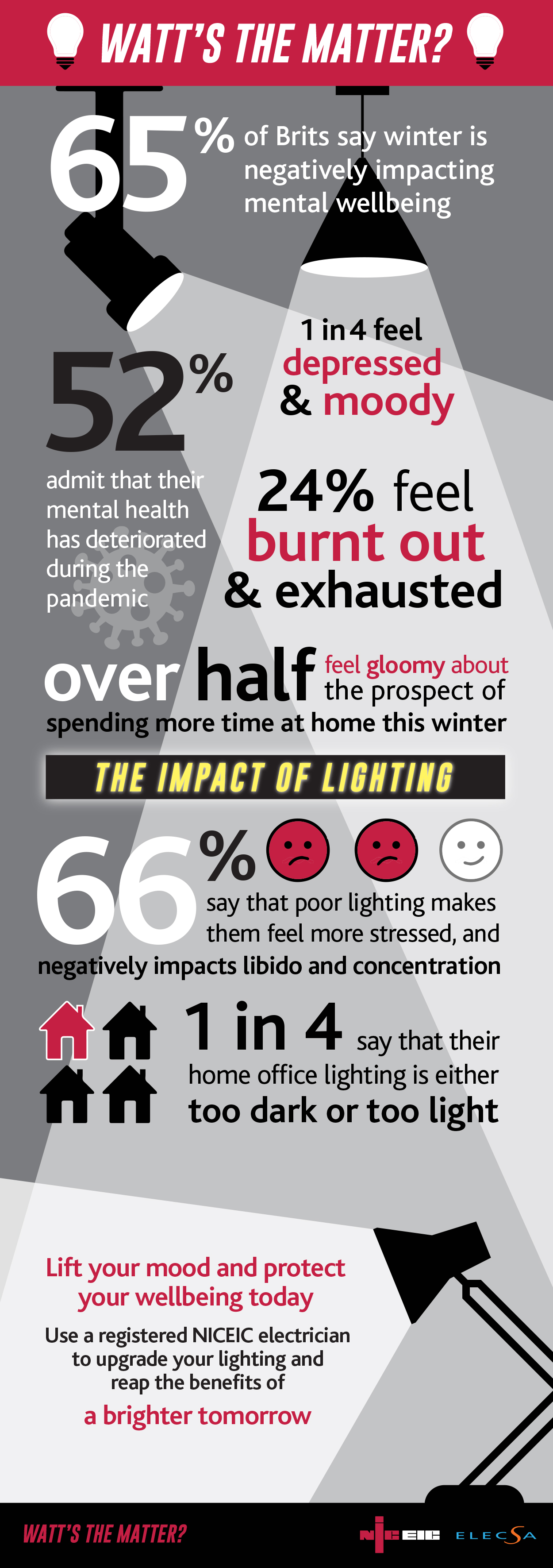
NICEIC and ELECSA campaign, linking good lighting and mental health
With 2020 hailed by many as ‘the worst year ever’, a record number of Britons have said their mental wellbeing is at an all-time low this Blue Monday, a new study has revealed.   According to stark new research by NICEIC and ELECSA, for many homebound Brits working from makeshift offices in kitchens or spare bedrooms since last year, poor lighting in the home is making matters worse. Two thirds of respondents (66%) admitted poor home lighting was negatively impacting their concentration levels and making them feel more stressed. Luckily, as record spending on home improvements continues, lighting has become a priority as almost one in four (24%) of those surveyed stated good home lighting made them feel better during the winter months and almost one in three (27%) said good lighting made them happier and more energetic. In response, and just in time for Blue Monday, the most miserable day of the year, NICEIC and ELECSA have launched their ‘Watt’s the Matter?’ consumer campaign. The campaign highlights the positive impact improvements in home lighting can have on the nation’s collective mood - while warning the public of the importance of using a registered electrical contractor for any planned electrical work. Paul Collins, NICEIC and ELECSA’s Technical Services Manager, comments: “With 2020 being one of the most challenging years in recent history, it’s unsurprising that just weeks into January, the mental wellbeing of a record number of Brits is at an all-time low this Blue Monday. “With the national lockdown and the fact that huge swathes of the population are still working from home, often in makeshift offices, the problem is clearly intensifying with many experiencing the detrimental impacts poor home lighting can have on mood. “As our electrical contractors are keenly positioned to help our ‘Watt's The Matter?’ campaign aims to address the problem and provide safe solutions, guiding consumers to registered electricians such as those registered with the NICEIC and ELECSA. “To help amplify the message we encourage all NICEIC and ELECSA registered contractors to take this opportunity to talk to their customers about effective lighting in the home. Through education and good advice collectively we can do our part and help lighten the mood this winter” Today’s findings come as a quarter (25%) of homeworkers admitted that the lighting in their home office was either too dark or too light, with just over a half (52%) revealing they regularly suffer from headaches, migraines or eye strain when working. Despite this, although almost a half (47%) of homeworkers bought a new desk, laptop, screens, or printers, just 9% have upgraded their lighting to make their home offices as comfortable as possible. This looks set to change, however, with around 65% of Brits surveyed saying upgrading lighting is now just as important to their home as painting, laying new carpets, and buying new furniture. The survey of 2,000 consumers reveals the nation’s collective weariness this winter, with some surprising disparities: 70% of 45-54admitted upgrading lighting was just as important to their home as painting, laying new carpets, and buying new furniture Brits located in Yorkshire and Humber regions have reported worst deterioration in their mental wellbeing and feel the gloomiest about spending the winter at home. Those living in the West Midlands are suffering most from poor lighting, with a fifth (20%) confessing it is making them feel depressed and moody. 46% of women said the coronavirus pandemic continues to make them feel anxious/fearful, compared to just 28% of men. In terms of mental wellbeing, the pandemic is having the worst impact on those aged 18-44, with 21% revealing they are suffering from Seasonal Affective Disorder (SAD).

Sheltering the Electronic Security market from COVID-19 impact
2020 has seen a sharp contraction in the electronic security market size, though the focus on replacement sales has to some extent sheltered the market from the even steeper fall in new construction output. COVID-19 has even created a surge of interest in pandemic-related products such as thermal imaging to measure body temperature and analytics to monitor occupancy levels.  Manufacturers have responded to the COVID-19 pandemic by launching or promoting products designed to provide appropriate security measures, such as AI software to monitor numbers of people entering or occupying a building and to ensure social distancing, thermal imaging cameras to provide a temperature screening solution, or touchless access control.  The electronic security market grew strongly from 2016 to 2019, particularly in services, CCTV and access control. It has been boosted by a healthy construction sector though construction output growth slowed in 2018 and 2019 compared with the previous three years as political and economic uncertainties associated with Brexit held back the UK economy and affected business confidence and consumer spending. In particular, the key end use sectors of offices and retail saw a decline in new build output in 2018 and 2019. Fiona Watts, Editor at AMA Research, comments on the market “growth has been driven by technological advancements increasing replacement demand, as well as a largely buoyant construction sector, despite a slowdown in construction output in the key end-user sectors of offices and retail in the past two years. However, the level of growth has been constrained to some degree by the intensity of price competition triggered by the market entry and increasing dominance of Chinese manufacturers.” Due to its essential nature, security equipment markets have historically been able to weather recessions somewhat better than most other industry sectors, and the economic downturn caused by the COVID-19 pandemic is likely to be no exception. In addition, the rapid pace of technological development will fuel growth of the replacement market. Looking ahead, recovery in the security market and in the wider economy will be gradual, only gathering significant pace from 2022 onwards. Though the interest in pandemic-specific solutions will wane, increasing adoption of advanced technologies will continue to drive growth in replacement sales, particularly in CCTV and access control.

Scolmore expands its technical engagement team
It is four months since the newly created role of head of technical engagement was taken up by electrical industry expert Darren Staniforth, and now Scolmore is ready to expand the team with the appointment of Jake Green as technical engagement engineer. Jake has worked in the electrical industry since leaving school 12 years ago.  After completing a full apprenticeship course with the NICEIC training academy at Bedford College, he started his apprenticeship with a small company in Huntingdon carrying out energy saving installations and agricultural installations. This was followed by a role within the electrical maintenance department of a chain of restaurants, before he took up the position of regional manager with facilities management responsibilities for a number of blue chip companies. Jakes joins Scolmore from Certsure, where he worked alongside Darren in a number of roles covering technical training and presenting, and this is when he became a familiar face to many contractors. Together with Darren, Jake will be responsible for engaging with professional contractors and electricians to advise and educate them on the right solutions and products to meet the ever changing regulations and technical requirements of the industry. He will also have a key role to play in developing and presenting training content across Scolmore’s social media channels, including the SGTV YouTube channel – a key conduit for communicating with industry influencers. Marie Parry, group marketing director for Scolmore Group comments, “For Scolmore, contractor engagement has a vital role to play in helping us to gain constructive insight into how contractors like to work, the issues they face and what they need to help them do their work in the most time-efficient and cost-effective way. It is valuable feedback from contractors working on the job and often in challenging environments that helps to drive the new product development programme.  With Jake’s training expertise and experience working with contractors over the years, he has all the right skills for this new position. His appointment will further enhance Scolmore Group’s training offer.”

Hudson Contract highlights help for tradespeople during pandemic
Hudson Contract is highlighting the help and support available to tradespeople and their families suffering from mental health or financial problems during the pandemic. The family-owned group is working with the Lighthouse Construction Industry Charity to raise awareness of the charity’s vital activities throughout its wide industry network. More than 2,500 construction SMEs trust Hudson to deliver audit contract and payroll services, bringing the business into direct contact with tens of thousands of subcontractors every week. Hudson has published an advert for the Lighthouse Club’s Construction Industry Helpline on the back of 18,300 paper tax statements posted this week. The advert will be visible to a further 46,000 people on the company’s online subcontractor portal Hudson Connect. The industry had an estimated 21,000 work-related cases of stress, anxiety or depression last year, according to the Health and Safety Executive. The sector has been singled out for a suicide rate three times the national average among UK males. Ian Anfield, managing director of Hudson Contract, comments: “Everyone knows someone who is suffering from stress, anxiety or depression and financial problems are commonplace. The Covid crisis has exacerbated many of these issues with all of us having to operate through considerable challenges and uncertainty. In these times, it is so important that we raise awareness of the help and support that is available to everyone in our industry. We are proud to promote the excellent work of the Lighthouse Club.” The helpline provides a 24/7 safety net for all construction workers and their families, offering advice on welfare and mental wellbeing, emergency financial aid and support on legal, tax and debt management matters. The app provides essential information and guidance on issues such as stress, anxiety, depression, anger and suicidal thoughts. Bill Hill, chief executive of the Lighthouse Club, says: “Now, more than ever it is crucial that we let our construction community know how they can access the support they need. By providing proactive support at the front end, such as our Construction Industry Helpline app and a wide range of free training, we can help to prevent situations reaching crisis point. Our mission is that no construction worker or their family is alone in a crisis and Hudson is ensuring that we reach those that might need support.”

Late night orders for next day delivery are no problem for tradespeople
IronmongeryDirect and ElectricalDirect are offering tradespeople more flexibility by extending their online order cut-off for next day delivery to 9pm. The new cut-off time allows customers an extra hour to purchase what they need, further supporting tradespeople who need large orders in a short space of time. Customers placing orders over £45 ex VAT are also entitled to free next day delivery. This added benefit for customers follows several recent announcements regarding the retailer’s expanded delivery offering. Same day delivery was launched for customers within the Southend-on-Sea, Chelmsford and Romford areas, and has now been extended to include IG, & E postcodes, with further areas to be included in the near future. For urgently needed goods, customers can order by midday Monday-Friday, with orders arriving by 4pm that day. In addition, the company has extended its Click & Collect network to include over 6,000 pick-up points nationwide, including Sainsburys, Matalan, and Homebase. Simply order online, select Click & Collect at checkout and your goods will be delivered within five miles of your home or workplace. Marco Verdonkschot, Managing Director at IronmongeryDirect and ElectricalDirect says, “We recognise that, especially over the last year, customer requirements are consistently evolving to meet the changes and challenges within the industry. As a specialist supplier, we want to guarantee tradespeople have what they need, exactly when they need it, so they can continue to work and deliver projects as efficiently as possible. “We have made several improvements to our delivery services over the past few months and as part of this, we are pleased to be able to extend our online next-day delivery option to meet our customers working hours or schedules that could change at a moment’s notice. “We will continue to take our customers feedback on-board and make the necessary changes to support the industry.”

Leeds improving the safety of residents with HomeLINK
HomeLINK have been awarded a 12-month project with Leeds City Council in a move towards improving the safety and wellbeing of their residents with IoT (Internet of Things) technology. The £500k investment from GovTech Catalyst for the district will see the deployment of up to 1,000 environment sensors such as temperature, humidity and CO2 (Carbon Dioxide) in up to 1,000 of its homes. Approximately 50 of these properties will also include further smart technology, like the Aico SmartLINK Gateway, for the remote monitoring and management of fire and Carbon Monoxide alarm systems. Aico’s SmartLINK Gateway utilises Aico’s next generation of wireless technology to report events including Fire/CO activations and alarm head removals as they happen to the SmartLINK cloud portal, for full visibility and remote monitoring to improve efficiency, reduce costs, aid with forecasting and compliance and enable smart asset management. Luke Loveridge, CEO of HomeLINK, comments “We're thrilled to be working in partnership with Leeds City Council, the University of York and the University of Leeds on the next phase of this £500k GovTech challenge. Leeds is ambitious, forward thinking and at the cutting edge of the smart city agenda. Providing enough homes that are efficient, safe and supports people's health and wellbeing is of critical importance; especially as people have been spending significantly more time indoors recently. With a deployment of up to 1,000 smart homes, we will test and develop new maintenance and wellbeing services for social housing residents. I'm glad that we are part of a partnership that has the experience and technology to support Leeds in this journey.” This project, in partnership with the University of Leeds and the University of York, follows as Phase Two from an earlier deployment in six properties. The initial phase included interviews, feedback and collaboration with over 100 residents, resulting in clear objectives for the second phase: integration of property management systems, mapping processes and the development of a resident app. The resident app is a vital component of the project as Phase One identified that by providing residents with their own data and suggested actions they could take reduced the risk of condensation, damp and mould. This project also had significant positive impact on relationships and engagement with residents, with all residents keen to participate in Phase Two. The Centre for Housing Policy at the University of York is one of Europe's leading centres for interdisciplinary housing and social policy research, with interests on housing and social justice, housing and later life and the operation of housing markets. Dr Alison Wallace, Research Fellow at the University of York comments of the project "Housing is a key determinant of people's health, so to work with HomeLINK, housing staff and tenants to explore the potential of IoT technologies to improve landlords and tenants responses to indicators of poor internal housing conditions is an exciting opportunity.”

Opening the door for the young in unemployment
Young people in unemployment are being given the chance to develop into prime job applicants, through a new energy programme in London’s West End. The community–run scheme is helping 16-19 year olds who have been out of the job market for a long time, and feel disengaged with education, uncertain of their future in these difficult times. It also aims to help lift youngsters and their families out of fuel poverty and unemployment through education. Energy Garden’s youth training programme covers sustainable energy, social enterprise, community development, and practical learning in the urban environment. In a partnership it has joined up with UK Power Networks which delivers power to 2.3 million homes and businesses across London, to give the young people behind-the-scenes insight into energy issues including the UK’s transition to net zero and a visit to Leicester Square where the company is installing £16.2 million worth of state-of-the-art underground equipment. They are supported with CV writing and how to use social media platforms to showcase their professional skills. Upon completion, trainees are awarded Assessment and Qualifications Alliance (AQA) certificates and receive careers advice to boost their employability prospects and confidence, with some either signing up for more study or gaining employment. Edward Sun, 17, born and raised in nearby Chinatown, says: “This programme has been incredible and provided a new engineering perspective, especially on electrical engineering. I’ve enjoyed the visit to the transformers under Leicester Square the most so far, as I had never known that underneath the busy square were three massive transformers that are so essential to everyday life in the area, and most likely provides me with electricity. This has been a wonderful experience and I look forward to the future of the programme.” Agamemnon Otero MBE, chief executive of Energy Garden, comments: “There is a misconception that youth want a way out of their communities. That is far from the truth - they want a level playing field. They want the same access to opportunities as those around them. Energy Garden provides place-based learning of the finance, IT, legal, technical and media elements of owning a community energy company. The trainees benefit from hands-on experience and meet top brass in the energy sector. A door to possibilities in their local community opens, and they walk through.” Liam O’Sullivan, head of capital programme and procurement delivery at UK Power Networks, adds: “We want to bring meaningful public engagement to our infrastructure projects, so we put people at the heart of the energy system, giving them the power to feed into plans and see what happens behind the scenes to keep London powered. This is about encouraging innovation, building resilience and creating a sustainable future and taking young people out of unemployment.”