2 November 2026
Product of the Month: Amari Floodlight range by Aurora Lighting
 
25 November 2026
Scolmore helps rejuvenate Tamworth Cancer Support Centre
 
25 November 2026
Leicester apprentice crowned 2026 SkillELECTRIC champion
 
24 November 2026
JTL celebrates opening of new Tyneside training centre
 
24 November 2026
LiGHT 26 welcomes record number of visitors to fifth event
 

Latest News


Electric Heating Could Be Key To Raising Efficiency Of Rental Properties, Says Dimplex
Modern electric heating appliances could be the answer to help landlords of more than 323,000 private rental properties to meet new energy efficiency standards, says Glen Dimplex Heating & Ventilation. From April 1, all private rented properties in England and Wales must achieve at least an Energy Performance Certificate (EPC) rating of E before landlords can grant a new tenancy to new or existing tenants, except where exemptions apply. The same will apply to all private rented properties, even when there has been no change in tenant, from April 2020. It is all part of the new Minimum Energy Efficiency Standard (MEES), under the Energy Efficiency (Private Rented Property) (England and Wales) Regulations 2015, which aim to raise the efficiency of homes in the private rented sector. Of the 4.85million private rented properties in England alone, 6.6% only have an EPC rating of F or G according to the government’s English Housing Survey, using figures from 2016. That means approximately 320,100 properties will need to increase their EPC rating by at least one band – and upgrading to modern, energy efficient heating appliances is one of the most effective, least disruptive ways in which to do it. Chris Stammers, head of insight for Glen Dimplex Heating & Ventilation, said, “Modern electric heating appliances like the Dimplex Quantum system are intelligent, efficient and incredibly easy to use. And with MEES forcing efficiency improvements upon landlords of thousands of properties, they could be just the solution many landlords need. “From April 1st, landlords can no longer ignore the efficiency of their property. The key will be in finding solutions that don’t just raise the EPC rating, but do so in a cost-effective way that will appeal to tenants and reduce the need for ongoing maintenance.”

NICEIC And ELECSA Offer 18th Edition Pre-Orders
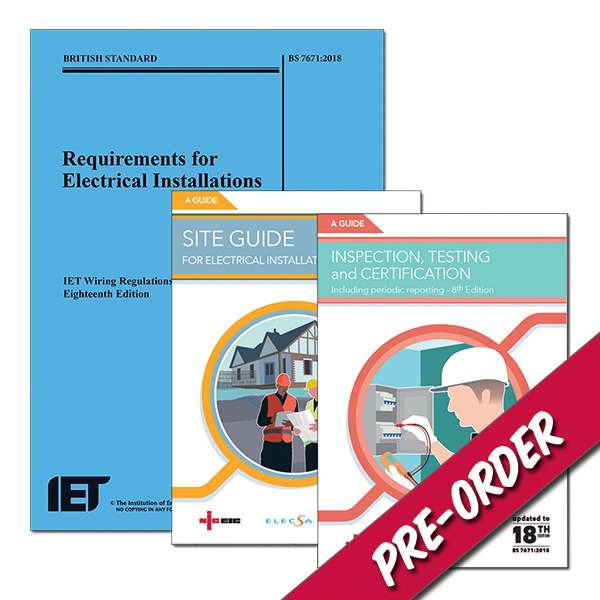
Electrical contractors can now pre-order their copy of the upcoming 18th Edition from NICEIC and ELECSA. The 18th Edition will be available on July 2. Contractors who pre-order their copy will ensure they get the book when it first comes out. The new standard is expected to retail at £95 when it launches. Contractors who pre-order their book early will receive a 10% discount. “Once it launches, contractors will have a six month period to get up to speed with the changes,” commented NICEIC and ELECSA’s technical development manager, Darren Staniforth. “From January 1 2019, it will then be a requirement that all electrical installations designed after this date comply with BS 7671:2018, 18th Edition (2018). “Everyone involved in the electotechnical industry will need to be able to demonstrate a level of understanding and awareness of the changes. “Therefore, many contractors will be keen to get a copy of the blue book as soon as it becomes available. By pre-ordering a copy now, they can ensure they get a copy as soon it comes out and have the maximum amount of time to make any necessary changes to the way they work. “They can also make some great savings in the process.” In addition to the book itself, there are also various bundle packages available, including the 18th Edition book plus NICEIC and ELECSA Site Guide. Anyone wishing to make an order can do so by visiting www.18edition.com.

New Guide To Improve Consumer Product Safety Recalls Released
The government’s new Office for Product Safety and Standards has teamed up with BSI, the UK’s national standards body, to launch the first government-backed Code of Practice (PAS 7100) for product safety recall in the UK. The Code of Practice includes details on how a business can monitor the safety of products and plan for a recall, and how market surveillance authorities such as local authority trading standards can support businesses in their monitoring of incidents and their implementation of corrective action. The Code of Practice, developed by BSI, is the first major initiative for the new Office, which was launched by the Department for Business, Energy and Industrial Strategy in January. It follows a recommendation by the Working Group on Products Recalls and Safety to introduce such a code to further strengthen the UK’s already tough product safety regime. This was created with the assistance of leading retailers, consumer interest groups and industry bodies, including; Tesco, Samsung Electronics, British Retail Consortium, Royal Society for the Prevention of Accidents and the Association of Chief Trading Standards Officers. The Code of Practice comes in two parts. The first is focused on non-food consumer products and is intended for use by manufacturers, importers and distributors. It provides details on: how a business can plan for a recall, including establishing mechanisms to deal with any product safety issue identified managing a possible safety related product recall or other corrective action establishing mechanisms to monitor the safety of products investigating any potential product safety issue reviewing corrective action programmes to ensure that product safety responsibilities continue to be met The second is aimed at regulators, specifically market surveillance authorities including local authority trading standards. It details how they can carry out their role in ensuring businesses meet their responsibilities in respect of consumer product safety issues by: monitoring incidents and analysing data supporting businesses in the preparation of their ‘product safety incident plan’ (PSIP) supporting businesses in their monitoring of incidents and their implementation of appropriate corrective action

NICEIC Launches Bursary Scheme For Women In Electrical Industry
To celebrate International Women’s Day, NICEIC is setting up a bursary scheme to help women in the electrical industry. NICEIC has long campaigned for more women to enter the electrical sector. Now it is taking the next step by offering grants to women already working in the industry or looking to get a helping hand at the start of their career. The bursary is open to women of all ages and can help cover training or other associated costs up to a maximum of £500. Emma Clancy, CEO of NICEIC, commented, “Through our Jobs for the Girls campaign, NICEIC has been at the forefront of promoting opportunities for women. “We have helped bring the issue to national attention and are now seeing more women look to take up a career as an electrician. “However, getting started in the industry is still proving difficult for many women. Through this bursary scheme we want to take the next step and help those directly involved.” Since launching its Jobs for the Girls campaign in 2011, NICEIC has noticed a marked change in the industry’s attitude towards women in the sector. However, the numbers are still low, with estimates suggesting that women still only make up around 2% of all those who work on the tools. Emma added, “Over the last seven years, we have seen a marked increase in the number of women coming to us looking for help and assistance. Colleges and employers have also been in touch to see how they can attract more female candidates. “Where possible we have provided access to training, technical information and opportunities with our registered contractors. But, it has not always been possible to assist those who just need a helping hand along the way. “Through this bursary we will be able to offer practical and financial support and hopefully create a smoother route into the industry.” In 2015, NICEIC worked in partnership with Sheffield-based charity WEST (Women in Engineering Science and Technology) and The Sheffield College to help promote the opportunities that a career as an electrician presents. NICEIC then financially supported three women who wanted to become an electrician by paying their college fees and helping them find work with a local registered contractor. One of those who benefited was Shauna Wigglesworth. Following her studies, NICEIC managed to find her work experience with national housing provider The Guinness Partnership. She was eventually taken on as electrical apprentice and last year was named their Apprentice of the Year. “The pilot scheme in Sheffield has proved to us the positive effect we can have in assisting more women into the industry,” concluded Emma. “If we can create more success stories such as Shauna’s and all the other women who are already out there making a fine career as an electrician then we will be well on the way to addressing the gender imbalance directly.” For more information on how to apply visit the NICEIC website.

The LIA Team Up With UL To Simplify Luminaire Certification
The UK’s lighting industry trade body, the Lighting Industry Association (LIA), and the global safety science organisation UL have announced a new agreement aimed to establish a strong collaboration between the two organisations that will simplify the testing and certification services for UK lighting manufacturers wishing to achieve third party testing and approval. The LIA operates an independent lighting test laboratory, accredited as both a Certification Body Test Laboratory (CBTL) and Notified Certification Body (NCB). It serves lighting manufacturers, suppliers, retailers, wholesalers, designers and the wider UK lighting market. Additionally, as a highly-respected trade association, the LIA offers its members advice and support with technical guidance and direction. The cooperation between the British association and the North America-based safety science organisation will empower the LIA to test and certify lighting products for the North American market. This means that, in addition to the CBTL test reports, this agreement allows the LIA to issue UL certifications along with the ‘UL mark’. The agreement will streamline the processes that UK lighting manufacturers currently have to navigate in order to test and certify their products for global markets. It offers manufacturers access to a complete services portfolio from a single reputable unique local supplier. Speaking about the agreement, the global commercial leader for UL’s Lighting division, Roberto Inclinati, said, “The agreement with the LIA supports our effort to reinforce UL’s presence in the UK. It offers additional guidance to the UK lighting manufacturers and all those professionals who demand safe and good quality lighting products. “UL believes that this new cooperation will enable UK manufacturers to reach their goals more quickly and easily, and enable them to stand out from the competition.” Steve Davies, CEO of the LIA, added: “The strategic cooperation between the LIA and UL will reinforce the global recognition of the LIA – and what’s more, help its members to grow and achieve excellence in product design, specification and performance, protecting the interests of both the public and the manufacturers.” The agreement is not limited to safety and performance testing, but also extends to Wellness services – provided by UL – and to the UL Verified Mark, which allows manufacturers to scientifically validate their marketing claims.

Prices Continue To Fall For Ultra-Efficient Solar Panels
The price of solar power is continuing its downward trend, while the efficiency of solar panels continues to improve. That means that electrical contractors can now get their hands on ultra-efficient ‘mono crystalline’ solar panels that cost just 45¢/W; that’s a 37.5% drop when compared to previous prices, according to the US Energy Information Administration. Unfortunately, mono   solar panels are still slightly more expensive than their less efficient poly crystalline counterparts. It’s estimated in some markets that they’re 6% more expensive, although the trade-off is that mono crystalline is 10% more efficient. That means that the price of the electricity produced can often be cheaper. Renewable energy is already on course to become the cheapest form of energy in 2018, according to engineering consultancy Arup. That includes energy created from both wind and solar farms. The historically low prices should continue to fall, however. In fact, in the US the Department of Energy is aiming for a price of $0.05 per kWh. There are many factors contributing to the reduction in the price of solar energy. China is a key proponent of solar energy, and its ‘Top Runner Program' has led to manufacturers investing heavily in mono crystalline solar panels thanks to financial incentives. The programme has also been penalising poly crystalline manufacturers. As more companies invest in mono crystalline solar panels, it should drive prices down even further. It requires the industry to change tact, however. Poly crystalline is still popular in the industry, with it said to have represented 70% of solar panel production, and many of the solar panels specified in projects still use the technology. With prices being driven down even further, it’s expected that mono crystalline could reach the 50/50 mark in 2018.

NET Introduces New Checklist For AM2 Preparation
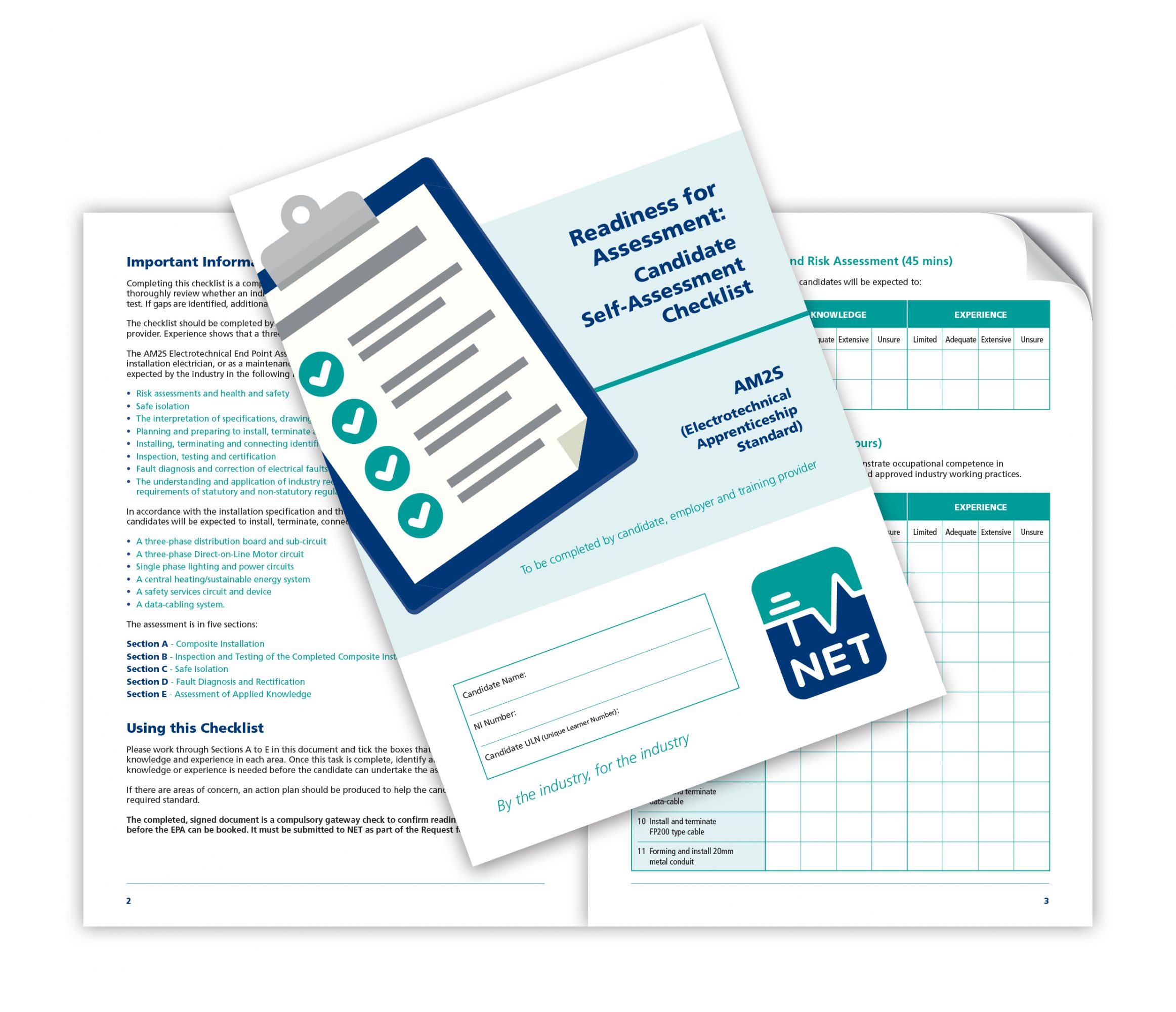
All those undertaking the AM2 or AM2S assessment must now complete a ‘Readiness for Assessment’ checklist in advance before the assessment can be booked, to help improve the candidate’s chance of passing the assessment first time.  NET, the industry charity responsible for the assessments, has introduced the checklist as a mandatory ‘gateway check’, this is in line with government requirements for the new apprenticeship standard introduced in 2015. The checklist asks the candidate, their employer, and training provider to make a judgement on each area of the assessment and whether the individual has the required knowledge and experience to undertake the test. By completing this task, it identifies any areas where further learning is needed before the candidate is ready to proceed. For over 30 years, the AM2 has been the final element of the electrical apprenticeship. This ‘end point assessment’, as it’s becoming known, is a rigorous practical examination and knowledge test where candidates are assessed on their skills and competence against a consistent criteria across England, Wales and Northern Ireland. In Scotland, the ‘FICA’ is the parallel assessment. The AM2S assessment is now running concurrently with the AM2, for those who are undertaking an apprenticeship against the new standard. By introducing the checklist as a compulsory element before the assessment can be booked, NET hopes that it will reduce the number of instances where a candidate attends an assessment without preparation. “Our analysis clearly shows it’s the candidates who have prepared that are the ones who pass first time,” said Carolyn Mason, chief executive of NET.  “In the past, training providers or employers have rushed to put a candidate through the AM2 when there are gaps in their knowledge or skills, which means invariably they will fail the assessment. Having to re-sit can be damaging to the candidate’s morale, and it’s also a waste of time and money for the employer and training provider. By strengthening the checklist, we are helping all parties to ensure the candidate is confident going into the assessment and have everything they need to succeed.”

IET And BSI Announce Official 18th Edition Wiring Regulations Changes
The official list of changes set to be included in the 18th Edition of the IET Wiring Regulations (BS 7671:2018) has been released by the Institution of Engineering and Technology (IET) and the British Standards Institution (BSI). BS 7671:2018, the national standard to which all new and amended electrical installations in the UK need to comply, is due to be published on July 1, 2018. The announcement comes as the IET urges those working in the electrical sector to familiarise themselves with the changes, ahead of the 18th Edition coming into force from January 2019. According to the IET, a number of significant changes will be included in BS 7671:2018. Among others, these will include: the requirement for a ‘switching device’ to be implemented in the installation of renewable energy storage systems recommendations for Arc Fault Detection Devices (AFDDs) in AC final circuits a change to the requirement for methods of supporting wiring systems in buildings against premature collapse in the event of a fire requirements for devices for protection against overvoltage a new appendix focusing on energy efficiency Changes will also come into force for electric vehicle charging installations with PME supplies requirements, and new guidance will be issued for the design and erection of electrical installations featuring local production and storage of energy for optimising efficiency. The amendments to BS 7671 are the result of changes to international and European standards – the technical intent of which the UK is obliged to adopt. Members of the JPEL/64, the national Wiring Regulations committee, represent the UK on many international committees during which these standards are discussed. The IET ensures that the JPEL/64 considers all amendments to the Regulations to ensure they meet the best needs of the industry before a new update is published. “The 18th Edition of the IET Wiring Regulations contains some significant changes to the way all electrical professionals are required to carry out their work in order to safeguard themselves and the public. With this in mind, it is essential that all electrical professionals ensure that they are up to speed with the new requirements,” said Mark Coles, head of technical regulations at the IET. “The IET will make the amended IET Wiring Regulations available in traditional print format, and from our digital platforms, meaning there is no excuse for not being familiar with the current requirements for electrical wiring.” The full list of changes to BS 7671 can be found on the IET website.

Luceco Lights Kendal Rugby Union Football Club
Luceco has recently supplied LED luminaires for an £11m sports facility, the new home for Kendal Rugby Union Football Club (KRUFC). The brand new facility benefits from two large hospitality areas and a viewing balcony overseeing two pitches, one grass and one all-weather surface, a restaurant, physio practice and a community gymnasium, Esteem. P Wright Electrical – based in Kendal – were the electrical contractors for the overall project and undertook the installation. Paul Wright commented, "The client was looking to create a sports hub for Kendal as well as a new home for the Kendal Rugby team. They wished to build an outstanding venue for sporting events and hospitality functions. Working with Luceco, we installed over 560 LED luminaires, including Platinum downlighters in the gym, corridors and reception areas and LuxPanels in the offices and changing rooms. "LED Dali dimmable dual switched downlights were used in the lounge bar and main function rooms, with colour changing LED strips to give a modern and interesting twist in these areas and something special for hospitality events." The new facilities at Kendal RUFC will ensure that the Black and Ambers enjoy a state of the art venue to continue their club’s success on and off the field.

Smart City Lighting Strategy Launched For The Square Mile  
The City of London Corporation has announced it will bring innovative lighting proposals to the Square Mile, including remotely operated lighting that will complement the look of historic buildings, improve energy usage and help tackle light pollution. The strategy will use state of the art technology and see urban spaces coated in various lighting types, levels and colours at different times during the night. This will complement the work that is already underway to upgrade the City’s street lighting to high quality, energy-saving and cost-efficient LED. The strategy will assess the balance between darkness and street and commercial lighting. Surveys show that currently some streets may be excessively lit compared to how many people actually use them, or that the current street lighting adds little because of the impact that nearby commercial lighting may already have. The strategy will also consider the important role that lighting has on crime prevention and reinforcing road safety. Studies have found that artificial lighting at night is contributing to an alarming increase in the amount and brightness of light pollution across the world. This leads to less starlight in the night sky, disrupted ecosystems, a reduction in biodiverse populations and can impact on human health and sleep rhythms. The strategy also seeks to address the needs of nocturnal animals in gardens and areas along the riverside. The City Corporation is working with lighting designer Speirs and Major on the strategy which will be implemented in phases throughout the City.