2 November 2026
Product of the Month: Amari Floodlight range by Aurora Lighting
 
25 November 2026
Scolmore helps rejuvenate Tamworth Cancer Support Centre
 
25 November 2026
Leicester apprentice crowned 2026 SkillELECTRIC champion
 
24 November 2026
JTL celebrates opening of new Tyneside training centre
 
24 November 2026
LiGHT 26 welcomes record number of visitors to fifth event
 

Latest News


JTL & Electrical Industries Charity Highlight Negative Impact Of Stress
JTL is working alongside the Electrical Industries Charity (EIC) to highlight the negative impact of stress. The joint campaign aims to help people working in the electrical sector to address stressful situations and seek help. It includes a dedicated Apprentice Support Programme, designed to help apprentices with any challenges they may face early on in their career. The assistance available through the EIC covers a wide range of issues – from caring for a sick or elderly relative to dealing with redundancy. The EIC’s team of trained advisors can offer free financial, legal, emotional or health-related advice. Thousands of people in the electrical sector are faced with a wide range of difficult situations in their lives, which often lead to mental health issues. Some of those affected reach out for help, but others have no one to turn to and often bury their struggles in alcohol or drug abuse. Addictions such as alcohol or drug abuse often not only have a dramatic effect on physical health but also has significant consequences on mental health which often leads to problems such as depression, anxiety, and many other issues. Recent statistics released by the NHS showed that in the UK in 2015/16 there were 8,621 hospital admissions with a primary diagnosis of drug-related mental health and behavioural disorders. It was also recorded that each year there were 2,479 registered deaths due to drug misuse. The National Institute on Drug Abuse (NIH) also stated that compared with the general population, people addicted to drugs are twice as likely to suffer from mood and anxiety disorders. To help to reduce these statistics and to give crucial access to support services to those who are affected by mental health problems, the Electrical Industries Charity has created the Employee Assistance Programme which offers all of the vital support needed to help people in the electrical sector to get back on their feet and create a life they deserve. Recently, the charity helped an experienced electrician Rhys Lynch to create a better quality of life for him and his daughter. Rhys first contacted the Electrical Industries Charity in 2012 when his partner left him and his two-year-old daughter. Rhys applied for sole custody of his daughter, leaving his job as an electrician to become a full-time parent. On gaining full custody, the council re-housed Rhys and his daughter into a one-bedroom property, and the charity provided a £1,000 grant for household items. In 2013, they were moved to a bigger, two-bedroom property, which better met their needs and once again the charity helped, providing a £1,000 grant for flooring. Despite starting a new life, Rhys’ problems were far from over. Over the years, Rhys was faced with numerous financial struggles which sadly resulted in him turning to alcohol and drugs and in 2015, Rhys lost not only his home but also custody of his daughter. With nowhere left to turn, Rhys resorted to theft to feed his addiction, and following many incidences, was sent to prison for 14 weeks. After serving his sentence, Rhys suffered a further relapse and nearly lost his life. Since then he has sought counselling and support for underlying issues which dated back many years. The charity once more offered support to help with his debts, and he was granted a debt relief order (DRO). Since September 2015, Rhys has been free from drugs and alcohol and can now see a brighter future ahead. But the road to recovery is never easy, and for people suffering from mental health issues, ongoing support is vital which is why Rhys contacted the charity once more in January 2017. The charity helped with the cost of updating his qualifications through Able Skills and as a result he has now passed his 2394/95 City & Guilds Testing & Inspection course. He has secured a maintenance contract with a local estate agent and has been offered a contract with a local construction company. Thanks to the support and financial assistance provided by the Electrical Industries Charity, he is once again living with his daughter and is well on his way to building a better life. Rhys’s story highlights that seeking help and having access to support services can remarkably change someone’s quality of life and this is why the charity always ensures that people in the electrical sector get the support they need when they need it. If you would like to contact one of the EIC’s team, go to jtltraining.com/free-support/ or just call 0800 652 1618.

NICEIC Bursary Helps More Women In To Electrical Industry
NICEIC is supporting women in the electrical industry through its Jobs for the Girls Bursary Scheme. The scheme offers grants to women already working in the industry or looking to get a helping hand at the start of their career. It is open to women of all ages and designed to cover training or other associated costs, up to a maximum of £500. In the six months since launching the bursary, NICEIC has provided £5,000 of funding to more than 20 women. The youngest applicant was a 17-year-old just staring out at college and the oldest was a 55-year-old who wanted to get back on the tools after a career break. The average age of all applicants was 29, perhaps an indicator of the later age that women traditionally come into the electrical industry. Emma Clancy, CEO of NICEIC, commented, “Over the last seven years, we have seen a marked increase in the number of women who come to us looking for help and assistance. Employers have also been in touch to see how they can attract more female candidates. “Where possible we have provided access to training, technical information and opportunities with our registered contractors, but it has not always been possible to assist those who just need a helping hand along the way. “Through this bursary, we have been able to offer practical and financial support and hopefully create a smoother route into the industry. “If we can help out those women who are just starting out or inspire others who might be thinking about a career in the electrical industry, then we will be well on the way to addressing the gender imbalance directly.”

Asbestos Awareness Training For Electrical Contractors
NICEIC and ELECSA have launched a partnership with Central Compliance UK (CCUK) to provide training on the dangers of working with asbestos. Figures from the Health and Safety Executive suggest that 14 people will die prematurely every day as a result of being exposed to asbestos – this equates to around 5,000 deaths a year. It is the single greatest cause to work related deaths in the UK and is considered a major factor to many types of health complications. Although receiving a total ban in 1999, there are an estimated 12.5m households that could still potentially contain asbestos. Working with CCUK, NICEIC and ELECSA contractors can take online or face-to-face training in asbestos awareness courses, fully certified by the UK Asbestos Training Association (UKATA). Mark Smith, marketing director for NICEIC and ELECSA said, “Tradespeople need to know they are working in a safe environment. These figures are a startling reminder of the work that needs to be done to protect those who are at greater risk of being exposed to asbestos. “These courses will highlight what to look out for if they believe asbestos to be present in their vicinity and what immediate action they need to take to prevent themselves and others around them from being exposed to this harmful material.” Billy Quinn, managing director for CCUK, added, “We are delighted to be working with NICEIC and ELECSA, who share the same passion to help standards and improve knowledge amongst construction workers. “There are potentially thousands of contractors who are still not aware of the dangers surrounding asbestos. At CCUK, we strive to get the message across that professional training can change the way today’s workers operate so they don’t put their lives at unnecessary risk.” The partnership means NICEIC and ELECSA contractors can take online training at a special discounted rate. Anyone looking to take the course should visit centralcompliance.uk/certsure.

Invest In Building Controls To Reduce Operational Costs, Urges BCIA
The Building Controls Industry Association (BCIA) is urging the industry to invest in building controls at the design stage of a building in order to lower the overall operating costs in today’s commercial buildings. The 10 80 10 concept represents the total lifetime costs of a building, whereby 10% of the costs of a building is invested at the construction stage; 80% is spent on operating the building and the remaining 10% is accounted for in dismantling and demolition. The majority of the operational budget is accounted for by the running of building services, which includes air conditioning, heating, lighting and ventilation. A study from the Royal Academy of Engineering showed that for every £1 it costs to build, it will cost £5 to maintain and a further £200 to operate a building during its lifetime. However, too often the £1 spent in the construction phase is squeezed by value engineering and the potential maintenance and operational efficiency benefits are not realised. This is particularly evident with the BEMS where connected points are paired back, metering is removed or commissioning time is cut short. The latest figures from the BCIA’s Market Information Services (MIS) revealed that a new record was set early this year of £654.8 million for the total controls and BEMS market in the UK. This highlights a 0.3% increase in comparison to one year ago and outlines the impact that controls systems have in today’s buildings. Therefore, building managers who utilise effective building controls at the design stage can considerably reduce the running and maintenance costs of a building while increasing energy efficiency and performance. Jon Belfield, president of the BCIA said, “The importance of an effective controls system being implemented at the design stage of a building cannot be underestimated. By investing more in building controls right from the start of construction projects, building user satisfaction will increase and the operational costs over the lifecycle of the building will be significantly reduced.”

Campaign For Statutory Recognition Of Professional Electricians Raised Again In Holyrood
The ongoing campaign to confer statutory recognition on Scotland’s professional electricians will again be under the spotlight when an MSP raises a further motion addressing the issue in the Scottish Parliament later this month. The move, by Jamie Halcro Johnston, Scottish Conservative and Unionist MSP for the Highlands and Islands, is the latest in a campaign by representatives of both employers and employees to secure official, legal recognition of qualified and competent electricians in the interests of public safety. Pat Rafferty, Scotland Regional Secretary of Unite the Union, has expressed its full support for the long-running campaign for recognition of the skills, knowledge, training, experience and qualifications of electricians and the vital role they play in the functioning of modern society. He said, “Unite has already contributed to the establishment of the Electricians Working Group which was convened at Holyrood following a concerted awareness-raising push by electrical employers’ association SELECT, the Scottish Joint Industry Board and the Scottish Electrical Charitable Training Trust, together with Unite. “The Government’s own statistics disclose that 69% of all accidental fires in Scottish homes are caused by electricity and it is clear that work carried out by unqualified operators poses a distinct threat to community safety. This motion is a crucial next step in our campaign for recognition and we are optimistic that it will be carried.” Fiona Harper, secretary of the Scottish Joint Industry Training Board, said, “Recognition of the vital role that trained and qualified electricians play in safeguarding all parts of Scottish society is long overdue. These are highly-trained, competent and qualified professional people whose contribution to Scotland’s economy and modern life is immense.” Halcro Johnston’s motion, which is due to be debated in parliament on Thursday October 25, will ask Holyrood to note the calls supporting the principle of the regulation of electricians, and will point out that, while more than 100 regulated professions exist in the UK, there is no protection afforded to electricians. It will again ask Parliament to appreciate that improperly-installed electrical work creates a significant risk of fire as well as other harm to householders and that the installation of electrical work by unqualified or only partly qualified individuals carries a safety risk. Finally, it will ask for acknowledgement of calls for the Scottish Government to consider how the Parliament’s powers over protection of title can be utilised to reassure the public of the safety of electrical work in domestic and non-domestic premises.

CEDIA To Offer Technical Talks For Electrical Contractors At London Tech Forum
CEDIA, the trade association for the custom install industry, has revealed a wide-ranging technical talks programme for electrical contractors at its forthcoming, free-to-attend London Tech Forum, taking place at the Emirates Stadium on Wednesday October 17. The event will also feature displays from 20 exhibitors, showcasing the latest products and technologies from some of the biggest smart home brands, and will close with a headline keynote presentation from Guy Singleton on The CEDIA Designer (TCD) software. Sessions on the day will be led by top industry presenters and cover: • Pro-tips for light control on luxury projects by Sam Woodward, Lutron • Smart home design: now and the future by James Drummie and Stuart Tickle, AWE • CI can be hi-fi and why high-performance audio is as important as control and display by Andy Oattes, Focal UK • Leading innovation in video delivery – OLED, AI HDR and More by Dean Little, LG UK • The realities of AV over IP by Rob Thompson, RGB • Addressing the three Rs of acoustics by Neil Davidson, Genesis Technologies UK During the day, delegates will have the opportunity to talk with all the 20 exhibiting sponsors and be able to explore what they have to offer. They are also encouraged to stay for the networking drinks reception, following the CEDIA keynote presentation. “This is the biggest London Tech Forum to date and is a must for electrical contractors seeking to stay up to speed with the latest industry thinking and products,” says Matt Nimmons, CEDIA EMEA’s managing director. “Those coming to the event will be able to attend insightful talks, network with their peers and get hands-on with some great new products from exhibiting companies, all within the state-of-the-art events space at the Emirates Stadium. The best part of it is that the London Tech Forum is absolutely free to attend.”

More Than A Month Of Work Is Lost To Congestion According To Mercedes-Benz
Congestion is increasingly becoming a critical business issue according to the latest research from the Mercedes-Benz Vans Business Barometer. Delivery drivers say that, on average, 16% of their working day is lost due to congestion, which means, based on a (very conservative) eight hour working day, this equates to one hour 17 minutes a day, or more than six hours across a typical working week, adding up to 37 working days a year lost due to congestion for the average delivery driver. Greater London reaffirms its place at the top of the ‘congestion league’, with respondents saying 18% of their working day is lost to congestion – higher than anywhere else in the UK. The research, undertaken amongst 2,000 van owners and operators in the UK, also highlights that congestion is now the second biggest ‘barrier to growth’, with 31% believing this will be a barrier to growth in the coming year, rising to 38% amongst fleet managers, and second only to rising fuel costs (57%). The top six transport related growth barriers are; Rising fuel costs 57% Congestion 31% Vehicle Expenditure 29% Driver shortages 21% Meeting increasing customer demand 16% Servicing ‘down time’ 10% More than 40% (43%) of respondents in the North West say that congestion will be a barrier to growth – the highest figure nationally. The North West is home to an emerging (and controversial) ‘Smart Motorway’ network roll-out that impacts some of Britain’s busiest motorways, including the M6, M56, M62 and M60 with completion dates years away. Further to this, more than half (55%) of owners and operators said they plan on increasing the number of vans they own or operate within the next 12 months, only adding to the strain on the vital arteries of the UK’s business network. With the delivery economy on the rise, business operators are citing growing customer bases (47%), continuing growth of online shopping (40%) and a shift away from heavy goods vehicles as the main reason they’ll be investing in bigger fleets. Steve Bridge, managing director, Mercedes-Benz Vans UK Ltd, said, “Anyone who has travelled along the M6 recently will fully understand the frustrations felt by our hard working van drivers – the amount of roadworks dotted all along the motorway is causing significant congestion issues, not least the stresses it puts time-sensitive couriers and distribution drivers under. “We know from our Business Barometer that a growing customer base ever more focused on online retail is a positive for the industry, but unless the issue of congestion is tackled, these businesses will suffer. Congestion causes delays that cost money as well as time and can damage the reputation of business that rely on their deliveries. “This is a key issue for the van driving/owning community so we hope that the trade associations and Government organisations reading this will continue to take note of the opinion and sentiment of van owners and operators and listen to their concerns.” The Mercedes-Benz Vans Business Barometer is a nationwide quarterly survey of 2,000 businesses, created to help understand the economic landscape and discover what van owners and drivers need to keep their business moving.

New York JIB Visits UK
The JIB played host to its US counterparts this month when the New York JIB visited London and Edinburgh as part of the JIB's 50th anniversary celebrations. Dr Gerald Finkel, chairman of the New York JIB, representatives of the International Brotherhood of Electrical Workers Local Union No. 3 and the Electrical Contractors of New York, were guests of JIB and ECA member T Clarke plc during a site visit to 22 Bishopsgate, the 62-storey commercial office development currently under construction in London. The delegation also attended the JIB National Board meeting on September 13 and were guests at a dinner arranged by the JIB before flying to Edinburgh, where the Scottish Joint Industry Board hosted a visit to a hydro electric scheme and a tour of the royal yacht Britannia . “The JIB Chairman Paul Corby and I were very pleased with the excellent camaraderie between our respective members and the remarkable alignment of the challenges our organisations face within different environments,” said Steve Brawley, JIB chief eecutive. “We have much to learn from each other and I look forward to continuing and enhancing our friendship and co-operation in the coming years.”

ACI Warns Of Dangerous Turkish Flexible Cord
Unsafe flexible cord, intended for use in domestic and industrial applications, has been found on sale in the UK, prompting the ACI to issue a fresh alert to the electrical supply chain. The latest find of substandard flexible cords is marked ‘Made in Turkey’ and ‘Ermaks’. Samples came to light following the Initiative’s recent `Counterfeit Flexible Cords’ campaign, which alerted the electrical supply chain to dangerous industrial flexible cords. According to the ACI, in two separate instances, 1.5mm² and 2.5mm² three-core PVC insulated and PVC sheathed ordinary duty flexibles have been submitted for testing to the ACI. Testing showed that the cable’s conductors were Copper Clad Aluminium (CCA). This is believed to be a deliberate attempt by the manufacturer to reduce the amount of copper within the core and in doing so the cost of the cables, says the ACI. The flexible cord could potentially be used in domestic extension leads and industrial connection leads which are exposed to constant flexing during their everyday use. Testing showed conductor resistance to be higher than that specified by the British and European standards that the cord claimed to meet. The reduced copper content results in the cords burning out whilst in use, creating a significant fire risk to the user. The reduction in copper content of the 2.5mm² conductors meant they only just met the maximum safe current carrying capacity of a 1.0mm². CCA conductors, being predominantly aluminium, are not as robust as copper conductors and break easier during normal flexing. This ultimately results in individual strands breaking leading to no continuity or a hot spot within the cable as electricity arcs between the gap where the strands have broken. ACI is warning that any cable or flexible cords marked ‘Made in Turkey’ and `Ermaks’ should not be used and should be tested by an approved electrician. Samples can also be sent to the ACI (minimum 5m length) for testing. For further advice on this issue and other substandard cable can be found at aci.org.uk.

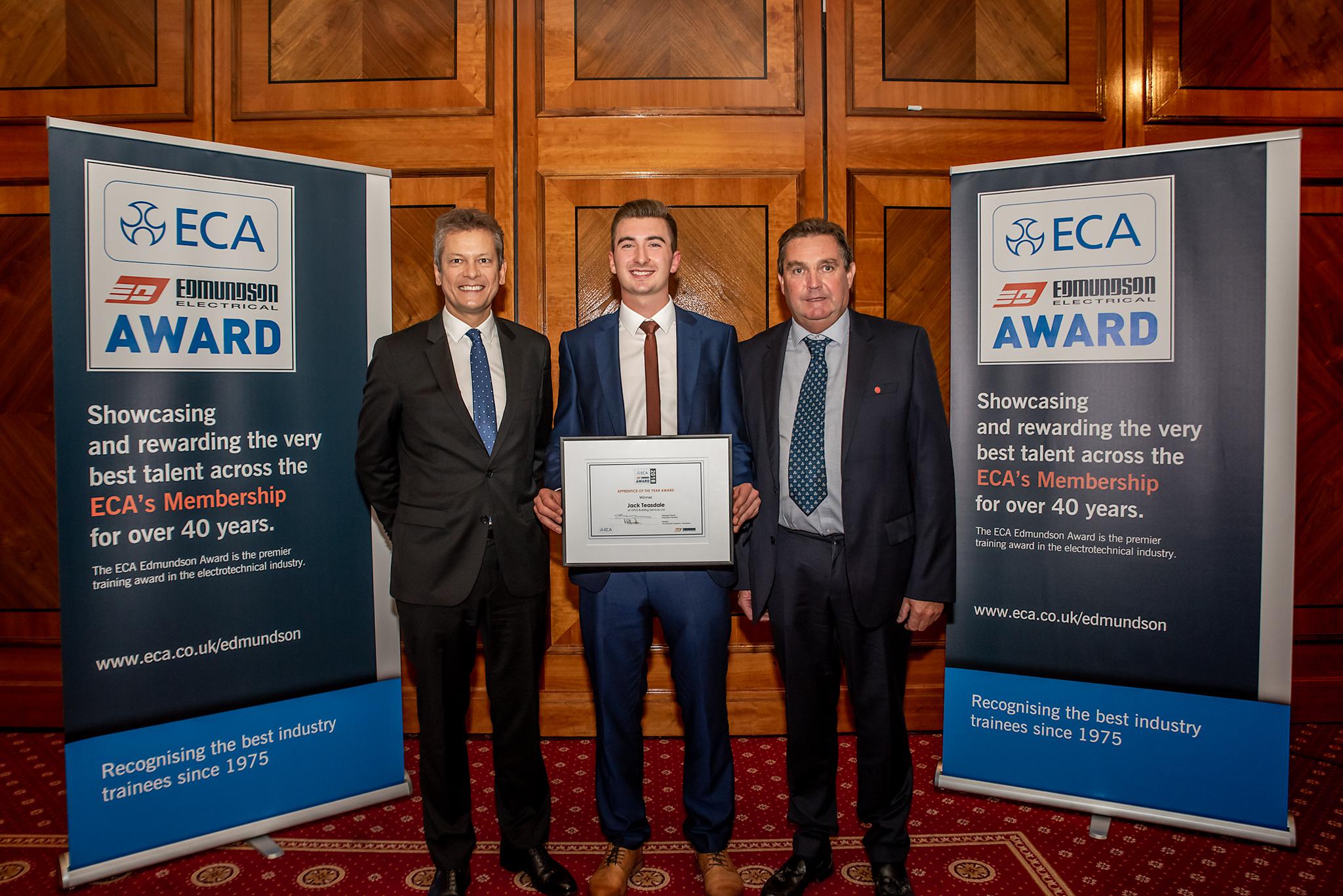
Jack Teasdale Wins 2018 ECA Edmundson Award
21-year-old Jack Teasdale has been recognised as one of the country’s leading electrotechnical and engineering services apprentices after winning the 2018 ECA Edmundson Apprentice of the Year Award during an awards ceremony held September 19 in London. Jack, who works for ECA member-firm Opus Building Services Ltd in Tyne and Wear, was trained by JTL. After overcoming fierce competition from two other finalists, Jack won prizes which include £1,500 and a study tour to France sponsored by industry manufacturer Hager. He will also go on to be an ambassador for the electrotechnical industry over the next 12 months. Jack said, “It’s very humbling and a privilege to be recognised as ECA Edmundson Apprentice of the Year, and to be an ambassador for other apprentices. One of my mentors was himself the winner of this award in 1997, so it’s an honour to follow in his footsteps.” The two runners-up, who each won £750 and a state-of-the-art toolkit, are Niall Watson of Derry Building Services and Conor McCarthy of Darke and Taylor ECA CEO Steve Bratt commented, “I’m pleased to offer our congratulations to Jack Teasdale for deservedly winning this year’s ECA Edmundson Apprentice of the Year Award. The quality of the three finalists this year is a real indication of the talent that exists in our industry. “Opus Building Services and JTL deserve credit for the support they have given to Jack during his apprenticeship, and which has been a clear success. Congratulations also to Derry Building Services and Darke and Taylor for presenting such able finalists, and supporting high quality training within our sector, which has clearly been a great success.” Edmundson Electrical managing director Mark Felber added, “Edmundson is delighted to have sponsored the industry-leading ECA Edmundson Apprentice of the Year Award for the last 44 years. We have a long-established policy of developing young people within our sector through both our apprenticeship and graduate schemes. “Many congratulations to Jack and the other two finalists for making such an impressive start to their careers – and of course for reaching the final stage of the ECA Edmundson Apprentice of the Year Award.” The 44th ECA Edmundson Apprentice of the Year Award ceremony, held at the Copthorne Tara Hotel, London, was attended by a host of leading figures from across the electrotechnical industry.