2 November 2026
Product of the Month: Amari Floodlight range by Aurora Lighting
 
10 November 2026
Openreach partners with Allstar to boost EV charging options
 
10 November 2026
VCHRGD appoints Craig Summers as Head of Partnerships
 
9 November 2026
UK Power Networks helps nine veterans secure energy sector jobs
 
9 November 2026
Exclusive: why getting project planning right from the outset matters
 

Latest News


Self-employment rockets as redundancies spike by over 400%
New data from the Office for National Statistics shows that there has been a surge in tradespeople turning self-employed over the last few months. Ellis Osborn, Ecommerce Manager at IronmongeryDirect, takes up the story: “Between December and March, the figure shot up from 227,000 to 274,000. This represents an increase of 47,000, or 21%, which is the biggest jump in 15 years, since the winter of 2008. “The overall number of workers in construction has remained fairly consistent, hovering around the 2.2 million mark, meaning these new self-employed workers are likely to have recently left companies. “The data backs this up, with a recent spike in redundancies within the industry. The latest report shows that 16,000 workers lost their jobs between February and April 2024, which is a staggering 167% increase from the previous period (January to March, where the figure was 6,000). At 16,000, the industry made more people redundant than any other sector in the UK economy during this time. At the same point last year, only 3,000 employees were made redundant, so this year’s figure is 433% higher. “Thankfully, however, the rate of redundancies appears to be slowing, with ‘potential’ cases dropping by 8% over the last few months, and falling by 23% year-on-year. “For those individuals who choose not to go self-employed, the good news is that construction vacancies are on the rise. There were 39,000 jobs advertised between March and May, up by 8% compared to earlier in the year. “Also positive is the earnings figure, with average weekly salaries now standing at £760, which is an increase of 4% from last year. “The data appears dramatic at a first glance, but it’s reassuring to see that people who have left their roles are finding alternative sources of employment, either working for themselves or having vacancies to apply for. Hopefully the picture will therefore improve as we enter the summer months.” For more from IronmongeryDirect, click here.

SELECT warns about demand for electricity from power-hungry AI
SELECT’s new President has warned that the demands on the electrical network to power AI may become unsustainable as it becomes a growing part of society. Mike Stark, who took over the association reins last week, said the UK’s National Grid could struggle to satisfy the voracious energy needs of AI and the systems it supports. The 62-year-old, who is Director of Data Cabling and Networks at Member firm OCS M&E Services, joins a growing number of experts who have warned about the new technology’s huge appetite for electricity, which is often greater than many small countries use in a year. And he questioned whether the UK’s current electrical infrastructure was fit for purpose in the face of the massive increase in predicted demand, not only from the power-hungry data centres supporting AI, but also from the continued rise in electric vehicle (EV) charging units. Mike says, “AI is becoming more embedded in our everyday lives, from digital assistants and chatbots helping us on websites to navigation apps and autocorrect on our mobile phones. And it is going to become even more prevalent in the near future. “Data centres, which have many servers as their main components, need electrical power to survive. It is therefore only natural that any talk about building a data centre should begin with figuring out the electrical needs and how to satisfy those power requirements. “At present, the UK’s National Grid appears to be holding its own, with current increases being met with renewable energy systems. But as technology advances and systems such as AI are introduced, there will be a time when the grid will struggle to support the demand.” Mike said that it is estimated that there could be 1.5 million AI servers by 2027. Running at full capacity, these would consume between 85 and 134 terawatt hours per year – roughly equivalent to the current energy demands of countries like the Netherlands and Sweden. He adds, “I remember attending an EV training session about 25 years ago and the standing joke was, ‘Where’s all this electricity going to come from?’ We all felt the network needed upgrading then, and now there is extra pressure from the new AI data centres springing up.” Mike has spent 44 years in the electrical industry, with 40 of those providing continued service at the same company; starting at Arthur McKay as a qualified electrician in June 1984 to his current role at what is now OCS. He was confirmed as new SELECT President at the association’s AGM at the Doubletree Edinburgh North Queensferry on Thursday 6 June, taking over from Alistair Grant, who recently warned about the dangers of rogue tradespeople installing renewable technology. Darren Crockett of Dundee-based Member firm Robert AS Crockett and Partners becomes the new SELECT Vice President, with David Harris of Glasgow’s DMH Electrical Services being appointed Depute Vice President. During his two years in the Presidential hotseat, Mike said he is looking forward to meeting fellow Members to learn about issues in the electrical industry and to maintain the association’s ongoing campaign to have the role of an electrician recognised as a profession. Mike notes, “Doormen who manage the front of house in clubs have to be regulated by the Security Industry Authority before they can work, but anyone can call themselves an electrician without any training or a full electrical apprenticeship. “That’s why we must continue with the great job that SELECT has done to raise awareness about the importance of regulation of the electrical industry and to have ‘electrician’ recognised as a profession.” Mike also stressed the importance of ensuring there is a continued pipeline of electrical apprentices to meet the future demands of a society that will depend so heavily on electricity. He concludes, “We have to have people who are qualified, skilled and knowledgeable to be able to introduce and oversee this new technology, which is why we need more properly trained and suitably qualified electrical apprentices acting as the vanguard of our industry.” For more from SELECT, click here.

Surrey County Council installs pop-up solar car park
3ti, a designer, installer, funder and operator of solar car parks (SCPs), has completed the installation of a ‘Papilio3’ pop-up solar car park and electric vehicle (EV) charging hub at the Council Depot Centre in Merrow, Guildford. Opened on 4 June, the latest installation will support the council’s transition to electrified fleets. Papilio3 was deemed to be the ideal solution to fulfil the urgent need for EV charging infrastructure for Surrey County Council (SCC), which required an installation suitable for a compact area at the site. Papilio3 is uniquely designed around a recycled shipping container, giving it the ability to be easily transported and lifted into place. The project not only underscored the speed, adaptability and versatility of Papilio3 for installation in space-restricted areas, but also demonstrated the 3ti team’s skill in overcoming uneven terrain at the site, the company tells us. To date, Papilio3 has been installed in a range of settings across the leisure, public, private, commercial and industrial sectors to quickly meet the need for destination and workplace charging at locations including the iconic Silverstone racetrack, Five Rivers Health & Wellbeing Centre in Wiltshire, Surrey Research Park and Raigmore Hospital in the Scottish Highlands. SCC will use Papilio3 to charge its growing electric vehicle fleet, which contributes to its sustainability strategy. Each Papilio3 has an installed capacity of 19.3kWp and can produce up to 18MWh of electricity in year one, equivalent to 64,343 EV miles, saving 3.6 tCO2e. Papilio3 combines local mains power with solar and is built around a recycled shipping container that can be installed in under eight hours. It can fast charge 12 electric vehicles at 7, 11 or 22kW simultaneously, ideal for a range of destinations with 2-5 hour dwell times, removing the reliance on carbon-intense and costly ultra-rapid charge points. Pre-fitted with a range of safety features, including motion lighting, CCTV and full accessibility for wheelchair users, Papilio3 can be rented on a monthly basis from 3ti. Surrey County Council has agreed a three-year hire for Papilio3. Paul Wheadon, Strategic Contract Group Manager for the Council’s Highways and Transport Department, comments, “We’re delighted to have Papilio3 installed, which represents an important milestone in our effort to reduce emissions and expand our electric vehicle fleet. “With charging capacity up to 22kW, multiple operational vehicles (when not in use) can be charged throughout the day, ensuring vehicles remain operational without the need for long dwell times on low-powered charging options. “As well as the benefit of generating solar power to charge our fleet, the nature of the structure means we have the flexibility to conveniently relocate the unit elsewhere on the site in the future if needed, unlike with other charging solutions. “Papilio3 aligns with our wider commitment to reduce the impact of transport on the environment, as we continue to work towards achieving a greener future.” Ben Marchant, CEO at 3ti, adds, "The installation of Papilio3 at the Council Depot Centre is enabling the council to expand its electric fleet and deliver on its commitments to securing a greener future by decarbonising the transport sector. This particular application introduced new constraints for our team to overcome, further illustrating the versatility of our innovative pop-up solar car park which continues to be able to adapt to a range of varied applications and conditions.” “We thoroughly enjoyed working with the council to overcome these challenges and are delighted to broaden access to EV charging and, together, ‘Leave Something Better Behind.’” As part of its ongoing commitment to supporting electric fleets, 3ti is spearheading a government-funded project that includes a six-month real-world trial using a fleet of over 10 EVs as grid assets. The ‘V2X Fast Hub’ project is using a customised Papilio3 with smart grid controls and a 280 kWh DC battery, while utilising an innovative DC microgrid system to manage bi-directional charging technology through both CCS and CHAdeMO EV charge points, harnessed by Turbo Power Systems. A flexible Energy Management System developed by GridBeyond will help oversee energy management and aggregation services, while Cenex will host the vehicle trial and capture data to share with Innovate UK. The project will reportedly be the first in the world to trial a 12 charge point DC Smart Microgrid for CCS V2X based on ISO15118-20, published in April 2022. The innovative set-up seeks to provide faster, bi-directional EV charging at speeds up to ±30 kW, with much higher power and round-trip energy efficiency than AC solutions. For more from 3ti, click here.

Smart grids to save over £227bn in global energy costs
A new study from Juniper Research, an expert in smart cities markets, found that by 2029, the savings potential from smart grids will increase by 249% - up from $84 million (£66m) in 2024 -  benefitting utilities and consumers in the process. This growth is driven by increasing investment in solutions from governments, including the US, China, and Europe, with BESS (Battery Energy Storage Systems) becoming a focal point for the market. An extract from the new report, Global Smart Grid Market 2024-2029, is now available as a free download. The research found the market shift to prioritising BESS efficiency and solutions is facilitated by the need to meet climate goals and reduce reliance on fossil fuels. Since renewable energies do not meet current demand, ensuring excess energy is not wasted is crucial for reducing carbon emissions. Research Author, Matthew Purnell, remarks, “Not only is the demand for BESS at an all-time high from grids, institutions, and even consumers, but investment in battery research is accelerating at an unprecedented rate. Future market leaders will be those developing improved batteries capable of integrating numerous energy sources whilst mitigating energy decay; saving money for utilities and consumers.” The report also identified that whilst AI is used extensively for grid automation processes, GenAI (Generative Artificial Intelligence) is providing additional features. Generative models trained on customer energy data can create scenarios for utilities to develop future grid strategies. For instance, calculating energy output requirements based on houses adopting solar technologies allows utilities to plan future grid investments. GenAI allows utilities to enhance grid efficiency, so technology companies must integrate solutions into their offerings before market saturation occurs. The new market research suite offers the most comprehensive assessment of the smart grid market to date; providing analysis and forecasts of over 21,000 datapoints across 60 countries over five years. It includes a ‘Competitor Leaderboard’ and examination of current and future market opportunities. For more from Juniper Research, click here.

Quotezone issues social media warning to tradespeople
@media (min-width: 1200px) { .container { width: 980px; } } Motoring insurance experts from Quotezone are urging tradespeople to avoid posting pictures of work vans and equipment online due to the fact that thieves are using social media to target them for their valuable tools and equipment. Four in five burglars use social media to find and select potential victims, making those posting online easy targets. Tradespeople are particularly vulnerable to thieves, and tools are often the target of criminal activity, a crime which is on the rise. Over 80% of UK builders have been victims of tool theft, with the average claim costing over £5,000. It is estimated that over a 40-year working life, a builder will lose an eye-watering £10,000 worth of tools. Advertising or posting business photos and information to social media sites such as Facebook, Instagram, and Twitter could entice criminals, Quotezone believes. Thieves can use any information posted on social media or online to find out locations, possessions and the levels of security around your valuables. They can also monitor posts for geo-tagging and holiday photos to pounce when tradespeople are away from their vans and equipment for an easy target. Tradespeople should use social media wisely and be mindful of the information they share, update privacy settings and secure accounts with two-factor authentication. Failing to do so could leave tradespeople in major financial trouble and unable to work until costly tools are replaced – and worse, it could even invalidate their insurance. CEO and motoring insurance expert at Quotezone.co.uk, Greg Wilson, explains, “Social media is a common tactic for burglars to find potential victims, and hardworking tradespeople are often targeted for their equipment. This means they must be extremely cautious of what they post online because opportunistic thieves are always on the lookout for easy targets. “It’s normally a requirement of your insurance that you take good care of your vehicle or the insured items in question. Some insurers may feel that displaying items on social media is irresponsible and shows a lack of care, which could render the insurance void. “Tradespeople sharing pictures and personal information must ensure they only have trusted family and friends on their profiles and that their privacy settings are up to date. Ensure location settings are turned off before posting anything to social networks and never post to social media that you are away on holiday. Simple things like marking or branding your tools can make it harder for thieves to sell on and therefore act as a deterrent. “It’s also important to ensure you’re protected with accurate insurance for your particular business, so if something goes wrong you have the help and funds to continue working. Tool insurance is a type of policy that reimburses owners for the cost of tools if they get stolen, and could be a lifeline for those unable to afford to replace expensive equipment.” Quotezone helps around three million users every year find savings on household bills and essentials, plus niche products such as van tool, commercial van and young driver van insurance.

Siemens and BASF collaborate on driving circular economy
Siemens Smart Infrastructure and BASF have announced the first electrical safety product to include components made from biomass-balanced plastics. Used across industrial and infrastructure applications, Siemens' SIRIUS 3RV2 circuit breaker is now being manufactured using Ultramid BMBcert and Ultradur BMBcert from BASF, where fossil feedstock at the beginning of the value chain is replaced by biomethane derived from renewable sources such as agricultural waste. Both materials offer the same quality and performance as conventional plastics. The material changeover in the SIRIUS 3RV2 circuit breaker production will reduce the emission of carbon dioxide equivalents by approximately 270 tonnes per year. Customers using these products contribute to a circular economy towards a more sustainable future. Siemens says the move supports its sustainability goals in the areas of decarbonisation and resource efficiency, outlined within its DEGREE framework, with the company following a 1.5°C science-based decarbonisation target - including a 90% reduction target for scope 1 and 2 until 2030, and the application of a Robust Eco Design for 100% of relevant product families by 2030. In the coming months, Siemens plans to expand the use of sustainable materials across the broader SIRIUS industrial controls portfolio. In addition to product design and features, as well as manufacturing and supply processes, the choice of materials plays a major role in further reducing carbon emissions and conserving natural resources. The SIRIUS 3RV2 circuit breaker meets the strict criteria of the recently introduced Siemens EcoTech label, designed to give customers a comprehensive insight into product performance across selected environmental criteria. In addition to most of the product housing and functional parts being made from biomass-balanced plastic, the product also offers lower power consumption over its lifetime compared to its predecessor. Andreas Matthé, CEO of Electrical Products at Siemens Smart Infrastructure, says, “With our products, we help customers to improve asset performance, availability, and reliability, through resource-efficient and circular products which optimise energy use, production, and supply chains throughout their entire lifecycle. In BASF, we have found a strong partner that supports us with its innovations in the field of sustainable plastics.” By increasingly relying on renewable and recycled raw materials for the manufacture of its products, BASF is committed to make its contribution to the circular economy and defossilisation. This is achieved through a process that gradually replaces fossil raw materials with bio-based and recycled feedstock. According to the mass balance approach, renewable or recycled raw materials are introduced into production at the beginning of the complex BASF value chains. If customers decide in favour of a certified product from such a value chain, BASF feeds sustainable raw materials into ongoing BASF Verbund production. Martin Jung, President BASF Performance Materials, comments, "The mass balance approach is a game-changing solution that enables the gradual replacement of fossil raw materials in sometimes complex production processes. The advantages of this approach are obvious, and the greater the demand for alternative products, the higher the proportion of alternative raw materials in the production network. This aligns with our goal of achieving a circular economy and net zero operations as soon as possible.” “In addition, the special thing about this project is that the SIRIUS 3RV2 circuit breaker is also used in our BASF production plants. This circuit breaker not only protects the motors but also increases their efficiency and reliability, making a double contribution to our sustainability objectives.” With the mass balance approach, various alternative raw materials, such as biomethane, bio-naphtha or pyrolysis oil, can be integrated into the value chain. The bio-naphtha and biomethane used by BASF are certified as sustainable according to established systems such as ISCC PLUS and REDcert. The SIRIUS 3RV2 circuit breaker is a proof for resource-efficient plastics production and a milestone on BASF’s #ourplasticsjourney. “The use of such an innovative material in an important safety component, without compromising its safety functionality and performance, is a unique achievement for Siemens,” Andreas adds. Circuit breakers are used in factories and buildings around the world and protect machines or electrical cables in the event of faults such as short circuits. They help prevent major damage, for example from fires. - The SIRIUS 3RV2 circuit breaker, using sustainable plastic components, will be presented for the first time on Booth E3, Hall 11 at the ACHEMA trade fair in Frankfurt on 10-14 June. For more from Siemens, click here.

Hanwha Vision launches AI wall mount camera
Hanwha Vision has launched the TNV-C8011RW - a 5MP AI IR Wall Mount camera ideal for entrances and exits, retail outlets, drive-throughs, self-checkout areas, and other areas where a clear view of faces is essential for identification purposes. Unlike cameras mounted high on walls, which typically provide a top-down view, the TNV-C8011RW is designed to be installed at eye level, so clear views of faces are possible, even when individuals are wearing hats or using umbrellas. A panoramic lens provides a nearly 180-degree field of view, with an adjustable tilt lens of 土25 degrees, resulting in no blind spots. Meanwhile, a 5MP resolution captures all the detail required to identify persons of interest - enhancing security and customer experience. Infrared (IR) functionality at distances of up to 15 metres also helps deliver clear images in varying lighting conditions. In addition to optimum mounting for identification purposes, the TNV-C8011RW uses AI to support the accurate detection and classification of people and other objects, improving operator efficiency and reducing false alarms. This frees teams to focus on higher-value tasks, as the intelligent solution only alerts them to events requiring their attention. Forensic search via metadata generated by the camera reduces the time operators must spend searching for specific events, while AI analytics are carried out ‘at the edge’ – in camera – eliminating the cost of maintaining separate computing infrastructure. Meanwhile compression technology, WiseStream Ⅲ, significantly reduces data size and bandwidth while maintaining a high image quality, for an efficient and cost-effective offering. The camera also includes valuable business intelligence features such as people counting, vehicle counting, queue management, and heatmapping. These are ideal for use in entrances and exits, lobby spaces, retail locations and drive-throughs to predict busy periods, inform staffing schedules and improve the customer experience. For example, operators can open additional checkouts when queues begin to form, while heatmap insights can highlight busy areas to influence store layouts, advertising, and more. While designed for mounting at eye level on walls, the TNV-C8011RW’s anti-ligature, rounded design and compact 167 x 80 x 57mm form enable it to remain discreet in day-to-day use. A white body colour can be replaced by an optional black skin cover (SBC-140WB), helping the camera blend into a range of interiors; while the camera can be installed on a wall or pole, and using a separate tilt mount accessory (SBV-140TBW), it can be tilted down to 20 degrees. As with all Hanwha Vision products, the camera features cybersecurity with Secure Storage, User and Network Authentication, OS/Firmware Protect, Data Protect, and Device ID (Hanwha Private Root CA). For more from Hanwha Vision, click here.

Leonardo signs Light as a Service deal with Signify
Lighting expert, Signify, has been appointed by Leonardo UK, a global Aerospace, Defence and Security (AD&S) company, to help accelerate its carbon reduction as part of the company’s ambitious sustainability strategy. In support of Leonardo's sustainability strategy – including a recently approved Science Based Target – and drive to Net Zero in the UK, Signify has signed a 10-year Light as a Service (LaaS) agreement that includes the full turnkey installation of LED lighting with Interact lighting management software, across 14 buildings at the Yeovil site. The lighting in each building has been carefully designed to ensure a safe and productive work environment for the 3,300 highly skilled personnel across the site. Signify’s LaaS model is a performance-based contract that guarantees light-level performance for the full duration of the contract. Crucially, the execution of the new lighting system does not require upfront capital investment – instead, Leonardo pays Signify an annual operating fee. This LaaS model enables Leonardo to realise cash-positive savings from the first year. Once completed, the programme is expected to reduce Leonardo's location-based CO2 emissions by an estimated 725 tons per year, supporting Somerset Council’s Climate Emergency Strategy. Leonardo is one of the UK's leading aerospace companies and one of the biggest suppliers of defence and security equipment to the UK MOD, making a significant contribution to the UK economy. Leonardo’s Yeovil site is the Home of British Helicopters – offering end-to-end helicopter manufacturing, training, and lifecycle services to operators worldwide. As part of the redesign, the buildings will also see the deployment of Signify’s lighting management system, Interact. The connected lighting system combines energy-efficient Philips LED fixtures with advanced sensors and Interact software. The system will ensure that the LED fixtures are only turned on when an area is occupied. When there is sufficient natural daylight, the LED fixtures will automatically dim to compensate. This maximises lighting energy savings while ensuring a safe working environment. Interact provides Leonardo with the ability to make changes to lighting groups and zones, as well as adjust sensor settings in order to further optimise or react to operational changes. In the future, Leonardo can connect the lighting management system to the cloud using wireless gateways. This enables data-based insights into lighting energy performance, space occupancy, and lighting asset management for all the connected LED fixtures and buildings. Data is presented in Interacts’ simple-to-use configurable dashboards, enabling Leonardo stakeholders to review historical and real-time data, and easily implement changes from any location with an internet connection. “We believe that choosing Signify as our partner for lighting will have a significantly positive impact on our sustainability goals,” says Paul Coombs, VP of Facilities, Real Estate and Infrastructure Projects - Leonardo Helicopters UK. “Saving energy and minimising waste are two ways we manage our environmental footprint to help preserve our planet for future generations. The LaaS model provided by Signify gave us the option to do both in an innovative way with no capital outlay. “Also, with Interact, we have a connected lighting system that provides more than just light. With the reduction in carbon emissions and the energy savings, Leonardo will continue its commitment to become a more sustainable organisation and lead the defence industry by example.” Derk Bots, Commercial leader for Europe Office & Industry - Signify, adds, “In the traditional method of lighting procurement, organisations get their lighting by purchasing and maintaining their lighting equipment. Light as a Service turns this around and encourages organisations to take a step towards a more sustainable future by making the switch to LED lighting or upgrading their systems to connected lighting and reap the benefits of data and IoT, so they can create spaces that adapt to their needs, making them more efficient, connected, and sustainable. “Light as a Service projects have an important contribution to the objectives set out in our Brighter Lives, Better World sustainability programme and contribute to the rapid growth of our systems and services business.” For more from Signify, click here.

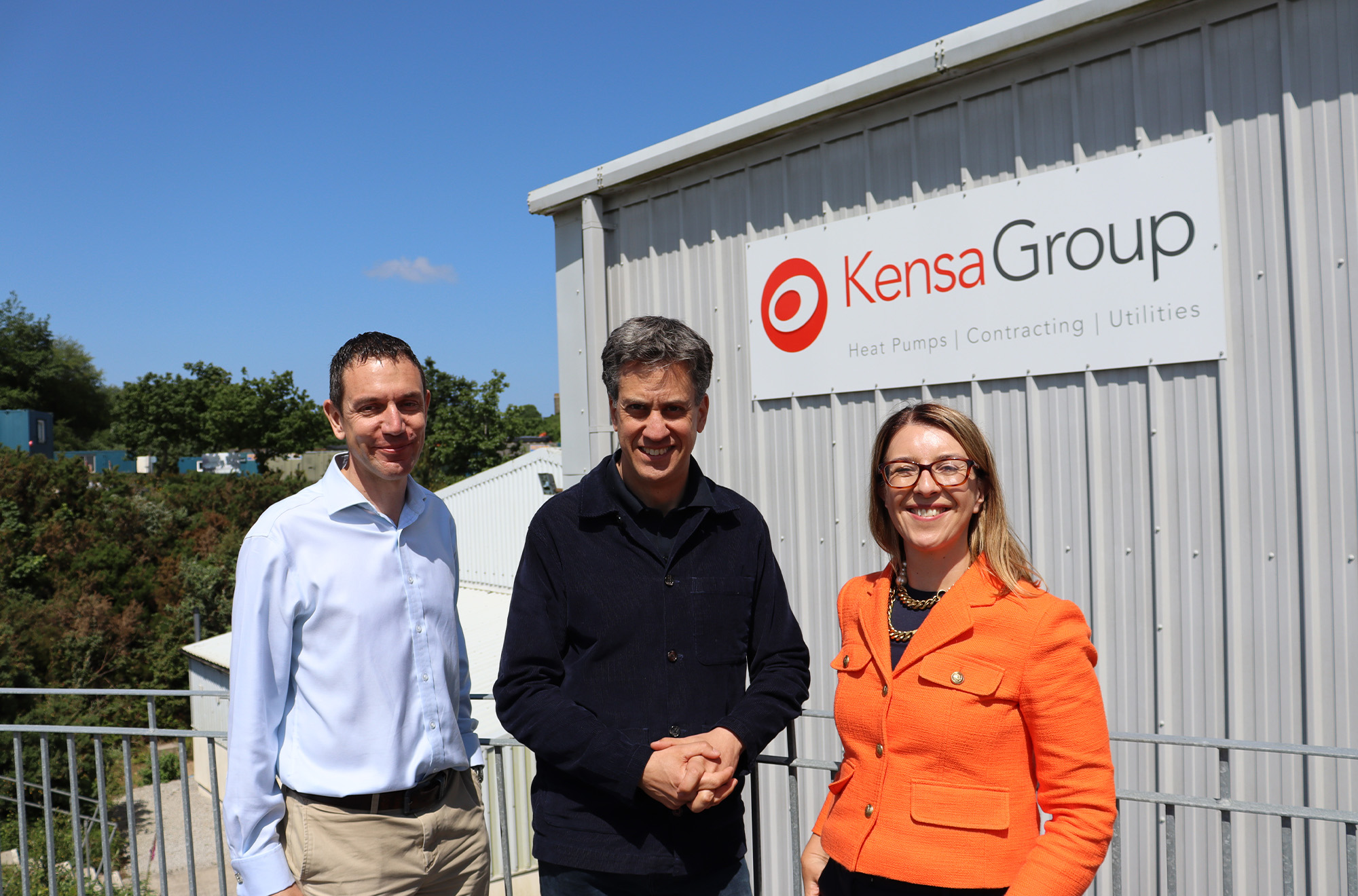
Ed Miliband visits Kensa's Cornwall factory
Ed Miliband, the Shadow Secretary for Energy and Net Zero, has toured Kensa's Cornwall factory to see how some of the UK’s ground source heat pump solutions are being developed. Joined by local Labour candidates Perran Moon and Jayne Kirkham, Mr Miliband met with Kensa’s CEO, Tamsin Lishman, and other employees to discuss the British company’s plans to decarbonise heat and hear more about their vision to deliver affordable, renewable heating and cooling to millions of people across the UK. On the back of £70m in investment from Legal & General and Octopus Energy, Kensa is working with communities and businesses across the UK to deliver its heat decarbonisation solution – Networked Heat Pumps. Networked Heat Pumps consist of ground source heat pumps installed in individual properties, whether that’s flats, terraced streets or newbuild homes, connected to a shared network of underground pipework, providing each property with low-cost, renewable heating, hot water and cooling. This solution has already been implemented for thousands of properties across the UK, including 273 high-rise social housing flats in Thurrock, lowering residents' bills by up to 66%. It’s also heating new-build properties in Bristol and has been rolled out under the streets for medium-density housing in Stithians, Cornwall. The Government has an ambition to install 600,000 heat pumps a year by 2028. Powered by the wider adoption of Networked Heat Pumps, Kensa expects to contribute significantly to this figure, ramping up heat pump production to 70,000 a year by the end of the decade and creating over 7,000 green UK manufacturing jobs in the process. Mr Miliband, told Kensa’s Tamsin Lishman, “I’m incredibly impressed by everything I’ve seen here. The workforce, the vision, the commitment to tackling fuel poverty, I think Kensa’s got a really important role to play. “It (ground source heat pumps) is an innovative technology, it’s a crucial technology, it’s absolutely part of the mix if I’m concerned, and If Labour’s in Government and I’m the Secretary of State after July 4th, I look forward to working with Kensa to tackle the shared goals we have, to tackle fuel poverty and decarbonise our country. “It’s not just about decarbonisation, and clean energy and tackling fuel poverty, it’s about good jobs for people, it’s about good wages which is really important to Cornwall and really important across the country. Talking to people on your (Kensa’s) shop floor, they’re really enjoying what they’re doing, but we need more people to know about these opportunities.” For more from Kensa, click here.

BEAMA launches climate change report
As the world navigates the critical journey to net zero, manufacturing businesses are at the forefront of a profound shift in the political, economic and environmental landscape. In response, BEAMA, the trade association for energy infrastructure and systems, has launched its comprehensive climate change report, providing a roadmap for businesses to effectively mitigate their impact on the environment. The report, Climate Change: A Guide for Manufacturing Businesses on the Journey to Net Zero, offers a comprehensive analysis of the intricate web of factors shaping the impact of climate change on manufacturing businesses. It highlights the urgent need to limit global temperature increases, the downstream market pressures driving change, and the imperative for sustainability. The report underscores the importance of climate adaptation planning, setting greenhouse gas emissions reduction targets, and formulating credible transition plans. By providing a foundation for informed decision-making and scientific action, the report offers top-level steps to help businesses start their net zero journey. "We recognise that climate change is a pressing issue that requires immediate attention," says Yselkla Farmer, CEO of BEAMA. "Our report is designed to provide guidance and support to manufacturing businesses as they navigate this critical period. By adopting a proactive approach to climate change, we can ensure a sustainable future for our industry and the wider economy." The report is not an endpoint, but rather a starting point for businesses to take action. It encourages companies to ask themselves not whether to act, but rather how swiftly and effectively they will adapt to the changing climate landscape. The report's key findings and recommendations include: The importance of setting science-based emissions reduction targets and developing credible transition plans The need for climate adaptation planning to mitigate the risks associated with climate change The role of circular economy principles in reducing waste and emissions The importance of engaging stakeholders and communicating climate action plans to employees, customers and investors To download the full report, visit the BEAMA website.