2 November 2026
Product of the Month: Amari Floodlight range by Aurora Lighting
 
11 November 2026
Energy, AI and smart buildings: register now for EMEX 2026
 
11 November 2026
Solar and batteries could cut electricity costs by 40%, data finds
 
11 November 2026
EIC confirmed as ECN Awards 2026 charity partner
 
11 November 2026
Acrospire to support Green Frog's European expansion
 

Latest News


Panduit launches WrapID automated labelling system
Panduit has introduced the compact semi-automatic, “PLA-100/E” WrapID automatic labelling system. The new labelling machine offers significant increases in productivity for medium to high-volume label applications. Users can benefit from faster turnaround times of up to three times faster than traditional manual installation and two times faster than leading competing systems. The winding head of the compact system is easy to reach, so that labels can be attached to the line or cable within 12.7mm of the connectors or terminals. In addition, the label head has a modular design and can be replaced easily and inexpensively during maintenance. The label position can be realigned at the push of a button. Today, valid cable labelling is an essential part of the documentation in switch cabinet construction, network technology or in the data centre for easier commissioning and maintenance. The new WrapID system, together with Panduit’s high-quality labels and label printers, is designed for large-scale cable harness production. Whether for cable assembly, switch cabinet or machine builders or network technicians, the WrapID labelling machine, delivers labels which are precisely positioned, and optimally attached ensuring increased quality in reduced timeframes. Panduit engineers improved the design ergonomics to reduce operator fatigue and minimise the risk of repetitive motion injuries. Panduit's analysis between manual and automated systems shows that the WrapID automated labelling system saves approximately 170 labour hours per 100,000 labels. Compared to competitor automated systems, Panduit's solution saves approximately 80 man-hours per 100,000 labels against competitor’s systems.

Niglon joins the EDA
A company supplying a range of more than 4,500 products to UK wholesalers has joined the Electrical Distributors’ Association (EDA). Niglon is now an affiliated member of the EDA, which represents around 75% of the wholesale industry – acting as a voice for the sector among policy makers and trade bodies. Paul Dawson, Niglon’s Commercial Director, says: “We are delighted to have become an affiliated EDA member and to be working more closely with the organisation going forward. “The EDA has a fantastic reputation within the industry and offers valuable networking opportunities, campaigns, initiatives and information-sharing. “We’re looking forward to taking full advantage of our membership and to seeing the positive impact this will have on our business.”

Legislation and sustainability on the agenda at the FPA 2022 InfoZone at FIREX International
The Fire Protection Association’s (FPA) InfoZone seminar theatre returns for 2022 this May, with an agenda covering a wide range of crucial talking points in the fire safety industry for attendees at FIREX International. Alongside its welcome reception area, where the FPA will be available for meetings and networking with members and the full supply chain of fire safety professionals, the popular InfoZone seminar theatre returns for FIREX International 2022, at London’s ExCeL between 17-19 May. FPA-InfoZone-22 Sessions will cover key talking points for the fire safety sector, with updates on legislation, presentations on sustainability, and several informative case studies will be featured. CPD accreditation from the IFE has been applied for, and highlights of the programme will include: Steve Hamm, Chief Executive of the Institution of Fire Engineers providing a plenary update on the fire sector A debate around sprinklers in schools – with participation from Zurich, FM Global and BAFSA, amongst others John Davidson from the NSI will present on the most common and serious issues fire risk assessors are coming across right now Fire safety legislation updates from Red Lion Chambers Hear from the Head of Fire Safety at Ocado. Jonathan O’Neill OBE, Managing Director of the Fire Protection Association, will be on-hand alongside the rest of the team at FIREX to provide advice and guidance to visitors. He comments: “The Fire Protection Association is delighted to bring to the sector our theatre of topical fire safety talks for the 11th year of the FPA InfoZone. “Our partnership with FIREX is an important part of the FPA’s external communications strategy within and together with, the wider fire sector. In 2020, following our first joint delivery of the FIRE conference with the IFE and the NFCC, I suggested that now was the time to raise standards across the board and that the government should encourage that all fire protection products and services were third party accredited; FIREX’s pledge for all exhibitors to be third-party approved or independently accredited is a welcome development which will itself directly contribute to improving competency in products and services across our industry.” Sessions will run from 10:00-17:00 on Tuesday 17th and Wednesday 18th May, and from 10:00-16:00 on Thursday 19th May, taking place on stand F2050 at FIREX International at London’s ExCeL. Register for FREE here.

Bounce for earnings during February: Electricians see 16.3% boost in pay
Self-employed electricians saw their earnings rise by 16.3% over the last month, according to the construction industry’s biggest payroll. Hudson Contract says average rates for electrical contractors rose to £1,145 per week during February. While the bounce is in keeping with annual trends, the rates are 5.2% higher than the same period last year. Ian Anfield, managing director, says: “It has been a mild start to the year and demand on sites remains high for skilled trades including electricians. We have had a busy month for entering new contracts and we are seeing anecdotal evidence of more Europeans returning to the UK labour market. “Our construction clients are telling us they have full order books but they are not seeing as many enquiries as this time last year. That’s consistent with what we said last month – that some housebuilders have eased up on the accelerator.”

The Housing Safety & Wellbeing Taskforce launches new research into the human impact of fires
The Housing Safety & Wellbeing Taskforce, with founding member Aico, is launching a seminal piece of research into the human impact of fire and how different legislations across the four nations impacts its prevalence. "One way or another we need to make buildings safe, that’s carbon monoxide and fire dangers. We have perhaps contributed to allowing a bad situation to continue for too long and I welcome finding the way forward," says Sir Peter Bottomley, MP for Worthing West, and Father of the House at the Housing Safety & Wellbeing Taskforce (HSWT) Launch. Domestic fire safety legislation is a crucial regulatory field to ensure that buildings are safe for habitation and that fire safety risks are adequately managed. However, due to several factors legislation and policies vary starkly between the constituent nations of the UK. As fire safety is a matter which is devolved to the UK’s constituent nations, there is an inevitable divergence in key regulations and legislation. The most pronounced tightening of restrictions has been in Scotland, where there will now be a requirement to have smoke alarms and carbon monoxide detectors in all dwellings from February 2022. In the other nations, these pieces of equipment are only required in properties under certain types of tenure. This tightening of restrictions in Scotland has led to a downward trend of fire instances over the last four years and, most importantly a reduction in fire fatalities of 47.5% between 2019 and 2020. The human impact of fire needs to be considered alongside the education outreach to prevent fires occurring and ultimately, the loss of life. The key findings from the research are: The cost of each fire has reduced by 41.5% in Scotland, compared with 23.2% and 24.4% in England and Wales respectively Accounting for additional investment, balanced against the Nett cost to the economy of fire incidents, significant savings have been seen in Scotland. If England saw reduction in costs at the same relative scale as Scotland, this would amount to £243 million of savings per year The aggregate cost of dwelling fires amounted to £1.1 billion in 2019/20 after adjusting for inflation Those classed as lower-income are a staggering 60% more likely than higher-income groups to face serious fire hazards in their homes Those to have ever experienced a fire, 18.7% reported subsequent psychological trauma. This represents an estimated 957,000 adults Individuals with children younger than five years’ old were the most likely to have experienced trauma in the aftermath of a fire, amounting to 31.8% of those in this category. With the cost of living crisis potentially pushing families into poorer quality accommodation and into fuel poverty, the government needs to address not just the fire safety standards but housing wellbeing. With potential savings of up to £243m a year this money can be spent helping those who currently live in unsafe homes due to the cladding crisis or those who are struggling with household essentials.

ESP continues racking up the orders
ESP has been experiencing sales growth across all of its product ranges – CCTV, access control, fire protection, emergency lighting and the Sangamo heating and timer controls. As the company continues to expand, this has led to the investment in the warehouse facility to accommodate the growing demand for its products and the introduction of new product ranges. The racking has been totally redesigned and expanded to provide valuable additional space. It has allowed for a 66% increase in the number of bulk pallet locations and an 88% increase in the number of picking locations. As part of the redesign, the racking has been turned to run lengthways and by reducing the aisle widths from 3m to 2m this has allowed an extra two runs of racking to be installed. With a reduction in the space between the aisles, ESP has invested in a new forklift, moving from the original reach forklift version to a Bendi forklift that is capable of operating within the narrower aisles. The addition of the Fort Smart Security range of products at the end of last year has vastly increased the stock levels that the business is holding. The need to expand the provision of space therefore became a priority.  ESP has now future proofed the warehouse facility with the creation of more space to store new products for picking and more pallet spaces for deliveries. The ability to spread the stock out across pick locations will also increase the speed of the picking process Whilst the redesign of the racking system was under way, ESP took the opportunity to upgrade the lighting in the warehouse, with new Inceptor Hion Highbay fittings supplied by Scolmore Group company, Ovia, as well as products from ESP’s Duceri emergency lighting range, installed. Microwave Sensor versions of the Inceptor Hion Highbays were chosen for their energy saving properties, with the built-in sensor activating lights only in areas that are occupied. Neil Baldwin, managing director comments: “As the business continues to experience strong sales growth, we continue to develop and expand our product range, and it is important that we invest in the operational facilities to ensure that we have the capacity to manage stock levels and maximise the efficiency of the picking process. This latest investment to increase our warehouse capacity and its functionality has set us up to meet further demand as the company continues to prosper.”

HellermannTyton launches new AT2000 CPK Hybrid cable bundling tool
The new AT2000 CPK Hybrid bundling tool from HellermannTyton offers automotive manufacturers automated and reliable cable bundling that’s fully functional in both factory and remote environments. The AT2000 CPK Hybrid complements its predecessor, the AT2000 CPK - which can be commonly found on the factory floors of car, bus, HGV and EV manufacturers. The new model, however, now allows for cordless usage through the inclusion of an optional 18V battery, allowing bundling and tying to happen virtually anywhere along the production line, even when a power supply isn’t readily available with 8000 ties per charge. [gallery ids="30286,30289,30287"] The AT2000 CPK Hybrid also provides a 20% speed increase on its predecessor, with a binding time now between 0.65 and 1.0 seconds, making the bundling and tensioning of cables and tubing quicker than ever. The tool works with cables up to a 20mm diameter and with the ability to bundle and tension up to 1.5 million cables before the blade needs replacing, and offers the same repeat and dependable performance time and time again. With seven tension levels, five speeds and three quality settings, users are provided with automated, cable-tie applications with recurrent bundling. There are various other settings such as a loop diameter which makes this tool versatile for bundling a range of materials and components of any sensitivity level. Graeme Morley, Product Manager at HellermannTyton, says: “We are proud to be launching the AT2000 CPK Hybrid as the latest tool in our product range. With EU regulations for mandatory emission targets and a proposed ban on the sale of new petrol and diesel cars from 2033, we have seen an increasing number of requests from manufacturers for tools that help them to improve production line efficiencies to meet the increasing demand. With its guaranteed repeatable and customisable bundling the AT2000 CPK Hybrid is crucial for ensuring vehicle cables are bundled with the correct tensioning. This is especially applicable within the electric vehicle market to avoid electrical power failures. From automotive to bicycles, bundling clips to automated packing lines, the AT2000 CPK Hybrid is a must-have tool for any industry. “The automotive industry is increasingly reliant on advanced technologies and data that informs their manufacturing processes. We’ve recognised this in the tool’s HT Data Management software which allows for extensive and fully exportable data monitoring of the tensioning process, covering everything from tension level to humidity. All production data is tracked, whilst ensuring optimum tension for every application, minimising production faults.” For increased usability, the ergonomics have also been improved with a new handle design, allowing integration of the battery, reduced weight, and the ability to stand upright on a workbench. Delivered in a practical tool case with dedicated space for tools, three batteries, a charger and a power supply.

EV home charger installation: Last week to claim £350 grant
With only two weeks to go, those who are considering an installation of an EV home charger should act now, as the OLEV grant is due to be removed on the 31st March. Anyone who tries to claim after this date will not be eligible. In light of this, Uswitch has put together this OLEV grant guide to help people benefit from the grant before it’s gone! What is the home charger OLEV Grant?  The OLEV Grant was introduced to encourage consumers to switch to an electric vehicle by contributing to some of the costs involved. Technically called the Electric Vehicle Homecharge Scheme, it covers up to £350 of the costs associated with installing a home electric vehicle charging point. Why is the government stopping the home charger OLEV Grant? The government is offering the OLEV Grant to drivers in order to help meet its ambitious net zero emissions target by 2050. However they announced that they have allocated a specific amount of money to this grant scheme, which has now come to an end. Because of this, home charging OLEV grants will be scrapped from 31st March. The next plans are to invest into more rapid public chargers, to focus on supporting those who are not able to get a home charger installed. Do I qualify for the home charger OLEV Grant?  You qualify for the OLEV Grant if: You have purchased an eligible electric or plug-in hybrid vehicle or leased one for a minimum of six months You have off-street parking (i.e. a driveway or garage) You commit to installing an OLEV-approved chargepoint You commit to using an OLEV-approved chargepoint installer The installation is due to be completed by 31st March 2022. Which vehicles qualify for the OLEV Grant?  All full battery electric cars meet the criteria. Only some plug-in hybrid vehicles with CO2 emissions below 75g/km will be included. Those with second-hand electric vehicles will also be eligible as long as the application for the grant is made within four months of receiving the vehicle. How do I claim the home charger OLEV Grant?  To claim, simply let your chosen charger installer know so they can claim it on your behalf. You may have to fill in a form or two confirming your details and eligibility, but the money should then be taken off your final bill. What next? With the purchasing of electric vehicles seeing a sharp rise over the last few years, there are now nearly 400,000 EV owners in the UK. With the public charging networks trying to keep up with this rise, installing a home charger can often be a good option for EV owners. Ben Gallizzi, EV expert at Uswitch.com says: "With only one week to go until the government's OLEV grant is stopped, booking a home EV charger installation before the deadline is going to be tough. However, for £350 off the cost of the installation, it's worth trying before the cut-off on 31st March. To speed up the process, ask yourself these questions before booking to see if you'd qualify: Have I had an electric vehicle for at least six months? Do I have off-street parking? Can I commit to installing an OLEV-approved charge-point? Can I commit to using an OLEV-approved charge-point installer? Am I available to have it installed by 31st March 2022?"

SELECT donates posters and toolbox cards to keep apprentices safe
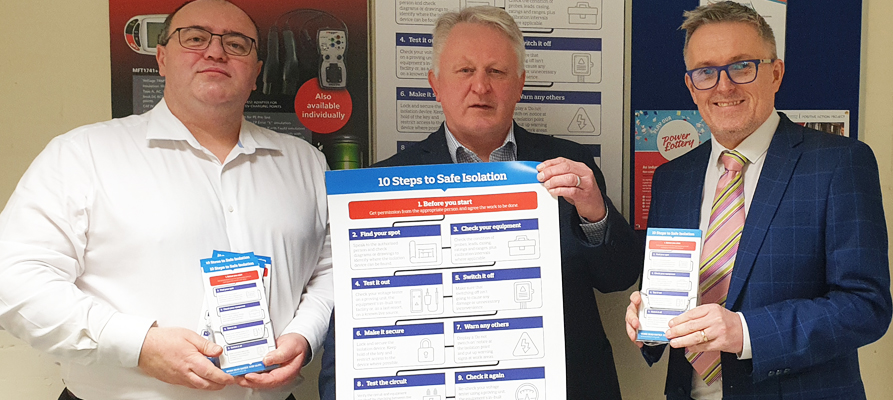
SELECT is distributing posters and handy toolbox-sized safe isolation flowcharts to remind apprentices and adult trainees of correct working practices. The campaigning electrical body is currently handing out 'Ten Steps to Safe Isolation' posters to all 22 training centres used by the Scottish Electrical Charitable Training Trust (SECTT), to be displayed prominently as a reminder of how to work safely. Smaller durable versions, designed to fit handily into toolboxes, are also being made available to all 2,669 electrical apprentices and adult trainees currently training in Scotland. Running under the banner ‘Work dead safely: Stay alive’, the posters and cards have been adapted from the range of safe isolation materials launched by SELECT in January 2021. The first resources were handed over to David Henderson, SECTT Assessment Centre Manager at Cambuslang, on Friday 18 March, by Bob Cairney, SELECT’s Director of Technical Services. David says: “These resources will help reinforce the importance of safe isolation for all apprentices and adult trainees and we will be encouraging all learners to include the toolbox cards as part of their day-to-day kit.” Bob adds: “It’s vital that apprentices learn about safe isolation at the start of their career so good practice becomes second nature and helps keeps them, and others, safe. We hope these resources will be a constant reminder of the need to work dead safely and stay alive.” The remaining posters and cards will now be distributed to the 21 approved centres around Scotland. The cards will also be handed out at SELECT’s upcoming Toolbox Talks in May and June, and posters are also available for members on request.  

Janus Technology takes the heat out of Homeplay's integration
Janus Technology gave peace of mind to Homeplay and their client when it came to controlling heating and air conditioning in a new-build property in Kingston, Surrey. The combined Janus Heatmiser/Coolmaster driver has been designed for use with the Control4 home automation system and offers the ability to provide two-way control of the Heatmiser underfloor heating system as well as Coolmaster air conditioning, from a single unified interface that provides enhanced features such as easy save and recall of schedules for the entire house. It supports complex set-ups with multiple 2-pipe systems, allowing air-conditioning to be used as a boost to underfloor heating for those very cold days. James Ratcliffe, Managing Director of Homeplay, elaborates: “The Janus ‘special sauce’ is that it takes both the Heatmiser and Coolmaster systems and it melds them together, so there’s an interlock. It means that the heating and air conditioning aren’t fighting against one another. Instead, there’s one thermostat that can be used with Control4 (it has heat, cool and auto modes easily selectable from a single interface) rather than one thermostat for heating and another one for cooling. It makes control and integration with Control4 so simple, it’s a joy.” For the 15,000 square foot Kingston project, with six bedrooms and a pool, Homeplay and their client opted for the Janus driver because they’d both had previous experience of working with it. In fact, the software was built specifically for both parties. “We’ve done several houses with the Janus driver for this client – we had it developed for him in the first place. We went to Janus and said, ‘can you build a driver that does this?’” says James, whose company also carried out the full smart home installation on the Kingston property, including a home cinema, security, distributed TV and audio, a data network and lighting. The air conditioning units were all hidden away, in the ceiling, the wall and the joinery. Thanks to the Janus software and its compatibility with Heatmiser and Control4, there were no visible thermostats – just one invisible temperature sensor in each room, which was plastered over and so flush to the wall. “Heatmiser is the standard for this type of application. It’s straightforward and inexpensive,” says James. “Builders, electricians and plumbers like it – and so do integrators, because it’s controllable and gives us a point of demarcation. If there’s a problem with the heating, we can identify precisely where that lies and as an integrator, we can draw a line on who is responsible for any system issue.  It’s easy for the homeowner to see that too. From the client’s perspective, they also get a much more efficient way of controlling the system.” “From our point of view, it was really quite easy – we connected the already-working Heatmiser system to our Control4 platform using the Janus driver,” adds James.