2 November 2026
Product of the Month: Amari Floodlight range by Aurora Lighting
 
11 November 2026
Energy, AI and smart buildings: register now for EMEX 2026
 
11 November 2026
Solar and batteries could cut electricity costs by 40%, data finds
 
11 November 2026
EIC confirmed as ECN Awards 2026 charity partner
 
11 November 2026
Acrospire to support Green Frog's European expansion
 

Latest News


Cambridge to benefit from power project
Cambridge is set to benefit from a new £5million investment to upgrade the electricity network and cater for future growth. Work is underway to install new state-of-the-art electrical equipment at a UK Power Networks’ site in Histon, including a third grid transformer to help increase capacity. This will help to meet future demand of local power supplies in Cambridge and surrounding areas and follows on from a completed scheme in the Madingley Road area. A further investment is being made to upgrade switchgear equipment (existing technology which enables power cuts to be fixed remotely), reducing the time customers could be off supply. The project by UK Power Networks, which distributes electricity across the East of England, is scheduled to finish in 2023. During the scheme, the firm will minimise any noise or traffic disruption to local residents. Michael Falcone, project manager at UK Power Networks, says: “This significant investment is part of our ongoing investment in the network to maintain reliable power supplies. “Cambridge and the local area continues to grow and this new electrical equipment will help enable that expansion as the country transitions towards Net Zero. “We are constantly working to improve the performance of our network and to meet future needs.” This project is part of the company’s £600million investment in electricity networks this year, and will have lasting benefits for the local community, with thousands of homes and businesses knowing they have more robust power supplies as the country moves towards Net Zero.

AA reveals: how to make sure your boiler is ready for winter
You may not think about your central heating system too often, but you'll certainly notice if it goes wrong. The AA reveals tips on how to make sure your boiler is ready for winter. To help keep it in good shape, try to get your boiler serviced in the summer to ensure that it's working efficiently before the winter comes. It may be worth looking into boiler insurance. During the summer too, put the heating on for 15 minutes once a month. This will show the system is working properly and should help clear any debris from the boiler pump. Improve your energy efficiency • Insulating your loft will reduce heat loss from your home. • Use radiator insulation foil behind your radiators to direct heat into your rooms. • If you have a hot water cylinder in the airing cupboard, make sure it has a thick thermal jacket, and isn't set higher than 60 degrees. • If your radiators feel warmer at the bottom and cooler at the top when the heating is on, bleed them to improve efficiency. Common causes of heating problems • Is the boiler power light on? If not, check if a circuit protection device has tripped that you can reset. • If the boiler has a pilot flame, check it's alight. Follow the manufacturer's instructions if you need to re-ignite it. • Is there a problem with your gas supply? Ask a neighbour if they're having problems too. • Is your meter in a cupboard where the on-off switch may have been knocked? Check to see if it's in the right position. • Has your central heating programmer been set correctly? • If the room's thermostat is set too low, the heating will fail to start. • Is the boiler pressure correct? If not, there might be a leak in the system. Be careful when investigating as any escaping water may be very hot. Ideally call qualified engineer. Stay safe from carbon monoxide Carbon monoxide is a silent killer. So if you don't already have one, buying a carbon monoxide alarm is essential to alert you to the presence of the gas. And if you've got a gas boiler, an annual service by a Gas Safe registered engineer can help minimise the risk of carbon monoxide poisoning.

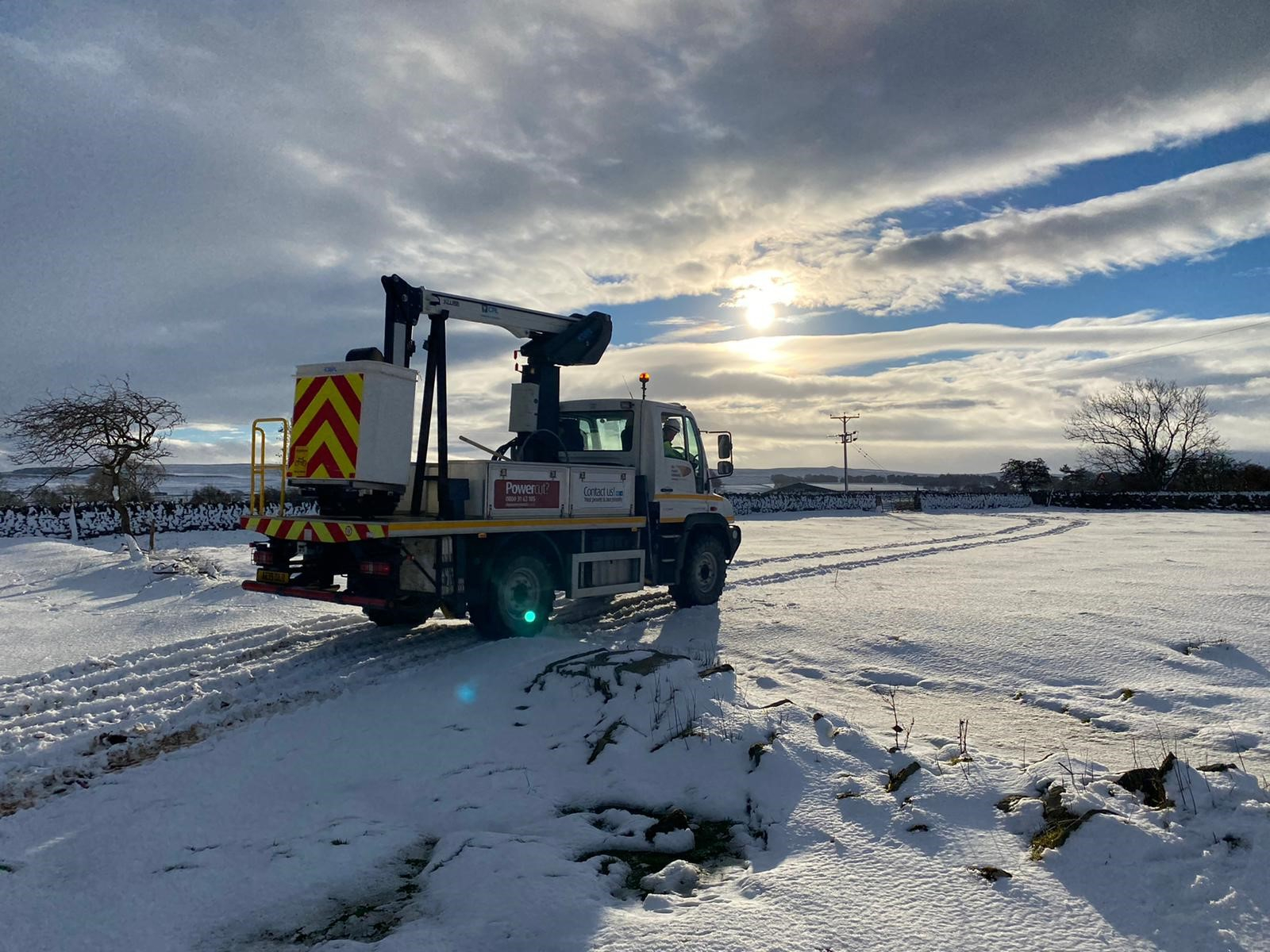
Power workers reach new heights
New all-terrain vehicles purchased by UK Power Networks proved their worth when they were sent to the snowy north to help reconnect power to homes cut off by Storm Arwen. They were put to work in remote areas of Yorkshire and Northumberland to give electricity teams access to fallen and broken poles in hard-to-reach areas. Normally the new vehicles are used in the fenlands of Cambridgeshire, the downs in Sussex and remote parts of East Anglia in all weathers. Electricity operator UK Power Networks commissioned six Mercedes-Benz Unimogs to cope with all ground conditions across the 29,000 square kilometres where it serves 8.3 million customers in the East, South East and London. The vehicles are used by highly-trained ‘hot glove’ teams working on live overhead power lines that carry up to 46,000 volts. They also have a two-person bucket for engineers working at heights of up to nearly 15 metres, unlike older versions which had two separate buckets. Staff from Network Operations and Transport teams at the company were consulted about key features that would be needed. The body of each vehicle has secure lockers, some of which are heated, as well as lights and beacons powered by a 1,000-watt inverter. The telescopic platform is fully insulated against electrical grounding and has the additional benefit of a powerful material-handling arm with a lifting capacity of 455kg. UK Power Networks’ vehicles are fitted with the biggest permissible agricultural tyres and equipped with optional inflation technology. This unique system allows drivers quickly and easily, and without leaving the cab, to lower tyre pressures, which creates a larger, flatter ‘contact patch’ and helps minimise damage to particularly soft ground. The hydraulic arms, buckets and bodywork were added by specialist supplier Versalift in Kettering, to vehicles supplied by dealer Arthur Ibbett, of St Neots, Cambridgeshire. UK Power Networks transport operations manager Cliff Allender says: “These vehicles are deployed daily across the area we serve, which stretches from East Anglia to the south coast, and are used to maintain overhead power cables supported by wood poles. “Many of our power lines are in remote and difficult-to-access locations but the fantastic off-road capability allows us to go anywhere, at any time, in all conditions. The extras lights and heated lockers that we included after consulting with our crews, will be a great help when they are called out at night or in severe weather.”

Aico’s Festive Fundraising in Support of Save The Children
The Christmas festivities for Aico continued on Friday 10th December with colleagues taking part in the annual Christmas Jumper Day. From glittery and glamourous to gaudy and garish, Aico donned their favourite festive jumper to raise over £335 for Save the Children. Children’s Charity Save The Children provides help and assistance to children in the UK and all over the world. Since its launch in 2012, the event has raised more than £27 million through the nation wearing their most festive jumpers for one Friday in December. Mental Health and Wellbeing at Aico is a key factor integrated into the company dynamic. Each month Mental Health First Aiders hold dedicated sessions discussing various topics to support all, from understanding stress to living with an illness/disability. December’s session was combined with Christmas Jumper Day with ‘Festive Wellbeing’ giving colleagues the opportunity to decorate cookies with a festive touch. The Christmas Spirit was shared all round with festive jumpers and jingles. Kelly Hodgetts, Sales Office Manager for Aico attended the Festive Wellbeing activity and was delighted that this could be incorporated into Christmas Jumper Day commenting “Christmas is well known for being a joyous, celebratory time of year, this isn’t always the case with some finding Christmas lonely, difficult or overwhelming. In these unpredictable times, Christmas can seem even more foreboding, and your mental health can really suffer. It was great to have some fun, down time with my colleagues today and we certainly got into the Christmas spirit, wearing our festive jumpers to raise money for Save the Children, decorating cookies and of course – eating mince pies!” Community Liaison, Jane Pritchard says “Christmas Jumper Day was great fun. As we all start to get into the festive spirit, it was fantastic to see so many colleagues supporting our December office fundraising day! As part of our mental health programme, colleagues also enjoyed our Cookie Decorating sessions. Just taking half an hour out of your day, getting creative and having a laugh, sent everyone home in good spirits for the weekend.”

JTL set to offer new Domestic Electrician Standard
JTL is proud to continue its work supporting the changing needs of electricians as it plans to offer the new Domestic Electrician Standard. Whilst the apprenticeship standard is still in development, JTL is planning to deliver the new Domestic Electrician Standard as soon as it becomes available, which is expected in late 2022/early 2023. Designed to take a minimum of three years to complete, the new Domestic Electrician Standard is intended to culminate in candidates receiving a Level 3 Electrotechnical in Dwellings Qualification as well as a Domestic Electrician’s Gold Card. The Domestic Electrician Apprenticeship Standard is intended to train domestic electricians in the best methods for the installation and maintenance of electrical services within domestic dwellings. As part of this course, it is hoped that participants will have the opportunity to explore the use of low carbon technology within the home, potentially including the installation and maintenance of electric vehicle charging points and Solar PV systems. Liam Sammon, Director of Learning and Innovation at JTL, says: “At JTL, we are looking forward to being able to offer this brand-new Domestic Electrician Standard once it’s available, which is expected in late 2022/early 2023. As a not-for-profit work-based learning provider, where all our funding is reinvested in apprenticeship training, we pride ourselves on being able to offer electricians and apprentices the most comprehensive and up to date training around – ultimately ensuring that safe working practices and high standards are upheld by our electricians. “Given the growing interest in green technologies, JTL is highly conscious of the need to train our electricians in the installation and maintenance of low carbon systems, and we hope that this new standard will prepare them for doing just that.”

Positive signs for the construction and electrical industries heading into 2022 
Using new ONS data, Dominick Sandford, Managing Director at IronmongeryDirect and ElectricalDirect, reviews 2021 for the construction and electrical industries and looks ahead into the new year. “It’s been another year of incredible challenges for both the country and the trade industries, but many of the most recent data releases show year-on-year (YOY) improvements, which hopefully suggest a positive start to 2022. “Overall, despite a slight drop towards the end of the year, the total number of people employed in UK construction has risen 3.5% YOY and now stands at 2.2m. “This has been supported by significant drops in the number of redundancies and unemployed workers. The amount of unemployed people in construction has fallen steadily over the last few months and now stands at 58,000, which is 22% less than the same period last year (74,000). “Likewise, the number of redundancies is also massively down YOY. The figure now stands at 6,000 (August to October), which is 77% less than the same section of 2020, when 26,000 workers sadly lost their job. “Despite falling a little in recent months, the amount of self-employed construction workers remains exactly the same as last year (248,000), having risen steadily over the summer. Similarly, in the electrical industry, recent drop offs have not been enough to prevent a YOY increase, with 4,000 more self-employed workers now (10,000) than a year ago. “Interestingly, the number of tradespeople working in the public sector has continued to fall. In fact, in 2021, only 34,000 construction workers were employed by the sector, which is the lowest total since records began over twenty years ago. For comparison, in 1999, there were 107,000 public sector construction employees. The industry’s sustained growth, however, can be attributed to a thriving private sector. “Positive signs are also found in the average number of hours worked each week, which has risen in consecutive months to reach 36.4. This figure peaked in May-July (36.6) but has been gradually rising all year, from 32.2 in December-February. The current average also compares favourably to 2020, as it is now 3.2 hours higher than last year. “This goes hand in hand with the YOY increase in construction weekly earnings. Unfortunately, income dropped between September (£685) and October (£673), but the most recent average is still the third highest of the year, and £20 up from 2020 – a 3% YOY increase. “The electricity, gas and water supply trade has seen an almost identical annual rise (3%), having grown from £719 in October 2020, to £740 in October this year. “It would be naïve to think that the industry has totally recovered from the pandemic, especially with the new Omicron variant potentially causing disruption in the new year, but it’s great to see that in many areas, the trades are making significant strides forward. “It’s admirable how well the industry and its workers have responded to continuous, stressful and unprecedented difficulties, and I wish them all the very best as we enter 2022.”

CICV Forum members reveal their Christmas wish-list for 2022 and beyond
After a year in which the construction industry in Scotland moved from crisis to recovery and rebuilding, members of the Construction Industry Coronavirus (CICV) Forum are looking forward to 2022 in a positive frame of mind. Asked about their wish-list for the sector for the coming year, its leading members expressed a strong desire for the continuation of the remarkable cooperation and collaboration which has been the organisation’s hallmark since its creation in March 2020. While supply chain, training and future skills issues were aired, the collective’s wish-list was predominantly focused on how it can consolidate and build on its many successes while making the necessary transformations to continue its momentum. Alan Wilson, CICV Forum Chair and Managing Director of electrical trade association SELECT, says: “The next 12 months will represent a new chapter and a new identity for the CICV Forum – more of which will be revealed in January. “Initially set up less than two years ago to deal with the impact of the COVID-19 outbreak, the Forum has quickly established itself as the representative voice of the trade and professional bodies who operate in Scotland and developed its work to deal with other issues, including the low carbon agenda, material shortages and skills. “It's great that everyone connected with the Forum wants to see it continue and flourish and my hope for 2022 is that it will go from strength to strength, representing the views of the thousands of businesses, large and small which make up the construction sector.” Fiona Hodgson, CEO of SNIPEF, echoed his sentiment, saying: “I am hopeful that 2022 will continue to see the CICV Forum collaborate and share constructive and meaningful conversations to further embrace the opportunities that the past two challenging years have brought to the construction sector. “With longer term strategic thinking and planning, rebuilding the way we work to be both creative and smarter will see us collectively benefit and provide the very best for our stakeholders and customers. Crisis events such as the pandemic can, and should, shape economic thinking and represent a rare but narrow window of opportunity to reflect, reimagine, and readjust priorities.” Asked for his hopes for the future, Gordon Nelson, Scotland Director of the Federation of Master Builders, comments: “Top of my wish-list is for buoyant workloads for the backbone of our construction industry – SMEs. I would like material prices to stabilise quickly and I would like to see the back of the elongated lead times for the likes of timber, bagged cement and insulation, which have been the bane of builders’ lives for much of 2021. These moves would boost confidence and allow the industry to continue to attract and train the apprentices needed to grow the workforce. For the Forum itself, I wish for a highly successful Green Home Festival in August that will build on the achievements of COP26.” Fiona Harper, The Secretary of the Scottish Joint Industry Board and Director of Employment & Skills at SELECT, adds: “We have all benefited from collaborating and working together since COVID-19 and I would very much like to see that continue. We all face essentially the same problems and issues, such as a shortage of people and an ageing workforce with an ever-growing workload. “The future talent pool is critical to the success and sustainability of the construction industry. With that in mind, we are surely stronger together as we address these issues and create the right training environments which are inclusive and train people in the right skills, making the businesses they work for truly competitive and diverse.” Iain McIlwee, Chief Executive of the Finishes and Interiors Sector, adds: “My New Year’s resolution is to find more time. Modernising methods of construction requires modern methods of procurement, and that means looking at how we allocate and use time more effectively and avoid repetition of mistakes. The Forum is a bastion of hope for me. It exemplifies collaboration and, as it evolves, I am confident it will help us to step out of the chaos of the project and find better ways of working.” Brett Amphlett, Policy & Public Affairs at the Builders Merchants’ Federation, says: “The past 18 months has cast light on the importance of the property repair, maintenance and improvement (RMI) market. With offices empty and many people working from home, a greater number of leaders can now see the extent of, and need to, repair, adapt and improve homes. My wish for 2022 is that this reaffirmation of the value of the RMI market offers businesses encouragement for future employment, productivity and prosperity in Scotland. “The work of the CICV Forum has been instrumental in bringing trade and professional bodies together and I'm glad that collaborative effort will be continuing for the benefit of all. BMF members are up to the challenge in 2022 and we can all look forward to better days ahead.” Iain Mason, Chair of the Forum’s Communications Sub-Group and Director of Communications at SELECT, comments: “It has been a remarkable year and the realisation that, as a sector, we are much stronger together is now firmly embedded as a foundation on which we can build with confidence. “There are great changes in store for the Forum in 2022 and we can look forward to the same spirit of collaboration and cooperation as we work towards a new, sustainable future for the construction industry in Scotland.”

The BCIA reflects on an eventful anniversary year
The Building Controls Industry Association (BCIA) has reflected on another busy year in the building controls sector, with apprenticeships, Net Zero and the return of the BCIA Awards among the many significant discussion points in 2021. This year was of course a milestone year as it marked 30 years since the BCIA’s formation. As part of the celebrations the BCIA created an infographic detailing some of the key technological landmarks that have occurred since 1991. It also spoke to two BCIA members, Roger Woodward, a founder member, and George Belfield, a winner of the BCIA’s Young Engineer award in 2017, who discussed their respective careers and how the industry has evolved in 30 years. The gradual lifting of lockdown restrictions meant the BCIA Awards took place as a live event in October, after the 2020 awards were held virtually. The BCIA also made its first trade show appearance since the lifting of lockdown restrictions at the Smart Buildings Show at ExCeL, London. This included a panel discussion featuring the BCIA President Terry Sharp and Vice-President Graeme Rees, titled ‘The Smart Buildings of the Future – why we need to start planning for them now’, which considered the issues surrounding the need for continued training and competency frameworks to ensure that the next generation of building controls engineers have the right skills to deliver true smart buildings in the future. The first cohort of BCIA apprentices started their BEMS Controls Engineer Apprenticeship with training provider Group Horizon, and the feedback from the programme has so far been excellent. Isabel Lamb, BEMS Controls Engineer Apprentice at AIMTEQ, says: “I have always been fascinated about engineering and enjoy problem solving. With the course and the support from Group Horizon and BCIA, I have found the modules both interesting and challenging.” Net Zero and the impact of buildings on the environment remain a high priority and the BCIA underlined the need for well-maintained building controls within buildings following the publication of a landmark report released by the Intergovernmental Panel on Climate Change (IPCC) that warned of the impacts of global warming of 1.5°C above pre-industrial levels and related global greenhouse gas emission pathways. The need for more energy efficient buildings has contributed to a predicted growth in the smart buildings market. According to MarketsandMarkets, the smart buildings market is projected to grow from USD 66.3 billion in 2020 to USD 108.9 billion by 2025, at a Compound Annual Growth Rate (CAGR) of 10.5 per cent during the forecast period. The major drivers for the smart building include rising adoption of IoT-enabled building management systems, rising awareness of space utilisation, increased industry standards and regulations, and increasing demand for energy efficiency in order to meet Net Zero targets. Casting his eye back over 2021, BCIA President Terry Sharp comments: “In what has been another year of disruption and uncertainty I am proud of the way the BCIA and the industry in general has continued with a ‘business as usual’ approach that has enabled us to get things done, lockdown or no lockdown, and make a difference in the drive towards a smarter, safer and more energy efficient built environment.” He adds: “The return to live events has been fantastic for the industry as companies have been able to showcase their latest projects and innovations and catch up with industry colleagues. Nobody could have forecast quite what our 30th anniversary year had in store back in 1991 and I just hope that there will be less disruption in 2022 than what we’ve dealt with in the last couple of years.”

IDEAL Industries steps up support for electrical talent with SPARKS sponsorship
IDEAL Industries is continuing its commitment to nurturing new talent in the UK electrical sector by sponsoring the SPARKS Learner of the Year contest. The move is part of a wide-ranging programme of product development and partnerships from IDEAL Industries aimed at supporting electrical students and apprentices. The company’s activities already include product donations and demos for colleges, along with safe isolation kits developed especially to support a safety-first culture for those training as electricians. Silver sponsorship of the SPARKS Learner of the Year competition reinforces IDEAL Industries’ support for the next generation of professionals and includes a commitment to provide a day’s training for the winner. The SPARKS Learner of the Year contest is a national competition, with six regional events culminating in a grand final. Participating colleges can enter just one student each, ensuring that the initiative showcases the very best of up-and-coming talent and inspires others. Around 10 - 14 contestants will battle it out for each regional accolade, with the regional winners going forward to compete in the final. With regional heats due to take place in January and February 2022, and the grand final scheduled to take place over two days during April, the competition involves a six-hour practical test, judged by NAPIT. As a sponsor, IDEAL Industries will provide products for use in the competition and will be there on the day to watch the electrical students use them as part of the test. Brett Smyth, general manager of IDEAL Industries EMEA comments: “Our focus as a business is on developing products that make electrical installations faster, safer and more consistent. Working with trainee and apprentice electricians enables us to highlight the innovative new approaches we have developed and support them with contemporary installation techniques as they begin their careers. We’re proud to sponsor this award and wish all the contestants the very best of luck.”

Earnings for electricians edge up as industry reverts to type in run-up to Christmas
Earnings for self-employed electricians increased by 1.6% to £1,123 last month, according to latest analysis of the construction industry’s biggest payroll. Hudson Contract, a £1.6bn-turnover group, is the UK’s largest provider of tax status and employment contract services to the industry and has a client base of more than 2,500 construction SMEs. Ian Anfield, managing director, says: “Our analysis shows we are back in the normal cycle where the industry as a whole works more hours in the run-up to Christmas. Storm Barra may have lost us a few days and contractors are fighting to get the materials they need but we are still within the most productive time of the year. The festive season is coming up and people know January will be slow with bad weather. “We are seeing strong demand for all skilled trades across England and Wales as increasing investment in housing and infrastructure feeds through to labour requirements and rates catch up. Hudson Contract delivers the most accurate indication of subcontractor pay trends across the construction industry, publishing the average pay for a spectrum of 17 different trades split across 10 regions in England and Wales. It supplies statistics to the Bank of England to keep policymakers updated with real-time insights on demand for skilled labour.