2 November 2026
Product of the Month: Amari Floodlight range by Aurora Lighting
 
12 November 2026
Schneider Electric transforms Southampton hospital estate
 
12 November 2026
GTEC Training opens new education facility in North Yorkshire
 
11 November 2026
Energy, AI and smart buildings: register now for EMEX 2026
 
11 November 2026
Solar and batteries could cut electricity costs by 40%, data finds
 

Latest News


Edmundson apprentice award open for entries
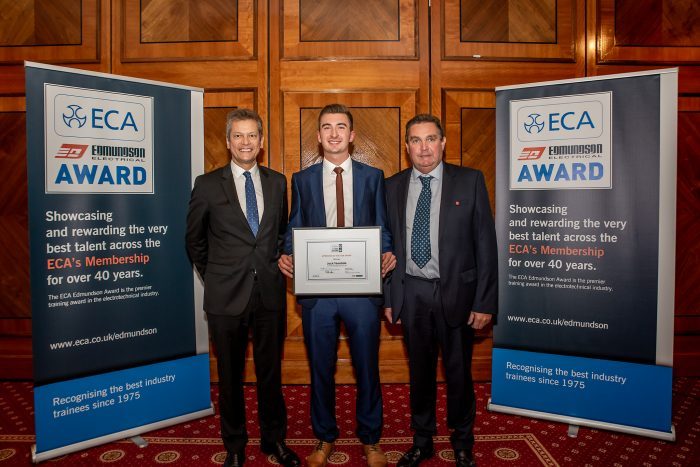
Entries are now open for this year’s ECA Edmundson Apprentice of the Year Award, which aims to showcase the very best talent across ECA’s member businesses. Now in its 43rd year, the award is widely recognised as one of the most prestigious training awards in the electrotechnical and engineering services industry. The three finalists will not only have good technical skills, but will also be role models for others in the industry. The winner will be recognised as an industry ambassador and be involved with ECA campaigns and events during the year. They will also receive an array of prizes, including a £1,500 cash prize, a state-of-the-art toolkit, and a unique study trip overseas hosted by a major electrical industry manufacturing company. There are also great prizes for two runners-up, including a £750 cash prize, a toolkit and a certificate of commendation. Andrew Eldred, Director of Employment and Skills at ECA, comments, “The electrotechnical apprenticeship remains the most popular and most demanding craft-level apprenticeship in the UK. At a time of ever-increasing demand for electrotechnical skills, it is appropriate that we raise the profile of our apprentices, the amazing work they are doing, and the exciting career options available to them as they complete.” Edmundson Electrical Managing Director, Mark Felber, adds, “We are delighted to once again sponsor the ECA Edmundson Electrical Apprentice of the Year Award. Edmundson has a long-established policy of developing young people within our sector through both our apprenticeship and graduate schemes. The industry continues to lead the way in offering great opportunities for young people to develop a rewarding and enjoyable career." Past winners of the ECA Edmundson Award have gone on to a range of careers, including running their own companies in the UK and taking high profile jobs internationally. The award has also boosted the profile of ECA member companies that enter their apprentices, by highlighting their support for future industry talent. 2018 ECA Edmundson Apprentice of the Year, Jack Teasdale of Opus Building Services, adds, “It’s been very humbling and a privilege to be recognised as ECA Edmundson Apprentice of the Year, and to be an ambassador for other apprentices. One of my mentors was himself the winner of this award in 1997, so it’s been an honour to follow in his footsteps.” Eligible applicants will have completed their AM2 between April 1, 2018 and March 31, 2019. The entry deadline is Friday 21 June 2019. For details on how to enter, visit www.eca.co.uk/edmundson.

Video: In-sure box to comply with 18th Edition regulations
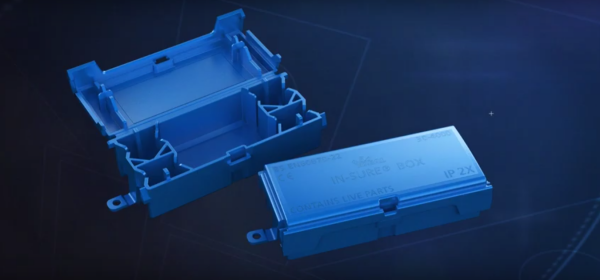
Ideal Industries, a producer of connectors, hand tools, testers, and meters for the electrical and telecommunications industries, has published the below video to explain the benefits of its In-Sure electrical junction box. The BS 5733 maintenance free accessory standard stipulates that a maintenance free junction box should be used when installing an electrical junction in an inaccessible location, i.e. behind plasterboard or under a floor, for instance. This eliminates the need for access panels or expensive re-work of finished surfaces. The In-Sure Box complies with the BS 5733 and the 18th Edition of the Wiring Regulations, and it makes electrical junction enclosure installation fast and easy without the need for any tools. Watch the below video to find out more. https://youtu.be/u7ertCaI20k For more information, visit www.wire-connectors.com

Tamlite supporting 'Building in Quality Tracker' initiative
Lighting manufacturer, Tamlite Lighting, is supporting a new initiative which aims to put an end to ‘spec breaking’ on construction projects. Tamlite believes that the Building in Quality Tracker (BIQ) initiative – which is led by the Royal Institute of British Architects (RIBA), in association with the Chartered Institute of Building (CIOB) and Royal Institution of Chartered Surveyors (RICS) – is vitally important for the reputation of the UK built environment industry. The lighting manufacturer says this initiative will go some way to rebuilding confidence, particularly from a consumer safety perspective. The BIQ tracker is a free to download digital tool which aims to improve the quality of outcomes in the construction industry. It sets up a chain of custody, allowing project teams to track quality on construction projects. Using the tracker, contractors are able to review and record the level of quality considered appropriate for a particular project, and then provide the means to deliver better quality outcomes. It allows clients to demonstrate their commitment to quality and differentiate themselves in the market. It is hoped that the wider adoption of the Quality Tracker will incentivise better quality in buildings, leading to improved human health, safety and wellbeing, whilst boosting the construction industry’s reputation. Commenting on the Building in Quality Tracker (BIQ) initiative, Tamlite Lighting’s Managing Director, John Allden, says, “In our view, the nature of lighting makes it far too vulnerable to spec-breaking. In the long-term, this ‘value-engineering’ or cost-cutting approach can present all kinds of issues. “Put simply, quality must never be compromised at any point in the supply chain. There is no doubt that in the age of LED, the landscape of our industry has altered irrevocably since high-profile tragedies such as at Grenfell Tower. As a leading lighting manufacturer, we must take the lead. We will do this by working hard to communicate a clear case for quality. We will help our customers to understand why our recommended offering may come at a higher price than cheap alternatives, and we will always help end users see the added value in our products and solutions.”

More smart meter owners report higher bills than savings
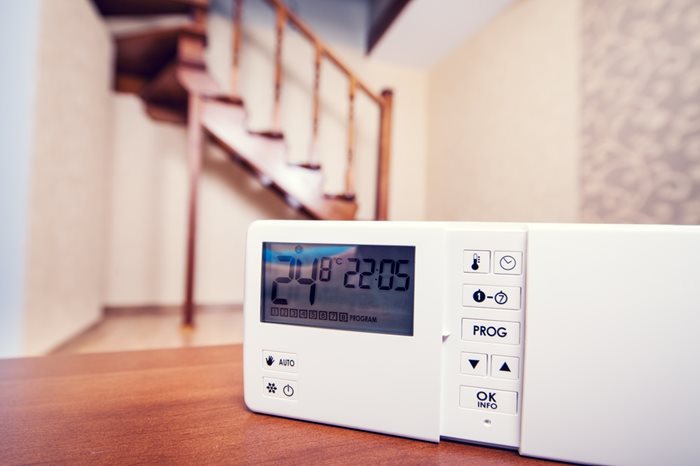
Having a smart meter installed at home very seldom means lower energy bills, according to new survey findings published by leading electrotechnical trade body, ECA. In the ECA’s recent YouGov survey of adults who are eligible for a smart meter, just one in 14 respondents with a smart meter (7%) said that having one had reduced their energy bills, while one in 11 (9%) said they had increased. This is despite one in four (23%) reporting that the main reason for having a smart meter installed was to reduce their energy bills. Overall, nearly half of respondents (47%) said they were ‘very unlikely’ to have a smart meter installed during the next 12 months, with 20% ‘fairly unlikely’ to do so. Just 5% of respondents said they were ‘very likely’ to do so, with a further 13% ‘fairly likely’ to have one installed in the next year. ECA Energy Advisor, Luke Osborne, comments, “These ECA findings suggest that smart meter users seldom report lower energy bills – which seems at odds with the Government’s ‘save money’ message. Smart meters can play a role in stimulating a shift towards a lower carbon future. However, the Government needs to do far more to incentivise change and explain the benefits of using smart meters if they are to increase consumer confidence and take-up in the near future.” While 61% of smart meter owners reported that they had no issues with their smart meter, almost half (45%) reported they had experienced no benefits in having one. The benefit that came out on top for respondents with a smart meter was more accurate billing (29%), while one in 11 (9%) cited connectivity issues as a problem. Furthermore, fear of data breaches and cyber-attacks came out as the top reason (30% of respondents) for not getting a smart meter, among those unlikely to do so. However, of those with a smart meter, less than 1% reported any issue with data security or hacking. Osborne adds, “Public awareness of data security has increased significantly recently. These ECA findings show that the Government must do more to explain to the public why smart meters do not present a security risk from hacking or other data breaches.” Less than one in three adults who are eligible for a smart meter (32%) surveyed have a smart meter installed, despite a Government commitment for all UK homes to have one by 2020.

NAPIT announces new technical roadshows for 2019
Following the success of its first eight events, NAPIT has added 10 more dates and locations to its NAPIT Expo technical roadshow line-up for 2019. NAPIT has revamped its EXPO events following the 18th Edition of the Wiring Regulations coming into force, and is offering attendees free CPD certificates of attendance for masterclasses in surge protection, EV charging and EICR codebreakers. Joined by supporting partners at each event, Expo visitors can browse the latest products and services available in the exhibitor’s area from the likes of Megger, Hager, LED Hut, Surge Protection Devices, Chint, Aico, NAPIT Insurance, Dehn and more. The expert panel will continue to be present at every show, giving attendees the opportunity to speak directly with industry experts who have been specifically selected to align with the masterclass topics covered at each event. As always, the technical roadshows are free to attend, both for NAPIT members and non-members. Visitors will also receive a complimentary welcome bag, refreshments, and the opportunity to win at every show, via two prize draws, with prizes provided by Megger and Chint. The new dates and locations are as follows: June 12 & 13: Basildon/Slough September 4 & 5: Doncaster/Derby October 8 & 9: Sunderland/Lancaster November 12 & 13: Cardiff/Wolverhampton December 10 & 11: Cirencester/Southampton In addition, there are still tickets available for the Norwich, Cambridge, Bradford and York roadshows. To book a free ticket, visit napitexpo.co.uk/events.

A spotlight on waste electronics
By Paul Reeve, FIEMA CEnv and Director of Business at ECA. The EU Waste Electrical and Electronic Equipment (WEEE) Directive was introduced over 10 years ago to boost the amount of WEEE that can be recovered, rather than landfilled. The UK’s WEEE Regulations, which implement the directive, had their latest update on January 1, 2019, and they greatly increase the scope of electrical and electronic equipment (EEE) covered by the regulations. Expanded scope... Many readers will already be aware of the application of the WEEE Regulations to the recovery of fluorescent tubes, but the latest update means that the regulations now apply to almost all EEE, unless it is specifically excluded. This wider scope even takes in everyday accessories such as plugs, sockets and switches. Who does WEEE 2019 apply to? The WEEE regulations are based on the principle of ‘producer responsibility’, which means that the main legal duties fall on ‘producers’ and ‘distributors’*. However, this does not just mean manufacturers or wholesalers, and it’s possible to pick up the duties of a ‘producer’ by directly importing EEE from abroad (e.g. via the internet), or by adding ‘own brand’ labelling to EEE products. Among a range of duties, producers, importers and distributors must finance their share of the cost of recycling WEEE that will be collected via UK WEEE compliance schemes and take-back facilities (see the ‘Producer Responsibility’ section further down the page). Removing WEEE… Significantly, anyone who stores or transports WEEE (e.g. as part of a replacement or maintenance contract) must still comply with applicable waste law (and some WEEE may be more costly hazardous waste). This means that clients must show diligence when choosing a waste service provider. However, the updated regulations do not put specific WEEE recovery duties on clients or their service providers. For these organisations, the commercial situation may even improve if they can take advantage of free WEEE recovery, brought about by the duties on producers and distributors. Conclusion Readers in doubt about their businesses’ status as an EEE producer/importer may wish to visit the government’s website or contact their trade association or a leading WEEE compliance scheme, such as Recolight. The broader scope of the regulations should increase supply chain and customer awareness of WEEE recovery, which will, in turn, require better management of EEE waste streams, as a contribution to a more ‘circular economy’. In addition to the legal duties on producers and distributors, others - such as clients and contractors - may find the new, broader scope presents practical challenges, but also some commercial opportunities.   *Under WEEE 2019, EEE producers, importers and distributors have legal duties that include providing or paying towards the free take-back of WEEE. Larger UK producers, or importers of in-scope EEE, must pay to join a Producer Compliance Scheme and report the weight of the EEE they sell (minus any batteries). Producers supplying less than five tonnes a year in the UK may register with the Environment Agency (this also involves a registration cost). Key terms Circular economy - decoupling economic activity from a linear ‘make, use and dispose’ business/consumer model by extending the whole-life value of products and materials through product design, service-based business/consumer models, and increased reuse and recovery. Producer responsibility - ensuring businesses that manufacture, import and sell products are responsible for ‘end of life’ impacts, often through regulatory duties to: Design products by reducing key material usage, and enhancing reusability and recyclability Minimise waste and promote product re-use (where possible) and recovery (which includes recycling) Ensure waste products are properly treated, and Meet UK recovery targets for waste materials. EEE - Electrical and electronic products that 'depend on electric currents or electromagnetic fields for their basic function' - whether connected to the electrical supply, or battery or solar-powered. EEE applies to products, rather than spare parts or components. When EEE becomes waste, it is WEEE. The ECA wishes to acknowledge the contribution of Recolight to this article, which outlines the updated scope, but does not seek to provide definitive guidance. The lead Government Department is DEFRA, and further information is available at gov.uk/electricalwaste-producer-supplier-responsibilities

Fire safety 'first' for cable management systems
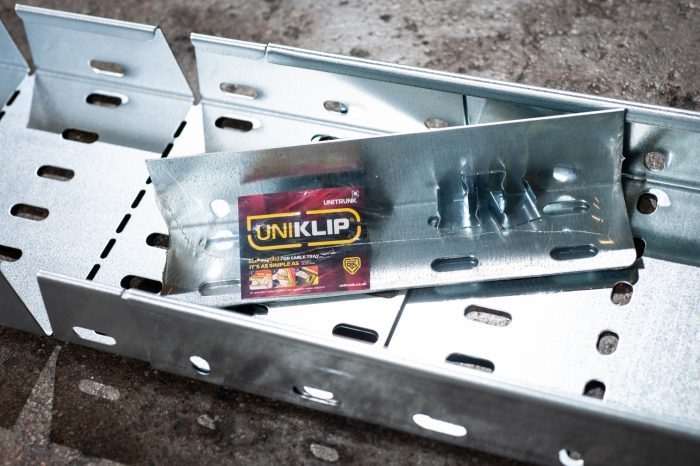
Unitrunk, the company behind Rapid installation System (RIS), is reportedly the first cable management specialist in the UK to pass fire safety testing for both its cable tray and cable ladder, providing peace of mind for specifiers, developers and end users. The move pre-empts any mandatory requirement to certify cable management systems for fire safety, and has seen Unitrunk proactively choose to undertake fire testing in response to general concerns about the safety of all elements of construction specifications. Independent third party tests have been carried out on Unitrunk’s pre-galvanised UniKlip cable tray from the RIS range, involving both heavy duty UniKlip and medium duty UniKlip, which achieved a fire rating of E90, indicating that the system can withstand temperatures rising to 1000°C for at least 90 minutes. The company’s EasyConnect basket tray is already E90 certified for fire resistance. Other Unitrunk cable management systems that passed the stringent fire testing process include  hot-dip galvanised cable tray and Speedway SW4 medium duty cable ladder in both stainless steel and hot-dip galvanised. Unitrunk’s Commercial Manager, Martin Gregg, comments, “Our decision to invest in fire safety testing for UniKlip, hot-dip galvanised cable tray and Speedway SW4 cable ladder system stems from a belief that this should be integral to quality assurance processes for all cable management systems, regardless of whether compliance to a standard is required. “The whole construction supply chain needs to take responsibility for designing fire safety into their products. Gaining certification ahead of any mandatory obligation helps specifiers include fire safety as a product selection criterion.” To pass the fire tests, all the cable management systems had to withstand a temperature curve as high as 1000°C whilst the cables in the system maintained circuit integrity. The cable management was then fire rated based on the number of minutes they were successfully able to withstand these conditions. Gregg adds, “Our goal is to offer customers complete peace of mind that they are specifying a cable management system that will enhance the fire safety of their completed construction or refurbishment project. As a UK manufacturer, we can offer total quality assurance and consistency for all our systems and fire certification adds to that pedigree.”

Vimark LED fire rated downlights introduced
DETA, a supplier of electrical products, has introduced a new range of Vimark LED fire rated downlights. Compact and versatile, with features that can enable a quick and efficient installation, the downlights are IP65 rated with a lense optimised to ensure even dispersion of flicker free light at a 38° beam angle. The energy efficient downlights deliver 550 lumens at 6W with a long lifespan, of more than 50,000 hours. The range is comprised of warm white, cool white and AmbiDim options, making them ideal for use within homes, retail shops, restaurants, offices, showrooms and other commercial environments. Here's some further information on the benefits of the new range: AmbiDim. Advanced AmbiDim technology enables a relaxed and ambient lighting atmosphere to be created, providing a warmer lighting tone (3000k to 2200k) as light levels are reduced, replicating the effect of traditional incandescent and halogen lamps. Compact and versatile. At only 50mm tall and with an IC-F rated construction, these fittings are perfect for use within shallow ceiling voids, and allow insulation to be laid directly over the top of the fitting. Easy to install. A large screwless loop-in, loop-out terminal block simplifies installation and keeps installation time at a minimum. Meanwhile, a remote driver helps to avoid the risk of overheating, preserving the life of the driver; and an inline connector allows first fic to be completed prior to decoration with a simple plug-in connection to be made at second fix. Twist & Lock Bezels. These white bezels are supplied as standard. Chrome and stainless steel bezels are available as separate accessories, allowing fittings to be customised to complement any décor. The new range is available today. For more information, visit detaelectrical.co.uk

Electrium launches new podcast series
Electrium, one of the UK’s largest electrical installation equipment manufacturing and supply companies – home to leading brands such as Crabtree, Wylex and Volex Accessories – has launched a new podcast series. ‘The Electrium Podcast’ will explore the people who make the sector what it is and tell their stories, while also debating the latest topics and get to the heart of what matters to designers and installers. The first two episodes are already live. In the first episode, Electrium speaks to Gary Hayers and Joe Robinson from Tresham College in Corby, Kettering. Both have been teachers for many years, and have recently found success with their YouTube series. In the debut podcast, they speak to Electrium about creating their video platforms, and the importance of apprenticeships and teaching the future of the electrical industry. In episode two, Mike Cash, Group Marketing Manager for Electrium and Simon Rowlinson, Product Manager for Wylex, discuss some of the key questions coming out of the 18th Edition so far. They chat arc fault detection devices, transient overvoltage protection, RCD selection and more. Mike Cash, Group Marketing Manager for Electrium, commented on the launch of the new podcast series: “Here at Electrium, we’re exploring new ways of getting interesting and helpful content to our customers. We believe our new podcast series will give listeners a different insight into the depth of our industry and the numerous people who make it a great place to work.” The Electrium Podcast is available to stream or download on Soundcloud, iTunes and Spotify, and is free of charge. Alternatively, you can listen at electrium.co.uk/podcast.

TrustMark seeks to raise energy efficiency standards
TrustMark, a Government endorsed quality scheme for tradespeople, is launching a pilot in partnership with East Sussex Trading Standards to improve the quality and energy efficiency of rented accommodation within Hastings and its surrounding area. The initiative, 'Better Homes for Hastings', kicked off with an event hosted in partnership with Hastings Borough Council on March 15. It brought together private landlords, housing associations, tenants and businesses, including TrustMark registered businesses, in the Hastings area to promote the minimum standards of safety, comfort, health and energy efficiency that these properties should ideally meet. The event not only educated tenants about their rights and encouraged the comfort and health factors in rented accommodation, but it also addressed the issue of fuel poverty through the improvement of energy efficiency measures, which is a key concern in this region. Private landlords, housing associations and letting agents also had the opportunity to learn about the incoming regulations relating to energy efficiency standards in rental properties, and the event also connected them with reputable businesses and tradespeople to help ensure their properties meet these requirements. Simon Ayers, CEO of TrustMark, says, “We are really excited to be working in collaboration with East Sussex Trading Standards and Hastings Borough Council on this project and to have the opportunity to educate both landlords and tenants on the importance of improving the quality of rented homes, particularly when it is detrimental to good health. Tenants and landlords need to be confident that the tradespeople they employ to carry out any work on their properties meet the required industry standards. By using a TrustMark registered business, they can be sure that the tradespeople have been vetted to ensure levels of technical competency, customer service and trading practices and are in accordance with Government endorsed quality. Together, we will work to drive standards upwards and enhance the safety, comfort, health and energy efficiency of Hastings rental properties.” Andy Batsford, Lead Councillor for Housing for Hastings Borough Council, adds, “Housing is the third highest contributor to greenhouse gas emissions in the UK. This event brought together landlords and those involved in the improvement of residential energy efficiency to encourage the improvement of standards in the private rented sector, which not only benefits tenants - many of whom maybe living in fuel poverty - but also the UK’s wider greenhouse gas reduction targets.” The Hastings pilot is part of a series of events designed to help the Government meet ambitious targets about reduced carbon emissions and fuel poverty. A further project is planned for Cornwall during 2019.