2 November 2026
Product of the Month: Amari Floodlight range by Aurora Lighting
 
26 November 2026
Thorn scores second Highland football lighting installation
 
26 November 2026
Segen pens exclusive distribution contract with M-Rack
 
25 November 2026
Scolmore helps rejuvenate Tamworth Cancer Support Centre
 
25 November 2026
Leicester apprentice crowned 2026 SkillELECTRIC champion
 

Latest News


Domus Ventilation Revit BIM files available as direct download
Domus Ventilation has announce that its full range of Revit BIM (Building Information Modelling) files can now be downloaded directly from its website, free of charge.   BIM is a government driven shared knowledge resource, providing all of the information about every component of a building, in one easy to access place. Autodesk Revit is a BIM software for architects, structural engineers, mechanical, electrical, and plumbing engineers, designers and contractors. It is used to create co-ordinated, consistent and complete model-based designs that drive efficiency and accuracy across the project lifecycle, from conceptual design, visualisation and analysis to fabrication and construction. Using BIM data reduces the risk of mistakes or discrepancies at an early stage, making for more cost-effective, safe construction.   The Domus Ventilation BIM library features an extensive array of products, including energy saving, whole house Mechanical Ventilation with Heat Recovery (MVHR) appliances, as well as award winning Radial semi-rigid duct systems and its full range of rigid ducting and accessories, which incorporates Domus Thermal duct insulation and duct sound attenuators.   BIM ‘Object’ data on Domus Ventilation products includes detailed information such as product properties, geometry, visualisation data and functional data that enables the ‘object’ to be positioned and behave in the same manner as the product would in-situ. Airflow rates, for example, can be set at each grille or air valve, allowing engineers to easily and more accurately estimate pressure losses and velocities within the ductwork, which isn’t possible using other design packages, such as AutoCAD. Product dimensions are automatically calculated to ensure it fits into the desired design space and even the correct amount of product required is calculated within BIM to prevent product wastage. In addition, BIM enables parts to be automatically scheduled during the design process, for speed and maximum convenience.

SME builders on the verge of extinction as numbers plummet 80%
The latest research from the real estate debt advisory specialists, Sirius Property Finance, has revealed why recently introduced government measures to help boost the number of SME property developers is sorely needed, as SME numbers have plummeted by 80% since the late 80s. Defined as small to medium-sized housebuilders, SME developers typically deliver between one and 1,000 homes to market on an annual basis, with a focus on smaller projects compared to the big names in the sector. In February of this year, the government’s housing accelerator, Homes England, together with the United Trust Bank, announced a £250m fund aimed at supporting SME builders - with the additional carrot of development finance up to a 70% loan to gross development value. The market analysis by Sirius Property Finance shows why this help is badly needed in order to help boost the dwindling number of SMEs. The data shows that in 1988, there were 12,215 SMEs operating across England delivering 77,524 new homes to the market. That was 40% of all new homes with an estimated market value of over £4.6bn, a significant proportion of market activity. However, since then, SMEs have faced various challenges including red tape barriers around finance and planning, a reduced level of opportunity due to not one, but two financial crashes, complicated public procurement processes and most notably, growing competition from the big housebuilders. As a result, the latest data shows SMEs are on the verge of extinction with just 2,500 currently operational across England. That’s an -80% reduction since 1988 at a rate of 335 SME developers a year (-2.7%). As a result, the number of new homes built on an annual basis by SMEs has reduced from 40% in 1988 to just 12% today. The only silver lining is that far higher new-build house prices mean the value of this 12% is higher than the 40% built back in 1988 at almost £5.8bn. Managing Director of Sirius Property Finance, Nicholas Christofi, comments: “Although it’s great to see the government finally recognise the importance of SMEs and the role they play in delivering much needed housing stock, it’s fair to say that this support is long overdue and perhaps too little too late. In the last three decades, they’ve come close to extinction due to a range of factors, but most notably due to competition from the big housebuilders and, as a result, the number of operational SMEs has plummeted. Hopefully, we will now see a reversal in this downward trend and the number of SMEs will once again start to climb. While the big housebuilders do an admirable job, greater variety and competition within the sector can only be positive and will force standards and quality of output to climb across the board.”

Home security expert comments on £435m to prevent crime
Chancellor Rishi Sunak announced in today’s Budget that £435m is going to be spent on helping to prevent crime, protect communities and help victims in England and Wales. Speaking on the Government’s move to increase CCTV, Robin Knox, Home Security Expert and Co-Founder of the smart home security start-up Boundary, commented the following: “A large proportion of the Government’s investment into crime is going towards ramping up security on the streets, helping women to feel safer with improved street lighting and better CCTV. It’s important that women feel safe on the streets, as does everyone else, and with the increased presence of CCTV seemingly wherever you go, whether it be on the street, from your doorbell or even in the car, it’s clear that there is a demand for these sorts of cameras to provide added protection. “It is however important to emphasise that, although this constant monitoring is important for when it comes to crimes committed out on the street, those looking to keep their homes safe from crime should look for other alternatives to CCTV. Although it may be comforting to know your house is being monitored, there is a substantial lack of privacy for your neighbours, who may have not given you permission to film around your house or may not even be aware that they’re being watched. “It’s important that, when looking into outdoor home security cameras, buyers look for systems that include privacy masking to avoid recording outside of the boundary lines of the home. Otherwise, signage would be required as well as compliance with GDPR data management regulations. Motion detection zones can also be set up to reduce false alerts. “Not only should a home security system flag legitimate threats of break-ins, but they should also then proceed to provide follow-through protection, such as automatic police response. Self-monitored cameras might initially seem useful and exciting but it can be hard to always be on-duty when at work, on holiday or asleep. A professionally monitored system from a recognisable brand makes it more likely that your intruder will be initially deterred, cause less damage and ultimately increase the likelihood of being caught, thanks to a swift and reliable 24/7 response. “Consumers who are buying smart devices for their homes should consider the privacy trade off they are making. Look out for systems that have BS EN 50131 tested motion sensors as not only are these private compared to cameras, they’re able to access the fastest police response available, actually faster than a visually verified (operator viewing camera) break-in."

Knightsbridge LED mirrors reflect modern tastes
Designed to upgrade any bathroom, the ML range – the latest LED mirrors from Knightsbridge – is bursting with features the discerning householder will find appealing. The top-of-the-range models comprise a demister pad, an on/off motion sensor, and include a dual voltage 115V/ 230V shaver socket outlet with independent switch control. The mirrors themselves, constructed from a pressed-steel base and high-quality glass, can be rectangular or circular, with a mini circular LED border design or illumination from a surrounding LED border. For reference, the product codes are: MLR6045SD (rectangular, back-lit design); MLC6045SD (rectangular design); and ML500 (circular design). Practical and yet just as stylish, the VML1 vanity mirror light is equipped with a mirror that magnifies the user’s face by three while it is lit by a frosted edge diffuser. The whole, wall-mounted unit is finished in polished chrome, and is easily positioned to achieve the best angle for shaving or applying cosmetics. For those customers after a colourful experience, the RCTRGB is an edge-lit mirror with an RGB remote control to change the colour of the edge light to red, green, blue or warm white as required. The remote has a memory function to ensure that it switches on at the last setting. Whatever style, functionality, shape or size, Knightsbridge has a collection of LED mirrors that will always reflect well on the homeowner, mixing good design with utility, practicality with a bit of pizazz. [gallery columns="2" ids="27643,27644"]

myenergi set to host EV drivers en route to COP26
myenergi will welcome electric vehicle drivers from across the UK and Europe to its eco headquarters in Lincolnshire, as they travel to the COP26 UN Climate Change Conference. Part of the ‘Electric Road to COP26’, an initiative organised by EVA England, EVA Scotland, GEVA and Local EV Groups (NEXUS), the group is visiting companies operating at the forefront of the electric vehicle revolution to raise awareness of the need for faster transport decarbonisation. When they arrive at myenergi, drivers will have the opportunity to meet the green team and take a private tour of the company’s state-of-the-art facility. They will also be introduced to myenergi’s latest range of renewable energy technologies, including the eco-smart zappi EV charger. From here, the group will travel up to the Britishvolt EV battery gigafactory site in Northumberland, before arriving in Glasgow for the opening of COP26. During the two-week event, representatives will be calling for all sales of new cars and light duty vans to have a plug by 2030 and be zero emission by 2035. Jordan Brompton, co-founder and CMO of myenergi, comments: “We’re looking forward to hosting drivers taking part in the Electric Road to COP26. As well as putting on lunch, we’ll be offering guided tours of our pioneering eco headquarters, which was officially opened earlier this year. “Initiatives to raise awareness of transport decarbonisation are hugely important. Indeed, transportation accounts for 24% of direct CO2 emissions from fuel combustion globally, of which road vehicles are responsible for nearly 75%. A rapid shift to electrification is essential to combat these statistics, but legislation is critical to accelerating the transition.” Alongside hosting the Electric Road to COP26 visit, members of the myenergi team will also be attending COP26. Kate Tyrrell, events & relationship manager, will be speaking at the COP26 Ferry Event (hosted by National Grid) and promoting eco-smart technologies in the Green Zone throughout the two-week event.

Appetite for electrical careers soar in Scotland
Scotland’s electrical training body has saluted an “excellent” start to the academic year after the number of electrical apprentices and adult trainees beginning their studies reached a 12-year high. More than 800 new learners have enrolled on the Electrical Apprenticeship and Adult Trainee Programmes for 2021, with colleges and training centres reporting full classrooms as future professionals take their first steps on the electrical ladder. The intake is the highest in Scotland since 2009 – and the Scottish Electrical Charitable Training Trust (SECTT) says it’s another encouraging sign of the determination to tackle the UK-wide skills shortage . Barrie McKay, Training and Development Manager at SECTT, which manages high-quality training on behalf of the Scottish Joint Industry Board (SJIB), says: “I’ve been at SECTT for more than 20 years and it’s really encouraging to see a return to such high numbers. “The figures are particularly satisfying  given the position the industry was in this time last year, when only 500 people began training due to the impact of COVID-19. “This improved intake illustrates that people recognise that the future is electric and also understand that their personal prospects will be brighter if they’re part of a sector that is going to play a key part in all our lives.” A total of 2,158 electrical apprentices and adult trainees are currently training in Scotland, including the 715 apprentices and 126 adult trainees recruited for the 2021 intake. Barrie adds: “Not only are the numbers looking good, but the quality of the young people being taken on – both male and female – is really impressive. “The industry has been concerned for some time about skills shortages as the demand for qualified electricians accelerates, and the enthusiasm and dedication of these new recruits goes a long way to easing these fears and suggesting that there is an appetite to learn among the electrical talent of tomorrow. “As colleges continue to recover from the challenges of COVID-19, they will now help their students embrace all the modern technologies which will play such a huge part in a greener and more sustainable future.” SECTT and the SJIB praised employers for taking on apprentices in numbers earlier this year, confounding fears that recruitment could be a casualty of the ongoing effects of the COVID-19 pandemic. Both bodies also pointed towards the altered perception of employment in the sector, thanks to the long-running campaign for regulation of the electrical industry spearheaded by SELECT, Scotland’s largest construction trade association. Fiona Harper, Director of Employment & Skills at SELECT and The Secretary of the SJIB, says: “The industry as a whole is committed to the next generation of talent coming through, and employers are clearly supportive of creating a pool of highly-trained, highly-qualified personnel to take their business and the sector forward.”

Electric Vehicle owners are most 'considerate' drivers
Almost three quarters (73%) of EV owners say they are more considerate drivers having made the switch to an electric car, new research from Love my EV reveals, the UK’s only dedicated EV and green energy comparison site. EV drivers are not only playing a vital role in reducing harmful emissions, but also making roads a safer and more pleasant place to be. Over two thirds (67%) of EV drivers have completely changed their driving style since moving away from fossil fuels, now less aggressive with their accelerating and braking. This change in behaviour not only saves drivers money by reducing the frequency or length of battery charge required, but it also benefits the environment as less energy is used and wasted. There is still a role for increased driver education, however, as almost 9% of EV drivers do not realise they can maximise each charge of their battery by driving less aggressively, reducing acceleration speed and using regenerative braking. Regenerative braking improves energy efficiency and extends the vehicle’s driving range. Eight in 10 (80%) EV owners make use of regenerative braking, which turns wasted energy from braking into electricity to charge the battery and boost efficiency, with half (50%) of these drivers doing so frequently. Driving efficiently in an EV appears to be contagious and research shows that couples are competing to maximise the mileage of their vehicle per kWh. More than half of all drivers admit they compete with a partner to be the most efficient driver, by either using the momentum of the vehicle to recharge their battery and/or paying more attention to the road in order to avoid harsh braking. Mat Thomson, co-founder of Love my EV, comments: “Electric vehicles offer incredible environmental benefits in terms of lower emissions, but it is great to hear that they could also be positively impacting driver behaviour. Avoiding harsh braking and excessive acceleration not only saves drivers money by maximising the number of miles they can drive on each full charge, but it also makes for a nicer environment for all road users.” “Higher efficiency per mile means the ‘all-in’ cost of driving an EV can be much lower than many people think. Love my EV matches people to an EV that is best suited to their unique needs, whilst also finding the best value and greenest home energy to power their car and home with.”

EPC rating remains important for only 30% purchasing a home
The latest research from NatWest and IHS Markit has revealed that the Energy Performance Certificate rating (EPC) of a property remained a relatively low priority among prospective homebuyers. The latest survey from the Greener Homes Attitude Tracker, based on responses from 4,500 people across the UK in the third quarter of 2021, found that only a small percentage of homebuyers considered EPC rating a 'very important' factor if purchasing a home in the next 10 years, the fourth lowest among the 12 factors surveyed. Only 15% of households said that having an EPC rating of C or above was essential when selecting a property. The EPC rating ranked below other environmental factors, such as air quality (37% said ‘very important’), amount of local green space (38%) and levels of noise pollution (41%). Out of all the environmental factors listed, risk of flooding was considered by far the most important (55%), even beating internet speed (46%) for importance. The recent rises in wholesale gas prices are another illustration of the challenges that consumers face as they try to understand what they can do to play their part, how much that may cost and how they can protect themselves from rising energy bills. The tracker found further need to raise awareness of what actions can be taken, with only one-in-seven homeowners ‘very confident’ of being able to replace their gas boiler with a more sustainable alternative at an estimated cost of £5,000. 57% were either 'not very' or 'not at all confident'. North versus South When it came to regional attitudes: 20% of Scottish households who are looking to buy a house in the next 10 years say an EPC rating of C or above is an ‘essential’ feature is when selecting a property (the highest proportion). Conversely, 10% of Scottish households say it’s ‘not at all important’, which is the highest of any region or nation. 10% of those in the North of England who are looking to buy a house in the next 10 years say an EPC rating of C or above is an ‘essential’ feature. By region, homeowners in the North of England (57%) are the most likely to have plans to make property sustainability changes in the next decade compared to 51% in Scotland. Attitudes by Age Group 18% of 35-44 year olds who are looking to buy a house in the next 10 years say an EPC rating of C or above is an ‘essential’ feature is when selecting a property (the highest proportion). 11% of 18-24 year olds who are looking to buy a house in the next 10 years say an EPC rating of C or above is an ‘essential’ feature  (the lowest). More than half of UK homeowners once again are planning to make improvements to the environmental sustainability of their property in the next decade, according to the third quarter results. Whilst this proportion (55%) has only changed slightly since the previous quarter (54%), the percentage of respondents expecting to make these changes in the next 12 months has risen to 16% (compared to 14%). Lloyd Cochrane, Head of Mortgages at NatWest says: ‘Making sustainable choices in the home can often be complex and expensive. The Greener Homes Attitude Tracker is designed to give the bank, and the wider market, a better understanding of consumer attitudes so we can ensure we support our customers in the best way. It’s one of a number of ways that we can contribute to raising consumers awareness around sustainability as the UK government works towards net zero target by 2050. 'But with COP 26 fast approaching, the tracker shows that there is a noticeable proportion of homeowners who firstly don’t consider an EPC rating or energy efficiency as important and secondly, have no plans to make improvements in the next decade. Alongside the products we provide to support customers make greener choices and the information to inform those choices there is much more we all need to do across industry and government to raise consumer awareness, provide relevant information and appropriate support. The switch to greener lives and homes should be accessible to all – not just those who can afford it.’ To address the key blockers in meeting net zero in the UK buildings environment, NatWest recently launched a ‘Sustainable Homes and Buildings Coalition’. By partnering with British Gas, Worcester Bosch, and Shelter the bank is setting out to improve UK buildings energy efficiency, to raise awareness and help customers understand the choices they have to decarbonise their homes and commercial buildings. The first report, Home is where the Heat is’ will be launched October 21st.

Multi-vehicle charging hubs are the future for commercial transport 
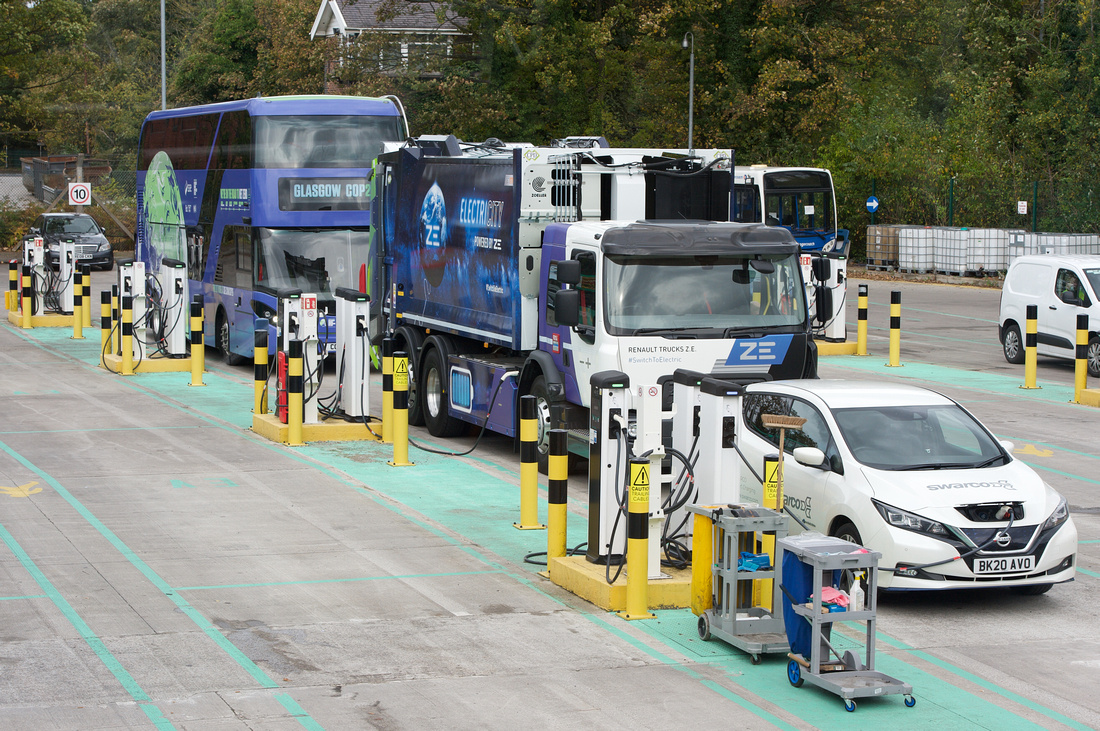
Plans being developed to open up electric bus charging hubs to lorries and vans so that any business can charge its electric vehicles (EVs) would help accelerate the UK’s transition to low carbon transport, according to energy industry leader SSE and SWARCO Smart Charging. The idea was highlighted today (25 Oct) during a visit to Sharston bus depot in Greater Manchester, which features 32 electric vehicle charging stations, making it the first sizeable EV bus charging depot in England outside London. SSE Energy Solutions and SWARCO Smart Charging are currently looking at a number of opportunities around the UK to equip bus depots with EV charging facilities which could then be made available for use by local business fleets. Two-thirds of electric cars bought in the UK are purchased by businesses, rather than private buyers, according to industry figures. Last year more than 108,000 new electric cars were registered. The Sharston site is used by Stagecoach, the UK's biggest bus and coach operator, and is the home to the region's first double-decker electric bus fleet which is estimated to save over 2200 tonnes of carbon a year. Stagecoach operates a fleet of clean, green buses across Greater Manchester. SSE highlighted the shared charging idea as part of a tour of the UK’s green energy and sustainable transport projects in the run up to the Cop26 climate summit on 1 November.  A COP26-branded electric bus drew up at the Sharston charging points alongside other commercial vehicles including a refuse collection vehicle and a car. The concept is that while buses are busy working the streets during the day, sites could be made available during daytime hours for other businesses who wish to charge their electric vehicles. It comes as SSE Energy Solutions works with Stagecoach in England to support their business cases for ZEBRA (Zero Emission Bus Regional Area) funding from the UK government.  Meanwhile in Scotland, SSE Energy Solutions has been working with Stagecoach to use SULEBS (Scottish Ultra Low Emission Bus Scheme) funding from the Scottish government. This is enabling SSE to install charging stations at Aberdeen and Perth bus depots, using chargers from SWARCO Smart Charging. Work starts on site at Perth this month (October) to install five chargers serving ten bus bays, and at Aberdeen next month (November) to install 11 chargers serving 22 buses, along with a single charger for ‘opportunity charging’ at the local bus station. Kevin Welstead, EV Sector Director for SSE Energy Solutions, says: “SSE Energy Solutions are working with Stagecoach and SWARCO on a number of sites across the UK, utilising our range of services to provide the optimal electrical infrastructure for each depot. We look forward to continuing to develop these relationships by building on our existing successes, and by working together for a green future for all modes of transport. By focussing on interoperability of chargers for electric vehicles across the network and efficient use of assets we can work together to benefit more electric vehicle users and support the nationwide transition to zero emission vehicles.” Justin Meyer, Managing Director at SWARCO Smart Charging, comments: “SWARCO is delighted to be working with SSE and others to help build a greener future for the UK transport needs. The idea of shared charging sites is being actively explored at a number of locations, to make best use of the charging assets we supply. This will undoubtedly help in the journey to net zero." Buses can be fully charged at sites such as Sharston in just a few hours. The Sharston depot also has a large solar array on the roof, generating renewable energy for the site to complement its grid connection. SSE is a major partner at COP26; and alongside the Go-Ahead group, Alexander Dennis, BYD and SWARCO Smart Charging is using an EV bus tour to showcase examples of the national effort already underway to decarbonise energy and transport. 

Extreme tools for extreme environments
For its spectacularly challenging motorsport series, Extreme E is counting on Bosch Professional to beat the elements and keep the events moving. Motorsport fans are used to roaring combustion engines and screeching wheels on blazing tarmac, but with Extreme E ‘X Prix’ races the action takes place in the wild. Extreme E is the world’s first off-road series to race 100% electric SUVs in the most remote parts of the world. In this, its inaugural season, Extreme E will take nine teams to the ends of the earth to raise awareness of climate change challenges. Together with the event crew, they have faced the desert in Saudi Arabia (Desert X Prix), the salt beds in Senegal (Ocean X Prix), the frozen ocean in Greenland (Arctic X Prix). And most recently rocky riverbeds in Sardinia (Island X Prix), with the final race taking place on the Jurassic coast in The UK (Jurassic X Prix). As official power tool supplier, Bosch Professional have been with them all the way. Ready for action – whatever the conditions “We work in some of the most aggressive environments in the world,” says Extreme E event manager Kester Wilkinson. “We need tools that can cope with everything from the sand and dust in Saudi Arabia to the cold, wind and rain in Greenland.” From deserts to glaciers, Extreme E needed professional power tools that could weather sand or storm. Bosch Professional has provided a full range of tools to make even the most difficult operations easier. With no easy access to replacement tools in the wilderness, Extreme E has no margin for error – so durability is vital. “Unless you have reliable, durable products, there’s no point bringing them,” says production crew member Dougie Dale. “You will end up breaking them and having to throw them away. But these” – he picks up a cordless Bosch Professional 18V BITURBO brushless circular saw – "work perfectly out here.” Although spare tools have been included in case of breakage, there has been no need to use them. “If a tool breaks, we need to have another one,” says Dale, “but our Bosch tools are not breaking. We have spares, but they’re still in the box.” Ultimate performance with maximum freedom At the heart of the Extreme E toolkit is a collection of Bosch Professional BITURBO tools, powered by the Bosch ProCORE18V Professional Battery System. BITURBO tools offer cordless freedom and convenience but deliver the same levels of power and performance as corded tools rated up to 1800W. Built to robust Bosch Professional quality standards, they benefit from advanced brushless motors which are much more powerful, energy efficient and longer lasting than the alternatives. The same can be said for Bosch ProCORE18V batteries, which combine perfectly with BITURBO tools to maximise each other’s performance. A key result of this is longer runtime between charges. When the power eventually runs out, full compatibility between Bosch Professional 18V tools, batteries and chargers enables quick and flexible swapping and charging. Amongst those Bosch products is the world’s fastest 18V charger. The Bosch Professional BITURBO range includes combis, drill drivers, impact wrenches, rotary hammers, saws, angle grinders and more. No power grid, no problem Of all the equipment supplied by Bosch Professional, its cordless tools are the most valuable on site. “We need tools that are reliable and can be deployed really, really quickly,” says Wilkinson. “Most of the Bosch tools we have are cordless, which means we can get them out of their boxes and use them straight away. The batteries are interchangeable, so we can just pick up a battery from one tool and put it on another. It's so easy.” Given the remoteness of its locations, Extreme E has to build sites from scratch – often without any power grid. “Obviously, having batteries that charge up and last is fantastic, because we have very little mains power out here,” says Dale. “It’s not like you can just plug a circular saw into a socket and start cutting. You need battery power, because we work in places where there’s no mains power.” In fact, as Extreme E travels from location to location on board the St Helena, a refurbished passenger-cargo ship, the batteries need to hold their charge in storage for over a month through aggressive marine environments – and be ready for immediate use upon arrival. Easy mobility After each race, the Extreme E crew has to pack up 50 containers’ worth of equipment, charge the tools and start planning for the next destination. “When the weekend’s racing is over, we need to break all the site facilities down on the Sunday night, put everything back onto the ship, and go,” says Wilkinson. “Confidence that our tools will work when we get them out in more than a month's time is absolutely essential. We’re delighted we have Bosch Professional tools which make that possible.”