2 November 2026
Product of the Month: Amari Floodlight range by Aurora Lighting
 
26 November 2026
Thorn scores second Highland football lighting installation
 
26 November 2026
Segen pens exclusive distribution contract with M-Rack
 
25 November 2026
Scolmore helps rejuvenate Tamworth Cancer Support Centre
 
25 November 2026
Leicester apprentice crowned 2026 SkillELECTRIC champion
 

Latest News


Balfour Beatty joins Government Kickstart programme for young people
Balfour Beatty today joins the Government’s Kickstart scheme to offer over 70 work placements to 16 to 24-year-olds at risk of long-term unemployment. Today’s announcement further supports the company’s ongoing commitment to young people and inspiring a new generation of talent within the construction and infrastructure industry. In partnership with The Prince’s Trust – a youth charity helping young people get into jobs, education and training – Balfour Beatty will offer six-month work placements from April 2021.The programme is being delivered as part of The Prince’s Trust Coalition for the Built Environment scheme, comprised of six companies from the construction and infrastructure sector which aims to bridge the skills gap present within the industry. On completion, Balfour Beatty aims to transfer Kickstart participants to the Balfour Beatty Apprenticeship Scheme. Balfour Beatty has long been committed to youth employment, having joined The 5% Club- a dynamic movement of employers committed to ‘earn & learn’ roles as part of ensuring Britain’s social mobility and shared prosperity - in 2014. This commitment to social mobility is further demonstrated by the business’ support of The Social Mobility Pledge, to which it became a signatory in 2020. Most recently, Balfour Beatty made a pledge to further support young people by increasing the number of apprentices, graduates and trainees recruited across the business by 30% in 2020 and currently has over 6% of employees in Earn and Learn positions, up from 5.4% in 2019 and exceeding The 5% Club goal. Paul Raby, Balfour Beatty Group Human Resources Director, said: “As we recover from the COVID-19 pandemic, there has never been a more critical time to open our doors to provide employment opportunities for young people - supporting them in building skilled careers is essential both for our industry and to help us to sustainably rebuild our economy and society. “As we support this new Government initiative, we are pleased to be working with The Prince’s Trust to expand opportunities to young people and leave a lasting, positive impact on those who work with us.” Ben Marson, Director of Partnerships at The Prince’s Trust, says: “The Prince’s Trust has 45 years of experience in supporting young people into jobs and we are delighted to be working with organisations such as Balfour Beatty to help ensure the Kickstart scheme sets young people up for success during this challenging time. “Right now, we need businesses, government and individuals to work with us to help those young people who need us most. By bringing together organisations in the built environment sector to create an innovative coalition we are opening up opportunities for young people and helping them to realise their potential.” Balfour Beatty’s commitment to attracting, developing and retaining talent forms part of its newly launched sustainability strategy, Building New Futures, in which it aims to positively impact more than one million people by 2040 through increased employment and training opportunities as well as social mobility.

Tradespeople losing more than £1,000 per year from withheld payments
UK tradespeople are seeing over £1,000 of payments per year withheld by customers following a completed job. The research, conducted by IronmongeryDirect, found that an average £1,062 is owed to tradies across the UK. A third (33%) said they were waiting for over £1,000 from customers for completed jobs, whilst nearly one in 10 (7%) are owed over £3,000. Nearly two thirds (61%) of tradespeople have had payments withheld by customers, which occurs twice per year on average. More than one in 10 (12%) however, experience withheld payments more than five times a year. Only 6% of tradespeople say that the payment issues are resolved within a week, whilst more than one in five (22%) have had to wait more than a month to be paid for a job. Plumbers were found to be the most likely to have to deal with payment problems, experiencing withheld cash 2.6 times per year on average. Landscapers, meanwhile, experienced the fewest issues, with an annual average of only 1.2 times. Trades most likely to have payments withheld (times per year) Plumber: 2.6 Electrician: 2.4 Builder: 2.3 Bricklayer: 2.2 Carpenter: 1.9 Surveyor: 1.8 Joiner: 1.7 Painter and decorator: 1.6 Plasterer: 1.3 Landscaper: 1.2 Builders are owed the most, with an average of £1,375 withheld by customers, with nearly half (45%) saying they had over £1,000 of outstanding payments. Bricklayers (44%) and carpenters (40%) are experiencing similar rates of withheld cash. Plasterers were found to be owed the least, with an average of £535 outstanding, followed by landscapers (£615). Female tradies were found to receive payment quicker than their male counterparts, experiencing higher rates of payment within a week (8% vs 4%) and within a fortnight (34% vs 20%). However, women were also found to be owed higher sums of money, with an average of £1,168 outstanding, compared to £972 for men. When it comes to age, millennials (25-34 year olds) are more likely to experience withheld payments than older tradespeople, with an average of 2.5 payment issues per year, compared to 1.6 for 55–64-year-olds and 1.7 for over 65s. People in this age group were also more likely to be owed larger sums of money, with millennials owed the most at £1,258 compared to other generations. Despite this, invoice problems were solved quicker for younger generations, with 14% of millennials waiting more than a month for payment, compared to half (50%) of 55–64-year-olds. Alison Werner from the UK’s leading business coach for trades and construction industry, The Trades Coach, says: “Be sure to display your full terms and conditions in the original quote, as well as your website. This should include a full breakdown of costs and a clause for late payments. Regular communication will also help address any misunderstandings as they arise and will also be looked upon favourably in the rare event of legal proceedings. “There might be a reasonable reason why a customer is late paying, so it’s important not to assume the worst and firstly find out what the issue is. Having a telephone conversation is the best place to start and then follow this up with an email and regular email reminders. If payment is still not received after several months, you should consider hiring a debt recovery company who will take a small commission to recover payment on your behalf.” Dominick Sandford, Director and Head of Merchandising & Marketing at IronmongeryDirect, comments: “Withheld payments are an annoyance that every tradesperson has to deal with at some point or another, but when significant amounts are owed by customers it can become a serious threat to your financial security. “It’s shocking to see how much tradespeople are waiting on and how long they’re having to wait for their payment following a job. We hope our useful tips help tradies get paid quicker and without any hiccups along the way.”

Toolstation launches campaign to locate the nation's heroes
Toolstation has launched a competition to locate the nation’s unsung heroes and give tradespeople back the ‘credit’ they deserve, both through recognition and up to £5,000 worth of prizes. The COVID-19 pandemic has been a tough year for many, but tradespeople have continued to provide essential services and keep us safe and comfortable at home. To celebrate the trades and to show recognition of their incredible support, Toolstation is encouraging customers to nominate either themselves or a tradesperson they know who has gone above and beyond, whether that is through helping the community or going the extra mile in their working lives. The entry period opened on Wednesday 31st March and will be closing on Thursday 29th April 2021. Prizes for the winner includes £3,000 worth of DeWalt products – ranging from tools and accessories, and £2,000 credit if they are already a Toolstation Trade Credit Account holder. There will also be two runners up prizes of £1,000 of DeWalt kit with an extra £500 to Trade Credit Account holders. Trade customers can easily apply for a Trade Credit Account in three steps for easy application, and brings the solution its trade customers have been calling out for, offering added support with more efficient financial management, with up to 60 Days interest free credit, flexible credit limits and fully online account management. Signing up for a Trade Credit Account allows customers to buy now and pay later and get the tools and supplies needed for larger jobs. James Mackenzie Managing Director at Toolstation is pleased to be able to give the trade credit where credit's due and says: “We are committed to providing our customers with the tools they need to get the job done, but more than that, giving them the recognition they deserve. After a tough year, tradespeople continue to keep the nation moving and work hard to keep homes and businesses safe, warm, dry and secure. As lockdown restrictions start to ease, we want to recognise the tradespeople who have gone above and beyond in their work or in their community and give credit where it’s due.”

'Depend On Us' says TREND Networks, as IDEAL Networks rebrands
As of the 31st March 2021, the company and brand name has changed to TREND Networks, heralding the start of a new chapter for the business, which was acquired by the incumbent management team and CBPE Capital more than two years ago. ‘Depend On Us’ confirms the company’s new vision, mission, and goals separate to the IDEAL name. “We recognise that our customers need to be confident that our test equipment provides fast, accurate results in all circumstances – even the most difficult ones,” says Paul Walsh, CEO for TREND Networks. “That’s why we have a deeply engrained ‘Depend On Us’ philosophy giving customers the reassurance that we will always provide the performance and support they need.” The ‘Depend On Us’ philosophy means that with TREND Networks, customers can always rely on Dependable Equipment, Dependable Data, and Dependable Support. For this reason, the dedicated team providing service and support remains unchanged following the rebrand and the company continues to provide a ‘Rapid Resolution’ service. This means that if the team cannot answer a Technical Support call immediately, it aims to return it within two business hours (terms and conditions apply). The full range of reliable and robust test equipment, such as LanTEK cable certifiers, is also unchanged following the rebrand and is protected by a ‘Lifetime Support Promise’. This means that TREND Networks will continue to calibrate and repair equipment for as long as it is in use. Should replacement parts for an older product become unavailable, users are offered a discount up to 30% off the latest tester as an alternative (terms and conditions apply). “Our key commitment throughout this change is to ensure installers can depend on us to simplify, demystify and educate in order to help them become ever-more productive,” says Paul. “But understandably, a lot of people have also asked us ‘What’s next?’ for TREND Networks.” “We are continuing to work on bringing a number of innovative and reliable new products and solutions to market and our initial focus is on transforming and modernising the way installers and technicians work, thanks to our cloud-based platform,” he continues. TREND AnyWARE Cloud, formerly IDEAL AnyWARE Cloud, was launched last year to support the company’s LanTEK IV cable certifier and SignalTEK 10G Ethernet tester and makes managing, editing, and sharing reports easier than ever. As part of TREND Network’s ‘Depend On Our Data’ promise, the AnyWARE Cloud ecosystem provides a unique capability for cable certification, active network troubleshooting and bandwidth testing, keeping installers’ requirements covered as their business grows or technologies change. Two million tests have been uploaded from LanTEK IV and the SignalTEK 10G to the platform. The user-friendly system helps boost productivity, enabling Project Managers to pre-configure all project information, eliminating potentially costly mistakes. It also facilitates enhanced collaboration through unique ‘Remote Troubleshooter’ technology, which enables instant remote access to the tester anywhere in the world to resolve problems fast, maximising workforce productivity. “TREND AnyWARE Cloud is uniquely designed to keep you covered even as technology changes and your business grows,” says Paul. “The next wave of development for the TREND AnyWARE Cloud will bring a range of these benefits to users of other TREND Networks testers, helping to increase efficiency and profitability.” The name TREND Networks is inspired by ‘Trend Communications’, a business which was previously part of IDEAL Networks, and had a reputation for innovating industry-first solutions for the test and measurement industry. “This closely echoes TREND Networks’ dedication to innovation in the future, alongside helping customers to get the fast, accurate data they need, even in tough circumstances,” says Paul.

Government allocates £560m to decarbonise housing
More than £560million has been set aside by the UK Government to boost the energy efficiency of 50,000 homes. The Government has issued £500m from the Green Homes Grant and £62m from a Social Housing Decarbonisation Fund to be shared by 300 local authorities in England and Scotland to fund upgrades to some of the fuel-poorest and least energy efficiency homes. The funding will go towards measures including insulation and replacing gas boilers with low-carbon alternatives such as heat pumps. The Government claims it will also support more than 8,000 energy sector jobs such as plumbers and builders. An estimated 25% of the UK’s emissions are thought to come from the country’s housing stock and the Government believes the new cash allocation will cut more than 70,000 tonnes of carbon a year – the equivalent of direct and indirect emissions from 9,000 households. UK Business and Energy Secretary, Kwasi Kwarteng, says: ‘We are ensuring households across the country enjoy warmer homes that are cheaper to heat and emit fewer emissions – all while creating new work for local plumbers, builders and tradespeople. ‘This is an initial down payment on the UK Government’s plan to invest over £9bn into eradicating fuel poverty, improving the lives and homes of low-income households. This is yet another important step we are taking to eliminate our contribution to climate change and build back greener from the pandemic.’ The funding consists of the £500m Local Authority Delivery (LAD) Fund, a component of the Green Homes Grant, and a further £62 million Social Housing Decarbonisation Fund Demonstrator. The Green Homes Grant, launched by Chancellor Rishi Sunak last summer, can be used by householders to cover two thirds of the cost of energy-saving home improvements – or 100% for those in the poorest households. It is due to run until March next year.

The 10 electrical appliances and brands electricians should watch out for
A new study reveals that faulty household appliances cause 38 electrical fires A DAY in England, and big name brands are responsible. Electrical wholesaler, ElectricalDirect, analysed fire and rescue statistics collated by the Home Office and UK government between April 2019 and March 2020 to find out just how many everyday appliances were the root cause of electrical fires in the home. The research found that household appliances caused a total of 15,000 accidental fires in homes across England. But when called out on the job which appliances, and brands, should electricians look out for the most? Faulty appliances accounted for 15% of appliance fires The biggest culprits were washing machines, accountable for nearly a quarter (23%) of the faulty appliance fires. Tumble dryers (20%) and cookers (9%) followed suit. Of the accidental appliance fires in 2019/20, 2.2k (15%) of them were caused by the appliance being faulty, which is 43 a week. The top 10 appliances that caused the most fires due to being faulty Rank Appliance Type Number of fires due to being faulty (2019/20) 1 Washing machine 520 2 Tumble dryer 459 3 Cooker incl. oven 201 4 Fridge/Freezer 181 5 Dishwasher 171 6 Extractor fan 118 7 Grill/Toaster 116 8 Other domestic style appliance 96 9 Microwave oven 74 10 Washer/Dryer combined 54 (Number of faulty household appliances caused in England in 2019/20) The top 10 household appliances most likely to cause an accidental fire Rank Appliance Number of fires caused in 2019/20 % change Y-O-Y 1 Cooker incl. oven 8,001 -3.50% 2 Ring/ hot plate (separate appliance) 1,581 -2.95% 3 Grill/Toaster 1,368 -4.00% 4 Microwave oven 922 -7.80% 5 Tumble dryer 668 4.70% 6 Washing machine 624 6.85% 7 Fridge/ Freezer 215 -6.11% 8 Dishwasher 194 -7.62% 9 Deep fat fryer 186 2.20% 10 Extractor fan 182 -0.55% (Number of household appliances that caused fires in England in 2019/20 and percentage difference in 2019/20 vs 2018/19) The study revealed that cookers, toasters, and hobs were the most likely to cause fires. Cookers were responsible for 8,000 accidental fires in 2019/20, 53% of total appliance fires in England. Hot plates and toasters came second and third, causing 11% and 9% of fires respectively. The most common causes for accidental appliance fires were placing household items too close to sources of heat, misuse of appliances and reported faults. Hotpoint appliances caused the most fault-led fires in 2019/20 Rank Brand Number of faulty appliance fires (2019/20) 1 Hotpoint 311 2 Indesit 183 3 Beko 150 4 Bosch 100 5 Hoover 93 6 Candy 59 7 Zanussi 47 8 White Knight 39 9 Whirlpool 33 10 Bush 32 (Number of faulty household appliances by the brand that caused in England in 2019/20) Hotpoint appliances were found to cause the most faulty appliance fires last year, with 311 recorded in 2019/20. The majority of which were washing machines (112) and tumble dryers (105). Popular household name, Indesit followed with a total of 183 reported fires. The biggest offenders were tumble dryers (69) and washing machines (67). Beko came third, whose goods caused 150 fires in 2019/20. Of these, the majority were washing machines (52) and tumble dryers (29), although dishwashers (27) and fridge/ freezers (26) weren’t far behind.

Police Alarm Receiving Centres to be ECHO-connected by October 2021
ECHO have announced that Essex Police and the Metropolitan Police have jointly issued notice to their registered Alarm Receiving Centres (ARCs) to be ECHO-connected by 1st October 2021. Chief Superintendent Ewen Wilson, Head of Contact Management Command, Essex Police says “From the outset we have been at the forefront of the transition from existing telephone call handling of alarm activations to a modern, fully automated solution providing tangible benefits, including the reduction of call handling demands and police response times. Having been the first police force in the UK to successfully test and adopt the new process, we have every confidence in the delivery of this new automated service.  After careful consideration, Essex Police are now giving notice to registered ARCs that we expect them to become ECHO-connected by 1st October 2021 in order to retain police response for verified alarm activations of Intruder and Hold-Up Alarm Systems.” Following recent successful ‘end to end’ testing of ECHO’s new automated alarm signalling transmission service, these two police forces are now accepting Intruder Alarm System (IAS) and Hold-Up Alarm (HUA) activation alerts directly into their police control rooms, without the need for manual call handling. From Friday 1st October 2021 both police forces expect all alarm signals from approved ARCs to be transmitted in this way via the ECHO platform, prioritising and increasing speed of police response. The introduction of the ECHO-connected service is the alarms industry response to the NPCC Requirements (‘Police Operational Advice and Security Industry Requirements for Response to Security Systems 2020’). Section 3.1.4 of the Requirements states ‘all Intruder Alarm System (IAS) and Hold-Up Alarm (HUA) activations be electronically transmitted to police control rooms…should the police force concerned be able to receive signals in this form’. In 2016 Operational Advice envisaged the potential benefits to the alarm user, industry and police service of the automatic electronic transfer of alarm signals, in eliminating communication errors and delays associated with manual telephone call handling, to ultimately provide a quicker police response. Alarm Receiving Centres registered with the Metropolitan Police Service and/or Essex Police requiring assistance to transmit alarm signals via ECHO should contact their alarm monitoring software provider.

New partnership helps Age of Light Innovations deliver rays of light
Founder and Managing Director of the Age of Light Innovations, Dr Shelley James, has today announced a powerful new partnership with creative agency, Parrot PR and Marketing, who together share an intrinsic passion for lighting. Individuals are becoming increasingly aware of the impact light has on our brains and bodies. This has resulted in a new understanding of the environmental impact, particularly the way we light our homes and cities. With a clear vision and shared ambition to build communities and ignite an enthusiasm for light and wellbeing in this new digital age, the Age of Light Innovations and specification industry specialists, Parrot PR and Marketing, will work together to deliver a series of interactive campaigns and pioneering initiatives which have been thoughtfully curated to light up the year ahead, and help others realise the transformational effect lighting has on our wellbeing. Most recently, Dr Shelley James has partnered with London Light and the UNESCO International Day of Light to launch Lighting Up 2021. This exciting initiative invites entrants to submit a short video to demonstrate their passion for light, while detailing a specific dimension of light that creates fascination, intrigue or delight. Submissions will be judged by a panel of experts including: Lighting Designers, Paul Constable and Mark Major; Physicist, Dr James Millen; Astronomer and Founder of the Commission for Dark Skies, Bob Mizon OBE; and Colour Specialist and Creative Director of Dulux, Marianne Shillingford, and Dr Shelley James. The deadline for entries is Friday 23 April 2021 and successful candidates will be selected by the panel for a special screening which will open a public debate on the shared language of light at 4pm UK time on Thursday 20 May 2021. For more details, please see the London Light website. Alongside this collaboration, Age of Light Innovations unveiled the overwhelmingly successful Luna Golightly campaign which seeks to put the ‘human’ back into human-centred lighting. Concerned by the impact of lockdown during the winter months, and a significant reduction in children’s exposure to natural light, Dr Shelley James launched a series of infomercials to help young people and their caregivers understand the importance of light on their wellbeing, and how to take simple and effective steps to improve exposure to positive sources of light. Sponsored by some of the world’s leading lighting organisations; Fagerhult, Seoul Semiconductor and Signify, Luna garnered further support from scientists and educational experts from across the world including Harvard, Manchester and Bristol Universities and UCL, the Finnish Institute for Health and Wellbeing, Royal College of Art, and Women in Lighting to name a few. Since launch in 2021, Luna™ has achieved global recognition, reaching over 1.7 million 13–19 year olds worldwide and securing more than 260,000 ThruPlays in total. Building on the resounding success of Luna and the growing commitment to the Well standard, Age of Light Innovations is preparing an exciting new initiative with a coalition of leading organisations from around the world to raise awareness of the underlying principles of human-centred design - the ‘why’ of WELL. To celebrate our shared experience of light, Age of Light Innovations and the London Light network of scientists invites you to join them to celebrate the international day of light on 16 May 2021. Dr Shelley James, Founder and Managing Director of Age of Light Innovations comments: “The world has faced a number of unprecedented challenges over the last year as a result of the global pandemic. During this time, it is evident that one's own wellbeing must now take priority. I am fascinated by the impact lighting has on an individual, and it is a real honour to work with likeminded individuals and organisations, such as Parrot PR and Marketing, to deliver these initiatives to further educate communities and provide accessible support.” Eve Gaut, Founder and Director of Parrot PR and Marketing adds: “We are thrilled to have been appointed by the Age of Light Innovations to assist in the delivery of these inspired campaigns. We are passionate about all aspects of lighting and very much look forward to this innovative and rewarding partnership with Dr Shelley James.” Register your interest for more information on Dr Shelley James’ upcoming initiative which will seek to convince specifiers about the benefits of healthy light.

NAPIT calls for Enhanced Electrical Safety Standards throughout the UK
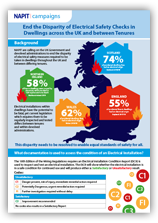
Electricity is in use all around us, it can be dangerous and has the potential to be fatal, yet the legislation surrounding the safety standards of electrical installations in dwellings differs throughout the UK and between tenures. NAPIT are calling on the UK Government and devolved administrations to end this disparity to enable parity of safety for all. In a recently published infographic, NAPIT examines the disparity of electrical safety standards within the UK, and within the 3 typical housing settings: owner occupied, social housing and the private rented sector. The summary clearly highlights the risk to life posed by electricity, with the number of fires in dwellings from an electrical origin being over 50% across all administrations. Yet, only England and Scotland have Regulations which require the regular inspection and testing of the electrical installations within privately rented homes at least once every 5 years, and only Scotland requires the regular inspecting and testing of electrical installations in Socially Rented Homes. There is currently no legal requirement to undertake any electrical safety checks in owner occupied dwellings, but with the current focus on Building Safety Reform, and enhancing safety standards in Higher Risk Buildings, NAPIT are supporting recommendation 188 from the Housing, Communities and Local Communities Select Committee’s pre-legislative scrutiny of the Building Safety Bill to: “recommend that the Government include supplementary provisions in the Bill for mandating regular electrical safety checks in higher-risk buildings.” This needs to be regardless of tenure to ensure the same safety standards are applied to all properties for parity. Four key requests: UK wide legislation to require every electrical installation in socially rented dwellings to have an electrical inspection and test, in the form of an Electrical Installation Condition Report (EICR) carried out by a competent and qualified electrical inspector at least once every 5 years. Legislation to require every electrical installation in privately rented dwellings to have an electrical inspection and test, in the form of an EICR carried out by a competent and qualified electrical inspector at least once every 5 years. (Needed in Wales and Northern Ireland) Legislation to require an EICR is carried out prior to the sale of all dwellings to protect the purchaser from potential electrical hazards. Legislation to require every electrical installation in dwellings within a Higher Risk Building, as defined by the Building Safety Bill, to have an electrical inspection and test, in the form of an EICR carried out by a competent and qualified electrical inspector at least once every 5 years. Commenting on the release of this infographic, Frank Bertie Chairman of The National Association of Professional Inspectors and Testers says: ‘Choosing to enhance the safety of electrical installations in dwellings can be a matter of life and death. Protection from electrical dangers should not be dependent on where you live. Policy alignment in this area is key to improving the electrical safety in dwellings and should build on the positive steps taken by the UK and Scottish Government’s in recent years, but it must go further. Unity provides clarity and consistency and must be adopted to provide assurance that regardless of the tenure or location of the home people live in, they are equally protected from electrical risks.’

Housing developers urged to end fossil fuel heating systems earlier than 2025
With the government setting a UK target to achieve net zero carbon emissions by 2050, it is no surprise that both businesses and consumers are seeking ways to contribute towards reaching this goal. In order to help achieve this target, the government has also announced a series of further goals such as the Future Homes Standard, due to come into play in 2025, which will require new build homes to be future-proofed with low carbon heating and world-leading levels of energy efficiency. Keith Bastian, CEO and founder of Fischer Future Heat, an expert in dynamic heating, explains why housing developers should be putting an end to using fossil fuel heating systems as soon as possible. When fossil fuels such as coal, oil and gas are burned, they release carbon dioxide and other harmful greenhouse gases, all of which trap heat in the atmosphere. Because of this, fossil fuels are the main contributor to global warming, climate change and an increased carbon footprint across both the UK and the globe. Currently, around 95% of homes have central heating, many of which will rely on gas or oil, and home heating is responsible for around 15% of the UK’s total greenhouse emissions. To reduce the UK’s carbon footprint, the Future Homes Standard sets out to ensure that all new homes built as of 2025 will have 75-80% less carbon dioxide emissions than homes built to current regulations. Although this is impressive, and it will make a phenomenal difference, what are we waiting for? Why not start now? Whilst it may appear that the responsibility lies with heating and energy providers to offer sustainable and cost-effective solutions, and to some extent it does, it is also down to the housing developers to build houses and homes that allow for newer, more sustainable heating systems. For newer homes, it will be relatively easy and affordable to change old fossil fuel heating systems to something a lot less damaging. However, for older homes, it can be quite the opposite. Because of traditional fireplaces and other energy escape routes through the fabric of the home, it can be extremely difficult for homeowners to make sustainable changes to their heating systems. The first step should always be – insulate, insulate, insulate. With approximately 247,000 houses being built in England and Wales each year, we can’t afford to wait until 2025 to become more eco-conscious. In today’s world, we are fortunate that eco-conscious consumers are beginning to desire more sustainable homes, so it seems obvious that housing developers should first and foremost be implementing eco-friendly heating systems. This will ensure the properties they are building are not only more desirable, but futureproofed when it comes to buying and selling on the property market. With the need for sustainable homes on the rise and somewhat of a necessity moving forward, eco-homes are continuing to prove popular. Using 50% less energy and 50% less water compared to houses being built to contemporary Building Regulations, housebuilders such as Gusto Homes are continuing to lead the way for sustainable housing. By maximising energy sources such as solar panels, minimising heat-losses from north facing elevations and concentrating on the overall eco-performance and waste-water heat recovery systems, Gusto Homes is transforming the industry and other property developers are slowly starting to follow suit. With this in mind, housing developers and homeowners alike should aim to install independent heating systems, with the likes of electric German clay heaters. Eliminating the inefficiencies that come with fossil fuelled heating systems, electric heaters are smart and sustainable room powered radiators that are more efficient for both the environment and people’s pockets. As well as helping to reduce the UK’s carbon footprint, electric heaters provide seasonal comfort. With traditional heating systems, you may struggle to find the perfect balance in room temperatures to suit the time of year, but with electric heaters, you are able to do exactly that. Electric heaters, combined with renewable energy sources such as wind and solar and the impending introduction of the Future Homes Standard, are a sure-fire way to contribute to the UK’s target of net zero carbon emissions by 2050. Why wait until 2025 to introduce such initiatives? Start now and make a real difference. The future is electric.