2 November 2026
Product of the Month: Amari Floodlight range by Aurora Lighting
 
26 November 2026
Thorn scores second Highland football lighting installation
 
26 November 2026
Segen pens exclusive distribution contract with M-Rack
 
25 November 2026
Scolmore helps rejuvenate Tamworth Cancer Support Centre
 
25 November 2026
Leicester apprentice crowned 2026 SkillELECTRIC champion
 

Latest News


MBO for Lancashire security and electrical firm, SEI
A Lancashire-based provider of security and electrical installations has been acquired by its management team. Security and Electrical Installations, which trades as SEI, has been bought from majority shareholders and founders Paul Mercer and Alan Ogden. Directors Bradley Ogden, Ian Hearle, Callon Ogden and Sharon Clarke have acquired the business for an undisclosed sum and will take over the day-to-day running of the Leyland-based firm. SEI specialises in the installation and testing of security, data cabling and electrical systems for a wide range of industrial and commercial clients including the NHS, HM Prison Service, education providers and local authorities. The company is also well-known for its work on high security sites in the energy, utilities and defence sectors. The corporate finance and tax teams at MHA Moore and Smalley advised Paul and Alan on the sale of the business, providing deal structuring, valuation and tax advice. Paul Mercer comments: “Our success over the last 20 years has been down to our ability to build lasting relationships with our clients who have come to value our dependability, drive and integrity. “Alan and I are proud to have passed the business on to an outstanding management team who embody these same values. They are the right team to take the business forward and will ensure seamless continuity for our valued clients.” Bradley Ogden says: “My fellow directors and I are privileged to have been entrusted to take the business on the next stage of its journey. Our whole team is committed to providing our clients with the same high levels of service and quality for which SEI is known.” MHA Moore and Smalley’s deal team was led by corporate finance director Stephen Gregson, tax partner Tony Medcalf, tax director Michelle Taylor, and corporate services director Judith Dugdale. David Filmer of Forbes Solicitors advised Paul Mercer and Alan Ogden on the sale. Nicola Whittle at Brabners provided legal advice to the management team. Stephen Gregson, corporate finance director at MHA Moore and Smalley, comments: “It’s been a pleasure to assist Paul and Alan in this transaction, enabling them to take a step back from the business and realise the rewards of two decades of hard work building a successful business. SEI can look to a bright future with an experienced and capable management team at the helm.” Founded in Lancashire, 2002, SEI has 23 staff and works with clients nationwide. In addition to security and electrical systems, its other services include LED lighting design and replacement, fibre optic installations, fire detection systems and the installation of electric vehicle charging points.  

ECS launches Invigilation Service in response to COVID-19 restrictions
The Electrotechnical Certification Scheme (ECS) has announced the launch of a pilot for an online invigilation service for the ECS Health, Safety and Environmental (HSE) Assessment as well as other new assessments through the ECS digital platforms. Responding to concerns regarding increased travel to assessment centres, especially as some have been closed due to COVID, the ECS has been working hard to see how it can better support its customers to ensure they can easily undertake their HSE Assessment needed when renewing or applying for an ECS card. The new online service is aimed at offering ECS cardholders and employers with the choice of undertaking the assessment without having to travel to an assessment centre. World class technology for automated invigilation using AI-powered, behavioural monitoring and verification tools provides a new facility for the industry to avoid unnecessary delays. With no requirements for downloading programs or browser extensions, users have the freedom to securely and safely complete their HSE Assessment at any time and anywhere. The powerful AI technology solution monitors the assessment to enhance the already stringent measures to prevent fraudulent activity. The system was initially launched as a pilot for employers in January and has seen a great interest with hundreds of assessments already through this remote system. Remote Invigilation is now an extended function within the Employer Portal; the Portal is already being used by almost 3,000 organisations across England, Wales and Northern Ireland. Work will be continually ongoing to improve the process, before expanding the service out to individuals and the wider industry in 2021. Jay Parmar, JIB Chief Executive, explains: “This is a fully integrated solution which can be undertaken online and gives immediate results, updating the individual’s card record as soon as the test has been successfully completed. Physical centres will still remain operational for those individuals and companies that wish to use this facility or don’t have access to a PC. Although the online system has predominantly covered HSE assessments in the past, this Remote Invigilation software can also be used for the new suite of assessments which have been introduced over the last year to support FESS Systems Operatives and Network Infrastructure.”

The future's bright, the future is Knightsbridge
Knightsbridge is further demonstrating it is Committed to a Brighter Future with a move to sustainable packaging that is both 100% recyclable and made from 100% recycled materials. In the case of cardboard boxes, the company has teamed up with the Forestry Stewardship Council (FSC) to ensure its packaging comes from wholly recycled  sources and is certified as such – look out for the FSC logo on these new materials. Where products were previous sold in plastic ‘clamshells’, these will now be sold in recyclable and biodegradable poly bags. The company also tasked its in-house recycling team to see what use could be made of materials received that would ordinarily go to waste. Its latest bright idea is converting incoming cardboard into ‘stuffers’ – the crinkle-cut packing that secures products within their outer cartons. The shift towards fully recycled and recyclable packaging falls within Knightsbridge’s Committed to a Brighter Future initiative, which sees the company’s determination to look after both customers and the environment turned into tangible, practical measures – rather than another round of corporate ‘greenwash’. Other achievements realised under the scheme so far include, for example, a 95% reduction in single use plastics, 98% of packaging being biodegradable; and contributions in both goods and volunteers that have helped feed over 1000 people at the company’s local food bank. Find Knightsbridge’s commitment to a brighter on social media via #committedtoabrighterfuture

Hydrosense protects new Dublin Airport control tower
Vimpex's Hydrosense Water Leak Detection System has been installed in Dublin Airport’s new Visual Control Tower (VCT) to protect the new state of the art facility from water ingress, which could seriously damage electrical, communication and computer networks. The 87m high tower is Ireland’s tallest occupied structure and a commanding new addition to Dublin city’s skyline. It comprises three separate but integrated building elements: the control cab and associated elements, the cab supporting shaft and a base building. The base building will accommodate staff facilities, electronic systems and mechanical plant space to provide control of the building environment. Vimpex’s Hydrosense Water Leak Detection systems are delivering the new standard in water leak detection; applying the integrity, control and reliability of life safety and building infrastructure systems to protect against water ingress that could seriously damage critical IT and communication infrastructure. It continuously monitors for water leaks around the clock, year in year out and has the facility for 72 hour battery standby in the event of power failure. Should a leak be detected the control panel sounds an alarm which can be extended to a remote location. When an alarm is raised, Vimpex Hydro-Cryer voice sounders can be used to broadcast an unambiguous message, avoiding confusion with other sounders on site. Utilising life safety technology in the design of Hydrosense provides the reliability and integrity of EN approved fire detection systems, meaning there is virtually no risk of failure, downtime and significantly fewer false alarms. Established in 1994, Vimpex is the UK's leading independent manufacturer and distributor of Fire and Building Infrastructure, Alarm and Evacuation products and accessories. The company produces and distributes a range of high quality Evacuation, Signalling and Fire System products - both Vimpex manufactured and supplied by the company's manufacturing partners.

Myenergi expands into Ireland as EV sales soar
A surge in EV sales and growing interest in ethical living has led to Myenergi, the award-winning manufacturer of renewable energy products for eco-smart home management, expanding its operations into Ireland. The new subsidiary, located in Ballycastle, Ireland, will be spearheaded by Pearse McHenry, a longstanding business partner of Myenergi. The move will bring the brand’s product range to the masses, helping residents benefit from a more sustainable lifestyle, as well supporting the government’s commitment to cleaner living. Myenergi’s zappi is the world’s first solar compatible EV charging device. With optional charging modes to either draw power from the grid, or utilise 100% of self-generated green energy, the pioneering system makes charging your car completely circular. A free supporting app allows users to utilise economy charging tariffs, engage the boost system and monitor energy usage. By August last year, there were more than 17,000 EVs on the road in Ireland, with a Government target in place to reach 936,000 by 2030. This target, which includes battery EVs and plug-in hybrid EVs, will be equivalent to one-third of the 2.8 million vehicles that are currently in use. Jordan Brompton, co-founder and CMO of Myenergi, comments: “Unveiling our subsidiary in Ireland is our latest step in an ambitious programme of international expansion. With Pearse at the helm, we’re confident that we can build on our strong market presence with on-the-ground expertise and knowledge. “Pearse has been a driving force in the Myenergi journey since the very beginning. Supported by the Irish government’s commendable plans for a cleaner future, we cannot think of a better person to help grow Myenergi in Ireland.” Ireland will not be Myenergi’s only subsidiary, with international operations already located in Germany and Benelux, and more to be announced shortly. The brand itself has grown significantly in 2020, resulting in the employment of more than 120 staff and requiring the relocation of the UK headquarters to a purpose-built 15,500 square foot flagship facility.

New appointments for ESP as business growth continues
As demand for its products across all categories continues to rise, ESP has made two new appointments within the sales team to strengthen its support for existing customers and continue to target and develop new business opportunities. Carl Darnell-Green has taken up the role of business development manager covering the London Region. A well-known face in the Scolmore Group, and a highly skilled business development manager with more than 30 years’ experience, Carl joins from his previous role with group company Unicrimp. His key responsibility will be to develop existing relationships and establish new connections with the contractors and specifiers who are key influencers in the decision-making process when it comes to specifying and procuring products from the ESP product portfolio. The full range currently comprises CCTV, access control, fire protection, emergency lighting and external surveillance systems, as well as the Sangamo range of heating controls and time switches. Darren Wiggs has been appointed area sales manager for the South East region. He brings with him a wealth of experience and knowledge, having spent 30 years with one of the industry’s leading electrical wholesalers, where he rose from van driver to group manager with responsibility for 13 branches and more than 70 staff. He will be using his expertise to promote and expand the growing ESP portfolio of products. As part of his remit, he will facilitate the delivery of contractor and wholesaler staff training to ensure that customers have a good knowledge of the breadth of products within the ESP range and fully understand the features and benefits – which is vital if they are to stay ahead in an increasingly competitive marketplace.

Fingerprint drug test used to support Nottingham CityFibre project
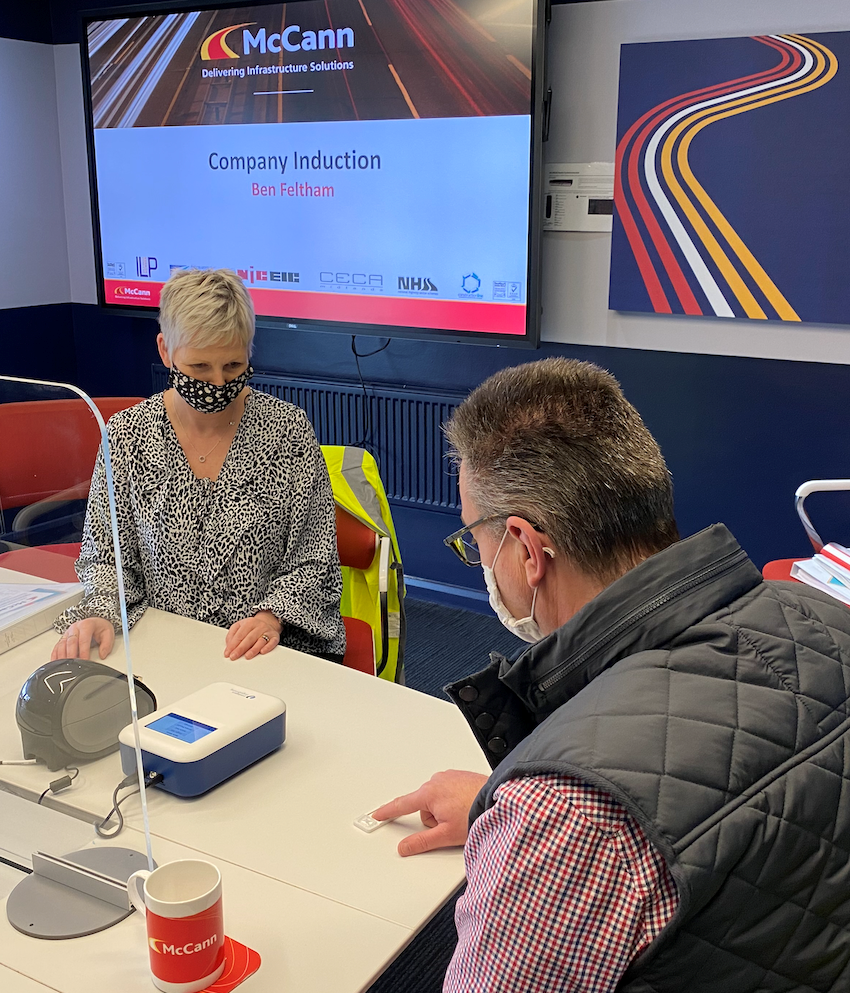
McCann, a Nottingham-based civil and electrical engineering construction company, is starting to use innovative fingerprint drug testing as part of its broader Health and Safety activities. This month McCann is starting to test new employees as part of the company’s induction process. Employees must pass the Intelligent Fingerprinting drug test before starting working on the major £60m Nottingham CityFibre contract, where McCann is supporting the delivery of the infrastructure to turn Nottingham into a Gigabit City with access to fibre. The Intelligent Fingerprinting test enables the entire drug testing process to be handled entirely in-house with results available within minutes – avoiding time away from site for testing. Candidates are simply asked to press each fingertip onto a small drug test cartridge to enable the rapid collection of a sweat sample. The cartridge is then placed in the portable DSR-Plus reader that analyses the cartridge and provides a positive or negative screening result for each drug in the test. McCann is screening for recent use of opiates, methamphetamine, cocaine or cannabis that could affect an employee and make them unfit for duty. The system is easy to use with virtual training for McCann’s team completed within an hour. Ben Feltham, Quality and Lean Manager of McCann says: “McCann operates throughout the UK on major road, rail and airport infrastructure projects for public and private sector clients. Our commitment to site safety has to be robust for both employees and the contractors under our responsibility. We previously used a saliva swab indicative drug test for initial for cause testing. If this proved positive, we then had to find an off-site 24-hour lab to provide a urine test for a final result. In some cases this has required a McCann HSEQ Manager being assigned to escort the operative being tested. As well as the obvious reluctance to carry out saliva swabs during a pandemic, there was a significant loss of time involved in escorting operatives for off-site second sample testing and waiting for results. “Also, we unfortunately encountered a contractor attempting to cheat the urine sample test at the offsite testing facility. With all of these negatives for traditional saliva- and urine-based drug testing methods, we were keen to strengthen our drug policy adherence by finding an alternative drug testing approach that would prove more robust against cheating. That’s why we were pleased to have discovered Intelligent Fingerprinting! “There are significant advantages with the Intelligent Fingerprinting drug test. We can bring the testing in-house – taking the samples and providing the results within minutes. In contrast to the offsite urine test method, we really can’t see any room for cheating to take place. It is also a relief not to have to handle saliva samples during a pandemic, particularly as this involved operatives having to remove their masks and inevitable close proximity. With Intelligent Fingerprinting’s method, face coverings can be worn at all times, while there’s no need for close contact or handling of biohazardous body fluids." Intelligent Fingerprinting’s drug testing system features a small, tamper-evident drug screening cartridge onto which ten fingerprint sweat samples are collected, in a process which takes less than a minute. The Intelligent Fingerprinting portable analysis unit then reads the cartridge and provides a positive or negative result on-screen for all drugs in the test in ten minutes. An introductory video demonstrating fingerprint-based drug testing in action is available here.

Siemens and DCS simplify switch to zero-emission fleets
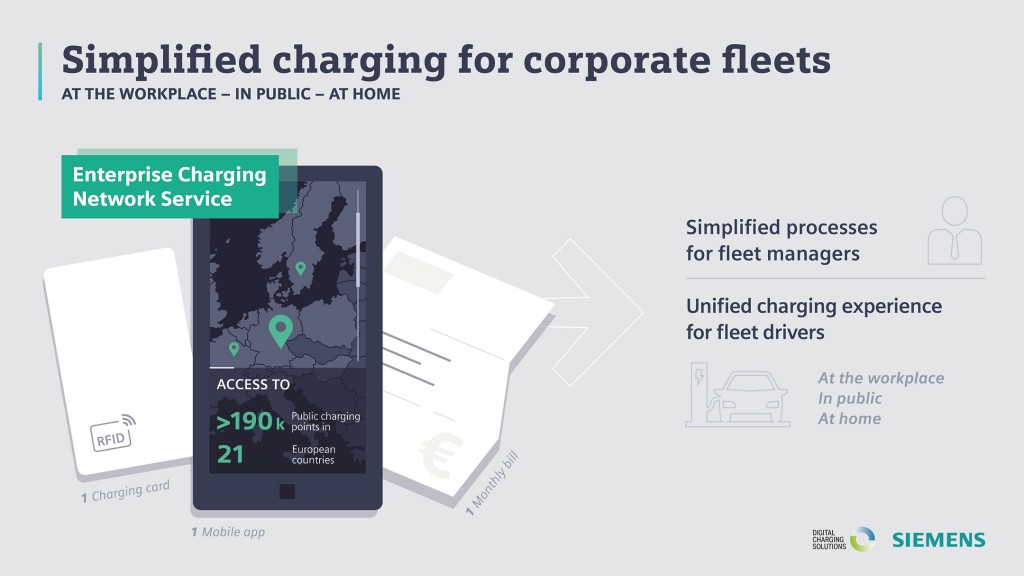
Siemens Smart Infrastructure and Digital Charging Solutions (DCS) are collaborating to help ease the transition to electromobility for drivers and managers fleets. The initial result of this collaboration is a new Siemens charging service called Enterprise Charging Network. This service provides a simple end to-end solution for charging at the company site, in the public and at home, thus standardizing the charging experience for drivers and reducing the effort for fleet managers. Simplified processes for fleet drivers and managers Drivers of company-owned electric vehicles can charge the same way wherever they are, using just one company charging card and app. They have access to the charging infrastructure at their own company sites as well as to over 190,000 public charging points in 21 European countries. All charging processes, regardless of where they take place, are billed via an integrated monthly invoice in the fleet portal. This gives fleet managers transparency over all operations while reducing the administrative overhead. The Enterprise Charging Network service is the initial result of the cooperation between Siemens and Digital Charging Solutions, which aims to make electromobility as accessible and usable for fleet customers as possible, thus promoting its adoption and expansion. To this end, the partners intend to connect electric vehicles, charging operations and the charging infrastructure intelligently and digitally to optimize the user experience for fleet drivers and simplify the processes for fleet managers. DCS brings Europe’s largest charging network with validated charging infrastructure point of interest (POI) data to the collaboration. “Electrifying corporate fleets comes with a variety of challenges. In addition to the management and maintenance of the hardware, the main thing is making charging and the associated processes as simple as possible. Charging corporate fleets needs to be as easy as charging a smartphone. Together with Digital Charging Solutions, we successfully launched a charging service that does just that,” says Jean-Christoph Heyne, Head of Future Grid at Siemens Smart Infrastructure. “In addition, we see potential in working with DCS and its OEM partners on on-board vehicle services because fleet drivers need a unified user experience – whether they’re using the charging app on their smartphone or an app in their vehicle. This is the only way companies operating large fleets will play a greater role in expanding electromobility over the long term.” Intelligently connecting electric vehicles and charging infrastructure “As an important player in the technology sector, Siemens is able to interconnect different areas, including charging infrastructure, distributed power generation and building technology. After all, linking electric vehicles and smart infrastructure doesn’t end at the charging station. While Siemens provides the right technology and services for EV charging at work and at home, we, as their partner, ensure a constantly growing public charging network. Together we integrate all charging processes, whether on the road, at work or at home, and offer companies a simple, reliable and convenient charging solution for their employees while at the same time creating the use cases of tomorrow,” explains Markus Bartenschlager, Managing Director of Digital Charging Solutions GmbH. Both companies are working on bringing additional joint solutions to the market. Over the last year, Siemens has continually expanded its portfolio of electromobility solutions. Its charging infrastructure portfolio includes solutions for slower charging during longer periods of non-use, including the Versicharge AC wall box, the depot chargers of the Sicharge UC family, and the Sicharge D fast charger for dynamic and parallel charging in between. This allows Siemens to provide corporate customers with the right solution for every application – be it at work, at home, in fleet depots or in public spaces. Customers can also take advantage of modular services such as operations and servicing, access and billing management as well as integrated charging management. The new Enterprise Charging Network service rounds out these offerings.

CICV calls for a Scottish Minister for construction in its first manifesto
In an unprecedented show of co-operation, commitment and collaboration, the construction industry in Scotland has come together to issue its first-ever manifesto detailing the crucial steps which need to be taken to secure a viable and sustainable future for the sector. Acting through the Construction Industry Coronavirus (CICV) Forum, a comprehensive range of trade associations, professional bodies, companies and individuals have signed up to the manifesto’s proposals. First among the proposals, published in the run-up to the Scottish Government elections in May, is a plea for a dedicated Government Minister for the construction industry, which would recognise its importance both to the recovery and to a net zero-carbon future. As well as a Minister for Construction, the manifesto proposes: A Chief Construction Adviser who would support the Minister and focus on delivery aligned with whole asset performance The development of an effective public sector maintenance and improvement programme The establishment of a VAT reimbursement fund for home repair and maintenance with a role for the Scottish National Infrastructure Bank Investment in affordable homes Development of the skills arena The introduction of a cycle network within the infrastructure investment plan The encouragement of conflict avoidance. The Forum points out that 175,000 people, including 10,000 apprentices, work directly in the sector in Scotland – 10% of the total workforce. It also contributes £21.5 billion to the country’s GDP and is a major economic multiplier, generating £2.94 for every £1 spent. Hew Edgar, Associate Director of Policy at the Chartered Institute of Building (CIOB), and Chair of the Forum’s Future Planning sub-group, says: “This manifesto is a declaration of intent, emerging from the environment of collaboration and co-operation which the CICV Forum has fostered during the COVID-19 pandemic. “This is the industry speaking with one voice, with an aim to benefit the future health, wealth and wellbeing of the country.” The manifesto is also designed to support the next government’s plans to meet Scotland’s ambitious targets on net zero, reduced energy use, decarbonisation, climate change, and other principal policy objectives around accessible, sustainable places and inclusive economic growth. He adds: “In offering these proposed policy initiatives, the CICV Forum and its members demonstrate that they will continue to engage positively with the next Scottish Government, representatives in Holyrood and the wider sector to provide intelligence, best practice and advice.” The manifesto is the latest initiative from the CICV Forum, which was established last March to protect and guide the industry through the ravages of the pandemic, Made up of trade associations, private companies and professional bodies, it has drawn on the collective expertise of its members to maintain a steady supply of information and practical advice to the sector.

How Computerised Maintenance Management is changing businesses
As a large business owner, with multiple premises, it can often be difficult to maintain oversight of the maintenance needs of each premises. This is where computerized maintenance management systems can really revolutionize processes, providing benefits such as increased visibility, reduced costs, efficient reporting, and maintained compliance. What is a Computerized Maintenance Management System? A CMMS is an accessible online system that hosts a range of facility management tools, from planned maintenance scheduling, to job tracking. Systems offered by facilities management companies, such as inSYNC from MSL Property Care Services, include various portals for your workforce to access and utilise. These can include portals to allow users to log jobs and request reactive maintenance work, management portals to show users how they are spending maintenance budget and wallboards, which display your live and ongoing tasks. How do they work? CMMS are created in line with your facilities’ needs, for a range of maintenance tasks. Once set up, they can be accessed 24/7 by business owners and their workforce to check for upcoming tasks, review live works, or to report any current issues to their facilities management provider. This can be hugely beneficial for larger businesses with multiple premises where employees can report issues at their site and management can have oversight of ongoing maintenance from head office. Benefits for larger companies Easy reporting With an CMMS, all relevant information is in one place. No matter which facility has an issue, the problem can be found and reported quickly and efficiently using the online system. Consequently, this reduces waiting times and minimises the effects of the issue as the request goes direct to your facilities management provider. Equally, having all your facility information online in one place means there is less complicated paperwork, so you’re less likely to lose important data, which causes delays in task completion. Better visibility A huge benefit of a CMMS is that those who have access can log in and track upcoming, ongoing, or completed tasks at all times of the day from wherever they may be. As a large business with multiple facilities and bigger workforces, this visibility is crucial for efficiency as it can be easy to miss small yet significant deadlines and information. With a CMMS, each member has a clear overview of the schedule and goals, allowing owners and their workforce to work cohesively to their best ability. Improved compliance One of the many amazing tools within a CMMS is scheduling, which allows you to clearly see every past, present and future facility inspection, and compliance certificates. Compliance is paramount to the smooth and safe running of facilities, yet often goes amiss when deadlines, certificates and tasks are not clearly visible. The online scheduling tool allows you to work with your facilities management provide to create an effective maintenance plan for each facility to ensure you are up to date with any required checks or legislations, ultimately avoiding expensive fines and other repercussions. Reduced costs As a result of these structured online maintenance schedules and improved visibility that come with an CMMS, businesses can act in advance, which in turn will reduce further expensive costs down the line. Additionally, if a maintenance issue suddenly occurs, the easy to report system means businesses can act accordingly and efficiently. This reduces waiting times, during which, the issue could potentially get worse, resulting in potential downtime and losses when your workforce could be in action. From the day to day running of facilities, to its long-term plans, investing in a computerized maintenance management system can truly revolutionize your large business.