2 November 2026
Product of the Month: Amari Floodlight range by Aurora Lighting
 
25 November 2026
Scolmore helps rejuvenate Tamworth Cancer Support Centre
 
25 November 2026
Leicester apprentice crowned 2026 SkillELECTRIC champion
 
24 November 2026
JTL celebrates opening of new Tyneside training centre
 
24 November 2026
LiGHT 26 welcomes record number of visitors to fifth event
 

Latest News


JTL signs charter as a commitment to further improve health, safety and wellbeing
JTL, the national training provider for electrical and heating and plumbing apprenticeships, has signed the Civil Engineering Contractors Association’s (CECA) Health and Wellbeing Charter as part of its Stop. Make a Change campaign (10-23 October). The signing of the charter demonstrates JTL’s continued commitment to improving all aspects of health, safety and wellbeing. JTL will continue to illustrate what good health, safety and wellbeing activities are and utilise the CECA’s ‘conversation starter’ resources to engage JTL training officers in the campaign, as well as using them as part of the regular health and safety checks with JTL leaners. Stop. Make a Change is a national event that allows leading UK contractors, customers and suppliers the opportunity to speak directly to employees and suppliers about health, safety and wellbeing issues, and to make commitments to actions targeting improved performance in these areas. Steve Smith, Head of Health & Safety at JTL, says: “JTL recognises that mental health issues, such as stress, anxiety and depression, are more apparent in the construction industry than in others sectors, with an estimated one in six workers suffering from a mental health issue. “JTL is already partnered with the Electrical Industries Charity (EIC) to offer a range of welfare support services to all of our learners and employers working within the electrical sector and the wider building services industries. As part of Stop. Make a Change, we are now looking forward to utilising the ‘conversation starter’ resources including respiratory, electrical installations, hand injuries and working at height to further support the health and safety of both staff and learners.” Stop. Make a Change will be held between 10-23 October and the European Week for Safety & Health runs from 19-23 October. To learn more, visit www.stopmakeachange.co.uk.

Amendment 2 to the 18th Edition: what could change?
Gary Parker, ECA technical manager, highlights some of the proposed changes to the 18th Edition of the Wiring Regulations. A brief history of the 18th Edition The IET Wiring Regulations, the essential publication for all professionals in the electrotechnical and engineering services sector, underwent an overhaul when the 18th Edition (BS 7671:2018) came into full effect in 2019. Amendment 1, which concerns electric vehicle charge points, came into effect on 1 February 2020. Now, BSI is seeking views on a new set of changes to the 18th Edition – Amendment 2 (AMD 2) – which could represent the biggest set of revisions to the Regulations yet. AMD2: why now? The rationale for Amendment 2 is similar to that behind the original 18th Edition: given the way our industry operates, the roles electrical engineers serve, and the increasing speed of technological change, the Regulations must reflect these changes to ensure installations are safe, efficient, useful, and able to meet evolving standards. The key potential changes are: Mandating of AFDDs on circuits with a rated current not exceeding 32 A The proposal: Regulation 421.1.7 proposes that arc fault detection devices (AFDDs) be required on all single-phase final circuits supplying socket-outlets and fixed current-using equipment. Some exceptions to this are listed. The impact: This proposal would effectively mandate the use of AFDDs across all small, single phase circuits, whether in a domestic, commercial or industrial installation, increasing the potential for safety but also the prospect of greatly increasing cost and complexity of installations. Risk assessment for sockets The proposal: Regulation 411.3.3 would be altered to remove the option for omitting RCDs on socket outlets not exceeding 32 A in installations other than dwellings. The impact: This proposal would leave designers with no option but to install RCDs on all socket outlets - unless they raise a departure against BS 7671. However, this is something the client may not be content with. Less paperwork for EICs The proposal: To reduce the number of items on the schedule of inspections for an electrical installation certificate. The impact: The number of boxes would be reduced to 13 items, greatly reducing the time needed to complete an EIC. A list of items that should be inspected (where relevant) is available, but this does not need to be completed. New cut-off date for complying with the 18th Edition The proposal: To state a date that, after which, all installations should be installed to the 18th Edition AMD 2 - regardless of when the design took place. The impact: If an installation is undertaken after 28th March 2023 then this would need to conform to the requirements of the 18th Edition AMD 2 regardless of when it was designed. This could impact contractors working on contracts which take some years to come to fruition. Energy efficiency and prosumers The proposal: A new Part 8 would be added for ‘Prosumer’s’ low-voltage electrical installations. The impact: This proposal highlights some of the additional requirements designers and installers should be aware of when working on newer installations that can generate their own energy supply. SPD requirements The proposal: To re-write the wording in section 443, Transient overvoltages due to the effects of indirect lightning strokes, to make this element easier to read. The impact: Potentially reducing the number of mandatory SPDs required in installations, however the wording should be closely read to ensure compliance. Foundation earthing The proposal: Regulation 542.1.2.202 would require that for new premises, additional earthing, such as foundation earthing, shall be provided. The impact: Every new build would need to be provided with a means of embedding electrodes to supplement the earthing system. This will require the use of electrodes or foundation earthing, in many cases at times when electrical contractors are not on site. Protected areas The proposal: The requirements of Section 422 would be dramatically re-written to introduce the phrase, ‘protected escape route’. The impact: Removing the conditions BD2, BD3 and BD4 and using the term ‘protected escape route’ would introduce requirements for designers and installers to consider how they install circuits in areas of escape and what types of equipment can be installed. How to share your views The 2nd Amendment to the 18th Edition of the Wiring Regulations (BS 7671:2018) opened as a Draft for Public Comment (DPC) on 21 September 2020. This will remain open for comment until 11 December 2020. The DPC is available via the BSI Standards development portal: https://standardsdevelopment.bsigroup.com/ In previous years, ECA Member comments have been directly responsible for improving the Regulations and ensuring that BS 7671 remains a practical and workable document, to the benefit of both customers and contractors. Please note, this article highlights some of the proposed changes in AMD 2. There are many others in the DPC, and ECAtoday readers are advised to pay close attention to the draft. To make sure your comments are worded and presented correctly, ECA has produced a handy guide to help Members complete the DPC – this can be found at www.eca.co.uk/amd2.

Critical financial wellbeing support launched
 The Lighthouse Construction Industry Charity’s free app has been upgraded with nudge, the financial wellbeing platform, in response to feedback from the industry and findings of its latest Impact Report. One of the key findings of the recently published report was that 62% of emergency financial grants were to help pay for daily living costs including buying food, paying utility bills, and clearing rent arrears and debt. Over 50% of our construction workforce are either self-employed, agency workers or on zero hour contracts, so when things go wrong financially, issues can quickly spiral out of control. In the current climate, the app’s new feature is yet another lifeline to the industry and focuses on the need for more preventative tools and building resilience in the areas of mental, physical, and financial wellbeing. Working in partnership with nudge, the charity is now able to offer even more support to the construction community, just when it is needed the most. Information and advice around money can be complex, overwhelming and conflicting, but nudge resolves this by providing personalised and unbiased financial education in a simple way. With timely prompts (nudges) to take action and the tools to help people manage their money, this latest development will help people to understand and manage their money more effectively, boost their financial wellbeing and, in turn, their overall wellbeing. The new feature offers: nudges: When there’s something people need to know, or a financial action they ought to take, users are sent a personal, timely nudge to remind them. Education: Bite size personalised content – boosts financial knowledge, skills and confidence. Tools: Money management tools help with tasks such as budgeting or saving for goals easier. The charity’s mission is that ‘no construction worker or their family is alone in a crisis’ and this latest addition to the app certainly responds to the needs of the industry. The free app complements the 24/7 Construction Industry Helpline. The charity has also recently announced free wellbeing training to the industry for the remainder of 2020 and this includes financial wellbeing sessions. In addition to this, the fallout of Covid-19 means an increasing number of redundancies and their free wellbeing programme now also includes two sessions aimed at improving employability. Bill Hill, CEO of the Lighthouse Construction Industry Charity said, “With financial stress at an all time high, it’s vital to address money worries quickly. By making all of our proactive and reactive wellbeing support services free, we hope to remove any barriers to access so that our construction workers get the help they need quickly.”

BASEC launches cable testing and certification to the data communication market
BASEC has extended its cable testing and certification offering by investing in new service capabilities for data communications market. The new service is designed to support the growing transformation of the data communication global market. The new data communications (datacoms) capability features industry standard state-of-the-art testing equipment which will be able to test the performance of the full range of datacoms cables including: CAT 5e, 6, 6A, 7, 7A, and CAT 8. In combining data transmission testing with nearly 50 years of cable testing and certification expertise, BASEC continue to deliver testing of electrical, mechanical, material, chemical and fire performance. End users, manufacturers and re branders of approved cables benefit from the added value that cable certification encompasses rigorous process auditing alongside physically cable testing, to deliver a holistic cable assessment. Tony Lioveri, BASEC’s CEO states, “BASEC has been working in partnership with cable manufacturers for nearly 50 years, and has a strong brand and heritage of being the mark of quality and safety, to be able to leverage this cable expertise to the datacoms market is an exciting proposition for BASEC. The BASEC brand is established worldwide and is delivered through our regional offices of dedicated teams of technical experts and superior customer care. Our goal is to give confidence to end users, manufacturers and rebranders that by using the BASEC mark that they can be assured of guaranteed quality and safety throughout the supply chain.” As the demand for data is forever increasing and technological advances continue to evolve. Investing in high performance networks that can accommodate the digitalisation of operations now and in the future is more important than ever. Three overarching transmission cable standards have been developed by industry to enable manufactures to comply with application requirements and work to ensure suitable cables are installed. ISO/IEC 11801 is designed for use within commercial premises in office spaces between 50-50,000 people ANSI/TIA 568 is designed to provide recommended design and installation criteria for cabling systems that will support existing and future services EN 50173 is consistent with the above, covering the entire channel whilst adopting additional cable specific requirements Tony Lioveri goes on to say, “We are excited to be expanding into the datacoms market. The enhancement of our facilities demonstrates our long-term commitment to deliver exceptional testing and certification to all customers across multiple markets.” The datacoms scheme has been developed to offer: An in-house capability covering the full depth of testing and certification services for a wide range of cables Simplification of the certification process, combining fire testing approvals Enable BASEC to extend the superior customer care to the datacoms market

FSA calls for mandatory use of competent fire professionals
A legal requirement to mandate the use of competent fire safety professionals should be introduced, according to a submission from the Fire & Security Association (FSA) to the Government. FSA argues that only competent fire risk assessors and fire professionals (engaged by Responsible Persons) should be able to undertake fire risk assessments. FSA contends that individual competency should include holding a robust, relevant qualification. Furthermore, FSA believes that the recording of all fire risk assessments should become mandatory, and that as part of plans to strengthen the legal basis of the Fire Safety Order the introduction of an ‘approved code of practice’ would set the requirements. FSA technical director Mike Smith says: “It’s absolutely vital that urgent steps are taken to give householders confidence that buildings and installations are safe and protected against the risks of fire and electric shock. “Mandating the use of competent fire professionals who hold robust qualifications is fundamental to this approach, and FSA strongly urges the Government to legislate on this critical issue.” FSA has also outlined how the role and responsibilities of the Responsible Person for a building should be enhanced, as well as what information should be readily available to tenants and homeowners. Due to the additional risks associated with higher risk buildings, FSA believes that three additional fire precaution requirements should apply to these buildings, specifically: provision and maintenance of means of escape, provision and maintenance of firefighting systems, and record keeping demonstrating the specific requirements. Furthermore, FSA believes that a tough sanctions regime should apply, including unlimited fines for certain breaches of the regulations, such as impersonation of an inspector.

Act now to make the most of £1bn energy efficiency fund, says Priva
Time is of the essence if public sector institutions are to take full advantage of the UK Government’s £1bn funding pot for improving energy efficiency, says Priva UK. A manufacturer of intelligent building control technology, Priva is urging local authorities to move quickly to apply for a share of £1bn fund - the detail of which was published by BEIS this week. Building management systems - specifically BEMs systems which are either bureau managed, remotely managed or not managed, are listed as eligible technologies. Applications are open to eligible organisations from 30 September; closing dates depend on the type of eligible organisation - ranging from 12 October 2020, to 11 January 2021. The Public Sector Decarbonisation Scheme, which will be administered and delivered by Salix Finance, will help councils install energy efficiency and low carbon heating measures, reducing energy bills and carbon emissions. The scheme is also expected to create up to 30,000 low-carbon jobs. This scheme is designed to enable new projects and those projects already started or completed are not eligible as they do not meet the additional criteria. However, if a project is currently underway and that project can be expanded with additional scope, an application for grant funding for that expansion can be made. Business and energy secretary, Alok Sharma, says: "Our plan to upgrade the nation’s buildings and help build back better is good news for jobs, the environment and people’s back pockets, as we reduce emissions and help cut energy bills." Gavin Holvey, General Manager, UK & Ireland, believes that the £1bn funding mechanism will not only stimulate the low carbon economy, it will catalyse essential change to in the pathway to net zero by 2050. “This is a very significant pot of money,” he says. “But, the opportunity must not be squandered. We have very ambitious targets to reach net zero - and our existing built infrastructure needs a great deal of investment to bring it up to standard. We - and our network of partners - stand ready and willing to work with the public sector act swiftly and reap the rewards of modern building management technologies.” This energy efficiency plan forms part of the government’s wider efforts to ensure the UK meets its legally binding target to reach net zero emissions by 2050 and build back greener from coronavirus.

Aico releases Fifth Edition of Electrical Contractors Handybook
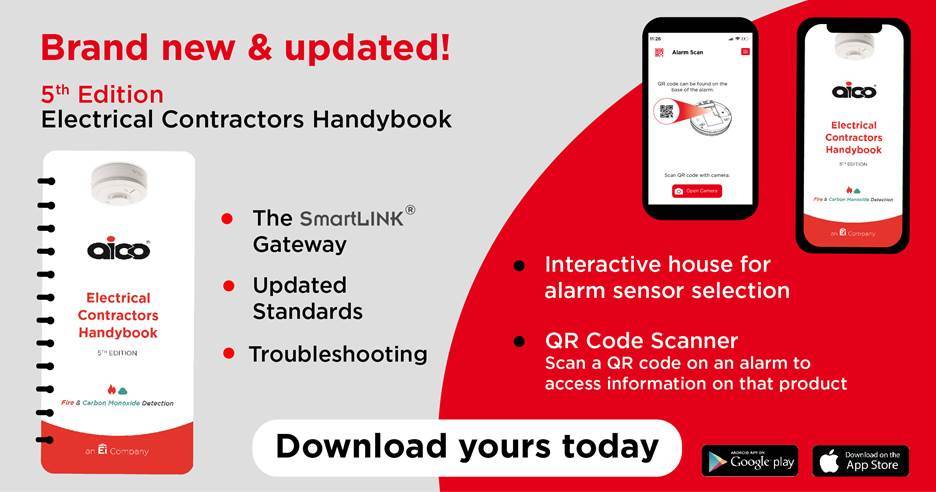
Aico has launched the fifth edition of its highly sought-after Electrical Contractors Handybook. Following on from the previous edition being designed with the customer in mind, the fifth edition compliments the new design with a wealth of extra features. The new edition has all the essential information you need to help you choose, site, install and maintain domestic Fire and Carbon Monoxide (CO) alarms and systems, along with new updates on the Ei1000G SmartLINK Gateway.The Handybook will keep you up to date with the latest standards and legislation, including the new updates in Scotland. It covers the different types of sensor available across Aico’s extensive range of fire and carbon monoxide products. It will also assist with the installation of the new Ei1000G SmartLINK Gateway, Aico’s new asset management tool that utilises their next generation of wireless technology to enable real-time notifications of fire and CO events. The fifth edition is completely free of charge and will provide extra information on the importance of testing and Aico’s wide range of accessories. Along with the physical copies, a handy PDF version is also being made available, with the Aico Handbook App also being updated. The previous version of the Handybook App was used by thousands of installers and gained great feedback. Aico has looked to go one step further with the updates, adding a QR code scanner, updated information on the Ei1000G SmartLINK Gateway, an interactive house for alarm selection and much more.

Vaillant TV campaign outlines investment in a sustainable tomorrow
With central heating making up 31% of all household emissions, Vaillant has launched its latest multimillion-pound marketing campaign, including a brand-new TV advert, to highlight the individual impact UK homeowners can make by having an efficient heating system. With its long-term strategy focused on sustainability, Vaillant will also be using its ‘Why Wait’ campaign, which began on 5 October, as an important milestone for the  industry as it becomes the first of the UK’s most popular boiler manufacturers to include renewables in TV advertising. With a strategic objective to bring low carbon technologies into mainstream consumer consciousness, the ‘Why Wait’ homeowner awareness campaign aims to educate millions of homeowners across the UK, why upgrading to a more efficient home heating system, such as heat pump or energy efficient boiler, can have a big impact on the climate and encourages them to turn to their local Vaillant installer to help them make a positive change for the future of the planet. Underpinned by extensive digital and social media advertising campaign,  aimed at homeowners who are looking for a new heating system, this latest campaign cements Vaillant’s commitment to delivering valuable support and homeowner leads to maximise the businesses of its installers and continue Vaillant’s Business Support strategy for its loyal installers. It comes after Vaillant’s entire range of domestic boilers was named the top-ranked gas boiler brand in the UK by the Which? Best Buy report 2020. This latest accolade, together with the TV ad campaign, means installers now have increased choice when it comes to specifying an efficient heating solution to their customers. Alice Woolley, marketing director at Vaillant, says: “As a business it’s important we look to the future. With the recent launch of the Green Homes Grant, together with the upcoming Future Homes Standard, the direction for our industry is clear. At Vaillant we have always had a longstanding commitment when it comes to developing innovative technology to deliver efficient and sustainable heating solutions for everyone. “Yet, while we continue to work towards a more sustainable tomorrow, we’re also focused on the ways we can continue to support our loyal installers. Our latest TV ad really brings to life how by investing in sustainability, we’re also investing in them. With a clear call to homeowners, and our recent Which? accreditation, we’re confident that the Why Wait campaign will deliver valuable leads to their businesses.” Vaillant is also offering a host of training courses specifically designed to cover low carbon heating technologies such as heat pumps and energy efficient boiler systems.

New structure sets the bar high for network infrastructure industry
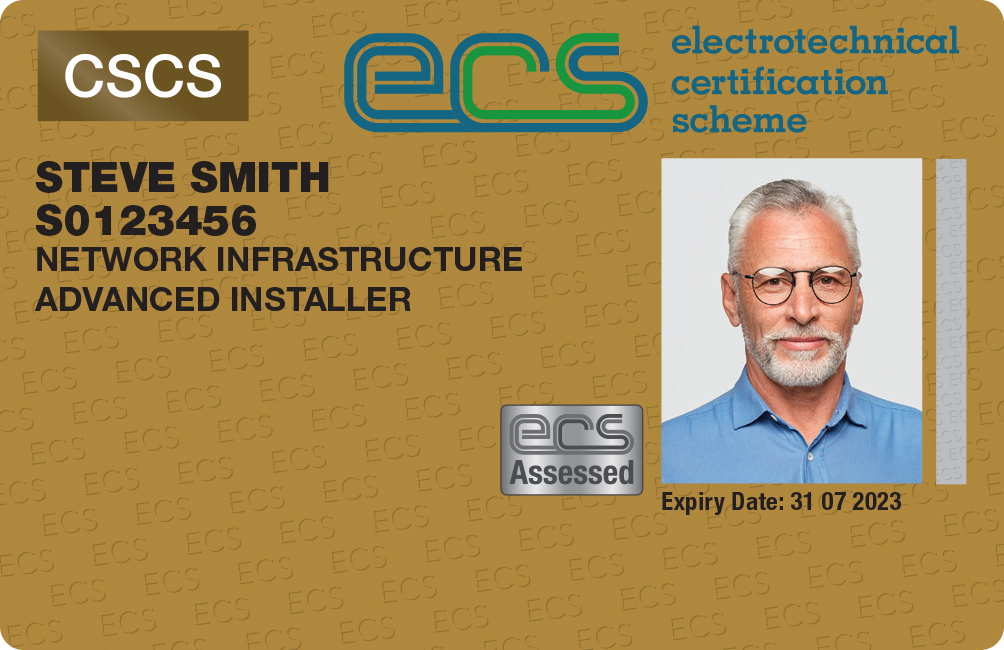
The Network Infrastructure industry has developed a new Occupational Qualification Structure leading to Electrotechnical Certification Scheme (ECS) Card recognition, which aligns with the future of the industry and addresses the need to bring together the wide-ranging skills which exist in the current workforce. Developed by an industry wide  group formed of the ECA, JIB, SELECT, CNet Training and a large group of employers, the new Occupational Qualification Structure follows the launch of the Network Cable Installer Apprenticeship Standard. It sets the benchmark for new entrants to the market at Level 3 but also crucially addresses the need to recognise professionals currently in the workforce that already benefit from hands-on experience, previous education and training and industry recognised qualifications. Formerly known as datacomms, the Network Infrastructure Industry covers the installation of data cabling, hardware  and other devices which enable computing and communication between users, services and other networked applications. This new pathway serves two important purposes, it clarifies the differences in education, training and experience for those already in the industry, and sets out a route for those entering the network cabling infrastructure industry. Jay Parmar, Chief Executive of the JIB says: “The introduction of the new Occupational Qualification Structure for the Network Infrastructure Industry is an exciting  step forward  as we strive to upskill the industry to deliver an infrastructure for a ‘Digital Britain’ by setting a  a benchmark for new entrants and recognition of the skills and qualifications of those already working in the industry. “A key strength of ECS and its partnership with CSCS is that it provides assurance and proof that cardholders working across sites in the UK have a high level of skills and experience and the appropriate  qualifications. We are delighted to be working alongside the Network Infrastructure Industry as they work to promote a higher degree of professionalism in the industry and, in keeping with the Construction Leadership Council’s target, ensure that all ECS cards are issued against an industry recognised qualification standard by the end of 2020.” Following the introduction of the new structure the following suite of ECS cards is now available which recognise a range of Network Infrastructure Industry occupations: Network Infrastructure Installer Apprentice Network Infrastructure Installer Trainee Network Infrastructure Assistant Network Infrastructure Installer (Level 3) Network Infrastructure Installer Gold Card Advanced Network Infrastructure Installer Network Infrastructure Supervisor Network Infrastructure Manager Network Infrastructure Designer From 1 January 2021 all new (initial) applications must comply with the Structure which includes the requirement for a Network Infrastructure Assessment for those applying for the Network Infrastructure Assistant card. From 1 July 2021 all card renewals will also need to meet the requirements of the new Occupational Qualification Structure.

NAPIT supportive of Setting the Bar report
The Final Report of the Competence Steering Group for Building a Safer Future, ‘Setting the Bar- A New Competence Regime for Building a Safer Future’ has been published. The report has been written following engagement with more than 300 organisations and through 13 working groups, with a unified vision to improve the competence of those who work in or on higher-risk buildings (HRB), be that design, construction, inspection or management as well as focusing on the safety and compliance of products used during the build and future renovations. The report focuses explicitly on the competence of installers working on and in HRB’s and how best to ensure their competence and identify them. Michael Andrews, NAPIT’s Chief Executive Officer comments: “It’s great to see a focus on ensuring the accredited third-party certification of companies alongside the verification of individual competence and supervision playing a key role within the recommendations set out in this report. Accredited company certification allows for insurance and consumer protection requirements to be mandatory and provides a route for monitoring the competence of individuals working for those companies. We fully support the proposal to require all installers working within HRB’s to have a core knowledge of fire safety within buildings and agree that requiring individuals to demonstrate their ability to work within HRBs, through regular third party assessments and CPD is a positive step forward for the industry- especially if authentication is digitalised. "We fully support the recommendation for constructive dialogue to continue between the Constructive Leadership Council, Working Group 2, the Competence Steering Group and Competent Person Schemes to ensure that competent individuals employed by a registered company are not having to jump through costly hoops to get additional cards with a particular logo on. Government Approved Schemes, namely Competent Person Schemes and TrustMark, should not be overlooked within this review as they are integral to the industry ambition of defining and identifying competence.” Following the publication of the final report from the Competence Steering Group, it is now up to industry to continue to work together on the implementation phase and ensure the recommendations within the report are put into practice. This work will be closely monitored by the new Building Safety Regulator, being set up within the Health and Safety Executive. NAPIT played an active role in the Installer Working Group which fed into this report, and will continue to work with industry to ensure that the recommendations within this report are realised in a way which enhances the existing system. To read the report in full please see below: Setting the Bar- Final Report http://cic.org.uk/setting-the-bar-annexes.php Setting the Bar- Executive Summary http://cic.org.uk/setting-the-bar-annexes.php