2 November 2026
Product of the Month: Amari Floodlight range by Aurora Lighting
 
11 November 2026
Energy, AI and smart buildings: register now for EMEX 2026
 
11 November 2026
Solar and batteries could cut electricity costs by 40%, data finds
 
11 November 2026
EIC confirmed as ECN Awards 2026 charity partner
 
11 November 2026
Acrospire to support Green Frog's European expansion
 

Latest News


Joining forces to make electric vehicles accessible to all 
More than two thirds of disabled drivers plan to make the switch to an electric vehicle in the next decade, according to the UK’s largest study of disabled drivers. However, many fear they will not be able to charge their EVs at home, with 71% of the 1,000 disabled customers who took part in the survey identifying the lack of accessible charging infrastructure as the main reason they couldn’t get an EV. UK Power Networks has worked in partnership with the charity Motability to understand the barriers disabled drivers who park on-street face and is leading the Enable project to create a coordinated approach with local authorities and other key players to overcome them. It is estimated there will be 745,000 Blue Badge holders across London, the East and South East - the areas where UK Power Networks delivers electricity - by 2030, and more than half will rely on on-street chargers if they buy an Electric Vehicle (EV). Almost 80% of those who took part in the survey said they expect their disabled parking bay to have an EV charge point installed next to it. Current EV charging infrastructure includes parking bays that are too small, few dropped kerbs making it difficult to get close to charging equipment and charging point plugs that are too high to reach for wheelchair users. As a result, drivers with disabilities are at risk of being left behind in the low carbon transport revolution. The project has engaged with 20 local authorities, OZEV, Transport for London and charge point installers to understand the current process of rolling out on-street charging for disabled customers. Sharing data and knowledge helps model when and where demand will emerge as disabled parking bays are electrified. As a result, the Distribution Network Operator can invest and liaise with people in the right locations, to make sure the electricity network is ready to meet that demand and that accessibility needs are taken into consideration. The findings from the project will be used to inform local authorities’ Local Area Energy Plans, ensuring accessibility needs are considered when rolling-out public charge points and everyone can take part in the transition to EVs. Findings from the project have also fed into an Accessible Transport Information Hub, to help customers, local authorities and other interested parties get the information they need for accessible charging infrastructure and help facilitate the transition to electric vehicles. Ian Cameron, head of customer service and innovation at UK Power Networks, says: “We want to ensure anyone who wants to, can make the switch to an electric vehicle and nobody is left behind in the transition to Net Zero. The first step is gaining a deeper understanding of our customers, which this study has given us. Using these insights we are advocating for accessible charging infrastructure, and are collaborating to put in place practical solutions that will make a material difference to people’s lives.” Catherine Marris, Head of Innovation at Motability, says: “This research shows that most disabled people are already planning to switch over to EVs, but are being held back by concerns over whether they can readily charge their cars near their homes or near their destinations. Disabled people are more reliant on cars for door-to-door journeys and have far fewer options for travel due to inaccessible transport, so it’s essential that accessibility is designed into EV infrastructure right from the start. Motability is sponsoring the British Standards Institute (BSI) to produce the world’s first Standard on accessible charging, and many organisations will then need to work together to make accessibility a reality – from local councils and distribution network operators to manufacturers and installers.” Paul Nicholls, Parking Strategy and Contracts Manager at Brighton and Hove City Council, comments: “It’s been a pleasure working with UK Power Networks on the Enable project. Knowledge sharing and engagement with disabled groups is at the heart of the development of accessible charging infrastructures. We’re grateful for the important insights this project has given us.”

Fantastic free training initiatives to support Mental Health Awareness Week
The Lighthouse Construction Industry Charity are announcing some fantastic initiatives to coincide with Mental Health Awareness Week and reminding everyone in construction about all the freely available resources they offer. The charity is launching three fantastic new masterclasses to complement the huge variety of free wellbeing masterclasses already available to anyone in construction and these can be booked now. Free New Masterclasses Crossing the line - Bullying vs Banter: Looks at what is meant by banter and when does it go too far and become bullying. Taking Control -Drugs & Alcohol: The importance of why and how organisations carry out regular testing on their employees and the physical and mental effects of drugs and alcohol. Promoting Happiness: Introducing happiness habits and providing an understanding of how to develop your attitude and improve your mindset. As well as announcing their new masterclasses, the charity has also launched their Road to Wellbeing package as part of their Company Supporters programme. As from 1st May all company supporters will be able to access as many scheduled online mental health courses as they wish, completely free of charge. This even includes MHFA England approved Mental Health First Aider Courses. Free Mental Health Training MHFA England Mental Health Awareness ½ day. MHFA England First Aid Course two days. Managing Mental Health in the Workplace – one day CPD accredited. Company Supporters will now also have access to additional support including, a dedicated resources hub, wellbeing champion training and critical incident response. Bill Hill, CEO of the Lighthouse Construction Industry Charity says, “There’s always a huge focus of activity around Mental Health Awareness Week, which is fantastic, but with two construction workers taking their own life every single working day, we need to do more. We understand that for many companies, creating and delivering initiatives to improve workforce wellbeing can be difficult, time consuming and costly, so we want to make things as simple as possible. Our Road to Wellbeing package underpins our commitment to ensure that everyone has easy access to a variety of pro-active resources to support every level of an organisation, from site operatives through to senior management.” Throughout Mental Health Awareness Week the charity will also be posting industry relevant statistics on mental health across their social media channels and their website to signpost to their core charitable services. Five core charitable services available to everyone in the industry for free: 24/7 Construction Industry Helpline offering free and confidential emotional, physical, and financial wellbeing support with translation services for those that need extra support. Construction Industry Helpline Self Support App which complements the helpline and signposts to over 3000 accredited organisations offering specialist support. Free text HARDHAT service that gives immediate access to text back counselling Lighthouse Beacons. 160 volunteer centres across the country that offer a safe place to meet in a confidential environment. CPD accredited Wellbeing Masterclasses covering topics such as Managing Stress, Building Resilience and Financial Management to name just a few.

BSIA to launch report on video surveillance market at IFSEC International
The British Security Industry Association (BSIA) will launch a major research report into the video surveillance market in the United Kingdom at IFSEC International at London’s ExCeL Centre on 18 May. The report, titled ‘The Bigger Picture’ is an extensive update to the BSIA's research report of 2013, ‘The Picture is Not Clear’, which has been quoted by the trade and mainstream media worldwide. The 2022 report has been produced for the BSIA by specialised innovation research and advisory company Anekanta Consulting. It extends much further than the original report and is hailed to be the most comprehensive study of the number, type, and use of video surveillance cameras in the UK. A selection of headlines will be revealed at BSIA Stand (IF2850) on 18 May 2022 at IFSEC International Excel London including: • Total number of professional video surveillance cameras in use in the UK • The public vs private sector ratio • Use of video surveillance cameras as a data source • Adoption of AI and facial recognition software The full report includes a detailed analysis of the types of cameras used and for what purpose, cloud storage trends and a comprehensive study of end user applications and future trends across 11 sectors including retail, transportation and CNI. Mike Reddington, Chief Executive, BSIA, says: “The need for video surveillance cameras continues to grow at an accelerated rate due to the ever-present threat of terrorism in public places and an increasing desire by the private sector to improve the safety and wellbeing of employees in the workplace. The threat of criminal damage and theft in the commercial sectors also remains a consistent driver for more video surveillance cameras.” Ben Linklater, Video Surveillance Systems Chairman, BSIA, comments: “The purpose and use of cameras are regularly brought into the spotlight, raising questions about whether video surveillance cameras are used in a legal and ethical manner and whether their use is excessive or disproportionate to the risks identified. To answer these and other questions and to aid stakeholders (such as the BSIA) in developing guidance, it is imperative that the industry conducts bodies of work such as ‘The Bigger Picture’ report.” Pauline Norstrom, CEO, Anekanta Consulting, adds: “Cameras are increasingly used beyond security and this report provides information about their other uses and whether Artificial Intelligence (AI) based technologies such as facial recognition, and object detection software enhance the benefit of the cameras.” The full report is of value to any company involved in the design, manufacture, installation, integration and use of video surveillance cameras, AI, and storage in the UK for security purposes and beyond and will be available to BSIA Members only.

Survey says global industry is accelerating investment in energy efficiency
Global industry is accelerating its investment in energy efficiency in the next five years as the crucial race towards net zero intensifies, a new survey finds. The Energy Efficiency Investment Survey 2022 comes in the wake of a recent UN report calling for concerted action from countries to cut greenhouse emissions at a faster rate. The global survey conducted by Sapio Research targeted 2,294 companies in 13 countries, ranging in size from 500 to 5,000 or more employees. It offers the latest snapshot of how industries across the world are planning to invest in energy efficiency measures to achieve net zero. A key finding is that more than half (54%) of the companies are already investing, while 40% plan to make energy efficiency improvements this year. “Significant population and economic growth will accelerate climate change to a critical point if governments and industry don’t intensify their efforts. Growing urbanisation and rising geopolitical tension will also make energy security and sustainability even more critical,” says Tarak Mehta, President of ABB Motion. “Improving energy efficiency is an essential strategy to address these potential crises. Therefore, the acceleration in investment highlighted by this survey is positive news.” Industrial motor-driven systems, in particular, hold huge potential for energy efficiency measures. Almost two-thirds of the survey respondents are upgrading their equipment to best-in-class efficiency ratings, such as high-efficiency electric motors controlled by variable speed drives. The report also highlights areas of concern. Half of the respondents listed cost as the biggest barrier to improving energy efficiency and 37% felt downtime was a barrier. Also concerning is that only 41% of respondents felt they had all the information needed regarding energy efficiency measures. “It is vital to help stakeholders across industry understand that net zero need not mean net cost. Both suppliers and governments have a role to play in promoting the message that adopting energy efficient technology offers a fast return on investment while cutting CO2 emissions. The bottom line is that energy efficiency is good for business and good for the environment,” comments Mehta. More key learnings from the survey: Respondents reported that, on average, 23% of their annual operating costs are attributable to energy usage. Nine out of 10 respondents indicated that rising energy costs are at least a minor threat to profitability, while more than half (53%) perceived it as a moderate or substantial threat. Despite cost being a significant barrier to investing in improving energy efficiency, cost savings were the most important reason for investing (59%).

Smart scenario switch added to Scolmore’s ClickSmart+ range
Scolmore continues to develop its Click Smart+ home automation range and has introduced a new wireless smart scenario switch that is designed to control lights and appliances from any location. The battery-powered wireless smart scenario switch allows you to control multiple lights and appliances and with one click, creating multiple smart solutions, bringing added convenience, comfort, security, energy saving and ultimately more control in the home. There are many possibilities: Create different atmospheres for each room by personalising the lights. Pair the smart switch to the ClickSmart+ or ESP Fort Security devices to enhance security. Set routines for lights and appliances to turn on and off as required to help create a more energy efficient home. Working in conjunction with the Click Smart+ hub (sold separately) the smart switch offers six possible activation clicks (one to three on the up click and one to three on the down click) to maximise the scenarios that can be controlled. The smart switch is designed with Scolmore’s GridPro module benefits in mind, allowing users to choose any finish plate desired. It can be installed using the clip in method with Yoke assembly or using the screw method directly to the front plate. The module is available in a white or black finish. It is configurable within the ClickSmart+ app for remote switching – with wireless pairing to ClickSmart+ switch and dimming devices. Multiple devices can be added to each Tap-to-Run action and the grouping of actions can create a range of scenarios around the home e.g., leaving home – one single click to switch off all paired devices. Decorative smart sockets now available in all finishes Also new to the ClickSmart+ range are further decorative sockets and finishes. 1 and 2-gang Smart products in some of the company’s most popular ranges - Definity screwless, Deco+ premium decorative and Deco decorative wiring accessories ranges were added at the beginning of the year in certain finishes. The range has now been expanded to include all finishes - Black Nickel, Brushed Stainless Steel, Stainless Steel, Polished Chrome, Antique Brass, Polished Brass, Satin Brass and Pearl Nickel.

State of the art power boost for Cambridge
Residents and businesses in south east Cambridge are benefitting from a recently completed £3.5 million state-of-the-art upgrade to their electricity network. The project, carried out by UK Power Networks, began in the Autumn of 2020 and has future proofed the network after upgrading the Fulbourn substation, which serves 48,000 customers in homes, businesses and industrial units. Old outdoor switchgear and concrete structures were replaced with a new indoor switch house to protect the newly installed equipment. The new technology also enables some power cuts to be fixed remotely, which can reduce the time customers are off supply. Richard Desborough, project manager at UK Power Networks says: “This project benefits the supplies within the Cambridge area, as it will cater for the proposed re-development in and around the city. It also means the network is more resilient and reliable. “We are pleased that the project was completed four months earlier than scheduled.” “This project is one of many multi million pound schemes we are carrying out this year with support from our Capital Programme Delivery alliance partners to make sure we continue to provide resilient power supplies for the local communities we serve.” UK Power Networks safely and reliably delivers electricity to 18 million people through cables, substations and power lines and invests around £600 million each year in the network. [gallery columns="2" ids="30965,30964"]

CityFibre celebrates Harrogate and Knaresborough’s full fibre rollout
Internet users across Harrogate and Knaresborough are now able to connect their homes and businesses to the best digital infrastructure available thanks to progress made by CityFibre. CityFibre has now made homes in Knaresborough, Rossett Green and the area to the South of the Stray in Harrogate ‘ready for service’, which means residents can choose to connect to full fibre-enabled broadband services when they go live in their area. In Harrogate and Knaresborough, customers can sign up to services from Boundless Networks, TalkTalk and Zen, with Giganet, Vodafone and other providers expected to join the network soon. The rollout is now progressing into new areas with construction underway in Pannal and Bilton in Harrogate, as well as parts of Starbeck, while work in Ripon is set to start later this year. Once the town-wide rollout reaches completion in 2023, almost every home and business locally will have access to full fibre services from a choice of internet service providers. Kim Johnston, Regional Partnership Manager at CityFibre, says: “CityFibre has been making great progress and people we've spoken to have been amazed at just how much fibre we've put down in the last 15 months. It’s hugely exciting to now see areas in Harrogate and Knaresborough ready for service and the first residents starting to benefit from our digital investment that will future-proof their connectivity for decades to come.” These towns are part of a growing number of locations in the UK to benefit from CityFibre’s £4bn Gigabit City investment programme which will bring new and better broadband infrastructure within reach of up to eight million homes and businesses nationwide. In Harrogate, Knaresborough and Ripon alone, CityFibre is investing £46m. Rachel Joyce, Executive Director of Corporate Affairs, Harrogate Borough Council, comments: “Investment in our digital infrastructure supports economic growth and is vital for modern, everyday life. Harrogate Borough Council is delighted to be working in partnership with CityFibre and North Yorkshire County Council to ensure that Harrogate district is at the forefront of digital connectivity”.

Local Elections 2022: ECA calls for better local EV charge point policy
With local elections taking place this Thursday (5 May), ECA is calling on its members, the wider electrotechnical industry and the public to ask their local election candidates how they plan to cater to the massive rise in electric vehicles in the UK. ECA's Energy and Emerging Technologies Solutions Advisor Luke Osborne shared a short video calling on viewers to ask their local candidates how they propose to ramp up electric vehicle charge point installation in their area. [embed]http://www.youtube.com/watch?v=Rt8o3e_nKXw[/embed]

More than £100 million of tools have been stolen in the UK since 2020
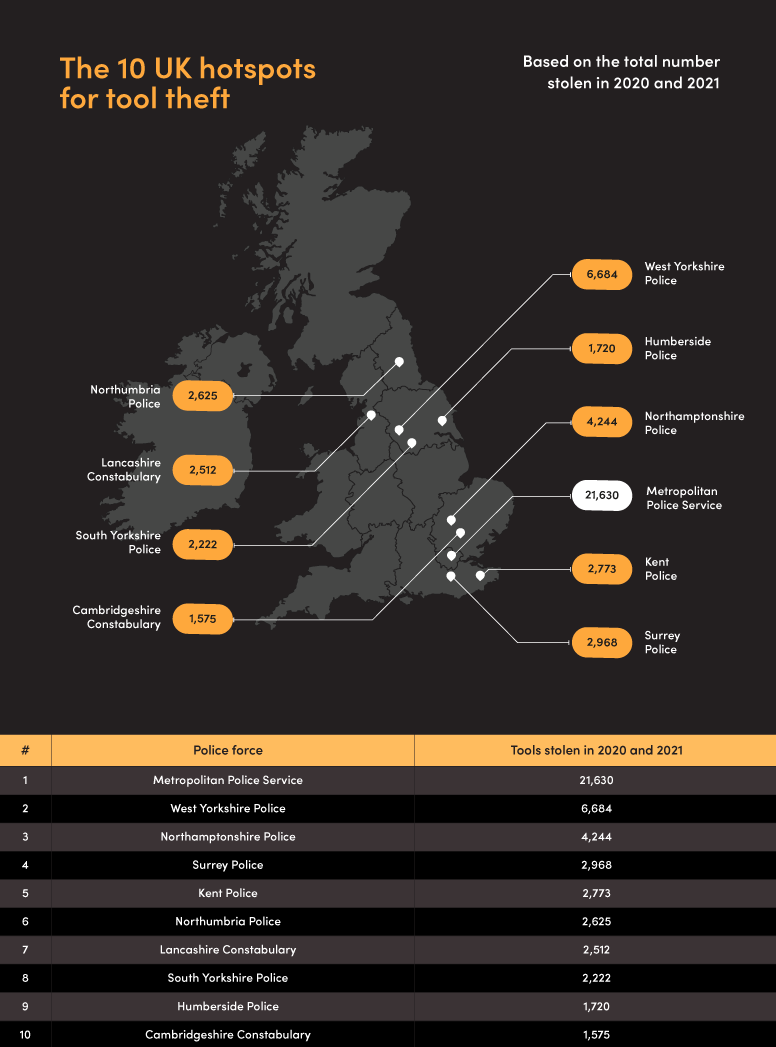
More than £100 million of tools have been stolen across the UK over the last two years, with almost 60,000 crimes committed, new research has revealed. The study, conducted by IronmongeryDirect issued Freedom of Information requests to police forces to discover how many tools were stolen in 2020 and 2021, and the value of these items. In total, 58,833 tools were reported stolen, averaging over 2,000 per region. The biggest hotspot for the crime is London, where over a third (37%) of incidents occur. Between 2020 and 2021, the Metropolitan Police Service dealt with 21,630 cases of tool theft. West Yorkshire takes second place, with 6,684 offences over the two years, but tops the chart for value of goods stolen. In 2020 and 2021, the combined value of stolen tools in the region was a staggering £50,242,427. This is more than half of the UK’s total value, which stands at £100,329,740. This figure could be even higher in reality, however, as in many incidents of tool theft, the value of items taken is not recorded. The five police forces reporting the highest value of stolen tools are: West Yorkshire Police with £50,242,427. Metropolitan Police Service with £34,635,644. Kent Police with £4,730,700. Derbyshire Constabulary with £3,182,605. Northumbria Police with £1,607,518. To help tradespeople protect themselves from tool theft, IronmongeryDirect has partnered with Stefano Lobban, Director at Herts Tools, to offer security advice. Here are Stefano’s top three tips: 1) Be careful where you store tools “If possible, don’t store tools in your van overnight. If you have to leave tools in your van for any length of time, park with rear or sliding doors against a wall or fence. Parking in a busy area covered by CCTV will also deter thieves.” 2) Invest in security “Get an alarm, a lockable interior cabinet, or interior deadbolts for your van. These measures make it harder and noisier for thieves to get at your tools. Make thieves aware of the safety measures you’ve taken by placing stickers on your van to deter them.” 3) Make your tools less appealing “Make your tools less attractive to thieves by removing brand name plates and marking them with neon spray paint. This will also make them easier to identify if they do get stolen.” Dominick Sandford, Managing Director at IronmongeryDirect, says: “Unfortunately, tool theft is a problem that thousands of tradespeople have to deal with every year, and it can have a huge impact on both the individuals and their businesses. “Workers will potentially have to pause their jobs until they are able to recover or replace the tools stolen, and that can be a lengthy and expensive process. “That's why we've partnered with experts to share advice on how to hopefully protect yourself and your tools, and make it harder for thieves.”

More power to employers in new ‘Skills Bill’
A new law recently passed through Government means that employers are now embedded at the heart of the skills system. The Skills and Post-16 Education Act in England has introduced a number of measures to improve the skills and training landscape, empower employers to drive up the quality of apprenticeships and prioritise green skills. In addition, schools will now be required to make sure all children get to meet training providers that offer technical education routes such as apprenticeships, T Levels or traineeships – opening their eyes to a wider range of careers and not just traditional academic options. TESP welcomed the launch of the Skills Bill and the positive impact it will have on its work to continually improve electrotechnical skills development, training and careers promotion. “With employers firmly at the heart of the system, this will allow our industry to develop coherent training pathways and ensure that only high quality technical qualifications, valued by employers and industry, will have a place in this new landscape,” says Ruth Devine, Chair of TESP and Managing Director of SJD Electrical. “TESP will continue to work in the industry’s best interests with employers at the helm.” Working alongside Ruth on the TESP board is Vice-Chair Nathan Smith of ESP. With its employer-led board, through consulting with employers across the industry, developing labour market information and building a clear picture of future skills needs, TESP represents the views of employers and acts as the industry’s voice to the UK Government and devolved administrations on electrotechnical skills issues.