2 November 2026
Product of the Month: Amari Floodlight range by Aurora Lighting
 
24 November 2026
JTL celebrates opening of new Tyneside training centre
 
24 November 2026
LiGHT 26 welcomes record number of visitors to fifth event
 
23 November 2026
Advanced acquires communications specialist Baldwin Boxall
 
23 November 2026
Trades face 'skills squeeze' as apprenticeship demand soars
 

Latest News


Bemco initiatives support new entrants to gain a foothold in smart home installation 
Bemco, one of the larger independent electrical wholesalers in the UK and a specialist in smart home technologies, has introduced Bemco SmartPRO, a new online channel for electricians’ keen to grow their business in the professional smart home space. This initiative is supported by a new ‘Innovation Room’, located at Bemco’s HQ in Wandsworth, South London, which will act as a physical demonstration space, showing how these technologies can be installed and seamlessly integrated into a customer’s home. Accessible at Instagram @bemcosmartpro and Twitter #bemcosmartpro, the Bemco SmartPRO channel focuses on providing solutions, advice and resources to help electricians get to grips with the latest technologies that will help them seize the smart home market opportunity.  Bemco SmartPRO is supported by Lutron (RA2 Select, Vive and Quantum), SONOS, Honeywell and Collingwood, whose products can be deployed to offer smart lighting, blind, audio, security and HVAC control solutions for the modern smart home. Bemco’s ‘Innovation Room’, a demonstration set up featuring products from these brands, is also now open to visitors. Here, those new to the market can see how different technologies can be applied and integrated to deliver an effective smart room solution for a client. Once inspired, Bemco can support electricians on a tailored training programme, to equip them with the skills they need to learn, improve and become a professional smart home technology integrator. “Consumer demand for professionally installed and integrated smart home technologies is growing,” says Julian Barkes, Managing Director at Bemco. “We know that the smart home represents a sizeable market opportunity for electricians, but it also requires new skills and a familiarity with new brands and fast-moving technology to meet consumer expectations. As a trusted and respected electrical wholesaler, we have relationships in place with the key players that enable us to provide a solid platform to educate and support our customers.  The Bemco SmartPRO channel together with the Innovation Room will give our customers a great start-point for exploring this market and help them develop expertise and experience so they can take full advantage.”

Octopus Energy Generation accelerates green power with wind farms in the UK, Sweden, France and Finland 
Octopus Renewables, the fund management specialist in Octopus Energy Group’s generation business, has signed four deals to ramp up wind power generation across Europe to help deliver net zero. The team already managed 745MW of wind assets - and these deals will boost its wind capacity by up to 90% over the next 10 years. The investments, all signed in the last three months, will see wind farms in the UK, Sweden, France and Finland provide a combined capacity of up to 690MW, enough to power nearly half a million homes a year. Development of nine wind farms in Scotland and Wales  In the UK, Octopus Renewables is investing in a joint venture to develop nine onshore wind farms with Wind 2 Limited, a specialist UK wind farm developer. The new wind farms will be developed across Scotland and Wales over the next five to 10 years, with a potential combined capacity of approximately 570MW. The deal will go a long way to help the UK create more home grown renewable energy. Building a Swedish wind farm with OX2 The business is expanding its footprint in Sweden with a third deal in the country, buying a ready to build onshore wind farm in Marhult, outside Växjö, from OX2, a developer of renewable energy across Europe. Once built, the 31.5MW capacity wind farm with seven Vestas turbines will generate enough to power 18,000 homes annually. Octopus Renewables has previously completed two other deals with OX2 - and is now strengthening this relationship. Managing French wind farm following deal with Energiequelle Octopus Renewables will now be managing a French onshore wind farm Broons/Biterne-Sud in north-east Brittany, after a deal with Energiequelle, a German project developer and operator of renewable assets and storage facilities. The wind farm has six Enercon turbines with a capacity of 14.1MW. This project has a government-backed Contract for Difference (CfD) for a 20-year period. CfDs encourage renewable generation by guaranteeing developers a fixed price for the green power generated. Acquiring two Finnish wind farms In the final investment, Octopus Renewables has acquired two onshore wind farms in Finland. The Saunamaa and Suolakangas wind farms have a combined capacity of 71.4MW. They will generate enough energy to power over 45,000 homes, avoiding the equivalent of 68,000 tonnes of carbon dioxide emissions annually. These wind farms have a five-year Power Purchase Agreement (PPA) with Baltic energy company Eesti Energia. This will allow Eesti Energia to provide its customers with more clean energy. Zoisa North-Bond, CEO of Octopus Energy Generation, comments: “We’re blown away by the prospect of building so many wind farms in the UK and further afield in Europe. We’re passionate about accelerating the transition to green energy across the globe - and these deals will hugely boost our wind power portfolio.” “The energy crisis has shown how exposed Europe is to global fossil fuel prices. These new wind farms will help Europe reduce its reliance on gas and become energy independent. Stepping up renewable generation will help deliver net zero targets and supercharge the green energy revolution.” More broadly, Octopus Energy Group has been stepping up its generation capabilities, constantly innovating to put people at the heart of green energy developments. Octopus Energy plans to supply around 2.5 million households with green power through its initiative ‘Fan Club - The Collective’ by 2030. This is all part of Octopus Energy Group’s plans to create 18 gigawatts of clean energy generation projects by 2027.

Gardeners urged to stay safe on spring return
UK Power Networks wants gardeners to put safety first as many spring into action and venture back outside at the end of winter. The UK’s biggest electricity distributor is reminding those with green fingers to stay on red alert when undertaking any digging work. The company, which distributes electricity to 8.3 million homes and businesses across London, the South East and East of England, needs gardeners to understand that contact with high voltage underground electricity cables can be fatal. The main risk to gardeners comes with deep digging, but wider advice includes how to stay safe using mowers, ladders and even replacing fence panels which may have been damaged during recent storms. The top tips for gardeners include: Be aware of the location of underground electricity equipment and request details before work starts. Cable plans can be found at linesearchbeforeudig.co.uk. For larger projects use a Cable Avoidance Tool (CAT). When digging deep in the garden, for instance planting trees or installing fence panels, assume all cables are live and hand dig trial holes to check the depth of cables. When mowing the lawn always fit plugs with a Residual Current Device (RCD) to protect against electrocution. This safety device automatically switches off power when there is a fault. If doing outdoor jobs involving a ladder, always look up and look out for overhead power cables, for instance near trees, as contact could cause serious injury or even death. Debbie Chachulski, Safety Advisor says: “As we move into spring and the better weather many people will be getting out and about more in their gardens, and our advice, when undertaking work yourself, is to stay safe and be aware of electricity infrastructure. “People do need to scope out any potential locations of underground cables before they carry out any work which involves breaking ground. Gardening can be a relaxing activity, but to stay safe there is always a need to stay focused on the tasks you are doing.” If gardeners spot a safety issue or need to report a damaged cable, the number to call is 105, while a range of advice and information is available at Safety advice and resources | UK Power Networks

Kickstart scheme ends, what next?
The first phase of the government’s Kickstart Scheme is to come to an end early for any new employers that may have been interested. The initiative offered funding to create job opportunities for 16 to 24-year-olds and it is believed that up to 300,000 young people have been placed through the scheme since it began in August last year, with hundreds finding placements through Gloucestershire’s Kickstart Support. Kickstart provides six-month job placements for young people who are on Universal Credit and at risk of long-term unemployment. The funding covered the national minimum wage for a 25-hour working week, employer National Insurance payments and automatic enrolment contributions. Cirencester’s Apprenticeship Management Group is behind EDA Apprenticeship Plus and set up Kickstart Support to aid companies it works for in understanding and getting the most from the scheme. AMG director John Henry says: “The jury is out on whether Kickstart was a complete success as there were a number of administration issues at the outset, as well as a lack of candidates due to the job market remaining buoyant when mass redundancies were anticipated, which prevented the government’s target for 600,000 placements being reached. Many young people have however, benefited through this initiative by gaining an employed position, often for the first time in their lives. It is a real boost for the individuals to gain experience and new skills while the employer gets to expand their employment base. Many may go on to permanent positions.” The issue now is how to replace Kickstart as a route to recruit for the employer and begin a fulfilling career for many thousands of young people that have been so disadvantaged over the past two years. With the team in place around the country AMG has experienced a huge increase in apprenticeship vacancies and would urge employers to take advantage of the current incentives to complement their offers of employment. With over a million jobs lost to COVID-19, repatriation to Europe and Brexit, businesses are seeking to fill essential roles in a market where two jobs exist for every applicant. This is a unique environment for all British industry and a challenge to every employer looking to recruit and expand with every sector experiencing serious issues in recruiting and training staff. Apprenticeships Plus is an initiative that has successfully addressed many of these issues and has clearly demonstrated that by attaching government funded training to the job role, recruitment of the best candidates is considerably improved. Indeed, businesses that have struggled to attract any employees have enjoyed the option of the best and most capable individuals looking for a career.

High-performers triumph at EDA Awards
Ten future leaders won an Electrical Distributors’ Association Learning Achievement Award at an annual lunch high above the rooftops at London’s iconic The Shard on Friday 4 March 2022. Now in its eighth year, the Association’s celebration of training excellence brings together talented individuals from EDA wholesaler and manufacturer businesses. Each worthy winner has delivered an outstanding performance in the EDA’s Product Knowledge Programme or in an apprenticeship. The Awards were presented by EDA President, CEF’s Managing Director, Chris Ashworth, and Michelle McCutcheon from event sponsors EDA Apprenticeships Plus, the organisation which operates the Association’s Apprenticeship Service. Margaret Fitzsimons, EDA CEO, says, “Our winners are the cream of the UK’s electrotechnical sector. Travelling from as far afield as Guernsey to the South, Cork in Ireland to the west, and North Yorkshire and from businesses large and small, but they all have one thing in common: each has worked extremely hard to achieve amazing results in their training. “Every year our high-performing winners and their guests tell us how much they enjoy this event. I think it is because they can see the fantastic career potential offered by our sector and I hope when they go back home they will share the inspiring stories they’ve heard today, encouraging others to follow suit.” For an outstanding performance in the EDA Product Knowledge Modules the Learning Achievement Awards went to: Sian Alford, Edmundson Electrical Ltd in Guernsey Joe Sayer, BEW Electrical Distributors Ltd in Peterborough, part of the Fegime UK buying group Gary Dowling, Kellehers Electrical, part of Rexel UK Ltd, in Cork, Republic of Ireland Dean Jones, Alert Electrical Wholesalers in Ilkeston, part of The IBA Buying Group Alex Bright, Termination Technology Ltd in Bristol Richard Banks, Deta Electrical Company Ltd, Charlton, Bedfordshire For an outstanding performance in an apprenticeship the Learning Achievement Awards went to: Shannon Rooney-Sadler, BED (Corby) Ltd, part of the ANEW buying group Finley Maxwell-Hoff, LAMPS – Lighting and Mains Power Solutions Ltd in Aylesbury, part of the AWEBB buying group Joshua Craggs, CEF in Ripon Harvey Small, Stearn Electric Co Ltd in Southampton

CityFibre deploys 100th fibre exchange to power its full fibre rollout
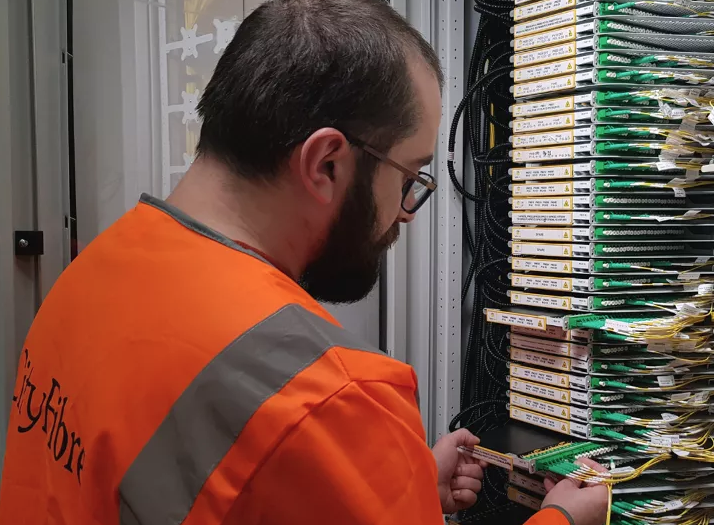
CityFibre has deployed its 100th Fibre Exchange (FEX), providing the capability to serve gigabit speed broadband to the first 4.8 million homes of its 8 million rollout. Located in Glasgow, this latest facility to come online is part of a rapidly growing network of purpose built, power-efficient, micro-edge data centres used by CityFibre to deliver, manage and monitor live services and data across its network. A CityFibre FEX unit is roughly the size of a shipping container and able to serve symmetrical gigabit speed connections to up to 60,000 premises at full capacity. Located in high security environments, these network hubs aggregate local data traffic for transport across CityFibre’s high-capacity national backbone. Alternatively, traffic in each city can be handed over directly to Internet Service Provider (ISP) partners using the extensive CityFibre Dark Fibre services available. To support future network expansion, most FEX sites have enough space and power to support an additional unit to be installed alongside the first. To support growing innovation and investment in edge computing, every FEX acts as a micro-edge data centre. This means, as well as co-locating their own network equipment, CityFibre’s ISP partners, councils and mobile operators can use a FEX to store and process data closer to their customers, enabling higher quality streaming and gaming, ultra-reliable access to the applications hosted in distributed hybrid cloud environments and improved data processing to support real-time decision making. Unlike the legacy telephone exchanges on which the UK’s incumbent networks are reliant, all CityFibre FEXs are aligned to Data Centre Tier 2/3 specifications, ensuring highest levels of network security and reliability to underpin a growing digital economy. Each site is served by two geographically diverse fibre routes for network resilience and is fully protected in the event of power failure by A+B uninterruptible power supplies and standby generators. The interior of a FEX is designed to house the latest energy-efficient routers, switches and servers and can adapt to future advances in core network technology. With environmental impact a major consideration, each FEX uses a combination of free-air cooling systems and intelligent climate controls to minimise electricity consumption, maximise equipment lifespan and reduce waste. Mains electricity is also secured from renewable sources wherever possible. David Tomalin, Group Chief Technology Officer at CityFibre, says: “Fibre Exchanges are the beating heart of our local networks and one of many areas in which CityFibre is setting new standards in our industry through a network that is Better By Design. Only when the optimum location for a FEX has been secured for long term use can the core network designs in each area be locked down ready for build to begin. Once in situ, not only is each FEX a secure, efficient and reliable data centre powering unbeatable broadband, it also empowers our partners to embrace edge computing technology and realise the benefits it offers for their customers.”

Unite, SECTT and SJIB salute employers for ‘nurturing and encouraging’ electrical talent 
With Scottish Apprenticeship Week (SAW) in full swing, union leaders and training providers have praised employers for 'nurturing and encouraging' young electrical talent in a year that saw record numbers return to the classroom. Unite the Union, the Scottish Joint Industry Board (SJIB) and Scottish Electrical Charitable Training Trust (SECTT) have all saluted businesses for 'supporting people, employers and the economy' – the theme of this year’s SAW, which runs until 11 March. Apprentices and adult trainee numbers in Scotland’s electrotechnical sector are at their highest level for 12 years, with nearly 800 new learners enrolling on the Electrical Apprenticeship and Adult Trainee Programmes in 2021. And Scott Foley, Chair of SECTT and Regional Officer at Unite the Union, praised employers for their commitment to building up a highly-skilled talent pool for the future of the industry. He says: “After all the industry has been through in the past two years, it is excellent to see employers taking a long-term view and putting their resources into nurturing and encouraging a new cohort of qualified electricians to take the sector forward. “I’m always greatly impressed when I get to meet electrical apprentices and hear their stories about how working, learning and earning is having a positive impact on their lives.” Tam Kirby, Fair Work Apprenticeship Coordinator at Unite the Union, adds: “Apprenticeships support people, employers and the economy and provide the best way to upskill the next generation and secure the future of our industry. “Unite the Union, SECTT and the SJIB are committed to the ongoing success of apprenticeships and we will continue to do everything we can to give our talented trainees the opportunities they need to succeed.” Last year’s intake of apprentices and adult trainees in Scotland was the highest in Scotland since 2009 – and SECTT and the SJIB say it’s an encouraging sign of the determination to tackle the UK-wide skills shortage . Fiona Harper, Secretary of the SJIB, says: “More and more, the message is clear that the future is electric and young people want to play their part in the transition to net zero. “An apprenticeship in the electrical industry in Scotland is seen not just as a path to a professional and highly-rewarding career, but as a means of making a contribution to a greener and more sustainable society.” Ms Harper, who is also Director of Employment & Skills at SELECT, Scotland’s largest construction trade association, adds: “Diversity is also a key dynamic in powering the future and, for the increasing numbers of young women who are signing up to the profession, comprehensive and tailored training can open many doors and create a rewarding career.” Anne Galbraith, chief executive of SECTT, which manages high-quality training on behalf of the SJIB, says: “The sustained support for training demonstrated by employers of all sizes across Scotland has been extremely encouraging, especially in this crucial recovery period. “There are now a total of 2,669 electrical apprentices and adult trainees training in Scotland, including the 660 apprentices and 110 adult trainees recruited for the 2021 intake, and the outlook for 2022-23 is more positive than it has been for many years.”

Increasing diversity of construction has never been more critical
The Scottish Construction Leadership Forum (CLF) is celebrating International Women’s Day by highlighting its work on a National Equity and Inclusion Plan for the construction industry in Scotland which will drive increased inclusivity. Funded by Scottish Government, this latest initiative is part of the wider plan for the industry to develop a more diverse and inclusive workforce, giving the sector access to a wider talent pool to support growth and help to address labour shortages. In the construction industry in Scotland in 2020, 84.6% of workers were men and 15.4% were women. 1.6% of workers in the construction industry were from a minority ethnic background compared with 4.3% of minority ethnic workers in Scotland as a whole. The National Construction Equity and Inclusion Plan seeks to address these imbalances by mainstreaming equity and inclusion within the industry as part of the CLF’s Construction Recovery Plan. The goals of the plan are to assess the current situation, share information on impactful equity and inclusion initiatives and develop actions to drive the realisation of a workforce that is more representative of society. The plan is being delivered in partnership with industry by Construction Scotland Innovation Centre (CSIC) on behalf of the CLF and is funded by the Scottish Government. The project is being supported by a steering group of experts who represent multiple aspects of the industry and have championed the cause of equity and inclusion throughout their careers. The strength of the steering group, combined with industry and government support, will help ensure that the recommendations of the plan are moved to active implementation once it has been published. Emma Dickson, Technical Director at Arcadis and industry co-chair of CLF’s Skills and Workforce sub group issued a challenge to the sector to ‘Celebrate International Women’s Day by taking a meaningful step towards improving gender diversity in your workplace. What will you do?’ She says: “The new Plan will focus on meaningful action, drawing from best practice and experience. It will be critical for industry to embrace and action the recommendations; our strong industry networks and leadership groups must take the lead. Skills shortages alongside the need for new green/digital skills in the industry mean that improving the diversity of our industry has never been so critical.” Minister for Business, Trade, Tourism and Enterprise and CLF chair Ivan McKee says: “It is really encouraging to see much needed progress towards creating a more diverse, equitable and inclusive construction industry that is representative of the world we live in. I am delighted to see this work being promoted on International Women’s Day, when we can celebrate raising awareness against bias and taking action to advance equality.” Lynsey Brydson, Head of Digital Programmes, CSIC says: “The collective objective we are aiming for is building a stronger, fairer and greener economic future for the construction industry and this investment is an important move in that direction. It is anticipated that the plan will be delivered in May”. Peter Reekie, Chief Executive of the Scottish Futures Trust and Chair of the Executive Group of the CLF, says: “The CLF is embarked on a radical overhaul of the industry in Scotland and it is important to maintain momentum as the recovery gathers pace. “The data shows that our track record on diversity is poor. The industry is missing out on the talents of too many people, and too many people who could have rewarding careers in the industry are not seeing it as a place for them. Leaders at all levels must do better and I am proud to support the group putting in place our first National Equity and Inclusion Plan, which will help them to do just that.”

Fuuse set for expansion following £1.7m investment
Miralis Data has secured £1.7m in Seed funding to accelerate the growth of its electric vehicle charging platform Fuuse, creating more than 30 jobs across the business. The investment will support the company’s strategy to become the enterprise level charge point management system of choice for fleets, workplaces, destinations and installers, creating 30-plus further jobs at its Lancaster and Glasgow offices. The funding will enable Fuuse to expand its sales and customer support operations, bolster its innovation programme, accelerate the platform’s product development roadmap and begin its planned international expansion. Michael Gibson, CEO at Miralis says, “Fuuse is making phenomenal progress with charge points live on our platform from the Walkie Talkie building in London to a recycling site on the Isle of Man, and from the workplaces of national retailers, NHS Trusts and manufacturers to over 250 public charging sites from Cumbria to Dorset. “This investment not only gives us the financial means but also access to exceptional people with vast experience in software, energy and infrastructure to help us accelerate our growth and continue to thrive”. Alastair Moore, Investment Manager with Par Equity comments, “We are hugely excited to be partnering with Miralis at this milestone in the growth of Fuuse. The pull from all corners of the market for Fuuse is testament to the quality of the offering that the team has built. “It has already established itself as the leading end-to-end platform for managing EV charge point assets and with 7 million EVs forecast to be on UK roads by 2030, the time for scaling up the infrastructure to serve this is now, with Fuuse perfectly placed to power this. We’re looking forward to the journey ahead”. Thanks to £600,000 grant funding from the Office of Zero Emission Vehicles and Transport Scotland, Fuuse is also about to launch its advanced fleet smart charging and energy management capabilities, and enable charge point booking and blocked bay alerts. Dr Will Maden, Chief Innovation Officer and Co-Founder at Miralis says, “This investment validates not only the success we’ve had with Fuuse so far but also the strategy, potential and pipeline of work we’ve put in place to build on it”.

One in three tradeswomen experience discrimination
New research from Rated People has revealed the biggest challenges faced by women who work in the trades industry, as well as the trades which have the lowest representation of women and the biggest gender pay gaps. The study discovered well over a third of tradeswomen (39%) aren’t taken seriously because of their gender. One in seven (15%) have had personal safety concerns when working, and almost one in 10 (9%) say they’ve had customers who won’t let them work on a job when they see they’re a woman. It’s 2022 and this needs to change The findings are taken from the newly-launched 2022 edition of Rated People’s Home Improvement Trends Report, where researchers spoke to more than 600 tradespeople across the UK about working in the industry, and over 2,000 homeowners about their attitudes to hiring tradeswomen. Positively, there’s growing demand from UK homeowners – nearly half (46%) say they’d definitely hire a tradeswoman, 43% have no preference and only 11% of UK homeowners say they’d prefer a tradesman. Almost one in three (29%) women in the UK also say they would feel safer hiring a tradeswoman to do a home improvement or maintenance job in their home. But the research highlights just how out of balance the industry is. Over half (11) of the 20 professions with the worst levels of representation of women in the UK are within the trades industry. Women make up less than 1% (0.99%) of carpenters and joiners in the UK, and less than 4% of electricians, plumbers, floorers and tilers are women. Across the 10 trades with the lowest representation of women, none of them have more than 5% of women in the workforce. The 10 trades with the lowest representation of women:  Rank Trade Women in workforce - 2021 1 Carpenters and joiners 2,399 (0.99%) 2 Electricians and electrical fitters 4,177 (1.73%) 3 Plumbers and heating and ventilating engineers 3,283 (1.93%) 4 Metal working production and maintenance fitters 3,594 (1.93%) 5 Elementary construction occupations 5,383 (3.03%) 6 Glaziers, window fabricators and fitters 1,472 (3.45%) 7 Floorers and wall tilers 1,111 (3.46%) 8 Electrical and electronics technicians 1,177 (3.61%) 9 Electrical and electronic trades 2,932 (3.91%) 10 Building trades 9,829 (4.01%) Please mind the gap On average, women earn just 72% of what men do across 15 key trades in the industry. But for floorers and wall tilers, this drops to a staggeringly low 41%. The few women who are carpenters earn just shy of £17,000 a year on average, but men in the same trade earn over £31,000 – a difference of almost £15,000 a year, or put another way, an annual carpenter’s salary for a woman is just 53% of a man’s. Women electricians earn 54% of what men do. Women in construction and building trades only earn the equivalent of 57% of a man’s salary, and women plumbers would take home just 61% of what a man would in the same trade. The 10 trades with biggest gender pay gaps:  Rank Occupation Average women's annual pay Average men's annual pay Difference in pay Women's pay as a percentage of men's 1 Floorers and wall tilers £12,514 £30,764 £18,250 41% 2 Metal working production and maintenance fitters £19,814 £38,586 £18,772 51% 3 Electrical and electronic trades £19,814 £38,586 £18,772 51% 4 Glaziers, window fabricators and fitters £13,557 £26,071 £12,514 52% 5 Carpenters and joiners £16,686 £31,286 £14,600 53% 6 Electricians and electrical fitters £20,336 £37,543 £17,207 54% 7 Construction and building trades £18,250 £31,807 £13,557 57% 8 Painters and decorators £16,164 £28,157 £11,993 57% 9 Plumbers and heating and ventilating engineers £21,900 £35,979 £14,079 61% 10 Electrical and electronics technicians £26,593 £33,371 £6,778 80% Opportunities for tradeswomen in the UK There are good indicators that change is starting to happen though – 32% of women in the UK now say they’d consider working in the trades industry. This could be a knock-on effect of the pandemic, people re-evaluating their jobs for example, or perhaps from increasing awareness of the opportunities that are available. According to Access Training, admissions of women on trade courses increased by 27% in 2021. Google data also shows many homeowners are actively trying to find tradeswomen across a variety of trades. People searched for women painters the most in 2021, pulling in 27,500 Google searches over 12 months, and women builders, gardeners, plumbers and electricians also saw between 5,000 and 10,000 Google searches in 2021. When speaking to tradeswomen about the biggest benefits of working in the industry, flexibility is key, with the top three advantages all about having increased autonomy. Almost one in four (22%) said ‘being their own boss’ was one of the biggest benefits for them, 18% said it was the flexible working hours, and 15% said they loved being able to choose how much work they took on. Helping women homeowners feel safe was also a plus-point, with almost one in ten (8%) tradeswomen saying they valued getting to help women who don’t feel comfortable or safe having a tradesman come into their home. The Rated People Empowering Tradeswomen Programme  Following the research, Rated People has launched their new Rated People Empowering Tradeswomen Programme to help more women get into the trades industry and build successful careers. Whether they’re considering a career change, or they’ll soon be leaving school and considering their options, the programme is designed to help women at all stages of their trades careers. The Rated People Empowering Tradeswomen Programme includes discounted skills training with Access Training, discounted business advice and coaching with Business Trades Coach, Alison Warner, and free exposure and discounted job leads on Rated People.