2 November 2026
Product of the Month: Amari Floodlight range by Aurora Lighting
 
26 November 2026
Thorn scores second Highland football lighting installation
 
26 November 2026
Segen pens exclusive distribution contract with M-Rack
 
25 November 2026
Scolmore helps rejuvenate Tamworth Cancer Support Centre
 
25 November 2026
Leicester apprentice crowned 2026 SkillELECTRIC champion
 

Latest News


CONEL launches Academy Hub to help Londoners get into construction
The College of Haringey, Enfield and North East London (CONEL) has launched a new Mayor of London Academy Hub to fast-track Londoners into construction and green careers. The Green Academy Hub, in partnership with Waltham Forest College, will provide skills training to create jobs and help the capital’s economic recovery from the COVID pandemic. Capital City College Group (CCCG), which includes CONEL, secured £250,000 to run the hub after a successful bid to the Mayor’s Academies Programme. According to the Construction Skills Network, more than 217,000 new workers will be needed in construction and green industries by 2025. The new hub will help meet this demand and support the UK’s target to achieve net-zero emissions by 2050 with a focus on modern sustainable construction methods, green technologies and the expansion of EV charging points. CONEL Vice Principal Robin Hindley says: “London is an everchanging city and there is a huge shortage of highly skilled construction workers across the sector, which has been exacerbated by Brexit and the pandemic. “The industry needs more people to work in skilled trades across the sector to enable them to meet their contractual commitments. The environment is also high on everyone’s agenda with a need to train people new technologies to ensure the UK meets its targets to cut carbon emissions. “Many employers have already given their firm commitment and support to our Green Academy Hub, and now it’s about building on those relationships, establishing courses and providing the industry with a pipeline of highly skilled, well-paid workers.” The hub will build on CONEL’s long-standing reputation for providing high quality training in construction trades including brickwork, plumbing and electrical installations at its centres in Tottenham and Enfield. It has been backed by employers and industry bodies including the Construction Industry Training Board (CITB), Morgan Sindall, Wates, Peabody, Vistry Partnerships, Absolute Solar, Retrofit Works, and the North London Waste Authority. There will be a strong emphasis on supporting those from under-represented and disadvantaged backgrounds including black and ethnic minorities, low earners, single parents, young people, caregivers, the disabled and unemployed. Robin comments: “We have huge experience in delivering training for this sector with well-established links with employers and a fantastic track record of getting people into work. Being part of CCCG means we also have links more centrally into Islington, Camden, Westminster and surrounding boroughs.” “Getting people trained and into work to help companies make profits and support the economy is a big part of it, but ultimately if we can build more sustainable developments and use green technologies to reach net-zero and prevent climate change to have a better quality of life, that will be the biggest win for all of us.” The Green Academy Hub is CONEL’s latest commitment to help more people into work, which also includes a new Skills Academy in partnership with Enfield Council and Vistry Partnerships to provide construction training for the £25 million Meridian Water regeneration in Enfield. Earlier this year the college launched the London Welding Academy alongside its London Rail Academy in Enfield with the number of welders in the UK having fallen by a quarter in five years. CCCG was also successful in winning bids to run hubs in Creative, Digital and Hospitality hubs run by CONEL’s sister college Westminster Kingsway College. The Creative Academy Hub is run in partnership with Film London.

Nescafé deploys EcoStruxure Asset Advisor to ensure efficiency
Schneider Electric has deployed its award-winning EcoStruxure Asset Advisor software at Nescafé‘s Toluca Complex in Mexico City. Producing approximately one million jars of coffee a day, the Nestlé Nescafé plant in Toluca, Mexico is the largest production facility for Nescafé and is key to Nestlé ’s overall global operations. In 2013, the company expanded the plant’s production capacity by 40% by investing approximately $125 million, making it the largest soluble coffee facility in the world. With the plant responsible for more than one million jars of coffee produced daily, preventing downtime is critical for Nestlé’s operations. Improving uptime reliability, greater visibility, and operational flexibility. Prior to Asset Advisor, maintenance was reactive. Eight unplanned shortages in one year, including a short-circuit inside an unmonitored section of the main substation that resulted in a 14-hour shutdown, costing the company approximately $588,000, saw production faltering. As service continuity is central to the production plant, EcoStruxure allowed Nestlé to move to predictive maintenance, letting teams resolve issues proactively to avoid costly disruptions that could cost up to $52,000 per hour. Implementing Asset Advisor gave Nestlé real-time visibility into its electrical equipment, allowing engineers to remotely monitor assets. By relying on data analytics to dictate service intervals, the electrical teams at Nestlé can now spend less time reacting to issues and the plant’s equipment spends more time performing optimally. Frédéric Godemel, Executive Vice President for Power Systems and Services at Schneider Electric says: “We’ve been seeing strong Services growth in our business, and we understand the importance of mission-critical systems and how it is non-negotiable for major production operation like the Toluca complex. With our EcoStruxture software, we are committed to providing customers like Nescafé greater visibility, increased resilience, and flexibility to improve their operational efficiency without the added costs and strain on the environment, and ultimately seen as the go-to-services expert in critical industries.” Luis Gilberto López Páez, electricity specialist in Nestlé Toluca Cafés says: “With a plant as large as Nestlé Nescafé, ensuring reliability of all the electrical systems is a particularly involved task. Across our operational network, we have been deploying flexible and scalable digital solutions to enhance our responsiveness, and the move to partner Schneider Electric was a natural one – having already collaborated in our production facilities in France and Switzerland. Since deployment, EcoStruxure Asset Advisor has allowed us to identify hot spots and attack them before they become a problem – saving us costly downtime, greatly enhancing our ability to respond quickly to changes in demand and ultimately better service our customers and reduce our operational carbon footprint.”

Vital Text HARDHAT to 85258 Service launches 1st February
The Lighthouse Construction Industry Charity is adding another route to vital wellbeing support by launching their text HARDHAT to 85258 service to provide immediate support to the construction community. This latest addition to the charity’s extensive portfolio of support services, launches on 1st February and underpins their mission that no construction worker or their family should be alone in a crisis. The text HARDHAT to 85258 service will complement their existing 24/7 Construction Industry Helpline and Helpline App and offers immediate support to those who feel more comfortable texting with someone rather than holding a one to one telephone conversation. Just like the charity’s helpline, the text HARDHAT to 85258 service is available at any time of the day or night and offers free, anonymous and confidential support to anyone in the industry who is feeling overwhelmed, stressed, anxious, suicidal or simply struggling with everyday life. Individuals can access support simply by texting the word HARDHAT to 85258. This will put them in touch with trained volunteers who will ask for a little more information about what the problem is, with the individual sharing what they feel comfortable with. The volunteers listen without judgement and can provide support and guidance on a huge variety of issues including; feeling anxious, relationship problems, loneliness and isolation, abuse, addiction, depression, bullying and harassment, self-harm, and suicidal thoughts and feelings. The text conversation will only finish when the volunteer has helped the person to reach a calm and safe place. They will also be able to provide a plan so that users can understand how to help themselves going forward and signpost to further resources or tools to provide more expert support. Bill Hill, CEO of the Lighthouse Construction Industry Charity says, “Our new text HARDHAT to 85258 service comes at a time when many are still struggling on a daily basis with debt, anxiety and family issues. Some things are returning to normality but there are still far reaching consequences and underlying problems that remain as a result of the COVID 19 pandemic. These pressures are in addition to the normal stresses and strains of working in an industry where two workers take their own life every single working day and a fifth of all work related illness is due to stress, anxiety or depression. Last year our charity supported 2788 families, an increase of 23% on the previous year and we delivered £1,077,015 of charitable giving to our construction community. This support ranged from making sure there was a meal on the table for families and paying household bills, helping with debt and financial issues, and providing quick access to professional counselling sessions. We know that there are many people who feel embarrassed or unable to reach out for help by calling someone.  Introducing our text HARDHAT to 85258 service is yet another route to access support before situations escalate out of control. We cannot stress enough that it really doesn’t matter how small or large you think your problem is, there is always support available and we can provide that help through the channels that people feel most comfortable with. That could be by using our free Construction Industry Helpline App, calling our 24/7 Construction Industry Helpline and talking to someone and now we have our text HARDHAT to 85258 service.”

Speeding up low carbon heating in social housing
Low carbon heating is to be installed in social housing to help cut bills and carbon emissions for people unable to afford the switch to clean heating. The ‘Right to Heat’ project will see new hybrid boilers - which use both gas and electricity - installed this year alongside solar panels and batteries in up to 25 homes across the South East to create a template for green heating in social housing. The partnership between electricity network operator UK Power Networks, Stonewater, Social Energy, Passiv UK, and SGN – is helping make sure nobody is left behind in the switch to low carbon technology: a key part of tackling the climate crisis. Latest figures show up to 3.9 million people around the UK live in social housing, and these homes account for 15% of the UK’s total greenhouse gas emissions. The compact hybrid heating systems have smart controls that can automatically switch between gas and electricity at certain times, depending on different factors including changing energy costs. By sometimes using electric heating, residents will use less natural gas overall. With solar panels providing renewable energy, and batteries storing the power for later, residents will also use less energy from the electricity network, saving them money and reducing household emissions at the same time. Stonewater customer Paul Brennan, who had a heat pump installed last winter as part of a related trial, says: “Even though my heat pump has only been installed a short time, it was immediately noticeable how much I was saving. If you think about all the people in this area using less than the energy they would normally use, it’s not just the savings to the people that would matter, but the impact overall would be brilliant as well.” Ian Cameron, head of customer services and innovation at UK Power Networks, says: “Right to Heat is about creating a scalable template for social housing so no one is left behind in tackling the climate crisis. We’re determined to make the transition work for all our customers, no matter their circumstances.” SGN’s regional development manager Dave Raymond adds: “What makes this exciting project so unique is the exceptional collaboration from all the partners involved, as well as its focus on those in society who otherwise would have difficulty in keeping up with Net Zero.” Adam Masters, environmental sustainability manager at Stonewater, says: “We understand the importance of everyone having a warm, comfortable and affordable place that they can call home. Our involvement with Right to Heat will enable more of our customers, but also residents of other housing providers, to reap the environmental and cost benefits of low-carbon heating - sooner rather than later.” Right to Heat continues to March 2023, and follows UK Power Networks’ HyCompact project, which is testing hybrid heating systems in seven homes across Wales, London and the South East with gas network Wales & West Utilities.

What the end of the home charge grant means for consumers
The grant that allows UK residents to save £350 on an electric vehicle home charging points ends on 31st March 2022. With just one month left for consumers to make a claim, EV industry expert Pilgrim Beart (DevicePilot) provides comment below on the impact of the grant, the future of the UK EV industry and what consumers should do now to avoid missing out. Pilgrim Beart, DevicePilot CEO and founder, says: “The UK EV industry is at a tipping point. March is an important month, in an important year, in a pivotal decade for electric vehicles in this country. “We saw with the end of solar subsidies, that the general public rushed to get the grant while they still could. This boom and bust was fleeting and did not stop the growth of the sector longer term. The initial subsidy of solar helped the industry mature and bring costs down more quickly, after which it could stand on its own, and I expect we’ll look back at the EV grant in similar terms. If you’ll forgive the car metaphors, it should help jump start the industry, accelerate growth and drive prices down. It’s a one-off grant which cannot and should not go on forever, but has helped the industry reach the stage where it can stand on its own and become self-sustaining. “Consumers considering an EV purchase should try to take advantage of the home charger grant while they still can. You should do it now if you can, because you’ll need one eventually. EVs are coming and you’ll have a charger at home eventually, but some people will have theirs subsidised by the government and some won’t. “As for the industry, the end of the grant will incentivise businesses to try new business models. They may start to see EV charging as less of a product, and more of a service. There is so much potential in the nascent home charging industry. Now is the time for vendors to look to build ongoing relationships with customers, offering the kind of consumer experience people expect from any other utility. Early adopters will accept shortcomings in new tech, for charging to be fiddly or unreliable, but mainstream consumers will not. If people charge their phone overnight, they expect a full battery when their alarm goes off in the morning. They will expect the same of their cars - for their car to charge overnight 100% of the time, all on a low energy rate of course.”

Knightsbridge brings décor matching with plaster wall lights
Knightsbridge has added two ranges of gypsum plaster wall lights to its extensive decorative lighting collection. [gallery ids="29129,29130"] Available as up/down surface-mounted wall lights for living spaces, or recessed fixtures that are ideal for use in areas like hallways and stairs. These new arrivals are all supplied in a stylish, timeless plaster white that can also be painted to match any interiors scheme. They work well when installed as standalone items, but also create a striking feature when mounted in series. The surface-mounted wall lights come in four curved or cuboid design options, with widths varying from 110mm to 200mm, heights from 90mm to 180mm and projections from 70mm to 150mm. The lamp fitting is designed for G9 LEDs. Offering discreet style, the recessed lights have a defined edge with a narrow opening, allowing for a subtle light output. They come in two shapes and sizes: rectangular, which is 350mm high, 100mm wide and 73mm deep; and a 78mm deep circular unit, the cut out for which is 250mm x 210mm. The lamp fitting for both items takes GU10 LEDs.

Ansell launches powerful Z LED Plus
Offering an impressive efficacy of 200 Lm/W, the Z LED Plus is a powerful new addition to Ansell Lighting’s Z LED high bay lighting range. Highly efficient, the luminaire delivers optimum lighting performance and optics, reducing the number of fittings required to achieve desired illumination levels, lowering power consumption and energy costs. The first of 30 new products set to be revealed during 2022 to mark Ansell Lighting’s 30th anniversary, Z LED Plus is ideal for a range of industrial, commercial and retail settings thanks to its versatility and durability. Designed with a high resistance to corrosion and wear and tear in mind, the IP65 rated Z LED Plus provides full protection against ingression from water and dust and is suitable for installation in harsh and high dependency environments. It also has a high impact rating of IK08, ensuring the fixture can withstand potential knocks and impacts. Thermal management has also been cleverly considered, with the heat produced by the fitting designed to dissipate away from the fixture, extending its lifetime and ensuring no premature failures. Quick and easy to install, the Z LED Plus can be ceiling mounted, suspended or wall mounted and is supplied pre-wired with a 3M H05RN-F cable to save fitting time. It is available in three output wattage options, 75W, 115W and 150W all of which feature a 0-10V dimming setting as standard, enabling lighting levels to be easily controlled. The Z LED Plus is also available with an IP65 programmable microwave sensor option which has a built-in daylight sensor, and an emergency option which removes additional costs as there is no need for separate emergency lighting. Mark Abbott, Managing Director at Ansell Lighting says: “We are really excited about the launch of the new Z LED Plus. It is an unbelievably powerful fitting which, thanks to its high Lm/W efficacies, delivers a significant level of lighting, reducing power consumption and lowering energy costs. “As the first of 30 new products set to launch this year, to mark our 30th Anniversary, it showcases perfectly what Ansell Lighting as a business is all about, creating high quality, durable lighting products that reduce environmental impact and offer long lasting economical benefits for the user.”

ECS scheme expands into the digital age
One of the largest personnel certification schemes in the UK for those working within the construction and the built environment, the Electrotechnical Certification Scheme (ECS), has expanded its scheme to include digital skills. Being the sole ID and competence card scheme in this industry that demonstrates the skills, knowledge, qualifications, and experience of individuals, and with ECS cards being compulsory on almost all UK construction sites, the ECS Scheme is recognised and endorsed within many industries throughout the UK, including Network Infrastructure and now Digital Infrastructure. Now the ECS is expanding the successful scheme into Digital Support occupations: Digital Support Technician and Operative Network Security Technician Digital Network Engineer Digital Support Manager These occupations cover those using digital technologies (likely as part of IT and/or telecoms infrastructure roles) in areas such as digital communications, network systems, data centre operations and management, network and cyber security, programming, software, support, and user skills. Not only are these areas essential skills for organisations of all sizes in a growing digital age, but there are also increasing overlaps between the traditional craft electrotechnical skillsets and the development of greater automation, controls, and programming requirements for those working within the built environment. To develop these new routes to personnel certification, ECS worked with the Department for Education, Institute for Apprenticeships, British Computer Society – Chartered Institute for IT, awarding organisations and providers, such as Pearson, CompTIA and the leading provider of technical education for the digital infrastructure industry, CNet Training, alongside a number of large employers and industry stakeholders. The cards are supported by education and training providers that deliver industry recognised qualifications, for example the new Digital Support Technician card is supported by the qualification level 4 Certified Data Centre Technician Professional (CDCTP®) and the Certified Wireless Infrastructure Technical (CWIT®), plus the level 5 data centre programs that span specialisms across the technical data centre environment from design and audit through to data centre sustainability. The Digital Support Manager card is supported by the level 5 Certified Data centre Management Professional (CDCMP®) program and the highly regarded level 7 Master’s Degree in Data Centre Leadership and Management. Those with the CNet qualifications and ECS Health & Safety Assessment can apply online at www.ecscard.org.uk via MyECS, an online portal that allows card holders to manage their ECS applications and renewals. Andy Reakes, Head of Growth at the Joint Industry Board and Electrotechnical Certification Scheme says, “All requirements for ECS cards are developed and agreed by industry. This latest expansion is the result of continued hard work with a number of organisations to ensure ECS covers sectors that are essential in the built environment of the 21st century.”

Two in five UK tradespeople suffer from work-related pain every week 
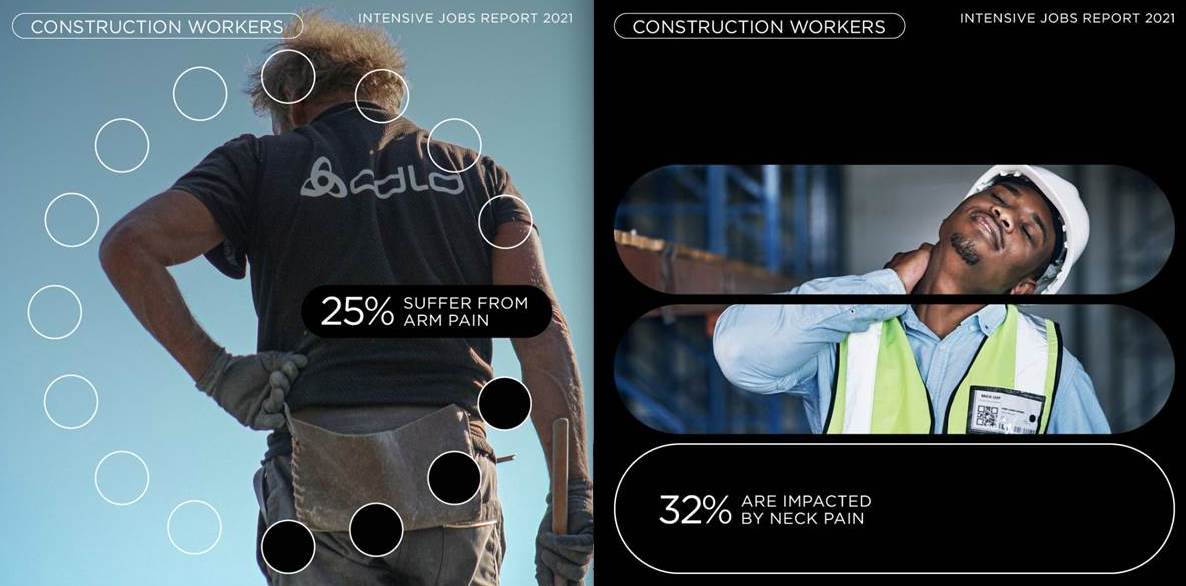
A study by Jacuzzi, the hot tub and hydrotherapy specialists, surveyed Brits from a variety of industries about their experiences of injuries and pain at work and found that half (50%) of tradespeople have taken time off work for a work-related pain or injury Three in five (60%) tradespeople report lower back injuries, making it the most common injury sustained on the job. Shoulder pain (31%) is the second most likely issue to trouble tradespeople. In construction, neck pain (32%) is the most common form of discomfort amongst workers, followed by arm pain (25%). Sadly, seven in 10 (71%) construction workers say that they experience pain at work at least once a week, the highest percentage of any industry. Only 7% never experience any form of work-related pain. Nearly nine in 10 (89%) of construction workers said that they’d taken time off due to injury, with 56% missing more than a week. Tracey Hudson, Executive Director, at HR Dept, says: “It’s worrying to see that regardless of the industry, a large portion of workers are experiencing pain, injury or discomfort as a result of their working conditions. “It’s no surprise to see back pain is the most commonly experienced form of pain, as this is an area of the body that’s put under considerable stress, whether you’re working at a desk or on a construction site. “If you experience pain due to your work, make sure to raise the issue with a line manager or your employer’s HR department, as they will take steps to ensure you are safe, and will work with Occupational Health or your GP who can often suggest changes to your working environment which can help prevent injury or the recurrence of pain

NAPIT gets ready for the release of Amendment 2 BS 7671:2018+A2:2022
BS 7671:2018+A2:2022 will be the first, full consolidated amendment to the BS 7671:2018 18th Edition IET Writing Regulations, which was first published in 2018. Amendment 2 will come into immediate effect when published on Monday 28 March 2022, with the previous version BS 7671:2018+A1:2020 being withdrawn six months later. The significant changes include: A new requirement for Arc Fault Detection Devices (AFDDs) in some AC final circuits for installations in some types of higher risk residential buildings. The requirement for the fire safety design of buildings to be documented where specific conditions of external influence exist, such as protected escape routes and locations with risk of fire. Changes to identification, labels and notices, such as for consumer units, affecting how safety information is provided to the user of the electrical installation. A chapter on Prosumer’s Low Voltage Electrical Installations, in a new part, Part 8. Method for determining the requirement to provide overvoltage protection. In preparation for its release, NAPIT is ensuring it has everything members need to get up to speed with the amendment, including: Pre-orders for updated NAPIT and IET publications are now live on NAPIT Direct. Hosting a range of CPD webinars to provide an overview of the amendment and what it means to its members, the webinars will take place on Tuesday 1 March, Tuesday 5 April and Tuesday 3 May at 6pm with a live Q&A with JPEL Committee representatives Frank Bertie, Paul Chaffers and Richard Townsend. Launching its new set of NAPIT EXPO Technical Roadshows with Amendment 2 CPD masterclasses starting April 2022, open to all with locations to be confirmed soon. Here you’ll have access to face-to-face technical training and membership advice, as well as free gifts, discounts, and refreshments. Frank Bertie, NAPIT’s Chief Technical Officer, (JPEL/64 member and deputy chair of Sub Committee A) says: “This Amendment is an essential update and is the result of years of work by the JPEL/64 committee, the committee responsible for BS 7671, with which NAPIT have had strong representation on for over 20 years. It’s important that our electrical members keep up to date with the ever-changing technologies and ways of working to ensure they are working to the safest standards, and they can do that by viewing our webinars, attending our events and within our updated publications.”