2 November 2026
Product of the Month: Amari Floodlight range by Aurora Lighting
 
26 November 2026
Thorn scores second Highland football lighting installation
 
26 November 2026
Segen pens exclusive distribution contract with M-Rack
 
25 November 2026
Scolmore helps rejuvenate Tamworth Cancer Support Centre
 
25 November 2026
Leicester apprentice crowned 2026 SkillELECTRIC champion
 

Latest News


Earnings for electricians hit highest level since start of pandemic
Earnings for self-employed electricians have reached the highest level since the start of the pandemic, according to the biggest payroll business in the construction industry. Average weekly pay rose by 2.4% to £1,150 during last month, the highest December pay levels on record and 6.7% higher than the same period last year. The previous high was £1,300 in January 2020, two months before the first lockdown. The analysis was carried out by Hudson Contract, the UK’s largest provider of tax status and employment contract services to the construction industry with annual revenues of £1.6 billion and a client base of more than 2,500 construction SMEs. Ian Anfield, managing director, says: “We capped off 2021 with the highest earnings for electrical contractors since the start of the pandemic. “As we have seen year after year, we usually see earnings fall back in January because people will be working fewer hours. We would then expect a steady rise in earnings to reach December levels by April.

Simplicity and integration: Growing the EV charging network
The UK EV market is booming, with more electric cars registered in 2021 than in the previous five years combined, and with an estimated 1 million EVs and plug-in hybrids now driving on Britain’s roads. The roll-out of a robust EV charging infrastructure is vital to support this rapid EV growth and, as such, is an important component in the transition to a fossil-free society. Equally important though is how these charging points operate, and how they integrate into the society we live in. Here are some predictions from CTEK about what they think will happen, as we strive to meet Government targets. 1. Open standards and load balancing are becoming increasingly important The connection of the charging points is one of the most important aspects for building stable electrical systems and overcoming possible power problems in urban areas. Open protocols like OCPP (open charge point protocol) should be standard. All charging points and networks should also be able to balance loads, which means optimising charging based on the needs and capacity of the grid, individual households and properties. Smart and safe charging benefits society at large. 2. EV roaming to make an entrance In mainland Europe, a number of operators like E.ON drive and Vattenfall inCharge have now entered into ‘EV roaming’ agreements that will open up the EV charging infrastructure for drivers, giving them access to thousands of charging locations worldwide, in much the same way as data roaming agreements work for mobile phones. This is a really positive development for EV drivers, and one that we would expect to see making its way to the UK fairly soon. EV roaming also fits well with the UK’s environmental goals, and wider global sustainability goals. 3. Payment solutions will be simplified When it comes to payment solutions, there are many players in the market today  which is a good thing, but it has also led to a plethora of different payment methods at charging stations. As an EV owner, you may need to carry several RFID tags in the glove box to charge on the roads. If you come to a new charging post, you may also need to scan a QR code and register on a website, or in an app, to charge your vehicle. Work is underway on EU legislation which would require operators to open their chargers to everyone in a non-discriminatory and transparent way, and allow debit card payments. Whether the UK Government decides to follow this legislation is yet to be seen, but hopefully 2022 will be the year when we exchange RFID tags, QR codes and apps for the ability to easily tap our mobile phones, and use our debit cards, when we need to top up our car batteries. The evolving international ISO 15118 standard for ‘vehicle to grid’ communications is a real game changer, as it will enable an EV to simply ‘plug and charge’. You don’t need all the different RFID tags and payments cards, the car automatically identifies itself to the charging station, and the cost of the charging session is then automatically taken from your debit or credit card – as simple as that! 4. Areas of growth Although home chargers will remain the biggest market in real terms (around 74%), we predict that chargers for commercial fleet will see the fastest growth, followed by destination, workplace and roadside charging. Many companies are already realising the benefits of fleet electrification. As well as the clear environmental benefits, the cost of running an EV are considerably lower than a petrol or diesel vehicle, and there are significant tax benefits for the company, and employees personally. The Government offers grants of 35% (up to £3,500) off the price of an electric car and up to 20% (up to £8,000) off an electric van. We can expect to see increasing Government pressure on businesses to make more environmentally sound choices about the vehicles they provide for staff, so installing EV chargers now is a smart futureproofing move.

CP Automation offers compact and versatile power analyser range
CP Automation now supplies the PQube 3 series of power analysers from Powerside. The power analysers measure, identify and record all power quality disturbances and environmental or process parameter symptoms in real-time. This will equip the company’s customers with the tools to effectively identify power quality disturbance issues and consequently improve productivity at their facilities. The PQube 3 series constitutes five models – the PQube 3, 3e, 3r, 3v and 3 Portable. The standard variety comes with an impressive number of features, such as up to 14 energy metering channels, four quadrant metering, alarms, intuitive touch-screen display and automatic reporting. Incredibly versatile, the power analyser can also be used as a controller, voltage monitor and revenue-grade meter. It is certified for class A power quality as per IEC 61000-4-30 Ed3 and measures in real-time, recording 2 kHz to 150 kHz emissions. In addition to the standard model, CP Automation also stocks the PQube 3 Portable power analyser. It detects high-frequency transients at 4MHz and records 2kHz to 150kHz conducted emissions. This device combines powerful communication capabilities with the quick installation of a portable instrument. Perfect for temporary power measurement activities, it can be used as a stand-alone with a USB stick for configuration and data download or if connected to a network, it delivers event notification and regular reporting. “There’s no question that power quality disturbances are on the rise,” explains John Mitchell, global sales & marketing director at CP Automation. “Harmonic currents, poor power factor and voltage fluctuations are all common problems in industry. Customers can install the PQube 3 for continuous monitoring and this is the first step toward gathering clear actionable data to solve power quality problems. Crucially, data recorded by the PQube 3 can help to pinpoint the root cause of power quality issues, reducing plant equipment failure or nuisance tripping. Its continuous recording allows the user to go back and in time and see what happened.’’ Typically used in a range of commercial and industrial facilities, the PQube 3 series is particularly suited to applications from a supply connection of a transformer, generator, PV solar plant or wind turbine in all industries, such as marine, data centres, manufacturing, transport, water and wastewater, and hospitals to name a few.”

TRILUX delivers lighting solution for the largest sports retailer in the world
Any sports enthusiast will have visited a Decathlon store. The world’s largest sporting goods retailer is famed for stocking a wide range of sports products; from basic supplies like tennis rackets to advanced extreme sports goods such as scuba diving equipment. Stores are typically sized at an average of 4,000m². They have been given an over-haul by TRILUX. Decathlon's main mission is to “make sport accessible to as many people as they can.” Their UK property team are working on delivering this by ensuring the shopping experience allows customers to test and try products in an environment which communicates the brands values of vitality and responsibility. These were core to a recent lighting upgrade program, which covered their Reading and Wednesbury stores. TRILUX proposed that the Wednesbury Decathlon store replaced its existing 49W T5 fittings with E-Line LED on the salesfloor and the back of house fittings with carefully selected LED equivalents. By switching to LED, Decathlon are not only benefitting from increased LUX levels on its retail space but would reap more rewards with the added benefit of healthy energy savings and minimal maintenance costs. The existing lighting was positioned in between aisles which made fixture movement quite restrained so a proposal was put to Decathlon to rotate the lighting by 90 degrees so it would no longer be aisle dependent which they were keen to implement. This allowed the removal of redundant trunking and cabling in the ceiling areas, reducing clutter. In implementing the TRILUX scheme Decathlon have achieved a fresh modern look throughout the store. They have created more impact with a better quality of light which intensifies and improves the clarity of product presentations, enhancing colours vibrancy. Light levels have increased from 500lux to 800lux at floor level and they are also benefitting significantly from energy and maintenance savings. Conor McAteer, Decathlon Operations Manager, concludes, “The new lighting has provided us with a modern and much brighter look to our store. As a company we aim to be as sustainable as possible and this lighting project has allowed us to do so by reducing our energy consumption.”

HandyPAT400 product upgrade from Martindale Electric
When it comes to testing portable appliances, the HPAT Series of portable appliance testers from Martindale Electric now includes the HPAT400 new update to its existing range, to enable both contractors and competent in-house personnel to quickly and safely verify the electrical safety of all types of appliances. Easy to use, the HPAT400 from Martindale Electric is an affordable, battery powered PAT tester. Suitable for Class I and Class II appliances, the basic tester incorporates large PASS/FAIL indicators and simple connection instructions on the tester. As well as performing a 500V insulation test, the HPAT400 now supports different test voltages of 250V and 500V. Designed for testing appliances with surge protected circuits, such as sensitive IT equipment at 250V. HPAT400 key features: Easy to use Simple one-button test selection to activate either a full Class I, Class II or lead test Maximum portability Lightweight, convenient battery powered, hand held PAT tester Clearly illustrated Connection diagrams are on the case, allowing users to begin immediately Excellent visibility High contrast backlit display ideal for low lit conditions Versatile Test voltage at 500V or reduced to 250V. Download quick guide PDF Simple PASS/FAIL indicators Showing PASS/FAIL result on screen clearly without needing to evaluate values Multifunctional Adaptor leads available enabling 110V appliance testing and equipment with three phase plugs [embed]http://www.youtube.com/watch?v=vV2eKe15vVw[/embed]

FireAngel supports Derbyshire Fire and Rescue's ‘Trauma Teddy’ campaign
Coventry based smoke, heat and carbon monoxide supplier, FireAngel, has partnered with Derbyshire Fire and Rescue Service to sponsor its popular Trauma Teddy community initiative throughout 2022. First launched in 2018, the campaign involves a Buddy Bear being given to young children who may have witnessed or been involved in an incident that has caused distress, pain or trauma, to help diffuse painful memories, whilst also providing a keepsake from the firefighters who helped them. Over the last three years, Buddy Bears have been given to children across Derbyshire who have been involved in upsetting incidents, including house fires and road traffic collisions. The latest partnership will see the continuation of the campaign throughout 2022m to provide children with the support and comfort they require. Lee Jones, Watch Manager at Derbyshire Fire and Rescue Service, says: “As an emergency service, we're very focused on people involved in emergencies, talking to them and explaining what's happening and how we're there to help, however it can be very difficult to build a quick rapport with children. “Using a buddy bear can help quickly break down this barrier and help try to take their mind away from the traumatic situation they may be in. The bear is theirs to keep, which hopefully works as a positive influence.” The latest partnership forms part of FireAngel and Derbyshire Fire and Rescue Service’s longstanding relationship, which recently included FireAngel’s sponsorship of the Fire and Rescue Service’s annual awards ceremony, which honoured the 77 individuals who achieved good conduct and long service throughout 2020 and 2021. Elizabeth Mitchel, FRS National Account Manager at FireAngel, says: “We are extremely proud to be supporting Derbyshire Fire and Rescue Service’s Trauma Teddy campaign this year to provide local children with the support and comfort they need at such distressing times. As a leading fire safety supplier, we are committed to working closely with the UK’s Fire and Rescue Services to provide individuals of all ages with the support and protection they require.”

CEF unveils a new flagship store in Doncaster
CEF is moving its Doncaster store to bigger, more accessible premises at Decoy Bank North, closer to transport links with the M18, M62, A1 and M1. The new 5000 sq ft CEF Doncaster store has a 2700 sq ft Mezzanine floor so it will house more stock, more brands and have more friendly and knowledgeable CEF experts to help customers with advice on products, training and electrical know how. Simon Legg, Group Manager for CEF in Doncaster comments: "The team at Doncaster have over 100 years of experience working within the electrical distribution industry, so we’re thrilled to unveil our new, bigger and better Doncaster store, where we can offer even more products and outstanding service to our customers. Bringing the expertise of our colleagues from Bentley and Doncaster together means customers can benefit from a great resource of local knowledge and electrical expertise.” As well as housing more electrical essentials, the new CEF Doncaster store will serve bean-to-cup fresh-ground coffee and chilled, filtered water from a machine in a bid to reduce single-use plastic bottle waste. It also has ample parking facilities for up to 20 vehicles. The new CEF Doncaster store is located at Unit 4 Decoy Bank North, Doncaster, DN4 5JR with regular opening hours of Monday - Friday 7.30am - 5.30pm and Saturday 8.30am - 12pm. The store telephone number remains the same 01302 340034.

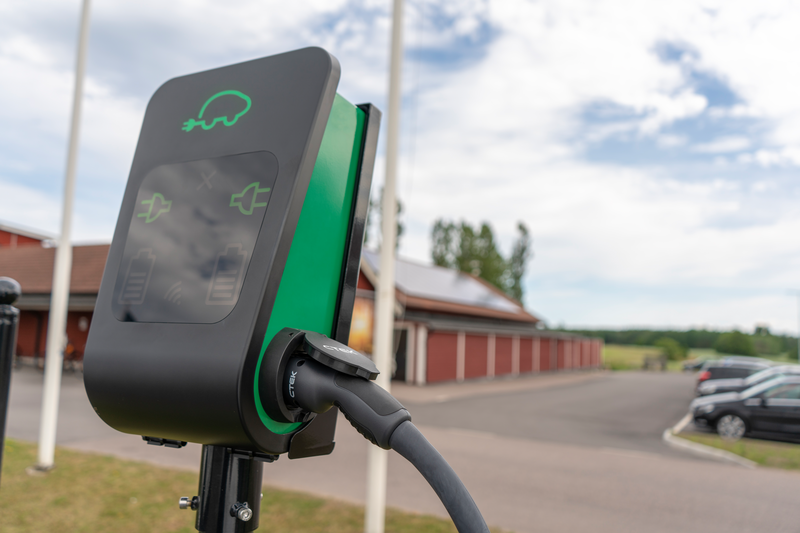
CTEK lights the Fuuse for integrated EV charging, payment and billing
CTEK has extended the software integration options available with their electric vehicle (EV) chargers to include the flexible charge point management, payment and billing platform Fuuse. This latest integration will allow customers looking to generate revenue from their EV chargers by integrating the CTEK Chargestorm Connected 2 (CC2) EV charger with sophisticated payment management software Fuuse Billing. This is a simple way to provide charging, payment and billing facilities in a single installation - and it’s fully scalable too, from a single charger to much larger networks. Both CTEK and Fuuse products and solutions are fully OCPP (open charge point protocol) compliant, meaning they will integrate seamlessly with other manufacturer’s hardware and software, as well as with each other. Cecilia Routledge, Global Director - Energy & Facilities, for CTEK says: “We are delighted to be making the Fuuse platform available to CTEK customers. Fuuse and CTEK are both committed to providing customers with maximum flexibility through OCPP, and this new option to provide CTEK chargers with Fuuse Billing incorporated adds an important new dimension to our customer offering. “This is especially so because, with the gradual shift towards destination and public charging, we expect more local authorities, hoteliers, retailers, employers, fleet managers and other charge point operators to be looking for an EV charging solution that not only meets driver demand, but also provides opportunities for revenue generation. The CTEK/Fuuse solution allows them to do just that.” Michael Gibson, Managing Director of Fuuse, comments: “It’s great to be working with CTEK in enabling their customers to generate revenue from their chargers. The EV rollout is certainly accelerating, and we want to make it as easy as possible for charge point owners and operators to reap the benefits and opportunities that the EV revolution presents.” Fuuse Billing is a fully secure, PCI (payment card industry) compliant system that’s available on a per charger licence or a percentage of revenue, whatever suits customers best. The system offers a complete range of services for payment and tariff management. Payment management features include collecting payments from drivers, automated invoicing, secure storage of drivers’ card and payment details and full financial reporting. Operators can also see financial data about specific chargers on their network in real time. Tariff management allows operators to charge drivers by the kWh, by the minute, or a mixture of both, and allows different tariffs to be applied for different times and days. Operators can also customise the pre-authorisation amount required from different groups of drivers. Fuuse also offers a full charge point management system through which CTEK customers will be able to manage their EV network remotely through a desktop or mobile app. As well as managing payments and tariffs, users can gauge the efficiency of their charger network, monitor and resolve hardware faults, manage and reduce electricity supply costs, set operating hours and restrict access, and tackle emerging challenges like ICEing and bay-hogging.

IET and BSI publish Amendment 2 to the 18th Edition
The Institution of Engineering and Technology (IET) and BSI have signed off the content for Amendment 2 to BS 7671:2018 (18th Edition of the IET Wiring Regulations), which introduces a new requirement for Arc Fault Detection Devices (AFDDs), updated requirements for the fire safety design for buildings, and a new chapter on Prosumer’s Low Voltage Electrical Installations. Amendment 2 comes into effect immediately when published on 28 March 2022, and the previous version, BS 7671:2018+A1:2020, will be withdrawn six months later. This essential update to the IET Wiring Regulations will form the national standard to which all new electrical installations and additions, and alterations to existing electrical installations in the UK, are to comply. The IET and BSI are now urging all electrical professionals to ensure they become familiar with the changes. Significant changes include: A new requirement for Arc Fault Detection Devices (AFDDs) in some AC final circuits for installations in some types of higher risk residential buildings The requirement for the fire safety design of buildings to be documented where specific conditions of external influence exist, such as protected escape routes and locations with risk of fire Method for determining the requirement to provide overvoltage protection Changes to identification, labels and notices, such as for consumer units, affecting how safety information is provided to the user of the electrical installation A chapter on Prosumer’s Low Voltage Electrical Installations, in a new part, Part 8. Members of the committee responsible for the technical content of BS 7671, JPEL/64, are not permitted to release any further information before the publication date. Dan Palmer, Associate Director of Committees at BSI says: “BS 7671 is one of the UK’s most important standards, providing authoritative requirements to promote electrical safety. The changes introduced in this new amendment will help electrical professionals keep up to date with new and innovative technologies, as well as ensuring they have current knowledge about designing safe installations.” Mark Coles, Head of Technical Regulations at the IET, comments: “The IET is the authority for electrical installations in the UK and ensures that the National Wiring Regulations Committee carefully considers all necessary updates to the Regulations to ensure they best meet the needs of the industry. “The Amendment continues the thread of embracing new technologies and Prosumer’s Low Voltage Electrical Installations is an exciting step into the future of renewable sources of energy and their integration into our lives. “Focussing on high risk environments with requirements for Arc Fault Detection Devices and the fire safety design of buildings is a major step in order to increase safety. “Amendment 2 is an essential update to provide for the safety of electrical installations in the UK and it is now imperative that the industry is ready to work to this amendment before BS 7671:2018+A1:2020 is withdrawn.” Further changes are included throughout all parts of BS 7671, including the incorporation of Amendment 1:2020 to BS 7671:2018 as part of the main document. Post Brexit, this Amendment sees the further adoption of CENELEC Harmonised Documents as the UK continues the inclusion of standards for new and developing technologies.

Vent-Axia donates MVHR unit to Eco couple educating neighbours
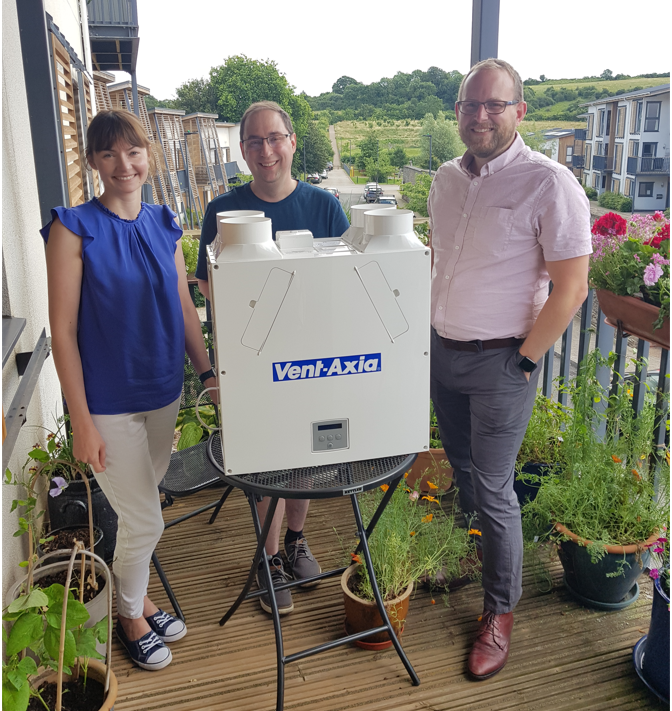
Vent-Axia has donated a Sentinel Kinetic Mechanical Ventilation with Heat Recovery (MVHR) unit to Tom and Jane Howson who are living in the award-winning Hanham Hall eco development near Bristol. The MVHR unit was presented to the couple at their home by Richard Paine, Product and Marketing Director at Vent-Axia. The MVHR unit will allow Tom and Jane to re-start the innovative ventilation workshops that they have previously been running in their local eco community. The workshops are designed to teach their neighbours how to maintain the ventilation units in their homes to help ensure good indoor air quality (IAQ), avoid condensation and mould, while explaining the benefits of features like the summer bypass. The pioneering couple moved into their first-floor one-bedroom flat at Hanham Hall in 2013. Built by Barratt Homes, Tom and Jane chose the property due to its eco credentials and were delighted their new home featured an energy efficient Vent-Axia Sentinel Kinetic MVHR unit to provide ventilation to the property. As they had bought a thermally efficient airtight property, the couple knew that it was vital to keep the MVHR system on at all times and were very interested to understand the appliance in their home while appreciating the importance of maintaining the unit. The Howsons therefore read the manual supplied by Barratt and sought further advice from Vent-Axia about maintaining their MVHR unit, to keep it working effectively and subsequently learnt how to change its filters and clean the heat recovery cell. However, the couple discovered that many of their community were unaware the MVHR units in their homes needed to be cleaned and maintained, while some neighbours were even turning the units off, leading to condensation and mould issues and poor IAQ. This was the driver for the couple to speak to Barratt and use Hanham Hall’s show home on site to run ventilation workshops to help educate their neighbours on how to maintain their units, how to use them effectively and, importantly, not to turn them off. So far, the couple have helped over 150 people. But unfortunately, when the show home was sold, Tom and Jane lost their workshop location. Vent-Axia therefore stepped in, donating an MVHR unit for the couple to use. Previously used in Vent-Axia’s R&D lab the MVHR has been wired as a demonstration unit and will allow Tom and Jane to run sessions again. “We wanted to look after this place because it’s very precious. We love it. We're also fascinated by the MVHR technology so it was a big driver for us to help educate people who didn't know that they had to change the filters and always keep it on”, explains Tom Howson. “We've shown many people over the years in the show home how to look after their MVHR. And now thanks to Vent-Axia’s generosity, we can continue sharing information on how to maintain and operate MVHR to improve indoor air quality. We’re really passionate about it. Having MVHR in our home has been a game-changer for us. We’ve never had condensation and mould issues, not even in the bathroom. The grout is still as new. And my asthma is much better here than in previous homes, even though we have a cat. And should we ever move, we’d be looking for a property with a Vent-Axia unit. I don’t think we would want to live anywhere without one.” “Tom and Jane are an inspirational couple, dedicating their time to educating their neighbours on the benefits of good IAQ and how to look after their MVHR which is an essential part of their eco home. As we try to meet Net Zero targets in 2050, MHVR is now becoming mainstream in new build homes as it ticks all the right boxes when it comes to balancing energy efficiency with good indoor air quality. We now need to educate people that just like a boiler needs an annual gas safety check, MVHR units need to be cleaned and filters changed to maintain good indoor air quality in the home.”, comments Richard Paine. Hanham Hall is located in South Gloucestershire, five miles from the centre of Bristol. The estate is one of the flagship Carbon Challenge schemes promoted by the Homes and Communities Agency and was England’s first large-scale housing scheme to achieve the 2016 zero-carbon standard. The development has 186 homes, ranging from one-bedroom apartments to five-bedroom houses, and all homes are super insulated timber frame buildings. The scheme was judged Best Sustainable Development in Britain in the 2014 What House? Awards.