2 November 2026
Product of the Month: Amari Floodlight range by Aurora Lighting
 
12 November 2026
Schneider Electric transforms Southampton hospital estate
 
12 November 2026
GTEC Training opens new education facility in North Yorkshire
 
11 November 2026
Energy, AI and smart buildings: register now for EMEX 2026
 
11 November 2026
Solar and batteries could cut electricity costs by 40%, data finds
 

Latest News


Early warning system to boost electricity network
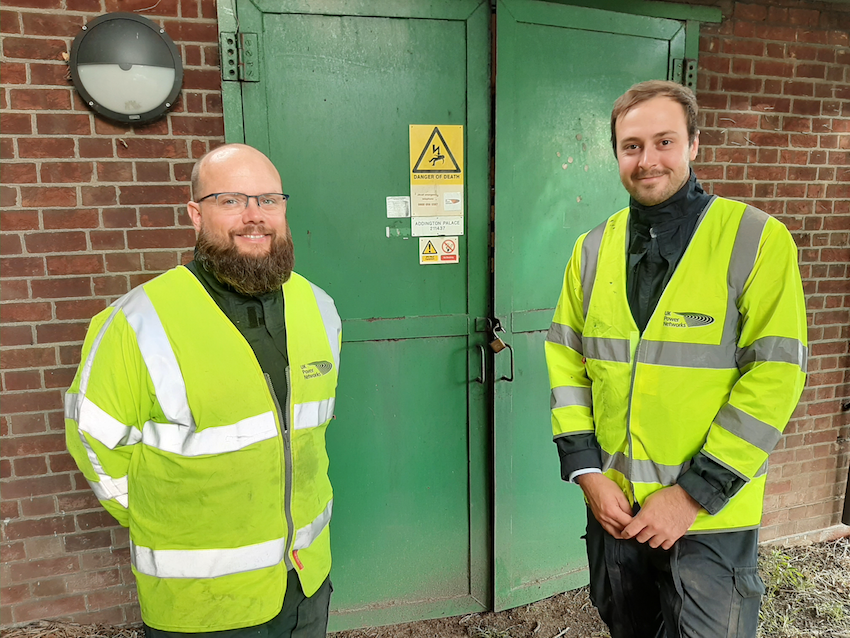
Pioneering technology has been installed for the first time in the UK to boost the reliability of power supplies at key sites across the South East and London. As part of a £435,000 innovation trial by UK Power Networks, engineers have this month fitted new ‘Smart Cable Guards’ at two sites – New Addington and East Grinstead - to detect and fix potential power cuts before they happen. It is the first time the devices – created by global energy expert DNV – have been installed on any UK electricity network. Working like a doctor’s stethoscope to track the network’s ‘pulse’, the box-like devices fit onto an underground power cable and the technology continuously monitors cables for tiny levels of electrical distortion – like an irregular heartbeat. The Smart Cable Guards are so sensitive that they can detect electrical disturbances lower than the power of a standard mobile phone charger on an industrial electricity cable that serves around 5,000 properties. When the device detects a disturbance, it alerts engineers exactly where on the cable a potential problem could occur, to within a few metres. Once a fault has been successfully identified, engineers can replace the cabling to protect the entire area from power cuts. With four sites completed, Smart Cable Guards will be installed at 18 more locations across Kent, Sussex, Surrey and London as part of this trial. The Smart Cable Guard project follows fresh results from the company’s collaboration with Scottish Power Energy Networks, which has already placed innovative fault-finding Radiometric Arc Fault Location (RAFL2) devices around Canterbury and near Glasgow and Edinburgh. Later this year, testing will also begin on the UK Power Networks’ £1.8 million MILES system at two sites near Canterbury and four around Crawley. MILES also uses sensors fitted to overhead cables to detect electrical radio wave disturbances around specific areas of the network. Up to 30 sensors will be tested for around six months, from this autumn, to detect where potential faults could happen. Lucy Craig, Director of Growth, Innovation and Digital at DNV, says: “We are increasingly reliant on electricity to power homes, businesses and industries – and that is set to increase in the future, for example, as we shift to electric vehicles. Technology, such as Smart Cable Guards, allows grid operators to digitally monitor their systems and receive real-time information to help them detect and avoid power failures.”

New £450m fund to unlock innovation
A new fund will unlock greener ways to travel and to heat and power homes and businesses, by harnessing a new approach to energy network innovation. This will keep bills as low as possible, drive the UK towards its goal of net zero greenhouse gas emissions by 2050, and help turn the UK into the ‘Silicon Valley’ of energy. The fund, which opens for application on 31 August, is part of Ofgem’s RII02 price controls for the electricity system operator and the network companies that operate GB’s energy pipes and wires. The fund will be approved by Ofgem and managed in partnership with Innovate UK. £450 million will initially become available over the next five years through the fund, with the option to increase in response to need and if innovators bring forward strong plans. Together, network companies, system operators, and the world’s leading businesses and researchers will use this money to drive big ideas that accelerate the transition to an emissions-free energy system and at the same time help to position the UK as a world leader in energy innovation. To apply for the first round of funding, network companies must address four major strategic challenges that are crucial for the energy transition. These are: Whole system integration Data and digitalisation Heat Transport Projects could range from ensuring the networks are ready to roll out clean heating solutions such as heat pumps to Britain’s homes to developing ways for network companies to work together across transmission, distribution, system operation, gas and electricity. Projects could also include developing new technologies for networks to support flexible energy solutions, such as battery storage technology, to ensure electricity is used and stored more effectively, thereby bringing down bills and emissions. Ideas need to be big, bold and ambitious with potential to scale across the networks upon completion. Energy Minister, Lord Callanan at the Department for Business, Energy and Industrial strategy, says: “The Strategic Innovation Fund will ensure the best projects and most talented minds have the grants available to reduce carbon emissions and enable bill payers to see the benefits of building back greener.”

Retentions ‘disproportionately penalise small businesses’ says Select
The Managing Director of Scottish construction trade association, Select, has told thousands of tradespeople across the UK that retentions “disproportionately penalise small businesses” in the construction industry. Speaking on the Thomas Nagy Electrical Show on Fix Radio, Alan Wilson said it was time to do away with the “outmoded system”. And he said it was vital for the whole sector, including Tier 1 contractors, public sector clients and small businesses, to sign up to a solution to the “clunky and difficult” practice which has bedevilled the sector for years Mr Wilson told listeners: “Construction is one of the few sectors operating this system. The principal being that clients and main contractors hold back a sum of money in case contractors do not complete the works they are contracted to do, is understandable, but in many cases now it is simply used to enhance cash flow, Carillion being the obvious example. “The fact is that it is a clunky and difficult means of contract completion which disproportionately penalises small businesses. It effectively has become an opportunity for certain bodies to penalise sub-contractors. “Every part of the construction has its own issues with retentions, depending on where they are in the supply chain. For instance, electricians and plumbers work near the end of a contract, whereas ground workers are at the beginning and, in some cases, might have to wait years before a client pays on completion.” Mr Wilson’s comments came just weeks after an in-depth review by the short life working group (SLWG) on retentions in Scotland, which made a number of practical recommendations to deal with the issue of cash retentions. While welcoming the initiative, Mr Wilson told Thomas that Select would like the government to put retention monies into trust in the short term and do away with the system completely in the longer term, to remove uncertainties for business. Listen to the show again here.

Aico examines new Scottish Legislation in virtual event
Recently, Aico held a virtual event on the changes to the Scottish Tolerable Standard, gaining clarification and examining implementation. Introduced in 2019 as a direct result of recent fire tragedies, the new Tolerable Standard details requirements for Fire and Carbon Monoxide detection within homes throughout Scotland. Applicable to all properties and tenure, including private homeowners, homes must be fitted with an interlinked fire alarm system and adequate Carbon Monoxide detection, by February 2022. The new legislative requirements stipulate that smoke alarms must be installed in every circulation space on each storey, such as hallways and landings, as well as in the room most frequently used for general daytime living purposes. A heat alarm must be installed in every kitchen and all smoke and heat alarms should be interlinked, either via traditional cabling methods or wirelessly. Carbon Monoxide alarms are to be fitted where there is a fuel-burning appliance or a flue. Aico’s virtual event sought to clarify these requirements, explore practical implementation and the associated challenges, with guest speakers from the Scottish Government, Clydebank Housing Association and Perth and Kinross Council. Firstly, Simon Roberts of the Housing Standards and Quality Team for the Scottish Government gave an overview of the Tolerable Standard, the basic standard for habitability, and the background of how these requirements have arisen; it is known that incidences of fatality and casualty from fire are lower when operational alarms are present. Simon explained that the requirements come as a result of recommendations outlined by a working group, in a drive towards safer homes, promoting health and wellbeing. The event then heard a social housing perspective from Jack Devlin, Acting Housing Services Manager for Clydebank Housing Association and Alan Burns, Team Leader at Perth and Kinross Council. Both detailed their approach to the implementation of upgrades to the Fire and Carbon Monoxide alarm systems across their housing stock, praising the invaluable training and support Aico have provided. Jack Devlin outlined the challenges to actioning these upgrades posed by property access, the effects of the pandemic and the issue of evidencing compliance. He went on to say how Aico’s Ei1000G SmartLINK Gateway has provided a solution to the latter, proving to be a crucial tool for the Housing Association. Alan Burns echoed these challenges, highlighting that resident engagement is paramount to reducing access issues. Perth and Kinross Council are also looking to implement Aico’s SmartLINK Gateway in the future, recognising the benefits this will bring to efficient management and maintenance. An interactive question and answer session concluded the event, with themes around consequences of failing to meet the requirements, the impact on insurance policies, siting and future scope for improvements to standards and legislation pertaining to home life safety. Aico’s virtual event highlighted that Scotland is adaptive and raises the question, can the rest of the UK follow suit in this holistic approach to home life safety?

Ovia mobile lighting showroom - back on the road!
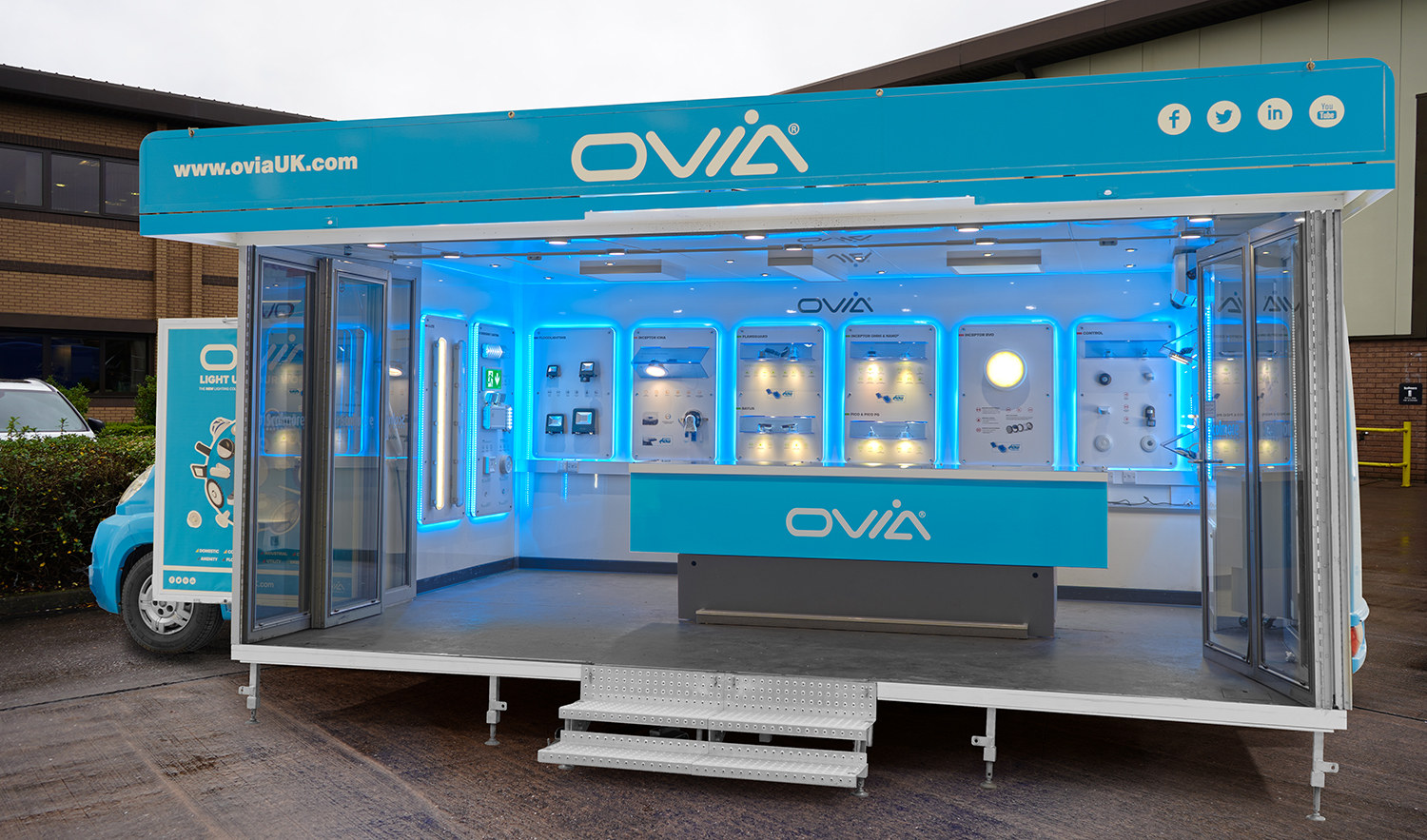
Ovia is delighted to announce that its custom-designed mobile lighting showroom will once again be taking to the roads, following a forced hiatus over the last 17 months. An eye-catching, state of the art, branded truck when in transit, the five-tonne unit transforms into a spacious and stylish showroom, fitted out with a comprehensive selection of Ovia lighting and lighting control products which are mounted on display panels. With room for a hospitality table and concealed storage for presentation materials and samples, the air conditioned, fully glazed unit provides an ideal space in which to host seminars and presentations and provide product training sessions for visitors. Its schedule for the remainder of 2021 will include branch visits and product training for key trade days organised by Ovia’s wholesale customers and Ovia will be welcoming enquiries from new as well as existing customers. Mike Collins, Ovia sales director, comments: “We are really pleased to once again have the opportunity to make the most of our mobile showroom. It’s a fantastic resource which enables us to demonstrate the breadth of our lighting products and allows us to host valuable education and training sessions. Our ongoing new product development programme means we are bringing new products out on a regular basis and the mobile showroom provides a platform to demonstrate the features and benefits that will help the contractor and ultimately drive sales through the wholesaler.” When fully opened, the floorspace covers approximately 9m x 5m - providing ample room for wall mounted displays to house products from the various Ovia lighting collections which includes domestic, commercial, industrial, utility, amenity, emergency lighting and floodlighting products, plus a range of lighting control solutions. Designed to bring maximum flexibility, the panels are all interchangeable, making it easy to tailor the displays to meet the needs of the audience or venue.

Ansell Lighting invests in Ireland
Ansell Lighting continues to expand its team with the appointment of Mark Rogers as National Sales Manager for Ireland, responsible for both Northern Ireland and the Republic of Ireland. Mark joins Ansell with more than 20 years’ experience in the Electrical Industry, starting his career with two independent wholesalers and gaining further experience with YESSS Electrical, before joining Bell Lighting as area sales manager for two years and National Sales Manager for three years and playing a pivotal role in growing the brand’s market share in Ireland. In his new role he will be responsible for supporting the Area Sales Managers, supporting buying groups and national and independent wholesalers, whilst expanding Ansell’s market share. Mark says: “I’m excited to be joining such a fast-moving and ambitious business. I’ve been particularly impressed by our product range and I’m excited to explore future opportunities in smart lighting, particularly with Ansell’s market-leading Octo brand.”

Freelance electricians' earnings rise to £1,080 per week
The cost of freelance electricians increased by 4.7% last month, highlighting the inflationary pressures in the construction industry supply chain. New payroll data from Hudson Contract show average weekly earnings for freelance electricians rose to £1,080 during July, handing them an extra £192 over the month. Ian Anfield, managing director, says: “The housing market is booming with the price of the average UK home increasing by nearly £25,000 over the last year. We expect strong demand for new housing and renovation schemes to continue for the foreseeable future. The government is committed to big infrastructure investments as part of its ‘levelling up’ agenda, which is adding to confidence in the sector. “The challenge for construction firms will be in managing rising costs caused by shortages in building materials and skilled labour. We encourage ministers to consider how the industry can increase access to skilled freelancers from Europe under the new immigration system. Self-employed subcontractors make up the most productive and flexible pool of resource in the industry and Britain needs them to deliver these projects on budget and on time.”

World EV Day highlights critical role of EVs in driving climate change
World EV Day on 9th September highlights and promotes the role of electric vehicles in the move to net zero and decarbonisation. Founded by Green.TV Media in 2020, the inaugural event was widely shared on social media and reached an audience of around 2 billion people around the world. World EV Day is partnering with the UK Cabinet Office on the government’s Together for our Planet campaign, celebrating how people across the UK are going #onestepgreener to tackle climate change. The 2021 #WorldEVDay event aims to bring the importance of e-mobility to an even wider audience across the globe, through three important strands: Education Accessibility sustainability. World EV Day is partnering with the UK Cabinet Office on the government’s Together for our Planet campaign, celebrating how people across the UK are going #onestepgreener to tackle climate change. Ade Thomas, Founder of Green.TV Media and of World EV Day, says, “Electric vehicles are accepted as a critical plank in reducing the world’s carbon emissions and in helping the drive towards transport net zero. “The recent IPCC report underlines ‘code red for humanity’ if we do not take drastic measures to lighten the human impact on the planet immediately, and the COP26 talks in Glasgow in November will provide pressure on governments and organisations to take action. “World EV Day is a catalyst for change, driving messages home via social media, consumed by billions of people daily, sparking conversations and challenging conventions. Green.TV Media is a strong believer in the power of conversations and connections to drive real change.” Sustainable technology experts, ABB, have lent their support to World EV Day again this year as headline partner and are also collaborating on the EV Moji competition to create and gain official status for an emoji for electric vehicles. Frank Muehlon, President of ABB’s E-mobility Division, says, “It’s critical now more than ever to encourage more people to engage with e-mobility and for governments, the automotive industry and the entire supply chain to support sustainable transport solutions for all. “Our headline partnership with Green.TV Media for World EV Day is part of our commitment to zero emission mobility, combining e-mobility with renewable energy generation.” As well as headline partner ABB, this year’s World EV Day is supported by partners: ALD Automotive AutoTrader BP Bryan Cave Leighton Paisner Climate Group EY Electrification Coalition Leaders for Clean Air LeasePlan LinkedIn Motability Parker Lord SSE Energy Solutions. Many other organisations, governments and individuals are using the hashtag #WorldEVDay and the awareness around the event to drive greater understanding of electric vehicles and their role in the path to net zero and climate change.

Boulting rebrands as BGEN to fuel ambitious growth plans
Boulting has rebranded as BGEN as part of the company’s ambitious growth plans.  The specialist, multi-discipline engineering solutions business, has appointed a new chief executive to oversee plans which include a recruitment drive to support a significant planned increase in turnover, alongside the opening of a new operation in Africa as the company expands its global footprint. BGEN, with a mindset focussed on next generation engineering, has promoted Robin Whitehead from managing director of its Technology business unit to chief executive of the new operation.  Robin began his career with East Midlands Electricity Board and has been in the engineering sector for more than 25 years.  He has spent the last 18 years at Boulting where he has helped to significantly grow the size and remit of the technology business. “Robin’s appointment was the obvious choice,” says John Sugden, Executive Chair at BGEN. “Robin has an excellent affinity with employees and customers alike having started his career as an electrician, before joining the company in 2003 and working his way up through the business.  The board has confidence that he will oversee the ambitious plans we have for the company over the next year and beyond.” The next 12 months will see BGEN go on a major recruitment drive, looking to expand its workforce from 860 to more than 1,000 employees, and hit an annual increased turnover in the region of £175 million*.  The company is looking to recruit a number of positions, from mechanical engineers and electricians to design engineers and technical project managers, as the company continues to service its existing client base whilst expanding operations. September will see BGEN open its African operation in Lagos, Nigeria, focusing on continuing to serve BGEN’s global clients that are looking to maintain and grow their business in that continent.  This expansion is on the back of decades of project delivery experience in Africa and will enable the company to grow its offering efficiently with local resources, backed by an experienced UK management team. “It’s an exciting time for the company, having recently been awarded a number of long-term frameworks in the utility sector which is testament to the quality of work we deliver”, comments Robin Whitehead. “While we’re proud of our heritage and will continue to serve those segments, we’re now working with customers in specialist sectors such as food, nuclear and pharmaceutical, on areas such as digitalisation and net zero emissions.”

Ideal Industries launches Gen II In-Sure Lever wire connector
Ideal Industries has built on the success of its In-Sure Push-In, Lever and SpliceLine Connectors with the launch of its innovative Gen II Lever Connector. Developed to enable even faster, easier and more consistent wire terminations up to 32 Amp, for any installation, including radial and final ring circuits, the new Ideal Industries Gen II Lever Wire Connector range is suitable for joining solid, stranded or flexible connectors. Available in two-, three- or five-port models, the connectors are re-useable and allow the use of multiple wires of different sizes and types within the same lever connector. Cables can be secured in place in seconds, with no screwdriver or crimping required using a simple strip, push, connect action. All Gen II models can be used with solid or rigid stranded cables of between 0.2mm2 and 4.0mm2, while suitable for use with any flexible cable from 0.14mm2 to 4.00mm2. Each connector features a built-in wire strip guide to enable installers to check the correct stripping length and, for solid and stranded cables, once the wire has been stripped, it can simply be pushed in with no need to lift the lever. For flexible wires, meanwhile, the lever is lifted before inserting the conductor and clamping it into place. Brett Smyth, general manager EMEA of Ideal Industries explains, “The Gen II Lever Wire Connectors have been developed following extensive research with electrical professionals as part of our commitment to designing products that are tailored to the needs of our customers on site. They are packed with features to prevent errors and ensure consistency, enabling wire terminations to be carried out more quickly with less risk of snagging. “For example, the levers have been designed to open in the opposite direction to the insertion port, locking the cables into position to prevent any accidental loosening or pull-out, ensuring a safe and secure connection throughout the lifecycle of the installation.” All the Ideal Industries Gen II Lever Wire Connectors in the new range have a clear casing to enable easy inspection and there is a check port for testing, enabling full safety and consistency verification at the point of installation. The compact design enables easier fitting in junction boxes and enclosures, which is particularly useful in lighting and access control installations, where multiple conductors often need to come together in a tight space. Ideal Industries has created a range of pack sizes for the new Gen II Lever Wire Connectors range, including boxes, bags and kits, to provide plenty of choice for electricians. Amongst the kits is a new Twin & Earth Kit, which includes a stripper, cutter and 20 each of the 32A-rated two- and three-port Push-In and Gen II Lever wire connectors, along with a 20-piece bag of assorted 32A connectors, including the popular SpliceLine and three-port Push-In Connectors, along with the new two- and three-port Gen II Lever Wire Connectors. Brett adds: “We already know that there’s a substantial move towards using lever and push-in connectors as a faster and more consistent alternative to terminal strips because of the success of our existing In-Sure range. “The new Gen II range enables even faster consistent connections, with a product that is CE marked, UKCA and UL listed, ENEC accredited, and fully compliant with the 18th Edition Wiring Regulations, helping electrical contractors to reduce both risk and labour costs when carrying out terminations.”