2 November 2026
Product of the Month: Amari Floodlight range by Aurora Lighting
 
12 November 2026
Schneider Electric transforms Southampton hospital estate
 
12 November 2026
GTEC Training opens new education facility in North Yorkshire
 
11 November 2026
Energy, AI and smart buildings: register now for EMEX 2026
 
11 November 2026
Solar and batteries could cut electricity costs by 40%, data finds
 

Latest News


Skills for Security launch new improved website and refreshed brand identity
Skills for Security has launched its new website and a refreshed brand identity to reflect its status as the largest supplier of fire and security apprenticeships in the UK. Skills for Security, the wholly owned subsidiary of the British Security Industry Association, has also relocated to Warrington to a new larger training centre, and the new website and brand identity is the latest development over the last 18 months to consolidate its commitment to deliver on their promise of providing a high quality education to their apprentices, and playing a crucial role in creating the skilled engineers needed within the industry. The new strapline ‘tomorrow’s engineers, today’, has been created to reflect this aspiration. As well as offering advice and courses designed for anyone wishing to become an apprentice in fire, emergency and security systems, team leadership and customer service, the new website offers accredited commercial technical training courses and continuing professional development, both online and classroom based. David Scott, Managing Director, Skills for Security (SfS), said: “In the last 18 months there have been a significant amount of changes at SfS as we continue to play a key role in delivering apprenticeship training across the United Kingdom. Launching our new fit for purpose website and refreshed brand identity - not to mention our recently opened training centre in Warrington - underlines our credentials as the leading provider of apprentices in the electronic fire and security sector. “Apprenticeships are a vital route into a successful career in the security sector; at present we have over 200 apprentices enrolled throughout England, we are leading the industry in online accredited training and we can offer highly effective programs for companies through a range of mixed delivery methods. I am really confident that our new identity and website is a positive reflection of our offer to apprentices and companies alike.”

Cautious welcome from Select for delay to new smoke alarm rules
Select has cautiously welcomed a proposed one-year delay to new rules on domestic smoke alarms – but says Holyrood needs to roll out a major awareness campaign on the rules in the meantime. The campaigning body for the electrotechnical sector says it understands why First Minister Nicola Sturgeon is set to postpone the requirement that all homes should have linked heat and smoke alarms, as well carbon monoxide alarms where appropriate, until February 2022. But it added that the issue remains a serious safety consideration and said that it was imperative that householders were made aware of the importance of professional installation so that they could plan ahead and get the precautions in place as soon as possible. Select Managing Director Alan Wilson said: “We recognise that in the current climate, some homeowners may be reluctant to have tradespeople in their home to carry out any work that needs to be done. “However, we also know that there was still a degree of uncertainty and misinformation among some homeowners, and more could have been done to raise awareness of the facts on a national level. Hopefully with the additional time we now have, that can be rectified with a clear government information campaign.” The decision by the Scottish Government to enforce the installation of the linked alarms came in response to the Grenfell Tower tragedy in London in June 2017, in which 72 people died. The new standard will cover all homes and it is the homeowner’s responsibility to ensure the work is carried out. Select, which is in the final stages of a campaign in the Scottish Parliament for the professional recognition of electricians, also warned of the dangers of the new alarm installations being carried out by unqualified and unskilled people.

Check approval for Category 3 Control fire performance cables
Specialist AEI Cables is highlighting the need to use only approved cabling in critical signal and control equipment in the event of a real fire, with the announcement of a revised version of the Code of Practice covering these areas of performance. The equipment served by these cables - including smoke and heat extraction systems - assists fire services in the case of firefighting and a safe evacuation in the case of life safety. As the only supplier in the UK with independent approval from LPCB for BS8519 Category 3 Control fire performance cables with a fire survival time of up to 120 minutes, AEI Cables is highlighting the reference in the new revised version of the standard. Graham Turner of AEI Cables, said: “The standard clearly references and clarifies the products and levels of performance that should be used for all parts of the supply chain from specifiers to contractors and installers. “We should point out that anything inferior installed is dangerous and could lead to some of these systems simply not surviving in a fire with the dangers that brings. These cables reduce the risk to life through the reduction of harmful smoke, toxic gases, and reduced flame spread. We should all strive to achieve the highest performance possible. “Fire and rescue services depend on these systems to help fighting a fire and the safe evacuation of those who may be in the building – installing the wrong products can be catastrophic.” The applications of Category 3 Control fire performance cables also applies to evacuation alarms for the disabled in care homes, emergency voice communications systems and voice alarm systems in relevant buildings including tall buildings, office spaces, hospitals, care homes, shopping malls and stadia.

Select: recognising electrician as a profession would bring ‘significant’ benefits
Campaigning trade association Select has told a parliamentary consultation that regulating the electrical industry in Scotland would help reduce death and injury, bring significant economic benefits and encourage more women and minorities to take up the tools. The respected body has used the consultation to present a comprehensive case for the recognition of the sector as a profession and registration of electricians, in advance of a proposed Holyrood Member’s Bill. In a series of detailed answers, Select has outlined the vital importance of creating protection of title for individual operatives in Scotland, in order to assure the public that anyone who presents themselves as an electrician is appropriately qualified and registered. The Bill, which is being proposed by Jamie Halcro Johnston, MSP, would be the culmination of a long-running campaign by Select and other leading industry bodies to make sure that those who work in the industry do so in a safe and competent manner. A major survey carried out in 2018 showed that faulty electrical installations accounted for 7.1% of all fires in Scotland, and the damage caused to property by these fires cost in the region of £9.6million. Select Managing Director, Alan Wilson, said: “At present, anyone can claim to be an electrician and work on an electrical installation. It cannot be right that those who have completed a full apprenticeship and who work in the industry in a safe and competent manner, can be compromised by those who call themselves electricians but who have no or inadequate qualifications. “Our research suggests net benefits to Scotland from proper regulation of electricians of around £58 million, including the benefits of higher electrical standards, such as fewer injuries and deaths, better functioning installations, less need for call backs or for poor/unsafe work to be repaired, leading to improved customer satisfaction.” Mr Wilson also pointed out in the consultation response that there was already a mechanism in place for registering individuals via the Scottish Joint Industry Board (SJIB) and that a robust scheme could be developed at very little additional cost. He said: “A single register based on the existing SJIB model would provide the comfort and security that someone calling themselves and electrician was qualified and competent to undertake electrical work. It would also enhance the profession's status and reputation by restricting opportunities for the unskilled or semi-skilled.” Mr Wilson also suggested that, if the industry was regarded as a profession, it would potentially become more attractive to women, ethnic minorities and other entrants, leading to greater diversity and benefit to the country as a whole.

COVID-19 and the reinvention of the construction industry
Asite has launched a new research report examining how the construction industry can adapt to survive and thrive in the face of COVID-19. The report entitled ‘COVID-19 and the reinvention of the construction industry,’ examines, with little prospect of a return to a pre-COVID normality, how industries such as construction must adapt to survive and thrive. The report delves into the recommendations from the UK’s Construction Leadership Council, who has played a key role in coordinating the industry’s initial response to the pandemic, which has now urged a three-step program of restart, reset, reinvent. This three-step program, to be delivered over the next two years, is part of the CLC’s Roadmap to Recovery, a strategy to drive the recovery of the construction and built environment sectors following the pandemic and resulting economic downturn. Restart In in its restart recommendations, the CLC talked about a rapid resumption of all projects and programs, maximising employment of all those working in the construction industry and supply chain, and minimising disruption due to contractual disputes. This step of the program is scheduled to take place within zero to three months of the overall strategy. Despite the high numbers of individuals working from home, Asite has witnessed first-hand how projects can be resumed - and even accelerated - through the adoption of digital ways of working such as video conferencing, highlighting the importance of online collaboration platforms. Reset As part of its reset strategy, the CLC says wider adoption of digital technologies across clients and throughout the supply chain will enable better data and information sharing across the built environment to improve efficiency, productivity, sustainability and building safety. This section of the overall strategy is set to take place during the three to 12-month period of the program. This reset includes ongoing programs such as Transforming Construction and the Construction Innovation Hub which are championing continued investment in building information modelling (BIM), design for manufacture and assembly (DfMA), digital twins, smart cities, and other process innovations. Reinvent If the CLC recommendations are carried through, from mid-2021, government and construction should be focused on applying such digital approaches to deliver better value, collaboration and partnership. These areas are not new additions to the mix in light of COVID-19. They reflect the UK Government’s continued commitment to its Construction 2025 goals, which include lowering project delivery costs, delivering projects quicker, with lower carbon emissions, and making UK plc more competitive, which were first set in 2013. This is the final section of the program, scheduled to take place during the 12th and 24th month. Reinventing construction after COVID-19 A return to old ways of working, or a slightly altered ‘new normal’ will not achieve the advancement the industry requires. Low productivity, low profitability, and low resilience have been caused by fragmented conditions which have been characterised by low margin, lowest-price procurement approaches, onerous and often-adversarial contracts, maximum passing of risk and low investment in digital working and collaboration.

World-first renewable energy market trial hits major milestone
A world-first project to create a new market for renewable energy has reached a major milestone by starting its first end-to-end live trial. UK Power Networks and National Grid Electricity System Operator (ESO) established Power Potential to enable distributed energy resources connected to the local electricity network to provide the only market-based reactive power source to the national electricity system. The team has now built an end-to-end integrated system that can enable automated reactive power services, creating more capacity on the national transmission system and a potential new income stream for energy generators including wind, solar and battery resources. Power Potential was established to help manage the rapid increase in the volume of renewable energy connecting to distribution networks without breaching safe limits. The south and East of England has seen a significant rise in distributed energy resources in the last decade, with more than 7GW of generators now connected to its networks in London, the South East and East of England. That’s almost as much as the UK’s entire nuclear power output. The latest trial follows a series of short trials involving individual generators. This is the first time that the full system has been trialed in a live environment with multiple generators. The project uses a Distributed Energy Resources Management System (DERMS) developed by ZIV Automation. UK Power Networks has integrated DERMS into its control room to facilitate the service instructed by the ESO. Up until now voltage on the national transmission system has been controlled by a combination of power electronics and support from larger generators. By connecting more distributed energy sources as new sources of voltage control, it’s anticipated that current constraints on the system can be better managed, making it more stable and affordable to run, while creating new opportunities for distributed energy businesses. Power Potential stands to save energy consumers over £400m by 2050 and enable connection of up to an additional 4GW of local generation in the South East region of the UK. The collective trial is split into two parts, an eight-week technical trial with the generators, and then a 12-week trial of the live commercial markets, which is scheduled to finish in March 2021. The project delivers on its aim to be more than just a theoretical proof-of-concept, as it already integrates with UK Power Networks’ live network management system and customer systems. Subject to a successful trial, work will continue to explore how the local and national electricity networks can collaborate further around reactive power services to address system management challenges.

BASEC launches cable testing and certification to the data communication market
Leading cable testing and certification provider, BASEC extends its cable testing and certification offering by investing in new service capabilities for data communications market. The new service is designed to support the growing transformation of the data communication global market. The new data communications (datacoms) capability features industry standard state-of-the-art testing equipment which will be able to test the performance of the full range of datacoms cables including: CAT 5e, 6, 6A, 7, 7A, and CAT 8. In combining data transmission testing with nearly 50 years of cable testing and certification expertise, BASEC continues to deliver testing of electrical, mechanical, material, chemical and fire performance. End users, manufacturers and re-branders of approved cables benefit from the added value that cable certification encompasses rigorous process auditing alongside physically cable testing, to deliver a holistic cable assessment. Tony Lioveri, BASEC’s CEO states, “BASEC has been working in partnership with cable manufacturers for nearly 50 years, and has a strong brand and heritage of being the mark of quality & safety, to be able to leverage this cable expertise to the datacoms market is an exciting proposition for BASEC. The BASEC brand is established worldwide and is delivered through our regional offices of dedicated teams of technical experts and superior customer care. Our goal is to give confidence to end users, manufacturers and re-branders that by using the BASEC mark that they can be assured of guaranteed quality and safety throughout the supply chain.” As the demand for data is forever increasing and technological advances continue to evolve, investing in high performance networks that can accommodate the digitalisation of operations now and in the future is more important than ever. Three overarching transmission cable standards have been developed by industry to enable manufactures to comply with application requirements and work to ensure suitable cables are installed. ISO/IEC 11801 is designed for use within commercial premises in office spaces between 50-50,000 people ANSI/TIA 568 is designed to provide recommended design and installation criteria for cabling systems that will support existing and future services EN 50173 is consistent with the above, covering the entire channel whilst adopting additional cable specific requirements Tony Lioveri goes on to say, “We are excited to be expanding into the datacoms market. The enhancement of our facilities demonstrates our long-term commitment to deliver exceptional testing and certification to all customers across multiple markets.” The datacoms scheme has been developed to offer: An in-house capability covering the full depth of testing and certification services for a wide range of cables Simplification of the certification process, combining fire testing approvals Enable BASEC to extend the superior customer care to the datacoms market

CENTIEL partners with Seahorse Electrical and Maintenance Services
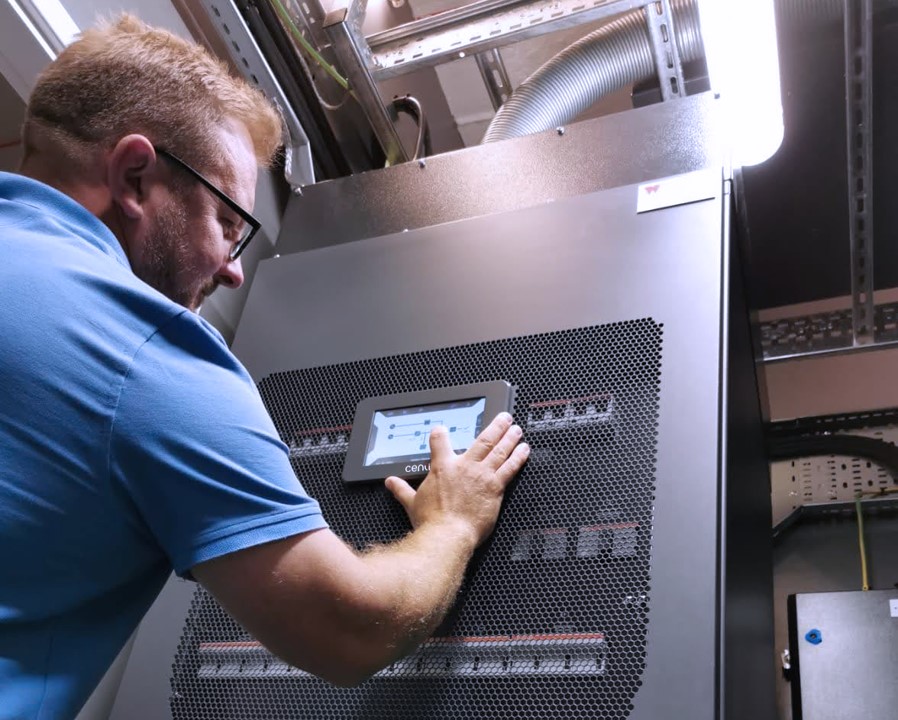
UPS manufacturer, Centiel UK, has joined forces with electrical sub-contractor Seahorse Electrical and Maintenance Services. Seahorse has now become one of Centiel's preferred partners for DC and AC works. Louis McGarry, sales and marketing director, Centiel UK explains: “We have a long-standing relationship with the team at Seahorse and have recently completed several large projects with them including a 7.2MW installation at a major medical facility. We are now delighted to cement this relationship on an ongoing basis. “Most recently we have worked with Seahorse to complete the installation of a new UPS to protect the power to a central London Venue. Located close to Covent Garden, the entertainment space is within an historical building used for dining, parties and drinks receptions, meetings and conferences for up to 1,000 delegates. The new UPS now supports the power for the entire building including lights, lifts, sound systems, a small gift shop, the internet, phone system and servers. “An outdated legacy UPS has been replaced with Centiel's fourth generation three phase modular UPS, CumulusPower,  which offers industry leading 99.9999999% (nine, nines) availability translating to just milliseconds of downtime per year. One of Centiel's top cable entry frame fitted with 5x50kW modules (200 N+1), along with 80 batteries now provides a 10 minute run time which then allows the switch over to a generator to ensure power is protected to the venue at all times.” McGarry continues: “For this central London project, Seahorse managed the full design and build, working with the main contractor and the client. This included UPS, switch gear, lighting, flooring, ceiling, fire dampeners, battery build, DC build, cable trays and all the cabling which included 100 metres from the plant room’s switch gear to the generator which was located externally.” Jason Gibson, director of Seahorse confirmed: “Due to the small size of the plant room, it was important for us to utilise every inch of space and so CumulusPower with its top cable entry option was chosen. The flexible, modular configuration of CumulusPower allows the inclusion of an input terminal to accept cables from above via steel wire armoured (SWA). It offered the perfect solution for the small plant room. The project was completed from strip out to commissioning of the UPS in 15 week “Working more closely with the Centiel team now means we have a reliable, experienced and trusted partner to support us with the delivery of major UPS installations.”

Top five fuel-efficient vans for tradespeople revealed
Van drivers who opt for the Mercedes-Benz Citan are getting the most bang for their buck, as it’s revealed to be the most fuel-efficient van to buy in 2020. That’s according to new research by Confused.com, which analyses some of the best vans on the market to discover the most fuel-efficient options across petrol and diesel. With so many vans on the market, choosing the right one to buy can be an overwhelming decision. Which van is the cheapest, and which costs the least to run? To help van drivers, Confused.com’s research calculates which vans will get drivers the furthest for their money, while also exploring some of the best electric van alternatives, for those who are environmentally conscious. The top five The Mercedes-Benz Citan takes the top spot as the most fuel-efficient van across all fuel types. The diesel model can reach 831 miles on a full tank and drive 123 miles further than the Volkswagen Transporter, which comes in second place (708 miles). Similarly, the Mercedes-Benz Citan also tops the list for the most fuel-efficient petrol van, with a range of 611 miles on a full tank. This is followed by the Ford Transit Connect and then the Volkswagen Caddy, which can both reach 580 miles and 541 miles per tank of fuel, respectively. At the other end of the scale, drivers who chose the Fiat Fiorino might be forking out more for petrol. With an MPG of 44, this petrol van can drive up to just 423 miles on a full tank. But how much does it cost to buy a fuel-efficient van? While it may seem the vans with the biggest fuel range might cost the most, Confused.com’s research proves this isn’t the case. In fact, the Mercedes-Benz Citan ranked as one of the cheapest petrol and diesel models on the list, costing £15,380 and £17,800 to buy outright, respectively. This suggests they truly are the most cost-efficient vans for drivers looking to save a few pounds on the initial outlay and the running costs. Electric alternatives The standard price of an electric van can put many buyers off, with a recent study finding that 60% of respondents felt that the high cost is the most significant barrier to ownership. The study also found that money off the initial cost would give people an incentive to buy an electric vehicle, with respondents asking for an average of £4,865 off the initial price. The current government plug-in car grant means drivers could be entitled to 20% off (up to a maximum of £8,000) the purchase price of some models, making it more affordable for the environmentally conscious. Ranking top for the most range-efficient electric van, the Iveco can drive up to 174 miles on a full eight-hour charge and has a payload of up to 1,652kg. This is, however, one of the most expensive models, and would set drivers back £100,000 to buy brand new. However, the LDV EV80 and the Nissan E-NV200 which rank in second and third places respectively for the most efficient electric vans are not only cheaper but eligible for the 20% government grant. Saving up to £8,000, drivers could be paying out just £52,000 for the LDV EV80 and £23,804 for the Nissan E-NV200. Not only is the Iveco the most expensive to buy outright, it is also the most expensive to charge. For a full eight hours of charge, drivers can expect to pay an average of £12.70. This is followed by the LDV EV80 which costs £7.80 while only taking seven hours to charge. Finally, the Nissan E-NV200 comes out with the cheapest figures, taking seven hours to charge up the battery, and costing van owners just £5.60 in total.

Employment experts to offer advice on redundancy and Job Support Scheme 
With the effects of COVID-19 beginning to impact businesses across Scotland, the Construction Industry Coronavirus (CICV) Forum is hosting two new webinars to advise and answer questions on redundancy, restructuring and other urgent employment issues. The UK Government’s new Job Support Scheme will also be on the agenda at the online discussions, which will again be hosted by leading industry experts and which follow the collective’s successful series of free commercial webinars. Held on Friday 23 October at 10am, the first webinar will advise on all aspects of organisational restructuring and redundancy, with advice on initial steps, the most important actions to take, and the pitfalls and what to avoid. The session will be presented by Vaughan Hart, Managing Director of the Scottish Building Federation, who will also answer queries in a Q&A session with Fiona Harper, Director of Employment and Skills at SELECT and Pete Walker, Director of Health, Safety and Training at the British Constructional Steel Association. The second session, on Thursday 29 October at 10am, will offer advice and guidance on the Job Support Scheme, with guidance from panellists Pete Walker, Stephanie Lowe, Human Resources Manager at SNIPEF, and Paul Mitchell, Head of Employment Affairs at the Scottish Building Federation. Vaughan Hart, who co-chairs the CICV Forum’s Skills and Workforce Sub-Group, said: “With no end in sight to the pandemic, the impact of COVID-19 is beginning to be felt by our industry, and redundancy and organisational restructuring is becoming a reality for many. “Such an unprecedented and tumultuous period throws up many questions and we are keen to advise our fellow professionals and support them however we can. “These webinars will not only deliver clear and relevant information about employment current issues, but also give delegates the chance to ask questions and receive the guidance they really need.” A fourth commercial webinar will be held on Tuesday 27 October and will cover giving notices, extensions of time, loss and expense, while a fifth on Tuesday 10 November will cover suspension and contract termination of contractors and sub-contractors. The topics covered in the final commercial session, held on Tuesday 24 November, will include conflict avoidance procedures, pitfalls and benefits of adjudication, the low-cost value adjudication process and expert determination. To register for any of the webinars, go to http://cicvforum.co.uk/webinars/ or mail info@cicvforum.co.uk